A crossbite is a common orthodontic problem that occurs when one or more of your upper teeth bite inside your lower teeth. In a healthy bite, your upper teeth should sit slightly outside your lower teeth, like a lid on a box. When this relationship is reversed, it creates a “cross” in your bite. This can happen in the front of the mouth (anterior crossbite) or in the back (posterior crossbite).
Beyond the aesthetic issue, a crossbite is a functional problem. If left untreated, it can lead to excessive wear on the teeth, gum recession, jaw pain, and even asymmetric growth of the jaw in children. The good news is that modern orthodontics offers several effective solutions for correcting a crossbite. But what kind of braces do you actually need? The answer depends on the severity and the underlying cause of your specific case. This guide will explore the options, from traditional braces to modern aligners and special appliances, to help you understand the path to a corrected bite.
What Kind Of Braces Do You Need For A Crossbite?
Understanding the Complexity of a Crossbite
Before diving into treatment options, it is important to understand that not all crossbites are the same. They are broadly categorized based on their cause and location.
-
Dental Crossbite: This is the simpler and more common type. The teeth themselves are misaligned, but the jawbones are in the correct position. This is often the result of a tooth erupting in the wrong spot or a retained baby tooth pushing a permanent tooth out of alignment.
-
Skeletal Crossbite: This is a more complex issue. The misalignment is caused by a discrepancy in the size or position of the upper and lower jaws themselves. For example, the upper jaw might be too narrow (a condition called maxillary deficiency). This often requires a different, more involved treatment approach than a simple dental crossbite.
The type of crossbite you have is the single most important factor in determining the kind of braces you will need.
The Treatment Options for Correcting a Crossbite
Your orthodontist will recommend a treatment plan based on your diagnosis. Here are the most common approaches, from traditional braces to special appliances.
1. Traditional Metal Braces
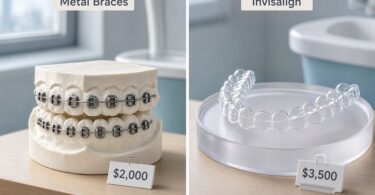
This is the most versatile and time-tested method for correcting crossbites. Metal braces consist of brackets bonded to the front of the teeth, connected by wires and elastic ties.
-
How It Works: The orthodontist uses the wires and elastics to apply constant, gentle pressure, gradually moving the teeth into their correct positions. For a crossbite, elastics (rubber bands) are often used to pull the misaligned upper tooth outward and forward, over the lower tooth.
-
Best For: Both dental and skeletal crossbites (often in combination with an expander for skeletal cases). They are effective for all severities of the condition.
-
Cost: $3,000 – $7,500 (as covered in a previous article).
The primary advantages of metal braces are their power and precision. They give the orthodontist complete control over the movement of each individual tooth. The downside is their visibility and the dietary and hygiene restrictions that come with them.
2. Ceramic Braces
Ceramic braces work on the exact same principle as metal braces. The key difference is that the brackets are made of a clear or tooth-colored ceramic material, making them much less noticeable. The wires can also be tooth-colored or clear.
-
How It Works: Identical to metal braces, using brackets, wires, and elastics to move teeth.
-
Best For: Individuals with dental crossbites or mild-to-moderate skeletal issues who are concerned about the aesthetics of metal braces.
-
Cost: $4,000 – $8,500.
These are a popular choice for adults. However, they are slightly more fragile than metal braces, and the clear elastics can stain if you are not careful with your diet.
3. Clear Aligners (Invisalign and Similar Brands)
Clear aligners have revolutionized orthodontics. These are custom-made, clear plastic trays that fit snugly over your teeth and are replaced every one to two weeks. They offer a nearly invisible way to straighten teeth.
-
How It Works: Each set of aligners is designed to make small, incremental movements. Modern aligner systems, like Invisalign, can now treat many types of crossbites, especially those that are dental in nature. They do this with the help of “attachments” (small, tooth-colored bumps bonded to the teeth) and sometimes elastics.
-
Best For: Older teens and adults with dental crossbites. Clear aligners are generally not the best choice for severe skeletal crossbites that require significant jaw expansion.
-
Cost: $3,500 – $8,500.
The major advantage is their near-invisibility and removability. The catch is that their effectiveness relies on patient compliance; you must wear them 20-22 hours per day.
4. Specialized Appliances: The Palatal Expander
This is a critical tool for treating skeletal crossbites, especially in children and young adolescents. A palatal expander is not a type of brace, but an appliance used in conjunction with braces.
-
How It Works: The expander is a custom-made device that is fixed to the upper back teeth. It sits against the roof of the mouth and has a small screw in the center. The patient (or a parent) uses a special key to turn the screw a tiny amount each day. This applies gentle pressure to the two halves of the upper jaw, gradually widening the palate. Once the desired width is achieved, the expander is left in place for a few months to allow new bone to form and stabilize the expansion.
-
Best For: Children and teenagers whose upper jaw is still growing. The bones of the palate fuse together around the age of 15-16. After this point, expansion is more difficult and may require surgery.
-
Cost: $2,000 – $3,500 for the appliance itself.
This is often the first phase of a two-phase treatment plan. The expander fixes the skeletal discrepancy, and then braces are used to align the teeth.
A Comparison of Crossbite Treatment Options
Here is a summary table to help you compare the options at a glance.
| Treatment Type | Best For | Aesthetics | Key Advantage | Key Disadvantage |
|---|---|---|---|---|
| Metal Braces | All types of crossbites (dental and skeletal). | Highly visible. | Most powerful and precise control. | Aesthetics and dietary restrictions. |
| Ceramic Braces | Dental crossbites; mild skeletal issues. | Less visible than metal. | Effective and more discreet. | More fragile than metal; brackets can stain. |
| Clear Aligners | Dental crossbites in adults/teens. | Nearly invisible. | Aesthetic appeal and removability. | Requires high discipline; not for severe cases. |
| Palatal Expander (+ Braces) | Skeletal crossbites in children/teens. | Fixed appliance; visible. | Corrects the underlying jaw problem. | Only works in growing patients; requires daily turning. |
What Happens in a Severe Case? Surgery
For adults with a severe skeletal crossbite, the only way to correct the jaw discrepancy is with orthognathic surgery. This is a major procedure performed by an oral and maxillofacial surgeon to reposition the upper and lower jaws into proper alignment.
-
The Process: This is a combined effort. The patient wears braces for 12-18 months before the surgery to align the teeth within each jaw. The surgery is then performed. After a healing period, the braces remain for another 6-12 months to fine-tune the bite.
-
Who Needs It: Adults with a significant jaw size mismatch that cannot be corrected with braces or an expander alone.
-
Cost: The surgical portion is often billed to medical insurance. The orthodontic portion is the responsibility of the patient or their dental insurance.
How to Know Which Option Is Right for You
The decision is not yours to make alone. The best way to determine the right treatment for your crossbite is to seek a consultation with a qualified orthodontist. They will perform a clinical exam and take diagnostic records, which usually include X-rays and photographs.
During your consultation, the orthodontist will:
-
Diagnose the Type of Crossbite: They will determine if it is dental, skeletal, or a combination of both.
-
Assess Jaw Growth: In children, they will evaluate the stage of growth to determine if an expander is a viable option.
-
Present Your Options: They will explain which treatment options are suitable for your specific case and why.
-
Discuss Timing and Cost: They will outline the estimated treatment time and the financial costs associated with each option.
Important Note for Readers: Do not delay treatment for a crossbite, especially in a child. As a child’s jaw grows, a crossbite can cause the face to develop asymmetrically. Early intervention (often around age 7-10) can guide the growth of the jaws and prevent the need for more invasive treatments, like surgery, later in life.
The Bottom Line
The kind of braces you need for a crossbite depends on the nature of the problem itself. A simple dental crossbite might be perfectly suited for clear aligners or traditional braces. A more complex skeletal crossbite in a child will almost certainly require a palatal expander followed by braces. And a severe skeletal crossbite in an adult may require a combination of braces and surgery. There is no single “best” brace for a crossbite; there is only the “right” treatment for your unique diagnosis.
Additional Resource: American Association of Orthodontists (AAO)
For reliable information on crossbites and other orthodontic conditions, and to find a certified orthodontist, visit the AAO website.
Link: https://www.aaoinfo.org/
Frequently Asked Questions
Q1: Can Invisalign fix a crossbite?
A: Yes, modern clear aligner systems like Invisalign are effective at correcting many types of crossbites, particularly those that are dental in nature. However, for complex or severe skeletal crossbites, traditional braces are often a more reliable and powerful tool.
Q2: Is a palatal expander painful?
A: The expander itself is not painful, but you will feel a sensation of pressure on your teeth, the roof of your mouth, and sometimes behind your nose when you turn the screw. This feeling usually fades within a few minutes. You may also experience some soreness and have difficulty eating and speaking for the first few days after it is placed.
Q3: What is the best age to correct a crossbite?
A: For a skeletal crossbite caused by a narrow upper jaw, the ideal time to intervene is during childhood or adolescence, while the jawbones are still growing and the palate has not yet fused. This is typically between the ages of 7 and 14. For a purely dental crossbite, treatment can be successful at any age.
Q4: What happens if a crossbite is not treated?
A: An untreated crossbite can lead to a host of problems. These include premature wear and chipping of the teeth, receding gums, an increased risk of gum disease, jaw pain and TMJ disorders, and in growing children, asymmetric facial development.
Q5: How much does a palatal expander cost on top of braces?
A: The cost of a palatal expander is usually a separate fee from the cost of braces. The expander and its associated appointments typically cost between $2,000 and $3,500. Your dental insurance may cover a portion of this cost if orthodontic treatment is a covered benefit on your plan.
Conclusion:
The right kind of braces for a crossbite depends entirely on whether the issue is rooted in the teeth or the jawbone, as simple dental cases can be treated with aligners or standard braces, while skeletal issues often require a palatal expander or surgery. A professional diagnosis from an orthodontist is essential to determine the most effective treatment path. Addressing a crossbite early, especially in children, can prevent complex and costly procedures later in life.