A code is never just a code. In the labyrinthine world of healthcare administration, the alphanumeric strings of the International Classification of Diseases, Tenth Revision, Clinical Modification (ICD-10-CM) serve as a critical lingua franca. They translate complex human suffering—the hallucinations, the fragmented thoughts, the emotional withdrawal—into a standardized vocabulary that drives diagnosis, treatment, research, and reimbursement. When that suffering stems from schizophrenia, a chronic and severe mental disorder that alters perception of reality, the act of coding becomes a profound exercise in precision and understanding.
This article ventures far beyond a simple listing of codes like F20.0 or F20.9. We embark on a detailed exploration of the ICD-10-CM framework for schizophrenia, dissecting its structure, clinical nuances, and the immense responsibility carried by the individuals who assign these codes. For medical coders, this is a guide to navigating one of psychiatry’s most complex diagnostic categories. For clinicians, it underscores the vital importance of documentation that is both clinically rich and codable. For healthcare administrators and patients, it illuminates how these codes shape the financial and systemic landscape of mental health care.
Schizophrenia affects approximately 1% of the global population, presenting a unique challenge to healthcare systems. Its diagnosis is clinical, based on history and observed symptoms, not on definitive laboratory tests. This makes the physician’s or clinician’s notes the primary source material for the coder. A single, well-documented word can dictate the difference between an accurate code that reflects the patient’s current state and a generic, unspecified code that may obscure clinical severity and impact care quality metrics.
We will delve into the subtypes defined by the fifth digit, explore the pivotal role of episode specification and remission status, and tackle common pitfalls and exclusions. Through detailed tables and explanations, this article aims to be the definitive resource for anyone seeking to understand not just what the codes are, but why they matter, and how to apply them with integrity and accuracy in the real-world clinical setting.
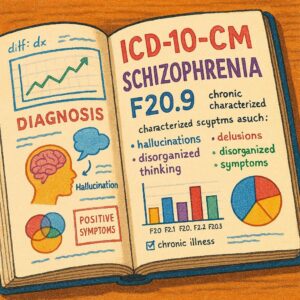
ICD-10-CM code for schizophrenia
2. The Bedrock of Classification: Understanding ICD-10-CM’s Purpose and Structure
Before zeroing in on schizophrenia, one must understand the system that contains it. The ICD-10-CM is a morbidity classification published by the World Health Organization (WHO) and modified (the “CM”) for clinical use in the United States by the Centers for Disease Control and Prevention (CDC) and the National Center for Health Statistics (NCHS). Its purposes are multifaceted:
-
Statistical Tracking: To monitor the incidence and prevalence of diseases and health problems.
-
Clinical Documentation: To provide a standard language for recording patient diagnoses.
-
Billing and Reimbursement: To serve as the foundation for medical claims submitted to insurers, including Medicare and Medicaid. Diagnosis codes are required to justify the medical necessity of services rendered.
-
Research: To enable epidemiological studies and outcomes research by standardizing diagnostic data.
-
Public Health: To inform policy and resource allocation by identifying health trends.
The structure is hierarchical and alphanumeric. Codes begin with a letter, which generally corresponds to a chapter (e.g., ‘F’ for Mental, Behavioral and Neurodevelopmental Disorders). This is followed by two digits representing the general category (e.g., F20-F29 for Schizophrenia, Schizotypal, Delusional, and Other Non-mood Psychotic Disorders). The third digit often specifies the particular disorder (e.g., F20 for Schizophrenia). Beyond this, fourth, fifth, and sometimes sixth digits provide increasing levels of detail regarding manifestation, severity, laterality, or episode.
The “F” Chapter (Chapter 5) is where schizophrenia resides. It’s crucial to note that ICD-10-CM is a clinical modification; while based on the WHO’s ICD-10, it includes additional detail and some structural differences to meet U.S. clinical and billing needs.
3. Deconstructing F20: The Schizophrenia Spectrum in ICD-10-CM
The category F20, Schizophrenia, is the primary home for this diagnosis. The general diagnostic criteria, inferred from the code structure and supporting guidelines, require the presence of characteristic symptoms for a significant portion of time during a one-month period (or less if successfully treated), with continuous signs of the disturbance persisting for at least six months. This six-month period must include at least one month of active-phase symptoms (e.g., delusions, hallucinations, disorganized speech).
Key features include:
-
Psychotic Symptoms: Delusions, hallucinations (often auditory), disorganized thinking/speech.
-
Negative Symptoms: Diminished emotional expression (flat affect), avolition (lack of motivation), alogia (poverty of speech), anhedonia (inability to feel pleasure).
-
Functional Impairment: Significant disruption in work, interpersonal relations, or self-care.
The code requires a fifth digit to specify the predominant clinical picture. This is where clinical documentation becomes paramount.
4. The Fifth Digit Imperative: Specifying Clinical Manifestation
The fifth digit sub-classification is not merely administrative; it reflects meaningful clinical distinctions that can guide treatment approaches and prognosis. Using an unspecified code (F20.9) when the information for a more specific code exists is a failure of the coding process and a disservice to data integrity.
ICD-10-CM Codes for Schizophrenia (F20)
| ICD-10-CM Code | Description | Key Clinical Features & Documentation Cues |
|---|---|---|
| F20.0 | Paranoid Schizophrenia | Preoccupation with one or more delusions or frequent auditory hallucinations. Documentation should note: “paranoid type,” persecutory or grandiose delusions, organized hallucinations. Cognitive function and affect relatively preserved. |
| F20.1 | Disorganized Schizophrenia | Marked disorganization in speech and behavior, with flat or inappropriate affect. Documentation should note: “hebephrenic,” “disorganized type,” silliness, incongruous facial expressions, thought disorder. Delusions/hallucinations fragmented. |
| F20.2 | Catatonic Schizophrenia | Prominent psychomotor disturbances. Documentation should note: “catatonic stupor/negativism/excitement,” posturing, waxy flexibility, mutism, echolalia/echopraxia. |
| F20.3 | Undifferentiated Schizophrenia | Meets diagnostic criteria but symptoms don’t clearly fit Paranoid, Disorganized, or Catatonic types OR features of more than one without clear dominance. Documentation often states: “undifferentiated type.” |
| F20.5 | Residual Schizophrenia | History of at least one schizophrenic episode, but current clinical picture is without prominent positive symptoms. Documentation should note: “residual state,” presence of negative symptoms, attenuated positive symptoms, odd beliefs. |
| F20.81 | Schizophreniform Disorder | Note: This is not a type of schizophrenia. Included here for differential. Symptoms meet criteria for schizophrenia but duration is less than 6 months (at least 1 month but < 6). Documentation must specify: “schizophreniform.” |
| F20.89 | Other Schizophrenia | Includes conditions like Simple Schizophrenia (insidious development of negative symptoms without prior psychosis) and other rare variants. |
| F20.9 | Schizophrenia, Unspecified | Used when insufficient information is available to specify subtype (e.g., “schizophrenia, NOS”). A code of last resort when documentation is lacking. |
Deep Dive into Key Subtypes:
-
F20.0 Paranoid Schizophrenia: This is often the most recognizable subtype. The patient’s delusions are typically organized around a central theme (persecution, jealousy, grandiosity). Hallucinations are often auditory and related to the delusional theme. Crucially, disorganized speech, catatonic behavior, and flat affect are not prominent. Documentation that simply states “patient has delusions of being followed by the FBI” strongly points toward F20.0.
-
F20.1 Disorganized Schizophrenia: Here, the disruption of thought and behavior is paramount. Speech may be incoherent (“word salad”), behavior may appear aimless or childish, and emotional responses are flat or grossly inappropriate (laughing at sad news). The clinical picture is one of severe functional impairment due to this disorganization.
-
F20.2 Catatonic Schizophrenia: This subtype, while less common today, presents dramatic motoric symptoms. These can range from stupor (no psychomotor activity, mutism) to excitement (purposeless, excessive motor activity), posturing (maintaining rigid, unusual poses), negativism (resisting all instructions), and waxy flexibility (limbs remain placed by an examiner). Documentation must capture these specific behavioral observations.
-
F20.5 Residual Schizophrenia: This code is for the chronic phase of the illness. The florid positive symptoms (hallucinations, delusions) have receded, but the patient is left with “scarring” in the form of negative symptoms (social withdrawal, lack of drive, blunted affect) or mild, lingering odd beliefs. It is essential that the documentation indicates the patient is in a “residual state” or “chronic phase” with an emphasis on these residual symptoms.
-
F20.81 Schizophreniform Disorder: Critical Distinction: This code is housed under F20 but is a distinct diagnostic entity. The symptom profile is identical to schizophrenia, but the total duration of the illness (including prodromal, active, and residual phases) is less than six months. If the disturbance persists beyond six months, the diagnosis should be changed to schizophrenia (and coded accordingly). Documentation must explicitly state “schizophreniform disorder.”
-
F20.9 Schizophrenia, Unspecified: This is a necessary code for instances where a provider has diagnosed schizophrenia but has not yet specified a subtype in the record, or for historical records where such detail is absent. However, its overuse due to poor documentation obscives valuable clinical data.
5. The Critical Role of Documentation: Bridging Clinical Care and Accurate Coding
The physician’s progress note, discharge summary, or diagnostic assessment is the coder’s source document. Ambiguity in documentation leads directly to coding inaccuracy. Here’s what coders look for and what clinicians should provide:
-
Specificity is Key: “Schizophrenia, paranoid type” is codable. “Patient is psychotic” is not.
-
Episode and Status: While ICD-10-CM schizophrenia codes do not have built-in episode specifiers (like those for mood disorders), the clinical picture described should align with the code. Documentation should clarify if the patient is in an acute exacerbation, a stable chronic phase, or in remission. This may influence the use of other codes (like Z codes for history) or be required for certain billing contexts.
-
Symptom Description: Vivid descriptions of symptoms are gold. “Expresses belief that neighbors are poisoning his air” (delusion). “Responds to internal stimuli, seen muttering and laughing to self” (hallucination). “Speech is tangential and difficult to follow” (disorganization).
-
Avoid Contradictions: Documentation should not state “paranoid schizophrenia” but then describe primarily disorganized speech and flat affect. The coder must query the provider for clarification.
6. Navigating Complexity: Multiple Codes, Exclusions, and Co-morbidities
Coding is rarely single-diagnosis. Several important rules apply:
-
Excludes1 Notes: These are “hard” exclusions. For F20, an Excludes1 note states: mood [affective] disorders with psychotic symptoms (F30.2, F31.2, F31.5, F31.64, F32.3, F33.3). This means if the psychosis occurs exclusively during an episode of major depression or bipolar disorder, you code the mood disorder with psychotic features, not schizophrenia. The conditions cannot be coded together unless they are truly independent.
-
Co-morbid Conditions: Patients with schizophrenia often have co-occurring disorders that must be coded separately. Common examples include:
-
Substance Use Disorders (F10-F19): Extremely common. Code the substance use disorder in addition to F20.
-
Anxiety Disorders (F40-F41)
-
Medical Conditions: Like metabolic syndrome, diabetes, which are coded from other chapters (e.g., E11.9 for Type 2 Diabetes).
-
-
Z Codes for Context: Supplementary Z codes from Chapter 21 provide valuable social context.
-
Z60.9 Problem related to social environment, unspecified.
-
Z65.4 Victim of crime or terrorism.
-
Z91.19 Patient’s noncompliance with other medical treatment and regimen.
-
7. The Financial and Ethical Implications of Accurate Coding
Inaccurate coding has real-world consequences:
-
Reimbursement: Insurers use diagnosis codes to determine if services are “medically necessary.” An unspecified code (F20.9) might be paid at a lower rate than a specified one in certain payment models, or could even lead to claim denial if it doesn’t support the intensity of service provided.
-
Quality Metrics and Risk Adjustment: Healthcare systems are increasingly graded on quality and outcomes. Accurate schizophrenia coding, including subtype and co-morbidities, ensures the patient’s complexity is captured in risk-adjustment models (like HCCs), which fairly reflect the resources needed for their care.
-
Research and Public Health: Poor coding distorts epidemiological data, making it harder to track the true prevalence of schizophrenia subtypes, study outcomes, and allocate public health resources effectively.
-
Audit Risk: Incorrect coding, especially if it consistently results in higher reimbursement, can trigger audits, recoupments, and legal penalties.
8. Looking Ahead: The Transition to ICD-11 and Its Impact
The WHO’s ICD-11, which some countries have already adopted, represents a significant shift in the conceptualization of schizophrenia. The U.S. will eventually transition from ICD-10-CM to a clinical modification of ICD-11 (ICD-11-CM).
Key changes in ICD-11 include:
-
Elimination of Classical Subtypes: ICD-11 removes the traditional subtypes (paranoid, disorganized, catatonic, etc.). This acknowledges the limited stability and prognostic value of these categories over time.
-
Symptom Specifiers: Instead, it uses a system of course specifiers (first episode, multiple episode, continuous) and symptom specifiers (positive symptoms, negative symptoms, depressive symptoms, manic symptoms, psychomotor symptoms, cognitive symptoms).
-
Implication for Coding: Future coding will focus less on “type” and more on the current symptomatic presentation and course of the illness. This aligns better with a dimensional, personalized approach to diagnosis. For now, U.S. coders must master ICD-10-CM, but understanding this direction is crucial.
9. Conclusion
Accurate ICD-10-CM coding for schizophrenia is a meticulous synthesis of clinical insight and administrative precision. It demands an understanding of psychiatric symptomatology, a mastery of the hierarchical code set, and an unwavering commitment to the narrative contained within the medical record. Each code, from the specific F20.0 to the generic F20.9, tells a story—a story that impacts individual patient care, shapes health system economics, and informs our global understanding of a profound mental health challenge. In this intricate dance between clinic and coder, precision is not just procedural; it is foundational to ethical, effective, and data-driven healthcare.
10. Frequently Asked Questions (FAQs)
Q1: What is the single most important thing a provider can do to ensure accurate schizophrenia coding?
A: Be specific and consistent in documentation. Always document the subtype (e.g., “paranoid schizophrenia”) or the specific clinical picture if using “undifferentiated.” Avoid using only “schizophrenia” without further qualification.
Q2: When should I use F20.81 (Schizophreniform Disorder) vs. an F20.0-F20.9 code?
A: Use F20.81 only when the provider has explicitly diagnosed “schizophreniform disorder,” meaning the total duration of symptoms (from onset to present) is less than six months. If the duration is over six months or the diagnosis is schizophrenia, use the appropriate F20 code.
Q3: Can I code both schizophrenia and a mood disorder with psychotic features?
A: Generally, no, due to the Excludes1 note. You must code based on the provider’s diagnostic determination. If the psychosis is deemed part of the mood episode, code only the mood disorder with psychotic features. If the patient has an independent psychotic disorder (schizophrenia) and an independent mood disorder without psychotic features, both can be coded. Query the provider if the documentation is unclear.
Q4: How do I code a patient with a history of schizophrenia who is currently in remission and stable on medication?
A: You would still code the most specific schizophrenia code known (e.g., F20.0) for the active diagnosis, as it is a lifelong chronic condition. You can also add a Z code such as Z86.59 Personal history of other mental and behavioral disorders if desired for additional context, but the primary code should be the schizophrenia code. The clinical documentation should support that the condition is in remission.
Q5: Where can I find the official, most up-to-date ICD-10-CM codes and guidelines?
A: The official code set and guidelines are published by the CDC and CMS. The AHA’s *Coding Clinic for ICD-10-CM/PCS* provides official advice. Always rely on these authoritative sources, not commercial websites, for final coding decisions.
Disclaimer: This article is intended for informational purposes only and does not constitute medical coding, billing, or clinical advice. ICD-10-CM coding is complex and constantly updated. Always consult the most current, official ICD-10-CM code set, payer-specific guidelines, and your facility’s coding professionals for accurate code assignment. Clinical decisions should be made by qualified healthcare providers.
Date: December 20, 2025
Author: The DeepSeek Editorial Team