If you work in mental health billing, you have likely come across a few codes that cause a bit of confusion. One of those is CPT code 90838. On the surface, it looks similar to other psychotherapy codes. But it has a very specific job.
This guide gives you a complete, honest look at CPT code 90838. We will cover what it means, when to use it, and when to avoid it. You will also learn how it differs from other common codes. By the end, you will feel confident adding this code to your billing process.
Let us start with the basics.
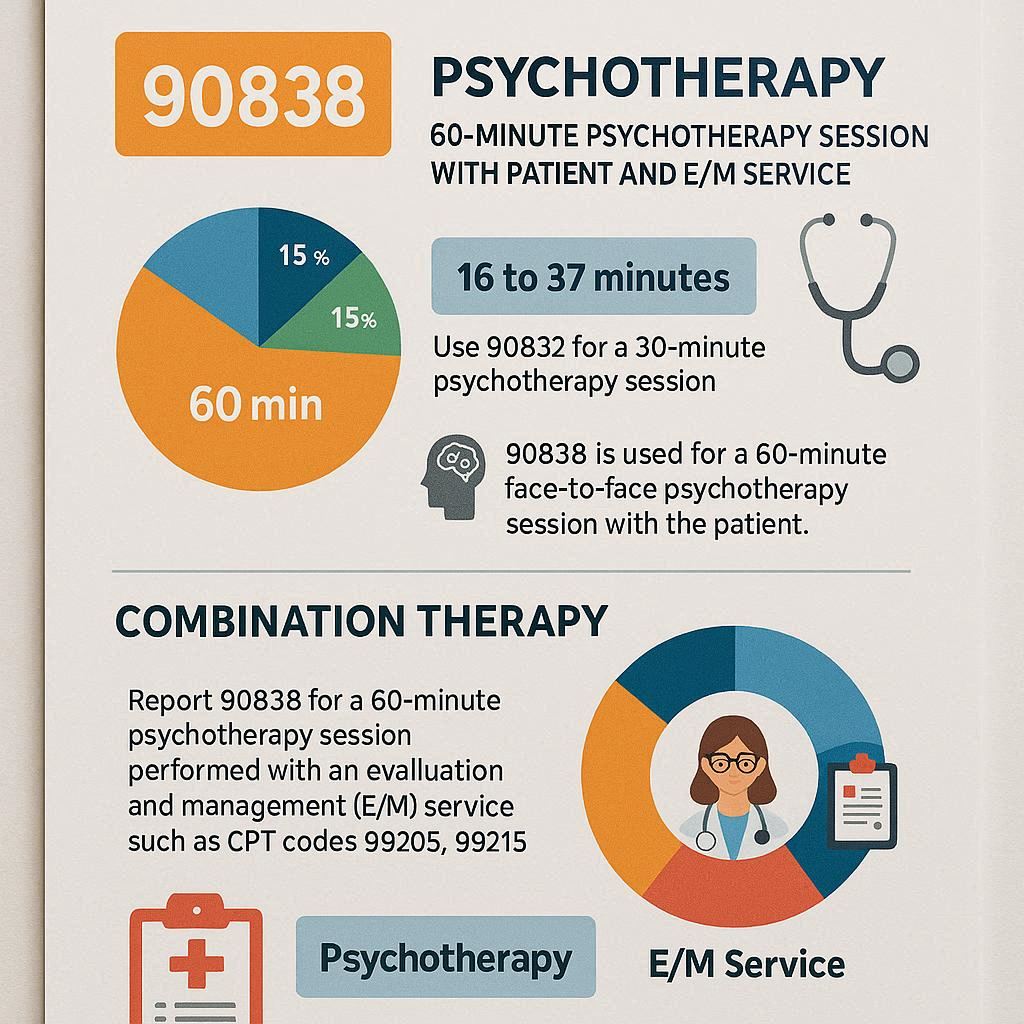
What Is CPT Code 90838? The Official Description
The official cpt code 90838 description from the American Medical Association (AMA) is:
*Psychotherapy with evaluation and management (E/M) service, when performed with an individual, 60 minutes.*
That sounds simple. But there is more to it. This code is not just about time. It combines two very different types of work into one billable service.
Breaking Down the Code
To understand 90838, you need to see its two parts:
- Psychotherapy (60 minutes). You spend at least 38 minutes (for the 60-minute code) doing talk therapy. This can include cognitive behavioral therapy, dialectical behavior therapy, or other evidence-based approaches.
- Evaluation and management (E/M) service. This is the medical part. You are assessing the patient’s medical status. You might review labs, adjust medications, or manage side effects. You also coordinate care with other doctors.
The key point is that both services happen during the same visit. You are not seeing the patient twice. You are mixing therapy and medical decision-making in one longer session.
Who Uses This Code Most Often?
You will see code 90838 used mainly by:
- Psychiatrists
- Nurse practitioners (psychiatric)
- Physician assistants (psychiatric)
- Any prescribing mental health professional
If you do not prescribe medication, you cannot use this code. That is a hard rule. Social workers, psychologists, and licensed professional counselors should use other codes like 90837 for therapy alone.
When to Use CPT Code 90838 (With Real Examples)
Let us move from theory to practice. Knowing the cpt code 90838 description is one thing. Knowing when to bill it is another.
Example 1: The Medication Check + Therapy Session
A patient comes in for a 60-minute visit. For the first 15 minutes, you review their recent mood changes. They started a new antidepressant two weeks ago. You assess side effects, check vital signs, and adjust the dose.
For the remaining 45 minutes, you provide trauma-focused therapy. You work on grounding techniques and explore a recent stressful event.
Here, you performed both an E/M service and significant therapy. Code 90838 fits perfectly.
Example 2: Chronic Mental Illness Management
You see a patient with treatment-resistant schizophrenia. They are stable but need close monitoring. During a 60-minute visit, you spend 25 minutes reviewing their lab results, checking for tardive dyskinesia, and adjusting antipsychotic medication. The other 35 minutes involve supportive therapy and adherence coaching.
This is also appropriate for 90838.
Example 3: When Not to Use It
A patient books a 60-minute therapy session. You do not prescribe medication. You only do talk therapy. No medical decision-making occurs.
You cannot use 90838. You should use 90837 (psychotherapy, 60 minutes).
Time Rules for CPT Code 90838 (What the Books Do Not Tell You)
Time is a common source of billing errors. Let us clarify the rules.
The 60-Minute Threshold
CPT code 90838 is a 60-minute code. That means you must spend at least 38 minutes of face-to-face time with the patient. The AMA uses a “rule of eights” for time-based codes. For a 60-minute service, the minimum time is 38 minutes.
But here is the twist. You do not need to spend all 60 minutes on therapy alone. You can split the time between E/M and psychotherapy. The total face-to-face time must be at least 38 minutes. However, most payers expect the total visit to be close to 60 minutes.
What Counts Toward Time?
Time includes:
- Face-to-face contact with the patient
- Reviewing history or symptoms during the visit
- Performing a mental status exam
- Delivering psychotherapy
- Making medical decisions
- Explaining medication changes
Time does not include:
- Documenting after the visit (unless done real-time with the patient)
- Scheduling follow-ups
- Billing or administrative tasks
- Waiting for the patient to arrive
Shorter and Longer Versions
CPT code 90838 is the 60-minute version. But there are two related codes you should know:
| CPT Code | Time | Description |
|---|---|---|
| 90833 | 30 minutes | Psychotherapy with E/M (16-37 minutes total) |
| 90836 | 45 minutes | Psychotherapy with E/M (38-52 minutes total) |
| 90838 | 60 minutes | Psychotherapy with E/M (53+ minutes total) |
If your visit is only 30 minutes total, you cannot use 90838. Use 90833 instead.
CPT 90838 vs. 90837: The Critical Difference
This is where many people get confused. Both codes involve 60 minutes. Both are for individual psychotherapy. But they are not interchangeable.
| Feature | CPT 90837 | CPT 90838 |
|---|---|---|
| Who can bill | Any mental health professional | Prescribers only (MD, DO, NP, PA) |
| Includes E/M | No | Yes |
| Medical decision-making | No | Yes |
| Medication management | No | Yes |
| Typical provider | Psychologist, LCSW, LPC | Psychiatrist, psychiatric NP |
| Payer difficulty | Moderate (some audits) | Higher (more scrutiny) |
Real-World Advice
If you are a psychiatrist who spends the entire hour doing therapy and no medication management, some experts suggest using 90837. But check your payer rules. Some commercial insurers require prescribers to use 90838 if any medical component exists.
If you are a psychologist, never use 90838. You will face denied claims and potential audits.
CPT 90838 vs. 90833 vs. 90836
Let us compare all three “psychotherapy with E/M” codes side by side.
| Code | Minimum Time | Maximum Time | Best for… |
|---|---|---|---|
| 90833 | 16 minutes | 37 minutes | Brief medication check + short therapy (e.g., 15 min med review + 15 min therapy) |
| 90836 | 38 minutes | 52 minutes | Moderate visit (e.g., 20 min med management + 25 min therapy) |
| 90838 | 53 minutes | unlimited* | Longer, complex visits requiring both medical and therapeutic work |
*Most payers expect around 60 minutes. Very long sessions (90+ minutes) may need special justification.
Choosing the Right Code
Ask yourself three questions:
- Did I perform medical decision-making? (If no, do not use any of these.)
- What was the total face-to-face time?
- How much of that time was therapy vs. E/M?
There is no required minimum for the therapy portion. You could spend 10 minutes on therapy and 50 minutes on E/M. As long as the total time meets the threshold, you can bill 90838. However, the code’s name starts with “psychotherapy.” So the therapy component should be meaningful.
Important Note: Some payers, including certain Medicare Administrative Contractors (MACs), expect that more than half of the time is psychotherapy. Always check your local coverage determination.
Documentation Requirements for 90838 (How to Avoid Denials)
Good documentation is your best friend. Payers audit this code often because it is high-cost. Here is what your note must include.
Required Elements
Your medical record for 90838 needs to show:
- Total time. Write the start and end time of face-to-face contact. Example: *”Face-to-face with patient from 10:05 AM to 11:10 AM (65 minutes).”*
- Breakdown of activities. Describe what you did during the E/M portion and what you did during the psychotherapy portion. Do not just say “therapy and med management.” Be specific.
- Medical decision-making (MDM) complexity. Your E/M level must be justified. For 90838, the MDM should be at least low or moderate. Simple prescription refills with no changes may not support 90838.
- Therapy modality and focus. Note the type of therapy (e.g., CBT, supportive therapy, motivational interviewing). Describe what you worked on.
- Signature and credentials. Always sign and include your NPI.
Sample Documentation Snippet
*”Face-to-face time: 62 minutes (10:00 AM – 11:02 AM). E/M portion (28 minutes): Reviewed recent labs showing therapeutic lithium level. Patient reports mild hand tremor. Assessed for other signs of toxicity. No abnormal involuntary movements. Decreased lithium dose from 900mg to 600mg daily. Discussed hydration and follow-up labs. Psychotherapy portion (34 minutes): Provided CBT for health anxiety related to tremor symptoms. Patient identified catastrophic thoughts about medication side effects. Practiced cognitive restructuring and relaxation breathing. Developed action plan for managing anxiety between visits.”*
This note clearly supports both components of code 90838.
Payer Policies and Reimbursement Rates
Reimbursement for 90838 varies widely. Let us look at real numbers.
Medicare Rates (2024 approximate)
Medicare pays for 90838 under the Physician Fee Schedule. The national average allowed amount is roughly 150–150–180 depending on your locality. This is about 20-30% higher than 90837 (which averages 110–140).
Commercial Payer Examples
| Payer | Reimbursement (estimate) | Notes |
|---|---|---|
| UnitedHealthcare | 160−220 | Often requires prior authorization after 8 visits |
| Cigna | 140−190 | May downcode to 90837 without proper documentation |
| Aetna | 150−200 | Covers well; audits for time documentation |
| Blue Cross (varies by state) | 130−210 | Highly variable; check local plan |
Why the Wide Range?
Reimbursement depends on:
- Your geographic location
- Your contract with the payer
- Place of service (office vs. telehealth vs. facility)
- Whether the patient has a high-deductible plan
Tips for Maximizing Reimbursement
- Verify benefits before the visit. Ask if the plan covers 90838 specifically. Some only cover 90833 and 90837.
- Check for prior authorization requirements. Many plans require authorization after a certain number of 90838 visits (often 8-12 per year).
- Appeal denials with your documentation. If you get denied, send your detailed note and ask for a coding review.
Common Billing Mistakes and How to Avoid Them
Even experienced billers make errors with 90838. Here are the most common.
Mistake #1: Billing 90838 for a 45-Minute Visit
If your total face-to-face time is 45 minutes, you cannot bill 90838. Use 90836 instead. Billing 90838 for under 53 minutes is technically upcoding. It can trigger audits.
Mistake #2: Using 90838 Without Medical Decision-Making
You review a patient’s meds, but nothing changes. No side effects. No new symptoms. No lab review. That is not significant E/M. Bill 90837 instead.
Mistake #3: Non-Prescribers Using 90838
As noted earlier, this is a hard stop. You cannot bill for E/M services if you cannot prescribe. Payers will deny these claims 100% of the time.
Mistake #4: Insufficient Time Documentation
Do not write “60 minutes.” Write the exact start and end times. Payers can and do deny claims with vague time statements.
Mistake #5: Using 90838 for Every Therapy Session
Some psychiatrists use 90838 for every patient, every visit. That is a red flag. Many visits are pure therapy or pure medication management. Only use 90838 when you truly do both in the same visit.
Telehealth and CPT Code 90838
Good news. Most payers cover 90838 via telehealth. But there are rules.
Medicare Telehealth Rules
Medicare permanently covers 90838 via two-way audio-video. You cannot use audio-only (phone) for this code. The patient must be located in a qualified originating site (usually their home, effective permanently after the PHE).
Private Payer Telehealth Rules
Most commercial plans follow Medicare’s lead. However, some require the patient to be in a healthcare facility. Others restrict telehealth to certain modalities (e.g., no video-only therapy with E/M). Always verify.
Documentation for Telehealth
Add a line to your note: “Service delivered via real-time, interactive audio-video telehealth. Patient located at [home/other site]. Provider located at [office/home].”
How to Introduce 90838 to Your Practice
If you are a prescriber currently using only 90837 or only E/M codes, transitioning to 90838 can increase revenue. But you need a plan.
Step 1: Review Your Current Caseload
Look at your last 20 long therapy sessions. How many included medication management? If you routinely adjust meds during therapy, you should be using 90838.
Step 2: Train Your Staff
Your front desk and billers need to know:
- Which providers can bill 90838
- What documentation is required
- How to verify coverage
Step 3: Update Your Templates
Create an EHR template for 90838 that includes:
- Time fields (start, end, total)
- Separate sections for E/M and therapy
- Medical decision-making table (problems, data, risk)
Step 4: Start with One Payer
Test the code with one insurance company first. Submit 5-10 claims. Track acceptances, denials, and payments. Then expand to other payers.
Step 5: Audit Yourself Monthly
For the first three months, review every 90838 claim before submission. Check time, medical necessity, and documentation. This builds good habits.
Real Questions from Clinicians (FAQ)
Let me answer some common questions I hear from mental health providers.
Can I bill 90838 and 90837 for the same patient on the same day?
No. You cannot bill two individual psychotherapy codes on the same day for the same patient. Choose the one that best fits the service.
Can I bill 90838 and 99214 (office E/M) on the same day?
Generally, no. The E/M component is already included in 90838. Billing a separate E/M code would be unbundling. The only exception is if you have a separately identifiable, unrelated E/M service (e.g., a physical exam for an acute medical problem). That is very rare in psychiatry.
What if my visit lasts 90 minutes?
You have two options:
- Bill 90838 for 60 minutes. You cannot bill a second unit because 90838 is not a per-unit code. You eat the extra 30 minutes.
- Bill an add-on code? There is no add-on for 90838. Some providers use modifier 22 (unusual service) with 90838 for prolonged time. But this is payer-specific. Many deny modifier 22 for psychotherapy codes.
Does Medicare cover 90838?
Yes. Medicare covers 90838 for psychiatrists and psychiatric nurse practitioners. However, some MACs have local policies restricting it. For example, certain MACs require that the psychotherapy portion be at least 25 minutes of a 60-minute visit. Check your local MAC.
What is the difference between 90838 and 90839?
90839 is for psychotherapy for crisis (first 60 minutes). It is for emergencies, not routine care. Do not confuse them.
A Note on Ethical Billing
I want to take a moment to talk about ethics. The cpt code 90838 description is clear, but pressure to increase revenue can lead to overuse.
Ask yourself honestly:
- Am I providing real, meaningful psychotherapy in these visits?
- Is the E/M component necessary and documented?
- Could this visit be split into two separate visits (one for meds, one for therapy)?
If you are using 90838 for every patient simply because you can, reconsider. Auditors look for patterns. A psychiatrist who bills 90838 for 95% of 60-minute visits will raise flags.
Better to use the code honestly for 30% of visits than to risk a payer audit that demands repayment for years of claims.
State-by-State Considerations
While CPT codes are universal, payer policies vary by state.
Medicaid
Each state Medicaid program decides coverage for 90838. Some states cover it fully. Others require prior authorization. A few do not cover it at all, preferring 90837 plus a separate E/M code on a different day.
Always check your state Medicaid provider manual.
No Surprises Act
The No Surprises Act applies to 90838 if you are out-of-network and the patient is insured. You must provide a good faith estimate for self-pay patients. For insured patients, balance billing is restricted in certain emergencies and facility-based situations.
Practical Tips for Higher Reimbursement
Let me share some strategies that actually work.
Tip 1: Document Medical Necessity for Both Components
Payers want to see why you needed to do both therapy and medical management in the same visit. For example:
- “Patient’s medication side effects are directly linked to therapy-interfering beliefs. Addressing both together is essential for progress.”
Tip 2: Use the Right Place of Service Code
Place of service (POS) affects payment.
- POS 11 (office) – highest reimbursement
- POS 02 (telehealth) – same as office for most payers
- POS 22 (outpatient hospital) – lower reimbursement
Tip 3: Bill Promptly
Unlike 90837 (which has a 1-year timely filing limit for most payers), 90838 is often subject to shorter limits. Some plans require filing within 90 days. Do not let claims age.
Tip 4: Appeal Every Denial
Do not accept a denial without a fight. Many 90838 denials are automatic due to coding edits. A simple appeal with your documentation often overturns them.
The Future of CPT Code 90838
What does the future hold for this code?
Value-Based Care
As mental health moves toward value-based payment models, time-based codes like 90838 may become less common. Some payers are experimenting with bundled payments for mental health episodes. In those models, you receive one payment for all services during an episode, regardless of whether you use 90838 or 90837.
Telehealth Permanency
Most experts believe telehealth coverage for 90838 will remain permanent. The genie is out of the bottle. Patients and providers like the convenience. However, audio-only (phone) will likely never be allowed for this code due to the E/M component requiring visual assessment.
Increased Audits
Expect more audits of 90838 in the coming years. Payers see high reimbursement and longer visit times as risk areas. Keep your documentation pristine.
A Complete Checklist Before You Bill 90838
Use this checklist for every claim.
- I am a licensed prescriber (MD, DO, NP, PA, etc.).
- Total face-to-face time was 53 minutes or more.
- I performed both psychotherapy AND medical decision-making.
- My note includes start and end times.
- My note describes what I did for E/M (e.g., med change, lab review).
- My note describes what I did for psychotherapy (modality, focus).
- I have checked the patient’s insurance covers 90838.
- I have any required prior authorization.
- The visit was not purely therapy or purely medication management.
- I did not bill any other E/M or psychotherapy code for this patient today.
If you checked all ten boxes, you are ready to bill.
Additional Resources for Mental Health Billers
You do not have to figure this out alone. Here are trusted resources.
Official Sources
- AMA CPT® Professional Edition – Buy the current year’s codebook.
- CMS Medicare Physician Fee Schedule Lookup – Search for 90838 rates in your area.
- Your Local MAC’s website – Find local coverage determinations for psychiatry.
Professional Organizations
- American Psychiatric Association (APA) – Offers coding and reimbursement guidance for members.
- American Association of Nurse Practitioners (AANP) – Has billing resources for psychiatric NPs.
Recommended Link
For a deeper dive into all psychotherapy codes, including 90832, 90834, 90837, and the E/M add-ons, visit the CMS Mental Health Services Billing Guide. You can find it by searching “CMS Mental Health Billing Guide 2024” on your preferred search engine.
Conclusion
Let me summarize what we have covered.
CPT code 90838 is a powerful billing tool for prescribers who blend medical management with psychotherapy in a single 60-minute visit. It requires careful time tracking, detailed documentation of both service components, and awareness of payer-specific rules. When used correctly and ethically, it properly compensates you for the complex work of treating mental illness from both a medical and therapeutic angle.
FAQ: Quick Answers to Common Questions
1. Can a psychologist bill CPT 90838?
No. Only prescribers (psychiatrists, NPs, PAs) can bill 90838 because it includes an evaluation and management (medical) component.
2. What is the minimum time for 90838?
You need at least 53 minutes of face-to-face time. The code describes a 60-minute service.
3. Does Medicare cover 90838?
Yes, but check your local MAC’s policy. Some have additional requirements about the psychotherapy portion.
4. Can I use 90838 for telehealth?
Yes, for real-time audio-video telehealth. Audio-only (phone) does not qualify.
5. What is the difference between 90838 and 90837?
90837 is psychotherapy only (60 minutes). 90838 is psychotherapy with E/M (60 minutes). Only prescribers can use 90838.
6. How much does Medicare pay for 90838?
Approximately 150–180, depending on your location. This is higher than 90837.
7. Can I bill 90838 twice in one day?
No. 90838 is a once-per-day code. Prolonged services do not have an add-on code.
8. What if I spend only 45 minutes?
Use 90836 (45-minute version) instead.
9. Do I need a separate E/M code with 90838?
No. The E/M is included in 90838. Do not bill 99213 or 99214 on the same day.
10. What happens if I am audited for 90838?
The auditor will check your time documentation, the split between E/M and therapy, and medical necessity. Keep detailed notes to survive an audit.
Disclaimer: This article is for educational purposes only. Coding and billing rules change frequently. Always consult the current CPT manual and your local payer policies before submitting claims. The author and publisher assume no responsibility for claim denials, audits, or financial losses resulting from the use of this information.