If you work in a dermatology clinic, a primary care office, or a sexual health clinic, you know that treating genital warts is a common procedure. But when it comes time to bill for that service, things can get confusing quickly. What is the correct CPT code for cryotherapy of genital warts? Is it the same as removing a skin tag? Does insurance cover it?
Let us clear up the confusion right now.
The most common CPT code used for cryotherapy of genital warts is 17110. However, there are specific rules, modifiers, and payer-specific policies you need to know before you submit that claim. Using the wrong code can lead to denials, audits, or lost revenue.
This guide walks you through everything you need to know. We will cover the codes, the documentation requirements, how to handle Medicare patients, and what to do when an insurance company pushes back.
CPT Code for Cryotherapy of Genital Warts
Understanding the Basics: What Is Cryotherapy for Genital Warts?
Before we dive into the numbers, let us quickly review the procedure itself. Cryotherapy involves applying liquid nitrogen or another freezing agent directly to the wart tissue. The extreme cold destroys the cells. Over the next few days, the treated area blisters and eventually falls off.
Genital warts are caused by the human papillomavirus (HPV). They are considered a benign lesion, but they are also a sexually transmitted infection. This dual nature—benign growth plus infectious condition—creates unique billing challenges.
The procedure is usually quick. A clinician uses a spray device or a cotton-tipped applicator. One or two freeze-thaw cycles are common. The patient may need multiple sessions because HPV can be stubborn.
From a coding perspective, the key question is always the same: Are we removing a benign lesion, or are we treating a medical condition? The answer dictates which code you choose.
The Primary CPT Code: 17110
Let us get straight to the point. For the vast majority of cases involving cryotherapy of genital warts, the correct code is 17110.
Here is the official descriptor for CPT 17110:
Destruction (eg, laser surgery, electrosurgery, cryosurgery, chemosurgery, surgical curettement), of benign lesions other than skin tags or cutaneous vascular proliferative lesions; up to 14 lesions.
Why 17110 Works for Genital Warts
Genital warts are classified as benign lesions. They are not malignant. They are not skin tags (which have their own code, 11200). They are not vascular lesions.
The code covers up to 14 lesions. If your patient has one wart or fourteen warts in the genital area during that single session, you use one unit of 17110.
The destruction method listed includes cryosurgery explicitly. So, whether you use liquid nitrogen or a cryoprobe, you are covered.
Important Note for More Than 14 Lesions
What happens if your patient has 15 or more genital warts? You do not use 17110 again. Instead, you turn to 17111.
-
17111 – Destruction of benign lesions other than skin tags or cutaneous vascular proliferative lesions; 15 or more lesions.
You only bill 17111 when the count reaches 15 or more in a single session. This is relatively rare for genital warts, but it does happen, especially in immunocompromised patients.
A Common Alternative: 54050 – 54065 (Destruction of Penile Lesions)
Many coders wonder about the 54000 series. These codes are specific to the male genitalia. Let us look at them.
| CPT Code | Description | Application for Genital Warts |
|---|---|---|
| 54050 | Destruction of lesion(s), penis (eg, condyloma, papilloma); simple | Sometimes used, but often payer-dependent |
| 54055 | Destruction of lesion(s), penis; extensive | For larger or multiple penile warts |
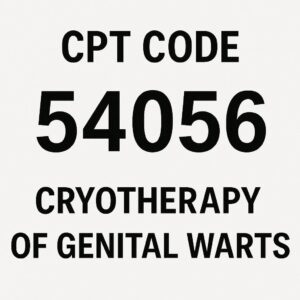
| 54056 | Destruction of lesion(s), penis; cryosurgery | Explicitly for cryotherapy on the penis |
| 54060 | Destruction of lesion(s), penis; surgical | Not applicable to cryo |
| 54065 | Destruction of lesion(s), penis; chemosurgery | Not applicable to cryo |
So, Which One Is Right?
This is where medical coding gets nuanced. CPT 54056 is anatomically specific for the penis. If you perform cryotherapy on a penile wart, you could argue that 54056 is more precise than 17110.
However, many payers (including some commercial insurers) prefer 17110 because it is the generic code for benign lesion destruction. The American Medical Association (AMA) does not forbid using 54056. The decision often comes down to:
-
Payer policy. Some insurers want the site-specific code. Others want the general code.
-
Medical necessity documentation. If you use 54056, your note must clearly describe the penile location.
-
Frequency of use. Most clinics default to 17110 for simplicity.
Pro Tip: Before you choose, check the specific payer’s coding manual. If they do not list 54056 as a covered code for warts, stick with 17110. When in doubt, 17110 is the safer, more universally accepted choice for benign genital warts.
What About Female Genital Warts (Vulvar or Vaginal)?
There is no specific CPT code for cryotherapy of vulvar or vaginal warts that mirrors the penile codes. For female patients, 17110 is almost always the correct choice.
For vaginal or cervical warts, the coding changes. Cryotherapy on the cervix is a different service entirely. That falls under 57511 (Cryocautery of the cervix). But that code is for cervical intraepithelial neoplasia (CIN), not routine external genital warts.
For external female genitalia (vulva, perineum, anal area), stick with 17110.
Documentation Requirements to Avoid Denials
Insurance companies deny claims for two main reasons: lack of medical necessity and poor documentation. For cryotherapy of genital warts, your clinical note must be crystal clear.
Here is a checklist for your medical record:
-
Location, location, location. Specify that the warts are in the genital region (eg, penile shaft, vulva, perianal area).
-
Number of lesions. Count them. Write the number down. For 17110, you need to confirm it is 14 or fewer. For 17111, you need a count of 15 or more.
-
Method of destruction. Write “cryotherapy with liquid nitrogen” or “cryosurgery.” Do not just say “destroyed.”
-
Diagnosis code. This is critical. Use the correct ICD-10 code (see the next section).
-
Consent. Note that you discussed risks (pain, blistering, scarring, recurrence) and obtained verbal or written consent.
-
Photographs (optional but helpful). Some payers request images for genital procedures. Check your payer’s policy.
A weak note looks like this: “Patient has warts. Treated with liquid nitrogen.”
A strong note looks like this: *“Patient presents with six discrete, exophytic papules on the penile shaft consistent with condyloma acuminata. After obtaining informed consent, liquid nitrogen cryotherapy was applied to each lesion using a spray technique for two freeze-thaw cycles. Total lesions treated: 6. Patient tolerated the procedure well.”*
The Right Diagnosis Code (ICD-10) to Pair With CPT Codes
You cannot bill a procedure without a diagnosis. For genital warts, the ICD-10 code is straightforward, but you must be precise.
The primary code is A63.0 – Anogenital (venereal) warts.
This code covers condyloma acuminatum. It is specific to HPV-related warts in the genital and anal regions. Do not use a general wart code like B07.9 (viral wart, unspecified) for genital lesions. That is incorrect and may trigger a denial because general warts are often considered cosmetic.
Other relevant ICD-10 codes (less common):
-
A63.0 – Anogenital warts (standard choice)
-
R19.6 – Halitosis (not relevant – just showing you unrelated codes are a problem)
-
D26.0 – Neoplasm of uncertain behavior of cervix (only if biopsy proves dysplasia)
Critical Note: Some payers may require a modifier to indicate that the procedure was not cosmetic. Genital wart treatment is almost never considered cosmetic because HPV is a transmissible disease. However, if the warts are asymptomatic and the patient requests removal only for appearance, some policies may deny. Always document symptoms (itching, bleeding, pain, or partner concern about transmission) to support medical necessity.
Medicare and Genital Wart Cryotherapy: A Special Case
Medicare has its own rules. And here is where things get tricky.
Medicare generally covers the destruction of benign lesions only when they are symptomatic or interfering with function. For genital warts, Medicare often covers treatment because:
-
They can cause pain, itching, or bleeding.
-
They are contagious.
-
They may be premalignant in some strains (though most genital warts are low-risk HPV types).
However, Medicare does not have a specific National Coverage Determination (NCD) for cryotherapy of genital warts. That means coverage is determined by your local Medicare Administrative Contractor (MAC).
What Medicare Wants to See:
-
CPT 17110 is accepted by most MACs.
-
ICD-10 A63.0 is required.
-
A detailed note explaining symptoms.
-
You cannot bill Medicare for the same wart twice in a short period without documented recurrence.
Medicare Modifiers to Know:
-
Modifier 25 – If you perform an Evaluation and Management (E/M) service on the same day as the cryotherapy (eg, a new patient visit plus same-day treatment), append modifier 25 to the E/M code.
-
Modifier 59 – Rarely needed for this procedure, but if you treat warts in two distinct anatomical sites (eg, penis and anal area) and need to bill two units, some MACs want modifier 59 on the second unit.
Warning: Do not bill Medicare for cryotherapy of genital warts performed during a preventive visit (like an annual physical) unless the patient had a specific complaint. Medicare is strict about splitting preventive and problem-focused services.
Private Payer Policies: What to Expect
Commercial insurers like UnitedHealthcare, Cigna, Aetna, and Blue Cross Blue Shield all cover cryotherapy of genital warts. However, their coding preferences vary slightly.
| Payer | Preferred CPT Code | Notes |
|---|---|---|
| UnitedHealthcare | 17110 | Accepts 54056 but may downcode to 17110 |
| Cigna | 17110 | Explicitly lists 17110 for anogenital warts |
| Aetna | 17110 or 54056 | Accepts both; site-specific is fine |
| BCBS (varies by state) | 17110 (most common) | Some plans require prior authorization for >3 sessions |
| Medicaid (most states) | 17110 | Usually covers; check state-specific guidelines |
The trend is clear: 17110 is the safe bet. Unless you have a specific contractual requirement to use 54056, use 17110 for both male and female patients.
How to Bill Multiple Sessions
Genital warts often require multiple cryotherapy sessions. The virus lives in the skin. Even after destruction, new warts can appear. You may see a patient every two to four weeks for several months.
Billing rules for follow-up sessions:
-
New lesions count separately. If a patient returns and you treat new warts that were not present last time, bill 17110 again.
-
Recurrent warts in the same spot. If the same wart regrows, it counts as a new treatment session. Bill 17110.
-
Frequency limits. Most payers do not have a strict limit, but if you bill 17110 six times for the same patient in three months, expect a records request. Be ready to prove medical necessity.
Example scenario:
-
Visit 1: Five warts. Bill 17110.
-
Visit 2 (3 weeks later): Two old warts resolved. Three new warts appeared. Bill 17110 again.
-
Visit 3 (6 weeks later): One persistent wart. Two new warts. Bill 17110 again.
That is appropriate and defensible.
Global Period Rules: Does Cryotherapy Have a Follow-Up?
Cryotherapy of genital warts is a minor procedure. Under CPT guidelines, it has a 10-day global period. That means the follow-up care related to the procedure is included in the payment for the first 10 days.
What does this mean for you?
-
If the patient calls with pain or blistering within 10 days, you cannot bill for a separate office visit.
-
If you see the patient again within 10 days to retreat the same warts (because the first treatment failed), you generally cannot bill a second 17110. You may need to eat the cost or document a complication.
-
If you see the patient after 10 days for new or recurrent warts, you can bill a new 17110.
Exception:
If the patient develops a significant complication (eg, secondary infection requiring antibiotics), you can bill for that separate E/M service with modifier 24 (unrelated to the global period). But for routine retreatment, wait 11 days.
Common Denial Reasons and How to Fight Them
Even good coders get denials. Here are the top reasons payers reject claims for cryotherapy of genital warts, plus solutions.
Denial 1: “Procedure Not Medically Necessary”
Why it happens: The payer thinks the treatment is cosmetic.
How to fix it: Appeal with documentation showing symptoms (itching, pain, bleeding, or risk of transmission to partners). Include the ICD-10 code A63.0. Add a note that HPV is an infectious disease.
Denial 2: “CPT Code Not Valid for This Diagnosis”
Why it happens: You used 17110 with a general wart code (B07.9) instead of A63.0.
How to fix it: Resubmit with A63.0. Or, if the warts are truly non-genital, use a different code. But for genital warts, A63.0 is non-negotiable.
Denial 3: “Missing or Invalid Modifier”
Why it happens: You billed an E/M service on the same day without modifier 25.
How to fix it: Append modifier 25 to the E/M code. The cryotherapy code (17110) does not need a modifier in this case.
Denial 4: “Frequency of Service Exceeds Allowable”
Why it happens: You billed 17110 multiple times in a short window (eg, weekly for four weeks).
How to fix it: Submit medical records showing new lesions at each visit. If you are retreating the same lesions, consider switching to a different treatment modality (like topical creams) and document failure of cryotherapy.
A Note on Bundling and Separate Billing
Cryotherapy is often performed with other services. Here is what you can and cannot bill separately.
You CAN bill separately for:
-
An E/M service (office visit) if the patient has a new problem or a significant change in condition. Append modifier 25.
-
A biopsy (11102-11107) if a lesion is atypical or you suspect dysplasia.
-
Treatment of warts in a separate anatomical area (eg, genital warts plus hand warts). Use modifier 59 on the second 17110.
You CANNOT bill separately for:
-
The cryotherapy itself (obviously, that is the main code).
-
Simple patient education about HPV (included in the E/M or procedure).
-
Application of topical anesthetic (included in the procedure).
-
A brief follow-up phone call within the global period.
Real-Life Coding Scenarios
Let us walk through three common clinical scenarios. This will help you see how the rules apply in practice.
Scenario 1: New Patient, First-Time Treatment
Patient: 28-year-old male. Complains of three small bumps on the penile shaft for two months. No prior treatment. You diagnose condyloma. You perform cryotherapy to all three lesions.
Coding:
-
E/M code (eg, 99203 for new patient, moderate complexity) with modifier 25.
-
CPT 17110 (up to 14 lesions).
-
ICD-10 A63.0.
Rationale: The E/M is separate because you performed a history and exam to establish the diagnosis. The cryotherapy is a separate service. Modifier 25 links them correctly.
Scenario 2: Established Patient, Recurrence
Patient: 34-year-old female with known HPV. Returns for a scheduled treatment. You see four recurrent warts on the vulva. No other complaints. You perform cryotherapy.
Coding:
-
No separate E/M code (the visit is only for the procedure).
-
CPT 17110.
-
ICD-10 A63.0.
Rationale: No new exam or medical decision making is needed. The patient came only for treatment. Bill only the procedure.
Scenario 3: Multiple Anatomic Sites
Patient: 40-year-old male. Has warts on the penile shaft (six lesions) and perianal area (four lesions). You treat all ten lesions in one session.
Coding:
-
One unit of CPT 17110 (total lesions = 10, which is less than 14).
-
ICD-10 A63.0.
-
No modifier needed.
Rationale: Even though the warts are in two areas, the code allows destruction of up to 14 lesions regardless of location on the body. Do not bill two units.
Legal and Compliance Risks
Medical coding for genital procedures carries extra scrutiny. Here is why.
Genital warts are often linked to sexual activity. Some payers have internal audits for these codes because they suspect fraud (eg, billing for warts that are not present or upcoding from a less expensive code).
Three rules to stay compliant:
-
Never bill for a wart you did not treat. Count carefully. Do not guess.
-
Never use 17111 (15+ lesions) without a written count. If your documentation says “numerous warts,” but you did not count, you cannot bill 17111. The number must be specific.
-
Do not unbundle. Some clinics try to bill per wart. That is fraud. 17110 covers up to 14 warts. You do not bill 17110 fourteen times for fourteen warts.
Compliance Reminder: The Office of Inspector General (OIG) lists dermatology and lesion destruction as high-risk areas for improper payments. Document as if you expect an audit. Because someday, you might get one.
When Cryotherapy Is Not the Right Code (Alternative Treatments)
Cryotherapy is one of many destruction methods. But what if you use a different technique? Here are alternative CPT codes for genital warts.
| Treatment Method | CPT Code(s) | Notes |
|---|---|---|
| Topical podophyllin | 17110 (destruction by chemosurgery) | Same code, different method |
| Topical imiquimod (Aldara) | No procedure code | Patient applies at home. Bill only E/M for prescription. |
| TCA (trichloroacetic acid) | 17110 | Chemical destruction |
| Surgical excision | 11400-11446 | Based on lesion size and location |
| Laser ablation (CO2 laser) | 17110 (or 54056 if penis) | Laser is included in destruction codes |
| Electrosurgery (hyfrecation) | 17110 | Same code |
The key takeaway: 17110 is a method-agnostic code for destruction of benign lesions. Whether you freeze, burn, or use acid, 17110 works for up to 14 lesions.
How to Optimize Reimbursement
Getting paid properly requires more than the right code. Here are five practical tips to improve your revenue cycle for genital wart cryotherapy.
1. Verify benefits before treatment.
Call the payer. Ask: “Does the patient’s plan cover CPT 17110 for the diagnosis A63.0? Is there a prior authorization requirement?” Some plans require pre-auth after the third treatment session.
2. Collect patient responsibility upfront.
Many plans apply cryotherapy to the deductible. If the patient has a high-deductible health plan (HDHP), they may owe $150-$300 per session. Tell them before you treat.
3. Use the correct place of service.
If you perform cryotherapy in an office (not a hospital outpatient department), use place of service 11. If you do it in an ambulatory surgical center (ASC), use POS 24. Reimbursement rates differ.
4. Appeal denials promptly.
Most payers give you 180 days to appeal. Do not let denials sit. A simple one-page appeal letter with medical records often reverses a “not medically necessary” denial.
5. Track your denial reasons.
If one payer denies 17110 for “bundling” three times in a month, call their provider line. Ask for coding guidelines in writing. Sometimes the issue is a software glitch on their end.
Frequently Asked Questions (FAQ)
Q1: Can I use CPT 17110 for anal warts?
Yes. Anal warts are considered anogenital warts. Use A63.0 as the diagnosis. The code does not distinguish between perianal and genital locations.
Q2: What if I treat genital warts on a child?
Genital warts in children are rare and raise concerns about possible abuse. From a coding perspective, use the same CPT 17110. But document extensively. Consult your state’s mandatory reporting laws.
Q3: Does CPT 17110 include local anesthesia?
No. Local anesthesia (like topical lidocaine) is not separately billable. It is included in the procedure. If you inject a local anesthetic, that is also included. You cannot bill 96372 for an injection of lidocaine before cryotherapy.
Q4: Can I bill for cryotherapy and a biopsy at the same visit?
Yes, if the biopsy is on a different lesion or the same lesion but for diagnostic uncertainty. Use biopsy codes 11102 (first biopsy) and 11103 (each additional). Append modifier 59 to the biopsy if it is truly separate. But be careful: if you biopsy a wart and then destroy it, some payers will only pay for the biopsy. Check your payer’s policy.
Q5: How much does Medicare pay for 17110?
Medicare rates vary by region. In 2026, the national average allowed amount for 17110 is approximately $90 to $140. Patient responsibility (copay or deductible) is typically 20% of that amount.
Q6: Is there a specific CPT code for cryotherapy of genital warts using a cryoprobe?
No. The CPT code is the same regardless of device. 17110 covers cryosurgery by any method (spray, probe, or cotton-tipped applicator).
Q7: What modifier do I use for bilateral genital warts?
There is no bilateral modifier for lesion destruction. 17110 is not a bilateral code. Just bill one unit.
Q8: My patient has genital warts and molluscum contagiosum. Can I bill two 17110 codes?
Yes, but you need modifier 59 on the second code. And you must document that the lesions are clinically distinct. Even then, some payers will bundle them. Consider billing 17110 once with both diagnoses linked.
Additional Resource
For the most current official CPT coding guidelines, always refer to the American Medical Association (AMA) CPT Professional Edition. For payer-specific policies, check the Centers for Medicare & Medicaid Services (CMS) Local Coverage Determination (LCD) database for your state.
👉 Link: CMS Medicare Coverage Database – Search for LCDs on Lesion Destruction
Conclusion
Coding for cryotherapy of genital warts does not have to be a headache. Remember the three core points from this guide. First, use CPT 17110 for up to 14 lesions and 17111 for 15 or more, regardless of patient gender. Second, always pair the procedure with ICD-10 A63.0 to prove medical necessity. Third, document the number of lesions, the method, and the symptoms clearly to avoid denials and survive audits. When in doubt, default to 17110 and focus on excellent clinical notes.
Disclaimer: This article is for educational purposes only. Medical coding rules change frequently. Payers have different policies. Always verify coding and coverage with your specific payer and consult a certified medical coder or compliance officer for individual cases. The author and publisher assume no liability for any billing errors or claim denials resulting from the use of this information.