If you have ever faced a denial for a preauricular cyst excision, you already know how frustrating it can be. The confusion usually starts with one simple question: Which CPT code should I use?
The answer is not always straightforward. Preauricular cysts sit in a unique anatomical zone. They are not simple skin lesions, but they are also not deep soft tissue tumors in the classic sense. This in‑between nature creates coding challenges for surgeons, coders, and billing staff.
This guide walks you through everything you need to know. You will learn the correct codes, documentation requirements, common mistakes, and how to handle tricky payer policies. No fluff. No guesswork. Just practical, honest information you can use today.
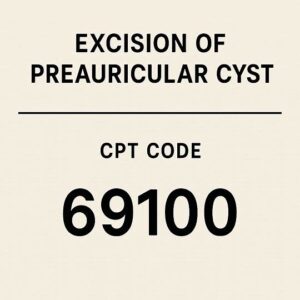
CPT Code for Excision of Preauricular Cyst
Understanding the Anatomy: Why Location Matters for Coding
Before we talk about codes, let us look at why the preauricular area is special.
The preauricular region sits just in front of the ear. It contains skin, subcutaneous tissue, cartilage remnants, and sometimes small sinuses or fistulas. A preauricular cyst can be a simple epidermoid cyst, a dermoid cyst, or part of a congenital preauricular sinus.
Coders and billers often make the mistake of treating this area like any other part of the face. That leads to wrong code choices. Insurance payers look closely at the depth, complexity, and anatomical site. If you pick a code for a simple skin cyst, you might get paid less than you deserve. If you pick a code for a major soft tissue excision, you risk an audit or denial.
The key is to match the procedure documentation to the correct code family.
The Primary CPT Code for Preauricular Cyst Excision
Let us get straight to the point.
For most preauricular cyst excisions, the correct CPT code is 11423.
That code falls under the excision of benign lesions. The full descriptor is:
Excision, benign lesion including margins, except skin tag (unless listed elsewhere), face, ears, eyelids, nose, lips, mucous membrane; excised diameter 2.1 to 3.0 cm
Wait. Does that mean the cyst must be over 2 cm? Not exactly. The code is selected based on the excised diameter, which includes the lesion plus the clinical margins. If your total excised diameter is smaller or larger, you will use a different code from the 11420–11426 series.
Here is the full family for face, ears, eyelids, nose, lips, and mucous membranes:
| CPT Code | Excised Diameter (lesion + margins) |
|---|---|
| 11420 | 0.5 cm or less |
| 11421 | 0.6 to 1.0 cm |
| 11422 | 1.1 to 2.0 cm |
| 11423 | 2.1 to 3.0 cm |
| 11424 | 3.1 to 4.0 cm |
| 11426 | Over 4.0 cm |
So if the surgeon removes a 1.5 cm preauricular cyst with 0.3 cm margins on each side, the total excised diameter is roughly 2.1 cm. That fits 11423.
But many preauricular cysts are smaller. A typical cyst might be 0.8 cm. With standard 0.2–0.3 cm margins, the total excised diameter could be 1.2 to 1.4 cm. That would be 11422.
Important note: You must measure the excised diameter after removal, not the clinical estimate before incision. The pathology report usually includes this measurement. If it does not, ask the surgeon to document it clearly.
When to Avoid the 11400 Series Codes
Not every preauricular cyst qualifies for the 11400 series. There are two main situations where you must use a different code family.
Deep or Subcutaneous Cysts
If the cyst extends below the subcutaneous tissue and requires dissection near cartilage or the parotid gland fascia, the procedure becomes more complex. In that case, you should look at the soft tissue excision codes.
CPT 11423 assumes a lesion that is primarily cutaneous or subcutaneous but does not involve deep fascia, muscle, or major nerves. If the operative report describes “deep dissection,” “exposure of tragal cartilage,” or “dissection off the parotid capsule,” you may need to use 11423 with a modifier or, more appropriately, a code from the 11400 series for benign soft tissue tumors.
Wait. That sounds similar. Let me clarify.
There is no perfect code for a moderately deep preauricular cyst that is not a malignancy. Many coders use 11423 with modifier 22 (increased procedural services). That tells the payer the work was more complex than a standard lesion excision. But modifiers do not always work. Some payers prefer 21011 (excision of benign soft tissue tumor of the face and scalp, subfascial).
However, 21011 is for subfascial lesions. That means below the fascia. Most preauricular cysts are above the fascia. Using 21011 incorrectly can trigger audits.
Realistic advice: If the cyst is simple and superficial, use the correct 11420–11426 code. If it is deep and requires significant dissection, use 11423 with modifier 22 and attach a strong operative note. Do not jump to 21011 unless the cyst truly lies beneath the superficial musculoaponeurotic system (SMAS) or fascia.
Congenital Preauricular Sinus or Fistula
A preauricular cyst that connects to a sinus tract is a different beast. If the surgery involves excising the entire sinus tract, including its epithelial lining down to the cartilage or temporal fascia, you are not just removing a cyst. You are performing a sinus excision.
In that case, the better code is 42815 – excision of branchial cleft cyst, sinus, or fistula, requiring dissection of deep structures. Some coders also use 42810 (excision of branchial cleft cyst or vestige, confined to skin and subcutaneous tissues). But preauricular sinuses are often considered first branchial cleft anomalies. So 42815 is more accurate for a complete excision with deep dissection.
Be careful. Not every payer accepts 42815 for a preauricular sinus. Some want unlisted codes. We will cover that later.
Documentation Requirements You Cannot Ignore
You can pick the perfect code, but without strong documentation, your claim will fail.
Here is what every operative note must include for a preauricular cyst excision:
-
Exact location – “right preauricular region, 0.5 cm anterior to the tragus”
-
Size of the lesion before excision – measured in two dimensions
-
Margins taken – “3 mm margins circumferentially”
-
Total excised diameter – lesion size + margins on both sides (example: 1.2 cm lesion + 0.3 cm margin left + 0.3 cm margin right = 1.8 cm)
-
Depth of excision – “down to but not through the superficial muscular aponeurotic system” or “deep to subcutaneous tissue, exposing the tragal perichondrium”
-
Pathology confirmation – benign cyst, consistent with epidermoid or dermoid cyst
Without these elements, the code becomes a guess. Payers love to deny claims when the documentation is vague. Protect your revenue by making sure every note is specific and complete.
Common Coding Mistakes and How to Avoid Them
Even experienced coders slip up on preauricular cyst excisions. Here are the most frequent errors.
Mistake 1: Using a lesion code without measuring margins
You cannot guess the size. If the surgeon documents “1.2 cm cyst removed with standard margins,” that is not enough. Standard margins vary. The note must say “3 mm margins” or “0.5 cm margins.” Then you calculate the total excised diameter.
Mistake 2: Using a repair code incorrectly
Some surgeons close the wound with a few sutures and think that justifies a separate repair code (like 12051 for intermediate repair). That is wrong. Lesion excision codes already include simple and intermediate closure of the same site. You can only bill a separate repair if it is complex (layered closure requiring extensive undermining) or if the closure is performed on a different anatomic site.
Quotation from CPT guidelines:
“Closure of a surgical wound created by excision of a lesion is considered part of the definitive procedure and is not separately reported.”
Mistake 3: Forgetting about multiple lesions
If the patient has bilateral preauricular cysts, you can bill each excision separately. Append modifier 50 (bilateral procedure) or modifier 59 (distinct procedural service) depending on payer preference. Do not assume you can bill two units of the same code without a modifier. Many payers require modifier 59 or XS.
Mistake 4: Using an unlisted code too quickly
Some coders jump to 19499 (unlisted procedure, integumentary system) because they are unsure. That is almost always a mistake. Unlisted codes invite extra paperwork, medical records requests, and delays. Use them only when no specific code exists. For preauricular cysts, a specific code almost always exists (11420–11426 or 42815).
CPT Code Comparison Table
Let us compare the most relevant codes side by side.
| CPT Code | Description | Best for Preauricular Cyst | Average Work RVU |
|---|---|---|---|
| 11422 | Benign lesion excision, face/ears, 1.1–2.0 cm | Small superficial cyst (total diameter under 2 cm) | 1.60 |
| 11423 | Benign lesion excision, face/ears, 2.1–3.0 cm | Medium cyst with margins (most common) | 2.12 |
| 11424 | Benign lesion excision, face/ears, 3.1–4.0 cm | Large superficial cyst | 2.85 |
| 11426 | Benign lesion excision, face/ears, over 4.0 cm | Very large cyst or multiple excisions combined | 3.53 |
| 42815 | Excision of branchial cleft cyst, sinus, or fistula, deep | Congenital preauricular sinus or deep tract | 8.38 |
| 21011 | Excision benign soft tissue tumor face/scalp, subfascial | Deep cyst below SMAS or parotid fascia | 7.24 |
Notice the big difference in RVUs between superficial lesion codes (1.60–3.53) and deep excision codes (7.24–8.38). That is why payers scrutinize claims for 42815 or 21011. You must prove the extra work.
Step-by-Step Guide to Choosing the Right Code
Follow this decision tree when coding a preauricular cyst excision.
Step 1: Read the operative report carefully.
Look for depth. Is it superficial (skin and subcutaneous only) or deep (down to or below fascia)?
Step 2: Check for sinus or fistula.
Does the report mention “sinus tract,” “branchial cleft remnant,” or “epithelial tract extending to cartilage”? If yes, go to 42815.
Step 3: Measure the total excised diameter.
Find the lesion size and the margin width. Calculate. Example: 1.4 cm lesion + 0.4 cm margin (total 0.8 cm added) = 2.2 cm.
Step 4: Match to 11420–11426.
Use the table above. For 2.2 cm, that is 11423.
Step 5: Consider modifier 22 if warranted.
If the cyst was unusually deep or adherent to cartilage, add modifier 22. Attach a clear explanation in box 19 of the claim form.
Step 6: Check for bilateral or multiple lesions.
Apply modifier 50 or 59 as required.
Step 7: Verify no separate repair is billed.
Unless the closure is complex (CPT 13131–13133 for face), do not add a repair code.
Payer Policies and Reimbursement Realities
Not all payers follow the same rules. Medicare and commercial insurers sometimes disagree on which code is correct.
Medicare (Local Coverage Determinations)
Most Medicare Administrative Contractors (MACs) accept 11423 for a preauricular cyst excision when documented properly. However, some MACs require the diagnosis code to match. Use L72.1 (epidermoid cyst) or L72.0 (trichodermal cyst). Do not use L72.3 (sebaceous cyst) because that term is outdated and often leads to denials.
Medicare does not usually pay for 42815 for a preauricular cyst unless the pathology confirms a branchial cleft anomaly. If the path report says “consistent with branchial cleft cyst,” you have a strong case. If it says “epidermoid cyst,” stick with 11423.
Commercial Payers
UnitedHealthcare, Aetna, Cigna, and Blue Cross plans vary widely. Some have internal coding edits that bundle 11423 with an office visit (99202–99215) if performed on the same day. Check your payer policies. You may need modifier 25 on the E/M service if a significant, separately identifiable evaluation was performed before the decision for surgery.
Warning: Some payers consider preauricular cyst excision cosmetic if there is no infection, no pain, and no functional impairment. Always document medical necessity: pain, recurrent infections, obstruction of the ear canal, or rapid growth.
Worker’s Compensation and Auto Insurance
These payers often want specific codes from the soft tissue or musculoskeletal section. Do not assume 11423 works. You may need to use an unlisted code and submit the operative report for manual pricing.
Real-World Billing Examples
Let us walk through three common scenarios.
Example 1: Simple Superficial Cyst
A 34-year-old woman has a 0.9 cm preauricular cyst that has been tender for six months. The surgeon excises it with 0.2 cm margins. Total excised diameter = 1.3 cm. The pathology report confirms an epidermoid cyst.
Correct code: 11422
Modifiers: None
Diagnosis: L72.1
Expected reimbursement (2025 Medicare, non-facility): Approximately $210–$260 depending on locality
Example 2: Large Cyst with Deep Dissection
A 22-year-old man has a 1.8 cm preauricular cyst that extends down to the perichondrium of the tragus. The surgeon dissects carefully, removes the cyst in one piece, and documents “dissection deep to subcutaneous tissue, exposing but not violating the tragal perichondrium.” Total excised diameter = 2.5 cm.
Correct code: 11423 with modifier 22
Modifiers: 22 (increased procedural services)
Diagnosis: L72.1
Documentation: Attach operative note explaining the extra time and complexity
Example 3: Congenital Preauricular Sinus
A 14-year-old boy has a history of recurrent drainage from a preauricular pit. Surgery reveals a sinus tract extending from the skin opening to the auricular cartilage. The surgeon excises the entire tract.
Correct code: 42815
Modifiers: None
Diagnosis: Q18.1 (preauricular sinus) or Q18.0 (branchial cleft sinus)
Reimbursement: Significantly higher than 11423 (often $800–$1,200), but expect medical records review
What to Do When a Claim Is Denied
Denials happen. Do not panic. Follow this plan.
Step 1: Read the denial reason carefully.
Common denials include “code not valid for diagnosis,” “missing documentation,” or “bundled service.”
Step 2: Verify the code and diagnosis match.
Some payers require specific ICD-10 codes. L72.1 (epidermoid cyst) is safer than L72.11 (epidermoid cyst of face). Check the payer’s medical policy.
Step 3: Appeal with the operative note and pathology report.
Highlight the total excised diameter, depth, and complexity. If you used modifier 22, explain why the work was more than usual.
Step 4: If all else fails, consider a coding consultation or a one-time code correction.
Do not rebill the same code without changes. That just creates more denials.
Additional Tips for Optimizing Reimbursement
-
Photographs help. Some payers accept clinical photos showing the cyst and the post-excision defect. Check your payer’s policy first.
-
Pre-authorization is your friend. For 42815 or any deep excision, get prior authorization. It saves hours of appeal work later.
-
Use the correct place of service. An excision in the office (POS 11) pays less than an ambulatory surgery center (POS 24) or hospital outpatient (POS 19). That is normal. Do not try to game the system.
-
Never upcode. Do not use 42815 for a superficial cyst just to get higher payment. That is fraud. Payers audit these codes frequently.
Frequently Asked Questions (FAQ)
1. Can I use CPT 11423 for a preauricular cyst on a child?
Yes. The code is age-neutral. However, pediatric payers may expect modifier 52 (reduced services) if the cyst is very small and the procedure was simpler due to smaller anatomy. Check with the specific payer.
2. What if the cyst is infected?
An infected cyst is still a benign lesion. Use the same 11420–11426 code. Add modifier 52 if the excision was incomplete due to inflammation. Use modifier 22 if the infection made dissection much harder. Attach documentation.
3. Do I need a separate code for draining a preauricular abscess before excision?
No. Drainage of an abscess in the same session is included in the excision code. If the drainage is performed as a separate procedure on a different day, use 10060 or 10061 (incision and drainage of abscess).
4. Is there a difference between a preauricular cyst and a preauricular sinus for coding purposes?
Yes. A cyst is a closed sac. A sinus is a tract that opens to the skin. Use 11423 for a simple cyst without a tract. Use 42815 for a complete sinus excision.
5. Can I bill for anesthesia separately?
If the surgeon administers local anesthesia, it is included in the surgical code. If a separate anesthesiologist or CRNA provides monitored anesthesia care (MAC) or general anesthesia, they bill their own codes (00160 for procedures on the ear).
6. What if the cyst recurs after excision?
A repeat excision in the same location may require modifier 76 (repeat procedure by same physician) or 77 (repeat procedure by different physician). The same CPT code applies based on the new excision size.
7. How do I code an excision of bilateral preauricular cysts?
Use modifier 50 (bilateral procedure) with one unit of the appropriate 11420–11426 code. Or use modifier 59 on the second code (two units). Check your payer’s preference.
Additional Resources
For the most current CPT coding guidelines and official payer policies, refer to:
🔗 American Medical Association (AMA) – CPT Network
https://www.ama-assn.org/practice-management/cpt
(Search for “lesion excision” or “branchial cleft cyst”)
This is the only official source for CPT descriptors and coding guidelines. Do not rely on third-party summaries for final coding decisions.
Conclusion
Coding a preauricular cyst excision comes down to three things: measuring the total excised diameter, confirming the depth of the procedure, and avoiding common traps like separate repair codes or using an unlisted code too soon. Most of the time, the right code is 11422, 11423, or 11424. For congenital sinuses or deep anomalies, switch to 42815. Document clearly, measure carefully, and appeal with confidence when denials happen.
Disclaimer: This article is for educational purposes only. CPT codes and payer policies change frequently. Always verify current codes and coverage with your local payer and the latest AMA CPT manual. This content does not constitute legal or medical advice.