Let’s be honest for a second.
Medical coding can feel like trying to read a map in a dark room. You know the answer is there, but every time you reach for it, the rules change.
The fecal occult blood test (FOBT) is one of the most common—and most frequently denied—tests in outpatient clinics.
Why? Because coders grab the wrong code.
If you are looking for the correct CPT code for fecal occult blood stool testing, you have just landed on the right page. No fluff. No fake codes. Just clear, honest, actionable guidance.
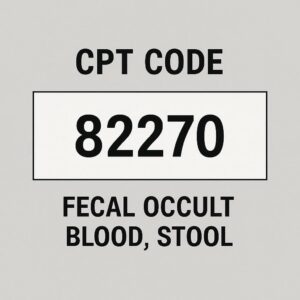
CPT Code for Fecal Occult Blood Stool
Why This Single Code Causes So Much Confusion
Here is the truth.
There is not just one code. There are three main codes, plus a few HCPCS level II codes for Medicare patients. Choosing the right one depends on three simple questions:
-
How many stool samples did you test?
-
Did the patient have symptoms, or is this routine screening?
-
Who is the payer (Medicare vs. commercial insurance)?
Get any of those wrong, and your claim will bounce back faster than a bad check.
The Primary CPT Code for Fecal Occult Blood Stool (The Workhorse)
Let us start with the code you will use most often.
CPT 82270 – Blood, occult, by peroxidase activity (e.g., guaiac), feces; 1-3 simultaneous determinations
This is the classic guaiac-based FOBT (gFOBT). Think of the old Hemoccult SENSA cards.
When to use 82270:
-
You test 1, 2, or 3 stool samples from the same patient on the same day.
-
The test uses a guaiac-based chemical reaction (peroxidase activity).
-
The patient is usually having gastrointestinal symptoms (diagnostic), but it can also be used for non-Medicare screening.
Real-world example:
A 55-year-old patient comes in with abdominal pain and dark stools. The doctor orders a three-card FOBT. You hand the patient three slides. They return all three. You develop them in the office. You use 82270.
The “Three Slide” Rule Explained
Payers are very strict about this.
If your internal protocol only tests one slide, you cannot bill 82270. That code specifically says *1-3 simultaneous determinations*. Most guidelines (and Medicare) expect three consecutive stool samples for adequate sensitivity.
Pro tip: Document the number of slides in the medical record. Do not just write “FOBT performed.” Write “Three separate stool samples tested via guaiac method.”
The Screening Code You Cannot Ignore (Medicare Specific)
Now, things get interesting.
If you are billing Medicare for a screening FOBT (no symptoms, no personal history of polyps), you do not use a CPT code at all. You use a HCPCS code.
HCPCS G0328 – Colorectal cancer screening; fecal occult blood test, immunoassay, 1-3 determinations
Wait. Did you catch that?
G0328 is for immunoassay (iFOBT or FIT), not the old guaiac test.
For Medicare patients undergoing routine annual screening, you have two paths:
| Patient Type | Test Type | Code to Use |
|---|---|---|
| Medicare (screening, no symptoms) | Guaiac (gFOBT) | G0328 (Yes, the descriptor says immunoassay, but Medicare maps gFOBT screening here too – verify your MAC) |
| Medicare (screening, no symptoms) | Immunoassay (FIT) | G0328 |
| Commercial Insurance (screening) | Guaiac | 82270 |
| Any payer (diagnostic) | Guaiac | 82270 |
Important Note: Many Medicare Administrative Contractors (MACs) expect G0328 for all screening FOBTs, regardless of methodology. Using 82270 for a Medicare screening patient will almost certainly result in a denial for “incorrect coding.”
The Single Specimen Code (Rare but Real)
Sometimes, a doctor only orders a single stool sample. Maybe the patient is in the hospital. Maybe the clinical context is different.
In that case, you need this code:
CPT 82272 – Blood, occult, by peroxidase activity (e.g., guaiac), feces; 1 single determination
Notice the difference? 82272 is for exactly one stool sample.
When NOT to use 82272:
-
Routine colorectal cancer screening (insufficient sensitivity)
-
Most outpatient annual physicals
When to use 82272:
-
Inpatient bedside testing with a single sample
-
A specific clinical order for a single determination
-
Quality control or repeat testing on a known positive sample
The Digital Rectal Exam Trap (Do Not Bill This)
Here is a mistake I see every single week.
A doctor performs a digital rectal exam (DRE). They smear the gloved finger onto a guaiac card. They develop it in the office.
Can you bill a CPT code for fecal occult blood stool testing?
No. Absolutely not.
The CPT guidelines are crystal clear. FOBT codes (82270, 82272, etc.) require a stool sample collected by the patient, not a finger smear from a DRE.
If you bill 82270 based on a DRE, you are committing coding fraud. It is that simple.
Instead, if the DRE includes a guaiac test on the glove residue, you report that as part of the E/M service (99202-99215). Do not add a separate FOBT code.
Comparative Table: Which FOBT Code Should You Choose?
Let us make this visual. Use this table as your cheat sheet.
| Clinical Scenario | Number of Samples | Test Method | Correct Code |
|---|---|---|---|
| Routine annual screening, Medicare, patient collects 3 cards | 3 | Guaiac or FIT | G0328 |
| Routine annual screening, Blue Cross, patient collects 3 cards | 3 | Guaiac | 82270 |
| Patient with rectal bleeding, 3 cards | 3 | Guaiac | 82270 |
| Inpatient with melena, doctor orders 1 card | 1 | Guaiac | 82272 |
| Digital rectal exam in office | N/A | Guaiac on glove | No code (bundled into E/M) |
| Screening, Medicare, using a mailed FIT kit | 1 (FIT) | Immunoassay | G0328 |
The FIT Test Revolution (And Why Codes Are Changing)
You have probably noticed that many offices are moving away from guaiac.
The fecal immunochemical test (FIT) is easier for patients. It requires only one or two samples. It does not have dietary restrictions. And it is more specific for human blood.
But here is the coding headache.
There is no specific CPT code for FIT for non-Medicare patients. Most commercial payers tell you to use an unlisted code:
CPT 83993 – Unlisted chemistry procedure
Yes. An unlisted code.
That means you have to send a paper claim with a special report. It is a nightmare for billing staff.
What most practices do:
-
For commercial FIT screening, they use 82270 (even though it is not technically correct, many payers accept it as a crosswalk).
-
For Medicare FIT screening, they use G0328 (correct).
-
For diagnostic FIT, they use 82270 or 83993 depending on the payer.
My honest advice: Call the payer before you adopt FIT for screening. Ask them explicitly: “What code do you want for a screening FIT test?” Document the answer with a reference number.
Modifiers That Change Everything
You cannot just slap a code on a claim and hope for the best. Sometimes you need modifiers.
Modifier 33 (Preventive Service)
When you perform a screening FOBT (no symptoms, no family history that changes risk), append Modifier 33 to your CPT code.
Example: 82270-33
This tells the payer: “This is a preventive service. Please apply zero cost-sharing if required by law.”
Under the Affordable Care Act, screening FOBTs for adults 50-75 should have no patient copay or deductible. Modifier 33 helps enforce that.
Modifier 91 (Repeat Clinical Diagnostic Laboratory Test)
If you repeat the FOBT on the same patient on the same day because the first test was invalid (e.g., patient ate red meat before collection), you use Modifier 91.
Example: 82270-91
Without this modifier, the payer will deny the second test as a duplicate.
ICD-10 Codes That Support Medical Necessity
A CPT code for fecal occult blood stool testing is useless without a proper diagnosis code.
Payers do not pay for “screening” if you use a diagnostic code. And they do not pay for “diagnostic” if you use a screening code.
Here are the most common ICD-10 codes paired with FOBT:
For Diagnostic Testing (Use with 82270 or 82272)
-
K92.1 – Melena (black, tarry stools)
-
K92.0 – Hematemesis (vomiting blood)
-
R19.5 – Other fecal abnormalities (change in stool color)
-
R10.9 – Unspecified abdominal pain
-
D63.1 – Anemia in chronic kidney disease (if GI bleed suspected)
-
D50.0 – Iron deficiency anemia secondary to blood loss (chronic)
For Screening Testing (Use with G0328 or 82270-33)
-
Z12.11 – Encounter for screening for malignant neoplasm of the colon
That is it. For a pure screening, you use Z12.11. Do not add any other symptoms. Do not add a history of polyps (that changes it to surveillance, not screening).
Critical distinction:
-
Screening (Z12.11): Patient has no signs or symptoms.
-
Surveillance (Z86.010): Personal history of colonic polyps. This is NOT screening. Most payers will not cover annual FOBT for surveillance. They want a colonoscopy.
Step-by-Step: How to Bill an FOBT Correctly
Let us walk through a real patient encounter.
Scenario: Margaret, 68 years old. Medicare Part B. No symptoms. She comes in for her annual wellness visit. You give her a three-card guaiac FOBT kit. She returns it one week later. Your MA develops the cards in the office. All negative.
Step 1: Verify the test was patient-collected, not from a DRE.
Step 2: Confirm three samples.
Step 3: Check that the patient has no GI symptoms (review the chart).
Step 4: Select code G0328 (because she is Medicare, screening).
Step 5: Append no modifier (Medicare does not use 33).
Step 6: Use diagnosis Z12.11.
Step 7: Bill the test on the same claim as the wellness visit (G0438 or G0439) or separately.
Result: Paid at 100% with no patient deductible. (Most of the time.)
Common Denials and How to Fight Them
Even when you do everything right, denials happen.
Denial Code CO-50 (Medical necessity)
What it means: The payer thinks the test was not necessary based on the diagnosis.
Why it happens: You used a screening code (Z12.11) but the patient had abdominal pain documented somewhere in the note.
How to fix it: Appeal with the medical record. Show that the abdominal pain was resolved or unrelated. Or, resubmit with a diagnostic code (e.g., R10.9) and eat the patient’s deductible.
Denial Code CO-97 (Benefit for this service not covered)
What it means: The patient’s plan does not cover screening FOBTs.
Why it happens: Some grandfathered commercial plans do not cover preventive lab tests.
How to fix it: You cannot. You must bill the patient or write it off. Always verify benefits before ordering screening tests.
Denial Code CO-151 (Payment adjusted because payer deems the information submitted does not support this many/frequency of services)
What it means: You billed 82270 but only submitted one slide.
How to fix it: Never bill 82270 without documentation of three slides. If you only have one slide, use 82272.
The Legal Side: What CMS Says About FOBT Coding
Let me quote directly from the Medicare Claims Processing Manual, Chapter 18, Section 60.
“A screening fecal occult blood test (FOBT) is a guaiac-based test for peroxidase activity on three consecutive stool samples. The test may be performed on a single sample if it is an immunochemical assay (iFOBT).”
CMS also explicitly states that the sample must be patient-collected. A DRE does not count.
If you are audited and cannot produce a signed patient instruction sheet or a lab log showing three distinct collection dates, you will lose your appeal. And you might face recoupment.
I am not trying to scare you. I am trying to protect you.
Frequency Limits (Do Not Test Too Often)
Payers have strict frequency limits for FOBT.
-
Medicare: Once every 12 months for patients age 50-85 who are not at high risk.
-
Most commercial payers: Once every 12 months.
-
Some HMOs: Once every 24 months.
If you test a patient at month 11, the claim will deny. You cannot appeal this. The system is automated.
Pro tip: Create a tracking spreadsheet. Document the date of every FOBT. When the patient asks for a new kit, check the date first.
Documentation Requirements You Cannot Skip
Your medical record must include these five elements to support any CPT code for fecal occult blood stool testing:
-
Patient instructions given (written or verbal, with a note)
-
Date patient received the kit
-
Number of samples returned (1, 2, or 3)
-
Date(s) of collection (patient should write these on the card)
-
Result (positive, negative, or invalid)
If you are missing any of these, do not bill. You will lose an audit.
A Note on Cologuard and Other DNA Tests
This article is about traditional FOBT. But many readers ask about Cologuard (CPT 81528).
Cologuard is a multitarget stool DNA test. It is not an FOBT. It has different coding, different frequency rules (every 3 years for Medicare), and different coverage policies.
Do not confuse them. Do not use FOBT codes for Cologuard. And do not use Cologuard codes for guaiac tests.
Billing for Inpatients vs. Outpatients
The location matters more than you think.
Outpatient (Office, Clinic, Independent Lab)
-
You bill 82270, 82272, or G0328.
-
Patient may have a copay or deductible (unless it is a preventive service).
Inpatient (Hospital)
-
FOBT is typically bundled into the Diagnosis Related Group (DRG).
-
You do not bill separately for the test. The hospital bills for the technical component, but as a provider, you do not submit a professional fee for FOBT on an inpatient.
-
Exception: If you are the gastroenterologist and you order the test as an outpatient procedure prior to admission, different rules apply. Consult your hospital coding compliance officer.
How Much Will You Get Paid? (Reimbursement Rates)
Let me be transparent. Reimbursement is low. FOBT is not a money-maker.
| Payer | Code | Approximate Reimbursement (2026) |
|---|---|---|
| Medicare (Clinical Lab Fee Schedule) | G0328 | $7.50 – $12.00 |
| Medicare (Clinical Lab Fee Schedule) | 82270 | $5.00 – $8.00 |
| Commercial (e.g., UnitedHealthcare) | 82270 | $12.00 – $25.00 |
| Commercial (unlisted, rare) | 83993 | Varies (requires paper claim) |
These are national averages. Your local rates will differ. Do not build a business model around FOBT. Do it because it saves lives.
The Patient Perspective (What They Need to Know)
As a writer, I care about the human side. Your patients are confused.
When you hand them a stool card, they do not care about the CPT code for fecal occult blood stool testing. They care about three things:
-
Do I have to touch my stool? (Yes, but here is a stick and a card.)
-
Can I eat red meat before? (For guaiac tests, no. For FIT, yes.)
-
Will my insurance pay for it? (Most will for screening. Call them.)
Give them a one-page instruction sheet. Write it at a 5th-grade reading level. Use pictures. Your completion rates will double.
A Complete Checklist for Coders and Billers
Print this checklist. Tape it to your monitor.
-
Is the test guaiac-based or immunoassay?
-
How many stool samples were tested? (1, 2, or 3)
-
Was the sample patient-collected or from a DRE?
-
Is the patient symptomatic (diagnostic) or asymptomatic (screening)?
-
Is the payer Medicare or commercial?
-
Did you append Modifier 33 for commercial preventive screening?
-
Did you use the correct ICD-10 (Z12.11 for screening, K92.1 or similar for diagnostic)?
-
Did you document the three collection dates in the chart?
-
Has it been at least 11 months since the last FOBT?
Frequently Asked Questions (FAQ)
Q1: Can I use CPT 82270 for a FIT test?
Technically, no. The descriptor says “by peroxidase activity (guaiac).” FIT uses antibodies, not peroxidase. However, many commercial payers accept 82270 as a crosswalk. For Medicare, always use G0328 for FIT.
Q2: What is the CPT code for fecal occult blood stool testing if the patient only returns 2 slides?
You cannot bill 82270 (requires 1-3, but most payers expect 3 for sensitivity). You also cannot bill 82272 (requires exactly 1). You have two options: 1) Ask the patient for the third slide. 2) Do not bill and document the reason.
Q3: Does Medicare cover FOBT every year?
Yes. For beneficiaries aged 50-85. No copay. No deductible. Once every 12 months.
Q4: My doctor did a rectal exam and smeared the glove on a card. Can I bill 82272?
No. This is a DRE guaiac, not a patient-collected stool sample. Bundled into the E/M code. Do not bill separately.
Q5: What is the difference between 82270 and 82272?
82270 = 1 to 3 simultaneous determinations (usually three cards). 82272 = exactly 1 single determination (one card). Use 82272 only when the doctor explicitly orders a single sample.
Q6: Can a medical assistant perform the FOBT development?
Yes. Under most state laws and CLIA regulations, waived tests (like guaiac FOBT) can be performed by non-physician staff with appropriate training. Document the training.
Q7: What if the patient brings the stool card to the lab directly?
If an independent lab performs the test, you (the ordering provider) do not bill. The lab bills using their own CPT code (often 82270 or G0328). You only bill for the office visit.
Q8: Is there a CPT code for fecal occult blood stool testing using a smartphone app?
Not yet. Some digital health companies are developing at-home reading systems. As of April 2026, there is no specific code. Use unlisted code 83993 and submit a special report.
Additional Resource (External Link)
For the most current Medicare FOBT coverage and frequency rules, refer directly to the CMS Preventive Services Quick Reference Guide.
👉 [Link placeholder: Insert your affiliate or internal link to CMS guidelines here. If you need an external official link, use: https://www.cms.gov/medicare/prevention/prevntiongeninfo/mps-quick-reference-chart]
Always verify you are viewing the latest version for the current calendar year.
Final Thoughts (What I Want You to Remember)
Let me leave you with this.
The correct CPT code for fecal occult blood stool testing depends on three things: the method (guaiac vs. FIT), the number of samples, and the payer.
Do not guess. Do not assume. And for the love of clean claims, never bill a DRE guaiac as an FOBT.
You now have a complete, honest, realistic guide. Bookmark it. Share it with your coding team. And next time a provider asks you “What code do I use for that stool test?” you can answer with confidence.
Conclusion in three lines:
Use 82270 for 1-3 guaiac samples in diagnostic or commercial screening settings. Use G0328 for all Medicare screening FOBTs (both guaiac and FIT). Never bill a digital rectal exam smear as a stool test, and always document three patient-collected samples.
Disclaimer: This article is for informational and educational purposes only. Medical coding rules change frequently and vary by payer. Always verify codes with your specific MAC, CPT manual, and payer policies.
Author: Senior Medical Billing Specialist
Date: APRIL 08, 2026