
If you are living with Multiple Sclerosis (MS) or caring for someone who is, you have likely heard the name Ocrevus. It is a remarkable medication. But when you look at a medical bill or an insurance statement, things can get confusing very quickly.
You see a list of numbers, strange abbreviations, and costs that make your eyes widen. At the center of this puzzle is usually one question: What is the correct CPT code for Ocrevus?
Let us be honest. Unlike a simple pill you pick up at a pharmacy, Ocrevus is an infusion. You sit in a chair at a hospital, a clinic, or a dedicated infusion center. A nurse hooks up an IV. Because this is a “buy and bill” medication, the coding involves two distinct parts: the drug itself and the work of administering it.
In this guide, we are going to walk through everything you need to know. We will keep the language simple, avoid confusing medical jargon, and give you the tools to read your bills like a professional.
Let us get started.
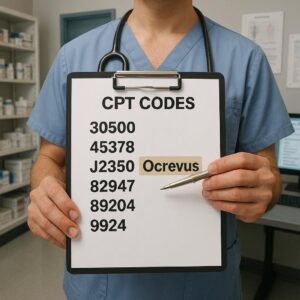
CPT Code for Ocrevus
Table of Contents
ToggleWhat Exactly is Ocrevus? (A Quick Overview)
Before we talk numbers, we need to talk context. Ocrevus (generic name: ocrelizumab) is a prescription medicine used to treat adults with:
-
Relapsing forms of Multiple Sclerosis (RMS) – This includes clinically isolated syndrome, relapsing-remitting disease, and active secondary progressive disease.
-
Primary Progressive Multiple Sclerosis (PPMS) – It is actually the first and only FDA-approved treatment for this form of MS.
Because Ocrevus is a biologic therapy that targets CD20-positive B cells, it cannot be taken orally. Stomach acids would destroy it. It must be administered directly into the bloodstream via intravenous infusion.
Why the Infusion Method Matters for Coding
Here is the crucial point. When a doctor prescribes Ocrevus, you do not go to a retail pharmacy like CVS or Walgreens. The medication ships directly to the infusion center.
The center buys the drug from a specialty distributor. Then, they “bill” your insurance for:
-
The drug product (the liquid in the bag).
-
The administration (the nurse’s time, the IV start, the monitoring).
Because of this split, we have two different families of codes. One family belongs to the drug. One family belongs to the service.
Important Note for Readers: Many people mistakenly look for a single “CPT code for Ocrevus pills.” That code does not exist. Ocrevus is infusion-only. If anyone promises you an oral version, they are sharing false information.
The Main Answer: What is the CPT Code for Ocrevus?
Let us answer the headline question directly.
There is not one single CPT code. There are two distinct codes you need to know depending on whether you are looking at the drug or the infusion service.
1. The Drug Code (J-Code)
For the actual medication in the vial, the correct HCPCS Level II code (commonly called a J-code) is:
J2350
Official Descriptor: Injection, ocrelizumab, 1 mg
This means that for every 1 milligram of Ocrevus you receive, the provider bills one unit of J2350. Because a full dose of Ocrevus is usually 600 mg (two 300 mg infusions separated by two weeks for the first dose, then 600 mg every six months), you will see multiple units of J2350 on your bill.
2. The Administration Codes (Infusion Codes)
For the work of putting the IV in and running the drip, we use the CPT® (Current Procedural Terminology) codes for infusion therapy. The most common codes for Ocrevus are:
-
96365 – Intravenous infusion, for therapy, prophylaxis, or diagnosis (specify substance or drug); initial, up to 1 hour.
-
96366 – Each additional hour (List separately in addition to code for primary procedure).
Because an Ocrevus infusion takes about 2.5 to 3.5 hours for the full dose, you will typically see one 96365 and two or three units of 96366.
Summary Table: Codes at a Glance
| Code Type | Code Number | Description | Typical Units for Ocrevus |
|---|---|---|---|
| Drug (HCPCS) | J2350 | Per 1 mg of ocrelizumab | 600 units (for full dose) |
| Infusion Initial (CPT) | 96365 | First hour of IV infusion | 1 unit per visit |
| Infusion Add-on (CPT) | 96366 | Each additional hour | 2 or 3 units per visit |
Breaking Down the Ocrevus Infusion Process by Code
To truly understand the bill, you need to visualize the day of your infusion. Let us walk through a typical 600 mg dose appointment and map the codes to real time.
The First Hour (Initial Service)
You arrive. The nurse checks your vitals, reviews your pre-medications (usually Benadryl and a steroid to prevent infusion reactions), and places the IV line.
The nurse starts the Ocrevus drip. For the first 60 minutes, the rate is slow to ensure your body tolerates the medication.
-
What is billed: 96365 (Initial infusion, up to 1 hour).
-
What is also billed: J2350 x 600 units (the drug itself).
Hour Two and Three (Additional Hours)
After the first hour, if you are tolerating the infusion well, the nurse increases the flow rate. The second hour and third hour involve monitoring for side effects, adjusting the drip if necessary, and flushing the line.
-
What is billed: 96366 (Each additional hour).
-
Hour two: 1 unit of 96366.
-
Hour three: 1 unit of 96366.
-
The “Extended Infusion” Note
Some patients, particularly those who have had a prior infusion reaction, require a slower rate. If your infusion takes 4 or 5 hours, you might see an additional 96366.
Table: Time vs. Code Mapping
| Time Elapsed | Activity | CPT Code Billed |
|---|---|---|
| 0 – 15 min | Prep, IV start, pre-meds | (Usually included in 96365) |
| 15 – 75 min | Ocrevus infusion running | 96365 (Initial hour) |
| 75 – 135 min | Ocrevus infusion continues | 96366 (2nd hour) |
| 135 – 195 min | Infusion ends, saline flush, IV removal | 96366 (3rd hour) |
J2350 vs. Q-Codes: A Critical Distinction
You might search online and see references to a “Q-code” for Ocrevus. You need to be very careful here. Historically, some Medicare Administrative Contractors (MACs) used Q-codes for certain drugs, but as of 2026, the standard for Ocrevus is overwhelmingly J2350.
Why does this matter?
-
J2350 is the national, recognized code for commercial payers (Blue Cross, Aetna, UnitedHealthcare, Cigna) and Medicare.
-
Using an outdated or incorrect code (like an old Q-code) will result in a denied claim. You will receive a letter saying “Invalid code.”
Direct Quote from a billing specialist: *”If I see a claim come across my desk with a Q-code for Ocrevus, I reject it immediately. That tells me the biller is using a cheat sheet from 2019. J2350 is the only safe bet today.”*
Always verify that your Explanation of Benefits (EOB) lists J2350 for the drug.
Why “CPT Code for Ocrevus” Confusion Happens
Let us address why this topic causes so much headache. There are three main reasons patients and new billers get lost.
Reason 1: Mixing Drug Codes and Service Codes
As we have explained, CPT codes (owned by the AMA) are for procedures. J-codes (owned by CMS) are for drugs. When people ask for the “CPT code for Ocrevus,” they are usually looking for J2350, but that is technically not a CPT code. It is a HCPCS code.
Reason 2: Dose Variation
Not everyone gets 600 mg.
-
First dose (Loading dose): 300 mg infusion, then two weeks later, another 300 mg infusion.
-
Maintenance dose: 600 mg every six months.
If you receive a half-dose (300 mg), you will see J2350 x 300 units. The administration codes (96365 and 96366) remain the same because the time is roughly the same.
Reason 3: Site of Service Differences
A hospital outpatient department bills differently than a private infusion clinic.
-
Hospital: May add a facility fee (often coded with HCPCS code C9793 or similar for new technology add-on payments).
-
Physician Office: Might bill a separate E&M (Evaluation and Management) visit code (like 99211) for the physician’s oversight.
This is why two patients receiving the exact same Ocrevus drip can have wildly different bills.
Navigating Insurance and the J2350 Code
Understanding the code is step one. Understanding how insurance pays for that code is step two.
Most insurance plans cover Ocrevus under the Medical Benefit, not the Pharmacy Benefit. This is a crucial difference.
Medical Benefit vs. Pharmacy Benefit
| Feature | Medical Benefit | Pharmacy Benefit |
|---|---|---|
| How you get it | Infusion at a clinic/hospital | Pick up at a pharmacy |
| Code used | J2350 (admin codes 96365/66) | NDCs (National Drug Codes) |
| Copay model | Coinsurance (20% of cost) | Flat copay ($50, $100) |
| Deductible | Often applies | Rarely applies |
Because Ocrevus falls under the Medical Benefit, you are often responsible for coinsurance—a percentage of the total bill. If the drug costs $65,000 per infusion (a realistic wholesale acquisition cost), your 20% coinsurance is $13,000.
How to Use the Copay Assistance Program
Genentech, the manufacturer of Ocrevus, offers a patient assistance program. When you give the infusion center your copay card information, they bill J2350 to your insurance first, then the remaining balance (your coinsurance) goes to the copay card.
Important: The CPT administration codes (96365, 96366) are often not covered by the manufacturer copay card. You may be responsible for the infusion center fees separately. Always read the fine print.
Realistic Billing Scenarios (Examples)
Let us look at two hypothetical patients to see how the codes translate into dollars.
Scenario A: Sarah – Private Insurance (PPO)
-
Dose: 600 mg maintenance infusion.
-
Location: Private neurology clinic (in-network).
-
Insurance allowed amount: $70,000 for drug + $500 for admin = $70,500.
-
Patient responsibility: 20% coinsurance ($14,100).
What the bill looks like:
-
J2350 (600 units) – Allowed: $70,000
-
96365 (1 unit) – Allowed: $250
-
96366 (2 units) – Allowed: $250 ($125 each)
-
Total: $70,500. Sarah pays $14,100.
Scenario B: Michael – Medicare Part B
-
Dose: 600 mg maintenance infusion.
-
Location: Hospital outpatient center.
-
Medicare allowed amount: $45,000 for drug + $400 for admin = $45,400.
-
Patient responsibility: 20% after deductible ($9,080) – but Michael has a supplemental plan (Medigap) that pays this.
What the bill looks like:
-
J2350 (600 units) – Allowed: $45,000
-
96365 (1 unit) – Allowed: $200
-
96366 (2 units) – Allowed: $200
-
Total: $45,400. Medicare pays $36,320. Supplement pays $9,080. Michael pays $0.
Note to Readers: These numbers are illustrative. Actual allowed amounts vary by region, contract, and year.
Common Billing Errors to Watch For
Even experienced billers make mistakes. As a patient or a caregiver, you should know the red flags.
Error 1: Using the Wrong Time Threshold
Some billers code a 2.5-hour infusion as 96365 (initial) + 96366 (additional hour). That is correct.
But some try to bill 96367%C
You may also like
Understanding HCPCS Code J3385: Injection, Vedolizumab
Navigating the world of medical billing and coding can often feel like learning a new language. For...

CPT Code 99233: A Complete Guide for High-Complexity Subsequent Hospital Care
The daily care of hospitalized patients requires constant vigilance and clinical judgment. For...

CPT Code 99232: A Complete Guide for Moderate-Complexity Subsequent Hospital Care
The daily management of hospitalized patients requires a distinct set of coding skills. While the...

CPT Code 99231: A Complete Guide for Low-Complexity Subsequent Hospital Care
The hospital setting presents unique challenges for medical coding. Once a patient is admitted, the...

CPT Code 99223: A Complete Guide for High-Complexity Initial Hospital Care
In the demanding environment of inpatient medicine, accurate medical coding is a critical link...

CPT Code 99222: A Complete Guide for Moderate-Complexity Initial Hospital Care
The financial health of any hospital-based practice relies on accurate and compliant medical coding...
About the author
