If you have ever tried to bill for a keloid injection, you already know the frustration. You open your code book. You search for “keloid.” And you find yourself staring at a handful of injection codes that do not seem to fit perfectly.
You are not alone.
Keloid treatment occupies a strange middle ground. It is not quite a simple lesion removal. It is not exactly a routine trigger point injection. And yet, every week, dermatologists, plastic surgeons, and family medicine doctors perform these injections.
So, what is the correct CPT code for injection of a keloid scar?
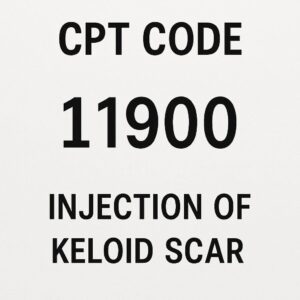
The short answer is that there is no single “keloid injection” code. Instead, you will use a combination of injection administration codes (11900 or 11901) and, when applicable, a drug supply code like J3490 for the medication itself.
But that short answer only scratches the surface. Payers disagree. Documentation requirements vary. And if you pick the wrong code, you leave money on the table—or worse, invite an audit.
Let us walk through everything you need to know, from code selection to real-world billing scenarios.
CPT Code for Injection of Keloid Scar
Understanding Keloid Scars and Their Treatment
Before we talk about codes, let us talk about the procedure itself. Keloids are not ordinary scars. They are overgrowths of scar tissue that extend beyond the original wound boundary. They can be itchy, painful, and psychologically distressing for patients.
What Happens During a Keloid Injection?
The clinician injects a corticosteroid—most commonly triamcinolone acetonide (Kenalog) —directly into the keloid tissue. The goal is to reduce inflammation, flatten the scar, and relieve symptoms.
The process is straightforward:
-
The provider cleans the keloid site.
-
Using a small gauge needle, they inject the steroid intralesionally.
-
They may inject multiple areas within the same keloid.
-
The patient returns every 4 to 8 weeks for repeat injections.
Because keloids can be large or multiple, the number of injections per session varies significantly.
Why This Matters for Coding
The number of injections directly determines which CPT code you use. And that is where most billing errors happen.
The Primary CPT Codes for Keloid Injections
There are two main administration codes for injecting lesions. Neither code is exclusive to keloids. But both are the correct choices for this procedure.
CPT 11900: Injection, intralesional; up to and including 7 lesions
This is your go-to code for most keloid injection visits.
What it covers:
-
Intralesional injection of a steroid or other medication
-
Up to 7 individual lesions treated in a single session
-
The professional work of administering the injection
When to use 11900:
You have a patient with one small keloid or several small keloids. You inject each lesion individually. As long as the total number of injected lesions is between 1 and 7, you use 11900.
Example:
A patient has a single 2 cm keloid on their earlobe from a piercing. The provider injects one site within that keloid. That counts as one lesion. Code 11900 is appropriate.
CPT 11901: Injection, intralesional; more than 7 lesions
When a patient has extensive keloid disease, you will need this code.
What it covers:
-
Intralesional injection of medication
-
8 or more individual lesions treated in a single session
When to use 11901:
A patient presents with multiple keloids across their chest and shoulders from acne scarring. You inject nine separate lesions. You would report 11901 for that visit.
Important note:
Some payers consider 11901 a “misvalued code” and may scrutinize it more closely. Always document the exact number of lesions and their locations.
A Quick Reference Table for 11900 vs. 11901
| Number of Lesions Injected | Correct CPT Code | Typical Use Case |
|---|---|---|
| 1 lesion | 11900 | Single small keloid |
| 2 to 7 lesions | 11900 | Multiple keloids or one large keloid injected in separate areas |
| 8 to 15 lesions | 11901 | Extensive keloid scarring |
| 16+ lesions | 11901 | Severe, widespread keloid disease |
Important Note for Readers:
Some providers ask: “What if I inject one large keloid in five different spots?” Great question. Most coding experts and payers consider each needle insertion into a distinct area of the keloid as a separate lesion for coding purposes. If you inject one 5 cm keloid in five quadrants, you count five lesions. Use 11900.
The Drug Itself: Do You Need a Separate Code?
Here is where things get a little more complicated. The CPT codes above (11900 and 11901) cover the injection service. They do not cover the cost of the drug injected.
The Short Answer
For most office-based providers using standard triamcinolone from a multi-dose vial, you do not bill a separate drug code. The cost of the drug is considered incidental and bundled into the injection service.
The Longer, More Honest Answer
Some payers—particularly commercial plans and workers’ compensation—may expect you to report the drug separately. And for certain medications used off-label for keloids (like 5-FU or bleomycin), you absolutely should bill the drug.
When to bill a separate drug code:
-
You use a single-dose vial (and waste a significant portion)
-
The payer specifically requires drug coding for all injectables
-
You are using a non-steroid medication (5-FU, bleomycin, verapamil)
-
You are billing for an outpatient hospital or ambulatory surgery center visit
Common Drug Codes for Keloid Injections
| Medication | HCPCS Code | Notes |
|---|---|---|
| Triamcinolone 10 mg/mL | J3301 | Usually bundled; verify with payer |
| Triamcinolone 40 mg/mL | J3301 | Same code; different concentration |
| 5-Fluorouracil (5-FU) | J9190 | Often used for refractory keloids |
| Bleomycin | J9040 | Less common; requires prior authorization |
| J3490 (Unclassified drug) | J3490 | Used when no specific code exists |
J3490 is your friend—but use it carefully.
When no specific HCPCS code exists for a drug or concentration, you use J3490 (Unclassified drugs). You must attach an invoice and a description of the drug. Without supporting documentation, J3490 claims often deny.
A Practical Rule for Drug Coding
Ask yourself three questions before billing a separate drug code:
-
Is the medication supplied in a single-dose vial?
-
Does the payer’s policy explicitly require separate drug reporting?
-
Is this medication something other than standard triamcinolone?
If you answered “yes” to any of these, bill the drug. If you answered “no” to all three, bundle the drug cost into 11900 or 11901.
Documentation Requirements for Keloid Injection Billing
Good documentation protects you. It also gets you paid. Payers deny claims for keloid injections more often than you might think—usually because the documentation does not support the number of lesions.
What Your Note Must Include
Every keloid injection note should contain these five elements:
-
Diagnosis: Clearly state “keloid” with the appropriate ICD-10 code. (We will cover those below.)
-
Location: List each keloid site (e.g., “left earlobe,” “central chest,” “right shoulder”).
-
Number of lesions: Count each distinct keloid or each distinct injection site within a large keloid.
-
Medication: Name, concentration, and dose injected (e.g., “triamcinolone 10 mg/mL, 0.2 mL total”).
-
Medical necessity: Document symptoms (pain, pruritus, functional limitation) and prior treatments.
A Documentation Example
“Patient returns for third keloid injection session. She reports persistent itching and tenderness over her chest keloids. Examination reveals four distinct keloids on the anterior chest, each measuring 1-2 cm. Under sterile technique, I injected each of the four lesions with triamcinolone 10 mg/mL, 0.1 mL per lesion (total 0.4 mL). Patient tolerated well. Follow-up in 6 weeks.”
This note supports four lesions → CPT 11900.
Common Documentation Mistakes
-
Listing “multiple keloids” without a number
-
Forgetting to document the medication dose
-
Using an injection code without a corresponding diagnosis
-
Billing 11901 for 7 lesions (that is the cutoff: 7 or fewer = 11900; 8+ = 11901)
ICD-10 Codes for Keloid Injections
You cannot bill a CPT code alone. You need a diagnosis code that supports medical necessity. For keloid injections, the correct ICD-10 code depends on the clinical scenario.
Primary Diagnosis Code
L91.0 – Hypertrophic scar
This is the code for both hypertrophic scars and keloids. The ICD-10 system does not separate the two. So even though you are treating a true keloid, L91.0 is your correct code.
Additional Codes to Consider
| Scenario | ICD-10 Code |
|---|---|
| Keloid with pain | L91.0 + G89.18 (other acute postprocedural pain) |
| Keloid with pruritus (itching) | L91.0 + L29.9 (pruritus, unspecified) |
| Keloid due to burn | L91.0 + T20-T25 (burn code) + Y92 (place of occurrence) |
| Keloid after surgery | L91.0 + Z98.89 (other postprocedural states) |
Important Note for Readers:
Do not use a “scar” code from Chapter 19 (Injury, poisoning, etc.) for keloid injections. Those codes are for traumatic scars that are not specifically keloids. Always default to L91.0 unless the payer has a written policy stating otherwise.
Real-World Billing Scenarios
Let us put everything together with common clinical examples.
Scenario 1: Single Earlobe Keloid
The patient: A 22-year-old woman with a 1.5 cm keloid on her left earlobe from a piercing. She has never had treatment before.
The procedure: The provider injects triamcinolone 10 mg/mL into one site within the keloid.
The correct coding:
-
CPT: 11900 (1 lesion)
-
ICD-10: L91.0
-
Drug: Bundled (no separate code)
Expected reimbursement: Varies by region. Typically $70–$120 for the injection service.
Scenario 2: Three Keloids on the Chest
The patient: A 35-year-old man with three distinct keloids on his upper chest from old acne. He reports significant itching.
The procedure: The provider injects each of the three keloids. Each keloid receives 0.1 mL of triamcinolone 40 mg/mL.
The correct coding:
-
CPT: 11900 (3 lesions)
-
ICD-10: L91.0, L29.9 (for itching)
-
Drug: Bundled
Documentation note: The note clearly lists “three chest keloids” and documents the itching as medical necessity for repeat injections.
Scenario 3: Extensive Keloid Disease (12 Lesions)
The patient: A 42-year-old woman with a history of multiple surgeries on her back. She has developed 12 small keloids along previous incision lines. She experiences pain when lying flat.
The procedure: The provider injects all 12 lesions with triamcinolone 10 mg/mL, 0.05 mL per lesion.
The correct coding:
-
CPT: 11901 (more than 7 lesions)
-
ICD-10: L91.0, G89.18 (pain)
-
Drug: Bundled
Reimbursement tip: 11901 pays more than 11900 because it reflects greater work. But you must justify the number of lesions. A photograph in the chart is excellent supporting documentation.
Scenario 4: Refractory Keloid with 5-FU
The patient: A 28-year-old man with a keloid on his jawline that has failed three rounds of steroid injections.
The procedure: The provider injects a combination of triamcinolone and 5-fluorouracil (5-FU) into the keloid.
The correct coding:
-
CPT: 11900 (1 lesion)
-
ICD-10: L91.0
-
Drug: J9190 (5-FU) + J3301 (triamcinolone) – only if payer requires separate drug billing
Important: For 5-FU, most payers expect you to bill the drug separately because it is not a standard bundled medication.
Payer-Specific Considerations
Not all payers treat keloid injections the same way. Medicare, Medicaid, and commercial plans each have unique rules.
Medicare
Medicare does not have a national coverage determination specifically for keloid injections. Local coverage determinations (LCDs) vary by region.
What you need to know:
-
Medicare generally covers intralesional steroid injections for keloids when documented as medically necessary.
-
Some MACs (Medicare Administrative Contractors) consider keloid treatment cosmetic and deny it. You must appeal with documentation of symptoms (pain, itching, ulceration).
-
For drug billing: Medicare typically bundles triamcinolone into 11900/11901. Do not bill J3301 separately for office injections.
Commercial Payers (UnitedHealthcare, Cigna, Aetna, BCBS)
Commercial payers are more likely to require separate drug coding. They are also more likely to cover keloid injections without a fight—provided you document symptoms.
Specific tips:
-
UnitedHealthcare: Requires the patient to have failed topical treatments (like silicone gel) before approving injectables.
-
Cigna: Considers intralesional steroids medically necessary for symptomatic keloids (pain, pruritus, or functional impairment).
-
Aetna: May require prior authorization for more than three injection sessions.
Medicaid
Medicaid coverage varies wildly by state. Some states explicitly cover keloid injections. Others consider them cosmetic and exclude them entirely.
Your best move: Check your state’s Medicaid provider manual. Search for “keloid” or “intralesional injection.” If you find nothing, call the provider helpline.
Workers’ Compensation
Keloids resulting from a workplace injury (burns, lacerations, surgeries) are almost always covered. Use the appropriate injury ICD-10 code plus L91.0. Workers’ comp payers expect separate drug billing for all injectables.
Modifiers for Keloid Injections
Modifiers tell the payer something special about the service. For keloid injections, two modifiers matter most.
Modifier 25 – Significant, Separately Identifiable E/M Service
You use modifier 25 when the provider performs an evaluation and management (E/M) service (like a new patient visit or a follow-up office visit) on the same day as the injection, and the E/M service is beyond the usual pre-injection work.
Example:
A new patient comes in for a consultation about a painful keloid. The provider takes a history, performs a full exam, discusses treatment options, and then performs the injection. You would bill:
-
99203 (office visit, new patient) with modifier 25
-
11900 (injection)
-
L91.0
Without modifier 25, the payer will bundle the E/M service into the injection payment. That means you lose the visit reimbursement.
Modifier 59 – Distinct Procedural Service
You rarely need modifier 59 for keloid injections. But if you inject two separate, unrelated lesion types in the same session (e.g., keloid on the chest and a seborrheic keratosis on the back), you might use modifier 59 on the second injection code.
In practice, most payers accept 11900 for all intralesional injections in the same session without a modifier.
Reimbursement Rates and Fee Schedules
How much can you expect to get paid? The honest answer is: it depends on your contract. But here are national averages to give you a ballpark.
2026 Medicare Physician Fee Schedule Estimates
Note: These are facility rates (non-facility pricing will be higher). Always check your local MAC fee schedule.
| CPT Code | Non-Facility Price (Office) | Facility Price (Hospital) |
|---|---|---|
| 11900 | $85 – $110 | $45 – $60 |
| 11901 | $140 – $180 | $75 – $100 |
| J3301 (if billable) | $10 – $25 per 10 mg | Same |
Commercial Payer Rates
Commercial rates are typically higher than Medicare. You might see:
-
11900: $120 – $200
-
11901: $200 – $350
Factors That Lower Reimbursement
-
Bundling: If you do not bill the drug separately when required, you lose that revenue.
-
Denials for medical necessity: A missing symptom in the documentation = no payment.
-
Frequency limits: Some payers limit keloid injections to 3 or 4 sessions per year. After that, they require prior authorization.
Common Billing Mistakes and How to Avoid Them
Let me share the mistakes I see most often in keloid injection billing. Avoid these, and you will stay out of trouble.
Mistake 1: Using the Wrong Code for Large Keloids
The error: A provider injects one large keloid in ten different spots but bills 11900 because “it is only one keloid.”
Why it is wrong: CPT instructions for 11900/11901 count individual injection sites within a lesion, not just discrete lesions. The American Medical Association (AMA) has clarified this in CPT Assistant publications.
The fix: Count each needle insertion into a distinct area as a separate lesion. Document “injected 10 sites within the keloid.” Bill 11901.
Mistake 2: Billing 11900 for a Biopsy or Excision
The error: A provider performs a punch biopsy of a keloid and bills 11900.
Why it is wrong: 11900 is for injection only. Biopsy codes (11102–11107) exist for tissue sampling. Excision codes (11400–11446) exist for removal.
The fix: Use the correct procedure code. If you inject, use 11900/11901. If you cut, use the appropriate surgical code.
Mistake 3: Forgetting the Drug Waste
The error: A provider uses a single-dose vial of triamcinolone 40 mg/mL, uses only 0.2 mL, and throws the rest away. They do not bill for the wasted drug.
Why it is wrong: For single-dose vials, you can bill for the amount administered plus the amount discarded—but only if you document the waste. Without waste documentation, you cannot bill for the discarded portion.
The fix: In your note, write: “Single-dose vial used. 0.2 mL administered. 0.8 mL discarded.” Bill J3301 for 1 mL (10 mg) total.
Mistake 4: No Diagnosis on the Claim
The error: A claim goes out with 11900 and no ICD-10 code, or with a generic “scar” code.
Why it is wrong: Payers will deny a claim without a diagnosis. A non-specific code may trigger an audit.
The fix: Always include L91.0. Add symptom codes (pain, itching) to support medical necessity.
Frequently Asked Questions (FAQ)
Q1: Is there a specific CPT code just for keloid injection?
No. There is no “keloid-specific” CPT code. You use the intralesional injection codes 11900 (up to 7 lesions) or 11901 (more than 7 lesions).
Q2: Can I bill an office visit (E/M) on the same day as a keloid injection?
Yes, but only if the visit is significant and separately identifiable. Append modifier 25 to the E/M code. Document the separate work clearly.
Q3: How many times can I bill 11900 for the same patient?
There is no strict limit, but most payers expect a finite course of treatment. Typically, 3 to 6 injection sessions over 6 to 12 months. Beyond that, you may need prior authorization.
Q4: Does insurance cover keloid injections?
Yes, for symptomatic keloids (pain, itching, bleeding, or functional impairment). Insurance generally does not cover keloid injections for purely cosmetic reasons.
Q5: What if I inject a keloid and a separate lesion (like a wart) in the same visit?
Bill 11900 for the keloid injection. Bill the appropriate code for the other procedure (e.g., 17110 for wart destruction). Use modifier 59 on the second procedure if required by your payer.
Q6: Do I need a different code for a hypertrophic scar injection?
No. Hypertrophic scars and keloids share the same ICD-10 code (L91.0) and the same CPT codes (11900/11901). The treatment is identical.
Q7: What is the difference between 11900 and 96372?
Great question. 96372 (Therapeutic, prophylactic, or diagnostic injection) is for subcutaneous or intramuscular injections—not intralesional injections. Do not use 96372 for keloids. Use 11900/11901.
Q8: Can I bill for cryotherapy followed by injection in the same session?
Yes. Bill the cryotherapy code (17000 for the first lesion, 17003 for additional lesions) plus the injection code (11900). Append modifier 59 to the injection code if the payer requires it.
Additional Resources
For more detailed guidance on intralesional injection coding, refer to these authoritative sources:
-
American Medical Association (AMA) CPT® Professional Edition – The official code book. Look for the “intralesional injection” section.
-
American Academy of Dermatology (AAD) Coding and Reimbursement – Offers specialty-specific advice and case studies.
-
CMS Local Coverage Determinations (LCDs) – Search for “intralesional injection” or “keloid” at the CMS Medicare Coverage Database.
Link to CMS Medicare Coverage Database – Use this tool to find your local MAC’s policy on keloid treatment.
Conclusion
To summarize what we have covered: The correct CPT code for injection of a keloid scar is either 11900 for up to 7 lesions or 11901 for more than 7 lesions, with the drug itself typically bundled unless you are using a single-dose vial or a non-standard medication like 5-FU. Always document the number of lesions, the medication used, and the patient’s symptoms (pain, itching, or functional impairment) to support medical necessity and avoid denials.
Disclaimer: This article is for educational purposes only and does not constitute legal or medical billing advice. CPT codes, payer policies, and fee schedules change frequently. Always verify codes with your specific payer and consult a certified medical coder for complex cases.
Author: Medical Billing Team
Date: APRIL 07, 2026