If you are researching vision correction options, you have likely stumbled upon a procedure called Refractive Lens Exchange (RLE). You might also hear it called “Clear Lens Extraction.”
But when you sit down to look at the paperwork, one question pops up immediately: What is the CPT code for refractive lens exchange?
The answer is not as simple as looking up a single number. Because RLE lives in a strange gray area between medical necessity and cosmetic choice, the billing codes change depending on why you are having the surgery.
In this guide, we will walk you through the exact codes surgeons use, how to read an estimate, and why you might see different codes on different bills. We will keep the language simple and honest, so you know exactly what to expect before you head to the operating room.
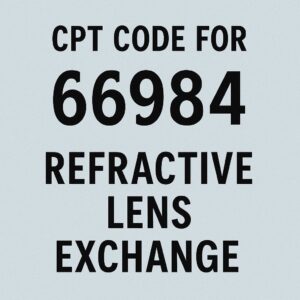
CPT Code for Refractive Lens Exchange
What Exactly is Refractive Lens Exchange?
Before we dive into the coding, let us make sure we are talking about the same procedure.
Refractive Lens Exchange is essentially the same surgery as cataract removal. However, there is one massive difference: you do not have cataracts.
In a standard cataract surgery, the natural lens of the eye has become cloudy. The surgeon removes that cloudy lens and replaces it with an artificial one (an intraocular lens or IOL).
In RLE, your natural lens is still clear. The surgeon removes it simply to change your prescription. The goal is to reduce or eliminate your need for glasses or contact lenses.
Think of it like this:
-
Cataract surgery: Fixing a broken part (medical).
-
Refractive lens exchange: Swapping a working part for a better one (elective).
The Primary CPT Code for Refractive Lens Exchange
Let us get straight to the point. When a surgeon performs a refractive lens exchange, they are physically removing your natural lens and replacing it.
Therefore, the surgical CPT code used is usually 66984.
-
CPT 66984: Extracapsular cataract removal with insertion of intraocular lens prosthesis (1-stage procedure), manual or mechanical technique (eg, irrigation and aspiration or phacoemulsification).
Important Note: You are reading that correctly. The code says “cataract removal.” Because there is no specific CPT code that says “Refractive Lens Exchange,” surgeons use the cataract code to describe the physical work they did.
However, this is where medical coding gets tricky. To tell the insurance company that this was not a cataract, the surgeon must attach a specific diagnosis code (ICD-10) that signals elective vision correction.
The Diagnosis Code (ICD-10) Changes Everything
You cannot bill a refractive lens exchange the same way you bill a cataract surgery.
-
For Cataracts: Diagnosis H25 – H26 (Medical necessity).
-
For RLE: Diagnosis Z41.1 (Encounter for prophylactic surgery for refractive error).
CPT 66984 + Diagnosis Z41.1 = The official code combination for refractive lens exchange.
The Big “Unbundling” Rule: Surgery vs. Consultation
One of the most common sources of confusion for patients is the estimate sheet. You will see the CPT code 66984 listed, but you will also see a bunch of other codes.
Why? Because the surgery itself is only half the story.
Refractive lens exchange requires a lot of pre-operative testing that standard cataract surgery does not always require (or that is bundled into a medical package). In the elective world, these services are often “unbundled,” meaning you pay for each piece separately.
Common Codes You Will See on Your RLE Estimate
Here is a breakdown of the codes that usually accompany a refractive lens exchange.
| CPT Code | Description | Typical for RLE? |
|---|---|---|
| 66984 | Lens removal and replacement (The main event) | Yes |
| 92014 | Comprehensive eye exam (new patient, medically necessary) | Sometimes |
| 92004 | Comprehensive eye exam (new patient, refractive/elective) | Often |
| 76519 | A-scan biometry (Measuring the eye length for the lens power) | Yes |
| 92136 | Corneal topography (Mapping the surface of the eye) | Often |
| 92250 | Fundus photography (Photos of the back of the eye) | Sometimes |
A word of honesty: Do not be alarmed if your estimate has 5 or 6 different CPT codes. RLE is a premium service. Unlike medical cataract surgery (where insurance dictates a single bundled price), refractive centers itemize everything so you know exactly what technology you are paying for.
When the CPT Code Changes (Medical Necessity vs. Elective)
This is the most critical section for your wallet.
Remember that primary code 66984? It is the same code used for a standard cataract surgery. So, how does the billing office decide whether to bill your medical insurance or send you a private pay bill?
It comes down to the reason for the surgery.
Scenario A: The “Hidden” Cataract (Medical)
Sometimes, a patient goes in for a refractive lens exchange consultation because they want to stop wearing glasses. The doctor examines them and finds a very early cataract that the patient did not even notice yet.
-
The Code: 66984 + H25.xxx (Cataract diagnosis)
-
The Result: This is no longer purely refractive. It becomes medically necessary cataract surgery. Your medical insurance (Medicare or commercial plan) should cover the base surgery. However, you may still pay extra for premium lenses (like multifocals).
Scenario B: Pure Refractive (Elective)
You are 52 years old. Your natural lens is perfectly clear. You have no eye disease. You just hate bifocals.
-
The Code: 66984 + Z41.1 (Prophylactic surgery for refractive error)
-
The Result: This is 100% cosmetic/elective. Medical insurance will deny the claim. You are responsible for the full cost (usually $3,000 to $5,000 per eye).
Scenario C: The Legal “Upgrade” (Combined)
If you have a minor cataract (medical) but you want a premium lens (like PanOptix or Vivity) to also fix your astigmatism, the billing gets split.
-
The Code for the Surgery: 66984 (Covered by insurance)
-
The Code for the Lens: Usually an unlisted code (0098T or similar) or a specific add-on code for astigmatism correction (CPT 66999).
Critical Note for Readers: Some clinics will use an “unlisted code” like 66999 for refractive lens exchange to avoid insurance confusion. If you see 66999, ask why. Usually, it means the clinic has decided not to use the standard cataract code because they do not want to deal with insurance denials.
A Deep Dive into CPT 66999 for RLE
You might find a surgery center that refuses to use 66984 for your RLE. Instead, they use CPT 66999 (Unlisted procedure, anterior segment of the eye).
Why would they do this?
Because 66984 is technically a “cataract” code. Some surgeons worry that using a cataract code for a clear lens is a compliance risk. They feel it is dishonest to use a code that says “cataract removal” when no cataract exists.
The Pros of using 66999:
-
It is technically more accurate for clear lens exchange.
-
It avoids any appearance of “upcoding” (billing for a disease the patient doesn’t have).
The Cons of using 66999:
-
Insurance companies hate unlisted codes. They often delay payment or deny them immediately.
-
If you have a medical insurance rider that might cover RLE (very rare), 66999 will likely get rejected because the computer does not recognize it.
-
You will usually have to sign a waiver accepting full financial responsibility.
The Verdict: For most pure refractive cases, you will likely see 66984 + Z41.1. For a small percentage of ethical/legal holdout clinics, you will see 66999.
How to Read Your Surgical Estimate (Avoid Sticker Shock)
When you receive your paperwork, it will look like a coded spreadsheet. Here is how to decode it without a medical degree.
Example Estimate for Left Eye RLE
| Code | Description | Charge | Insurance Pay | You Pay |
|---|---|---|---|---|
| 66984 | Lens Exchange | $2,500 | $0 (Elective) | $2,500 |
| 76519 | Biometry | $350 | $0 | $350 |
| 92136 | Topography | $200 | $0 | $200 |
| V2787 | Standard Monofocal Lens | $1,000 | $0 | $1,000 |
| Total | $4,050 | $0 | $4,050 |
If you see an asterisk (*) next to the CPT code, read the fine print. Often, that asterisk leads to a note saying: “This code is used for billing purposes only and does not imply medical necessity.”
The Role of “Modifiers” in Refractive Lens Exchange
Sometimes, a simple CPT code is not enough. Billers add two-digit modifiers to give the insurance company more information.
Modifier -LT and -RT
These are simple. They tell the insurer which eye was operated on.
-
-LT: Left eye
-
-RT: Right eye
If you have RLE on both eyes (usually done 1-2 weeks apart), you will see 66984-RT on one bill and 66984-LT on the second bill.
Modifier -50 (Bilateral Procedure)
Some clinics try to use modifier -50 to do both eyes on the same day. This is extremely rare for RLE. Doing both eyes on the same day (simultaneous bilateral RLE) carries a high risk of a blinding infection called endophthalmitis affecting both eyes at once.
Most reputable surgeons will refuse to use modifier -50 for RLE. They will insist on separate dates of service.
Why Insurance Denies the CPT Code (Even When It Looks Correct)
Let us be realistic. You might have a PPO plan with “outpatient surgery coverage.” You might think, “Well, the code is 66984, which is surgery, so they should pay.”
They won’t. Here is exactly why.
Insurance contracts usually contain a clause called “Medical Necessity.”
When the billing software receives a claim with CPT 66984 and Diagnosis Z41.1, it triggers an automatic flag. The computer reads:
-
*Code 66984 requires a cataract diagnosis (H25-H28).*
-
You provided a refractive diagnosis (Z41.1).
-
*Denial Code CO-50: These are non-covered services because this is not a medically necessary service.*
The only way around this denial? You don’t have one. RLE is not covered by standard health insurance or Medicare. It does not matter which CPT code you use. The “refractive” part is the disqualifier, not the surgical code.
Comparing CPT Codes: RLE vs. LASIK vs. PRK
To put the RLE code in perspective, let us compare it to other vision correction surgeries.
| Procedure | Primary CPT Code | Typical Insurance Coverage |
|---|---|---|
| Refractive Lens Exchange | 66984 (or 66999) | None (Elective) |
| LASIK | 65760 (Lamellar keratoplasty) | None (Elective) |
| PRK | 65665 (Photorefractive keratectomy) | None (Elective) |
| Cataract Surgery | 66984 (with H25 code) | Yes (Medical) |
| Astigmatic Keratotomy | 65772 | None (Elective) |
Notice how LASIK and PRK have their own unique codes (65760, 65665) that are never used for medical diseases. RLE does not have that luxury. It has to borrow the cataract code, which is the root of all the confusion.
The “Premium Lens” Add-On Codes
Here is where the pricing gets complex. The CPT code 66984 covers the work of removing the lens and inserting a standard monofocal lens.
But if you want a toric lens (for astigmatism) or a multifocal lens (for reading and distance), the price goes up. These lenses require additional billing codes.
Common Lens Codes Paired with 66984
| HCPCS Code | Description | Typical Out-of-Pocket Cost |
|---|---|---|
| V2787 | Astigmatism correcting lens (Toric) | +$1,000 to $1,500 per eye |
| V2788 | Presbyopia correcting lens (Multifocal/EDOF) | +$2,000 to $3,000 per eye |
| C1780 | Lens, intraocular (used in hospital outpatient depts) | Varies |
How to read this: If your estimate says “CPT 66984” and next to it says “HCPCS V2788,” that means you are paying for the premium multifocal lens out of pocket, even if your medical insurance covered the base surgery (which it won’t for pure RLE).
The Anesthesia Code (Do Not Forget This)
The surgeon does the cutting, but the anesthesiologist keeps you comfortable. They bill separately.
For RLE, most surgeons use topical anesthesia (numbing drops) with mild IV sedation (twilight sleep).
-
CPT 00142: Anesthesia for procedures on the anterior segment of the eye; not otherwise specified.
Do not be surprised if you get a separate bill from a different company with this code on it. For RLE, the anesthesia bill is usually between $300 and $600 per eye.
Frequently Asked Questions (FAQ)
1. Is there a specific CPT code just for Refractive Lens Exchange?
No. Currently, there is no unique CPT code for clear lens extraction. The industry uses 66984 (the cataract code) or 66999 (unlisted) to bill for the procedure.
2. Can I use my FSA or HSA to pay for CPT 66984 for RLE?
Yes. Even though insurance denies the claim, the IRS considers refractive surgery a qualified medical expense. You can use Flexible Spending Account (FSA) or Health Savings Account (HSA) funds to pay for the surgery billed under CPT 66984.
3. Why did my estimate have two different CPT codes for the same surgery?
You likely saw one code for the surgeon (66984) and one code for the facility fee (usually S0620 or a similar ASC code). The surgeon bills for their skill; the surgery center bills for the room and equipment.
4. Will Medicare ever cover CPT 66984 for RLE?
No. Medicare explicitly excludes coverage for refractive procedures (excluding cataract surgery). If you have a cataract, they cover 66984. If you do not, they deny it. There is no gray area with Medicare.
5. My doctor used code 66982 instead of 66984. Is that okay?
66982 is for complex cataract surgery requiring special techniques (small pupil, dense cataract, trauma). Using 66982 for a routine RLE would be upcoding (billing for a more expensive service than performed). That is insurance fraud. Ensure your surgeon uses 66984 for standard RLE.
How to Verify Your CPT Codes Before Surgery
You have the right to ask for the codes before you sign the consent form.
Step 1: Ask the surgery scheduler for a “Good Faith Estimate” with all CPT codes listed.
Step 2: Call your insurance company (if you plan to try to submit it) and read them the codes: “CPT 66984 with diagnosis Z41.1.”
Step 3: Ask the insurance representative: “Does my plan have any coverage for refractive error surgery?”
Step 4: When they say “No,” ask if there is a “rider” or “optional benefit” for vision correction. (This is rare but exists in some union plans).
The Future of RLE Coding
The American Medical Association (AMA) updates the CPT code set every year. There is a growing movement among ophthalmologists to create a unique code for Refractive Lens Exchange.
Why? Because using 66984 for a clear lens is technically inaccurate. It forces doctors into a “white lie” for billing purposes.
If a new code is introduced, it will likely fall under the 657xx series (Refractive Keratoplasty) or get its own 0099T category (Category III temporary codes).
For now, however, 66984 remains the standard.
Conclusion (Three Lines Summary)
Refractive lens exchange is billed using the cataract surgery code CPT 66984, paired with a refractive diagnosis code (Z41.1) to signal it is an elective procedure. Medical insurance will not cover this combination, meaning you are responsible for the full cost, which typically ranges from $3,000 to $6,000 per eye. Always ask for a written estimate with all CPT and HCPCS codes before scheduling your surgery to avoid unexpected facility or anesthesia bills.
Additional Resource
For the most up-to-date annual changes to CPT codes and Medicare reimbursement rates, visit the American Academy of Ophthalmology (AAO) Coding Today portal.
👉 Link to AAO Coding Resource (External)
Disclaimer: This article is for informational purposes only and does not constitute medical coding advice or financial advice. CPT codes are copyright American Medical Association. Reimbursement policies vary by insurance carrier and jurisdiction. Always consult with your specific surgeon’s billing department and your insurance provider before undergoing any surgical procedure.