If you work in medical billing, oncology nursing, or prior authorization, you have likely faced a moment of confusion. You know Keytruda (pembrolizumab) is a powerful immunotherapy. But when it comes time to submit the claim, you pause.
Which code goes first? Do you use the drug code or the infusion code? What about the waste?
You are not alone. This drug has transformed cancer care. But it has also transformed the complexity of oncology coding. Do not worry. This guide walks you through every single code you need, from the injection to the IV push to the prolonged infusion.
Let us clear up the confusion once and for all.
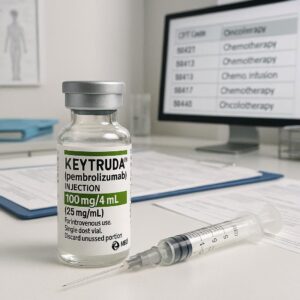
CPT Code for Keytruda
Understanding the Basics: Why Keytruda Needs More Than One Code
Before we list numbers, you need to understand a core rule of medical coding. A single medication like Keytruda never travels alone on a claim. Every infusion requires two distinct types of codes.
First, you need a code for the drug itself. This covers the cost of the liquid inside the vial. Second, you need a code for the administration. This covers the nurse’s time, the IV tubing, the pump, and the clinical oversight.
Think of it like buying a car. You pay for the car itself (the drug). But you also pay for the mechanic’s labor to install it (the administration). Keytruda is no different.
The Primary Drug Code: J9271
This is the most important code on your claim. The Healthcare Common Procedure Coding System (HCPCS) assigns a specific J-code to Keytruda.
The primary CPT code for Keytruda (the drug) is J9271.
Here is the exact description according to official HCPCS guidelines:
“Injection, pembrolizumab, 1 mg”
Let us break that down. J9271 is billed per 1 milligram. This is critical. Keytruda is not billed per vial. It is not billed per dose. It is billed per milligram.
How to Calculate Units for J9271
Most patients receive a standard dose of Keytruda. Common dosages include:
-
200 mg every three weeks
-
400 mg every six weeks
To calculate your units:
-
For 200 mg: You bill 200 units of J9271.
-
For 400 mg: You bill 400 units of J9271.
Important Note: Do not confuse this with the old code J9270. That code is for a different drug (mitomycin). Always double-check your digits. J9271 is the correct code for pembrolizumab as of the latest coding updates.
The Administration Codes: Infusion vs. Injection
Now we move to the second piece of the puzzle. How does the patient receive Keytruda? The route of administration changes your CPT code dramatically.
Keytruda is almost always given as an intravenous (IV) infusion. However, occasionally, it is given as a slow IV push. The codes for each are different.
| Route of Administration | CPT Code(s) | Description |
|---|---|---|
| IV Infusion (first hour) | 96413 | Initial hour of IV infusion, up to 60 minutes |
| IV Infusion (each additional hour) | 96415 | Each additional hour (beyond 60 minutes) |
| IV Push (injection) | 96374 | Therapeutic IV push, single substance |
| IV Push (each additional substance) | 96375 | Additional sequential IV push |
Scenario A: The Standard 30-Minute Infusion
Most Keytruda infusions are prepared in 100mL or 250mL bags of normal saline. The infusion runs over 30 minutes. In this case, you bill 96413 only. Why? Because 96413 covers the initial hour. Even if the infusion takes 30 minutes, you do not reduce the code. You use the code that covers up to 60 minutes.
Scenario B: The Prolonged Infusion
Sometimes, patients have fragile veins or a history of infusion reactions. The nurse may slow the drip to 90 minutes. Here is how you code that:
-
First 60 minutes: 96413
-
Remaining 30 minutes (beyond the first hour): 96415 (this code represents each additional hour)
Pro Tip: You only add 96415 if the total infusion time exceeds 60 minutes. If the infusion takes 61 minutes, you bill 96413 and one unit of 96415. If it takes 90 minutes, you still only bill one unit of 96415 (because you bill per hour, not per minute).
The “Waste” Dilemma: Single-Use Vials
This is where many billers lose money. Keytruda comes in single-use vials. The most common vials are:
-
50 mg
-
100 mg
Let us say your patient needs 180 mg of Keytruda. How do you draw that up? You cannot open a 100 mg vial and a 50 mg vial and only draw 30 mg from the second vial. You must waste the remainder.
Here is the honest truth. Payers want you to bill for the drug you administered plus the drug you wasted, as long as the waste is medically necessary and documented.
How to Bill Waste for Keytruda
Using the example above (180 mg needed):
-
You open one 100 mg vial (use 100 mg, zero waste).
-
You open one 100 mg vial (use 80 mg, waste 20 mg).
On your claim:
-
J9271 x 180 units (This covers the drug given to the patient)
-
J9271 x 20 units (This covers the waste)
-
You must append modifier JW to the waste line.
-
The line should read: J9271 -JW (20 units)
-
Do not forget the JW modifier. Without it, the payer assumes you saved the leftover liquid for another patient. Since these vials have no preservative, you cannot. The JW modifier tells the payer: “We threw this away because we had to.”
Coding for Different Care Settings
The CPT codes for Keytruda are the same numbers, but the way you package them changes based on where the patient sits.
Hospital Outpatient Department (HOPD)
If you bill for a hospital clinic:
-
Use J9271 for the drug (and waste).
-
Use 96413 and 96415 for the infusion.
-
You may also add C8957 for chemotherapy preparation (depending on your specific payer). Many commercial payers bundle preparation into the infusion code, so check your contract.
Physician Office (Private Oncology Clinic)
If you bill for a private practice:
-
Use J9271 for the drug.
-
Use 96413 and 96415 for the infusion.
-
You do not usually bill a separate preparation code. The practice expense is included in the infusion codes.
Home Infusion
Keytruda is rarely given at home. However, in some palliative or stable maintenance scenarios, it happens. For home infusion:
-
Use the same J9271 and 96413 codes.
-
Add home infusion-specific codes for nursing visit (e.g., 99601 or 99602) depending on the duration of the visit.
Common Billing Mistakes (And How to Avoid Them)
Even experienced coders slip up. Here are the three most frequent errors we see with Keytruda coding.
Mistake #1: Using 96365 Instead of 96413
This is a big one. Code 96365 is for therapeutic infusions (vitamins, antibiotics, hydration). Code 96413 is specifically for chemotherapy and immunotherapy administration. Keytruda is immunotherapy. Always use 96413.
Mistake #2: Billing 96415 for a 30-Minute Infusion
We see this often. A coder thinks “more codes = more money.” That is not true. It gets you an audit. If the infusion is 30 minutes, you only bill 96413. Do not add 96415 unless the time exceeds 60 minutes.
Mistake #3: Forgetting the Initial Service
If the nurse places the IV line specifically for Keytruda, you may also bill for the IV start. Code 36000 (introduction of needle or catheter) is sometimes separately payable. However, many payers consider this bundled into 96413. Check your local coverage determination (LCD).
A Complete Coding Example (Step by Step)
Let us walk through a real patient scenario. This will tie everything together.
Patient: Jane, 58 years old, metastatic lung cancer.
Order: Keytruda 200 mg IV over 30 minutes.
Vials used: Two 100 mg vials (no waste because 100+100 = 200 exactly).
Nursing action: Nurse places peripheral IV, runs infusion for 30 minutes, flushes line.
The Claim (Hospital Outpatient):
| CPT/HCPCS | Modifier | Units | Description |
|---|---|---|---|
| J9271 | (none) | 200 | Pembrolizumab, 1 mg |
| 96413 | (none) | 1 | IV infusion, initial hour |
| 36000 | (none) | 1 | IV start (if payer allows) |
What about a patient with waste?
Patient: Robert, 65 years old, melanoma.
Order: Keytruda 180 mg IV over 30 minutes.
Vials used: One 100 mg vial (use 100) + one 100 mg vial (use 80, waste 20).
The Claim:
| CPT/HCPCS | Modifier | Units | Description |
|---|---|---|---|
| J9271 | (none) | 180 | Pembrolizumab administered |
| J9271 | JW | 20 | Pembrolizumab discarded |
| 96413 | (none) | 1 | IV infusion, initial hour |
Notice the waste line has its own row with the JW modifier.
What About Keytruda Given as an IV Push?
This is rare, but it happens. Some clinical trials or specific protocols use a slow IV push (manual injection via syringe) over 5 minutes. In this case:
-
You still use J9271 for the drug.
-
You replace 96413 with 96374 (therapeutic IV push).
If the nurse pushes Keytruda and then pushes a flush or another medication, you use 96375 for each additional substance.
A word of caution: Most commercial payers and Medicare prefer the infusion method for immunotherapy. IV push for Keytruda is unusual. If you use 96374, have clear documentation from the oncologist explaining why the push method was chosen.
Payer-Specific Nuances (Medicare, Medicaid, Commercial)
You need to know that not all payers read the CPT manual the same way.
Medicare
Medicare follows the OPPS (Outpatient Prospective Payment System). For Keytruda:
-
They accept J9271, 96413, and 96415.
-
They require the JW modifier for waste.
-
They do not usually pay separately for IV start (36000) when billed with 96413.
-
Important: Medicare has specific units of payment for J9271. You must bill in 1 mg increments. Do not round up or down.
Commercial Payers (UnitedHealthcare, Cigna, Aetna, BCBS)
Most commercial plans follow Medicare’s lead, but not all.
-
Some require prior authorization for the administration code, not just the drug.
-
Some do not recognize the JW modifier and instead want you to bill waste on the same line with a different modifier (e.g., JZ for no waste).
-
Always check the payer’s medical policy for “Pembrolizumab (Keytruda).”
Medicaid
State-specific. Most state Medicaid programs follow Medicare coding rules. However, reimbursement rates for J9271 vary wildly by state. Some states pay 80% of AWP. Others pay a flat fee. You must look up your state’s fee schedule.
Documentation Requirements (Protect Yourself)
You can have the right CPT codes. But if your documentation is weak, the claim denies. Here is what your medical record must clearly show for Keytruda.
Required Elements in the Nurse’s Note:
-
Start and stop time of the infusion (to justify 96413 vs 96415).
-
Site of IV (left arm, right hand, etc.).
-
Total volume infused (e.g., 100mL of 0.9% NS with 200mg Keytruda).
-
Flow rate (e.g., 200mL/hr).
-
Patient response (any redness, itching, shortness of breath?).
-
Flush volume (e.g., 20mL NS flush).
Required Elements in the Provider’s Order:
-
Exact dose in milligrams (not “one vial”).
-
Route (IV infusion or IV push).
-
Duration (over 30 minutes, over 60 minutes, etc.).
-
Frequency (every 3 weeks, every 6 weeks).
If the order says “Keytruda per protocol” and the protocol is not attached to the chart, the claim will be denied. Be explicit.
How to Handle Denials for J9271
Denials happen. Do not panic. Here is the most common denial reason for Keytruda and how to fix it.
Denial Code: CO-234 (This procedure is not paid separately).
Why it happens: You billed J9271 without an administration code (96413), or you billed J9271 on a date of service with no corresponding nurse note.
Fix it: Appeal with a copy of the nurse’s note showing the infusion time and the medication administration record (MAR) showing the dose given.
Denial Code: PR-96 (Non-covered charge).
Why it happens: The patient’s diagnosis is not on the FDA-approved list for Keytruda, or the medical records do not prove medical necessity.
Fix it: Submit the pathology report and the oncologist’s clinical note explaining why Keytruda is appropriate for this specific tumor type.
The Future of Keytruda Coding (What to Watch For)
Coding changes every year. The AMA releases CPT updates every January. HCPCS updates happen quarterly (January, April, July, October).
As of April 04, 2026, J9271 remains the correct code for pembrolizumab. However, keep an eye on two trends.
Trend 1: Subcutaneous Keytruda
Merck has developed a subcutaneous (under the skin) version of Keytruda. This is not yet widely available in the US as of this writing, but it is coming. When it arrives, it will have a new J-code (likely J9272 or similar). It will also use administration codes 96372 (therapeutic subcutaneous injection) instead of 96413.
Trend 2: The “JZ” Modifier for No Waste
Medicare is pushing for the JZ modifier. This modifier tells the payer that you used an entire single-use vial with absolutely no waste. For example, if you give exactly 100 mg and open a 100 mg vial, you would use J9271 with the JZ modifier instead of JW. This is not yet mandatory everywhere, but it will be soon.
Quick Reference List: All Codes at a Glance
Here is your cheat sheet for Keytruda coding. Bookmark this list.
-
J9271: Keytruda (pembrolizumab), per 1 mg.
-
J9271 -JW: Keytruda wasted (discarded) drug.
-
96413: IV infusion, immunotherapy, initial 60 minutes.
-
96415: IV infusion, each additional 60 minutes (use with 96413).
-
96374: IV push (manual injection), initial substance.
-
96375: IV push, each additional substance.
-
36000: IV catheter placement (may or may not be payable).
-
99211 – 99215: Evaluation and management (E/M) visit if the oncologist sees the patient before the infusion (append modifier -25 to the E/M code).
A Note on Modifier -25
If the oncologist examines the patient and then orders the Keytrusa infusion on the same day, you can bill both:
-
The infusion (96413)
-
The office visit (e.g., 99214)
But you must attach modifier -25 to the office visit code. This modifier means “significant, separately identifiable service.” Without it, the payer bundles the visit into the infusion payment.
Frequently Asked Questions (FAQ)
Let us answer the questions we hear most often from billers and nurses.
Q1: Is J9271 the same as the old code J9999?
A: No. J9999 was a miscellaneous code used before Keytruda had its own specific J-code. Do not use J9999 anymore. Always use J9271.
Q2: What if the patient’s infusion takes 55 minutes? Do I still bill 96413?
A: Yes. 96413 covers the first 60 minutes. You do not need 96415 until the infusion exceeds 60 minutes. A 55-minute infusion is still 96413 only.
Q3: Can I bill for the saline flush separately?
A: Generally, no. The normal saline used to flush the line is considered a supply. It is bundled into the infusion code. Do not bill J7040 or J7050 for the flush unless you are giving a large volume of hydration separate from the Keytruda.
Q4: What is the difference between J9271 and C9145?
A: C-codes are temporary pass-through codes for hospital outpatient departments. C9145 was an old temporary code for pembrolizumab. It is no longer valid. Use J9271.
Q5: Does insurance cover Keytruda waste?
A: Most Medicare and commercial plans cover waste if it is medically necessary (you cannot use the leftover drug for another patient) and you append the JW modifier. However, some plans limit waste to a certain percentage. Check your policy.
Q6: How do I code Keytruda for a pediatric patient?
A: The same codes apply. J9271 and 96413. Pediatric dosing is often based on body weight (2 mg/kg). Calculate the total mg, then bill J9271 for that total. Infusion times may be longer in children. Use 96415 if the infusion exceeds 60 minutes.
Q7: What if the nurse stops the infusion early due to a reaction?
A: Document the exact infusion time. If the patient only received 15 minutes of a planned 30-minute infusion, you still bill 96413 (because it covers the initial hour). For the drug, bill only the amount actually infused. If you had to waste the remainder of the vial, bill that waste with JW.
Additional Resources
For the most current information on Keytruda coding and reimbursement, bookmark these official sources. Do not rely on internet forums.
-
CMS HCPCS Quarterly Updates: [Search CMS.gov for “Alpha-Numeric HCPCS File”] (External link)
-
AMA CPT Code Search: [AMA-assn.org (CPT category III codes)] (External link)
-
Merck Access Program (Keytruda reimbursement support): Search “Merck Access Program Keytruda” for patient assistance and coding hotlines.
A Final Word on Compliance
This guide gives you the technical codes. But your best friend in billing is your compliance manual. Every clinic and hospital has different contracts with different payers.
One payer might love the JW modifier. Another might reject it and ask for a paper appeal. Always:
-
Verify codes annually (every January).
-
Subscribe to your local Medicare Administrative Contractor (MAC) email list.
-
Attend the oncology coding webinar offered by your billing software company.
Keytruda saves lives. Good coding ensures patients keep getting access to it. You are on the front lines. Code carefully. Document thoroughly. And when in doubt, ask your compliance officer.
Conclusion
In summary, the correct CPT code for Keytruda is J9271 for the drug itself (billed per 1 mg), paired with 96413 for the initial IV infusion. Use 96415 for infusions lasting over 60 minutes. Always document waste with the JW modifier. Avoid confusing infusion codes (96365) with immunotherapy codes (96413). Stay updated on payer policies and future subcutaneous formulations.