If you have been navigating the world of medical billing for spine or pelvic procedures, you already know that the sacroiliac joint can be a tricky area. Finding the correct CPT code for SI joint fusion is not always straightforward. You might see several possible codes and wonder which one fits your specific surgical scenario.
Do not worry. This guide walks you through everything you need to know. We will cover the primary codes, how to choose the right one, common pitfalls, and practical tips to keep your claims clean and payable.
Let us start with the most important question first.
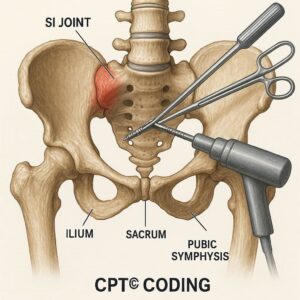
CPT Code for SI Joint Fusion
Table of Contents
ToggleWhat Is the Correct CPT Code for SI Joint Fusion?
The short answer is that there is no single universal code. The correct CPT code for SI joint fusion depends entirely on the surgical technique the surgeon uses.
Currently, the most common codes you will encounter are:
-
27279 – Arthrodesis, sacroiliac joint, percutaneous or minimally invasive (including image guidance, when performed).
-
27280 – Arthrodesis, open, sacroiliac joint, including dislocation.
-
27248 – Arthrodesis, sacroiliac joint, with autogenous graft (includes obtaining graft).
Each of these codes describes a different surgical approach. Using the wrong one can lead to claim denials or audits. So, let us break them down in detail.
Why the Confusion Around SI Joint Fusion Codes?
Historically, SI joint fusion was an open procedure. Surgeons would make a large incision, prepare the joint surfaces, and often place bone graft. Then, minimally invasive techniques emerged. These new methods use small incisions and special implants.
The American Medical Association (AMA) created new codes to reflect these changes. However, many billing professionals still struggle to distinguish between them. You are not alone if you find this confusing.
Important Note: Always verify the exact surgical approach described in the operative report before selecting a code. Do not rely on the procedure name alone.
Deep Dive: CPT 27279 – Percutaneous or Minimally Invasive SI Joint Fusion
This is the most frequently used code for modern SI joint fusion. If your surgeon uses a small incision, places implants across the joint, and uses fluoroscopy or CT guidance, 27279 is likely your code.
What the Description Means
The official CPT language says “percutaneous or minimally invasive.” That means the surgeon does not fully open the joint. Instead, they pass instruments through small skin punctures. Image guidance is included when performed, so you do not bill radiology codes separately for the guidance.
Key Characteristics of 27279
-
Small incisions (usually less than two centimeters each).
-
Use of intraoperative imaging (fluoroscopy, CT, or navigation).
-
Placement of triangular or cylindrical implants.
-
No extensive bone graft harvesting (though some systems use synthetic graft).
-
Shorter recovery time compared to open surgery.
When to Use 27279
Use this code when the operative report clearly states:
-
“Percutaneous SI joint fusion”
-
“Minimally invasive SI joint arthrodesis”
-
“Image-guided SI joint fusion with implants”
When NOT to Use 27279
Do not use 27279 if the surgeon:
-
Makes a large incision to expose the joint directly.
-
Harvests autogenous bone graft from the patient’s own body.
-
Dislocates the joint or performs extensive joint preparation with curettes and drills in an open fashion.
Deep Dive: CPT 27280 – Open SI Joint Fusion
This is the traditional code for SI joint fusion. It describes an open surgical approach. The surgeon makes a larger incision over the posterior pelvis, exposes the sacroiliac joint, and performs arthrodesis.
What the Description Means
The code includes the words “including dislocation.” That means the surgeon intentionally disrupts the joint surfaces to promote fusion. This is a more invasive procedure.
Key Characteristics of 27280
-
Incision length typically five to ten centimeters.
-
Direct visualization of the joint.
-
Use of osteotomes, curettes, and drills to prepare the joint.
-
May include placement of screws, plates, or other hardware.
-
Often requires a hospital stay.
When to Use 27280
Use this code when the operative report describes:
-
“Open posterior approach to the sacroiliac joint”
-
“Direct exposure and preparation of the SI joint surfaces”
-
“SI joint arthrodesis with dislocation”
When NOT to Use 27280
Do not use 27280 if the procedure is percutaneous or if the surgeon harvests a separate bone graft (see 27248 below).
Deep Dive: CPT 27248 – SI Joint Fusion with Autogenous Graft
This code is less common today, but you still see it. It describes an open fusion where the surgeon harvests bone graft from the patient (usually from the iliac crest).
What the Description Means
The key phrase is “including obtaining graft.” That means the graft harvest is part of the procedure. You do not bill a separate code for the bone graft harvest.
Key Characteristics of 27248
-
Open approach (similar to 27280).
-
Additional incision or extension of the same incision to harvest bone.
-
Graft material taken from the patient’s own body (autograft).
-
Graft placed into the prepared SI joint.
How 27248 Differs from 27280
The main difference is the graft. Code 27280 does not specify graft. If the surgeon uses synthetic graft, allograft (donor bone), or no graft, you should not use 27248. Use 27248 only when the surgeon harvests autogenous graft from the patient.
Important Note: Many payers consider 27248 a more extensive procedure. It carries higher relative value units (RVUs) than 27280. However, you must have clear documentation of the graft harvest site.
Comparison Table: 27279 vs. 27280 vs. 27248
| Feature | 27279 | 27280 | 27248 |
|---|---|---|---|
| Surgical approach | Percutaneous / Minimally invasive | Open | Open |
| Incision size | < 2 cm per site | 5-10 cm | 5-10 cm plus graft site |
| Image guidance | Included | Not specified (usually not needed) | Not specified |
| Joint dislocation | No | Yes | Yes |
| Bone graft | Synthetic or allograft possible | Variable | Autogenous (patient’s own) |
| Typical setting | ASC or hospital outpatient | Hospital inpatient | Hospital inpatient |
| Recovery time | Shorter | Longer | Longer |
Which CPT Code Is Most Commonly Used Today?
The vast majority of SI joint fusions performed in 2026 use the minimally invasive technique. Therefore, 27279 is the most common CPT code for SI joint fusion in current practice.
Surgeons and patients prefer this approach because it offers:
-
Less blood loss.
-
Shorter hospital stays (often outpatient).
-
Faster return to daily activities.
-
Lower infection risk.
However, some complex cases still require open fusion. For example, patients with severe joint degeneration, previous failed fusion, or significant deformity may need code 27280 or 27248.
Billing and Reimbursement Considerations
Choosing the right code is only half the battle. You also need to understand how payers view these procedures.
Medicare and Commercial Payer Policies
Many payers have specific coverage policies for SI joint fusion. Some consider it investigational for certain indications. Others cover it only for specific diagnoses, such as:
-
Sacroiliitis confirmed by image-guided injection.
-
Degenerative sacroiliitis after failed conservative treatment.
-
Post-traumatic SI joint disruption.
Always check the local coverage determination (LCD) for your region. Medicare Administrative Contractors (MACs) vary widely in their coverage of SI joint fusion.
Modifiers You Might Need
Depending on the scenario, you may need to append modifiers:
-
RT / LT – Right or left side. SI joint fusion is unilateral unless documented otherwise.
-
50 – Bilateral procedure. If the surgeon fuses both SI joints during the same session, use modifier 50 with the appropriate code.
-
22 – Increased procedural services. Use this if the case is significantly more complex than typical (e.g., revision surgery). You must provide supporting documentation.
What About the Implants?
Do not bill the implants separately with surgical codes. The hardware is included in the global surgical package for 27279, 27280, and 27248. However, some payers allow separate billing for expensive implantable devices under HCPCS codes. Check your specific payer guidelines.
Facility vs. Non-Facility Pricing
These codes have different reimbursement rates depending on where you perform the procedure:
-
Hospital outpatient department – Facility pricing only.
-
Ambulatory surgical center (ASC) – ASC-specific rates.
-
Office-based procedure room – Non-facility pricing (includes practice expense).
Be careful. Using a non-facility place of service when the procedure occurs in a hospital will result in a denial.
Common Billing Mistakes and How to Avoid Them
Even experienced billers make errors with SI joint fusion coding. Here are the most frequent pitfalls.
Mistake #1: Using 27279 for Open Procedures
This is the most common error. The surgeon may call the procedure “minimally invasive” because they use a small skin incision. But if they open the joint directly, it is not truly percutaneous. Review the operative report carefully.
Mistake #2: Billing Image Guidance Separately
CPT 27279 includes “image guidance, when performed.” Do not add codes like 77002 (fluoroscopic guidance) or 77011 (CT guidance) on the same claim. This is unbundling and will trigger an audit.
Mistake #3: Forgetting Laterality
SI joint fusion is almost always unilateral. If you do not specify right or left with modifier RT or LT, the payer may assume a bilateral procedure and reduce payment by half. Or worse, they may deny the claim as incomplete.
Mistake #4: Using 27248 Without Documentation of Autograft Harvest
Some billers default to 27248 because it has higher reimbursement. Without operative report evidence of bone graft harvest from the patient, this is fraud. The notes must specify the harvest site (e.g., “autogenous bone graft harvested from the left posterior iliac crest”).
Mistake #5: Billing SI Joint Fusion with Spinal Fusion Codes
Do not report SI joint fusion together with lumbar fusion codes (like 22633) unless the documentation clearly supports separate and distinct procedures. Some payers consider SI joint fusion part of a longer spinal fusion construct. Others allow separate reporting with modifier 59. Check payer policy.
Real-World Examples
Let us look at three scenarios. Each one points to a different CPT code.
Example 1: Minimally Invasive Approach
Operative report excerpt:
“Under fluoroscopic guidance, two small incisions were made over the right sacroiliac joint. A guidewire was advanced across the joint. Three triangular titanium implants were placed percutaneously across the SI joint. Final fluoroscopic images confirmed good implant position.”
Correct code: 27279-RT
Example 2: Open Fusion Without Graft
Operative report excerpt:
“A 7 cm incision was made over the left sacroiliac joint. The gluteal muscles were reflected. The joint capsule was incised. Using osteotomes and curettes, the articular cartilage was removed. Two 7.3 mm cannulated screws were placed across the joint. No bone graft was used.”
Correct code: 27280-LT
Example 3: Open Fusion with Autograft
Operative report excerpt:
“Through the same posterior incision, bone graft was harvested from the right posterior iliac crest using an osteotome. The graft was morselized. The right sacroiliac joint was exposed, prepared, and packed with the autogenous bone graft. Two screws were placed for compression.”
Correct code: 27248-RT
Documentation Requirements for Clean Claims
Your operative report must support the chosen code. Here is what payers look for.
For 27279
-
Statement of “percutaneous” or “minimally invasive” approach.
-
Description of image guidance (fluoroscopy, CT, or navigation).
-
Number and type of implants.
-
Confirmation of intraoperative imaging.
For 27280
-
Description of open incision and its length.
-
Direct visualization of the joint.
-
Joint preparation techniques (curettes, drills, osteotomes).
-
Hardware placement details.
For 27248
-
All elements of 27280 plus:
-
Specific description of graft harvest site.
-
Method of graft harvest.
-
Graft preparation and placement.
Pro Tip: Ask your surgeons to include the specific CPT code in their dictation. Many practices now include a “billing suggestion” section in the operative report. This reduces back-and-forth between coding and clinical teams.
Frequently Asked Questions (FAQ)
Can I bill 27279 and 27280 together for the same joint?
No. You cannot report two different arthrodesis codes for the same joint during the same session. Choose the code that best describes the primary technique.
Is 27279 considered outpatient only?
Not necessarily. While most 27279 procedures occur in outpatient settings, some patients with medical complexities stay overnight. The code itself does not require inpatient status.
Does 27279 include the cost of the implants?
From a CPT perspective, yes. The surgical package includes all routine supplies and implants. However, some payers make separate implant reimbursement under pass-through programs. Check with each payer.
What diagnosis codes support SI joint fusion?
Common ICD-10-CM codes include:
-
M46.1 – Sacroiliitis, not elsewhere classified.
-
M43.28 – Fusion of sacroiliac joint (congenital), sacral and sacrococcygeal region.
-
S33.6XX – Sprain of sacroiliac joint (use appropriate 7th character).
-
M99.03 – Segmental and somatic dysfunction of sacral region.
Always verify medical necessity. The diagnosis must justify the procedure.
How do I bill a bilateral SI joint fusion?
Use modifier 50 with the appropriate code. For example: 27279-50. Some payers prefer RT and LT on two line items. Check your specific payer’s preference.
What is the difference between 27279 and an SI joint injection?
An injection (27096) is a diagnostic or therapeutic procedure. Fusion (27279) is a permanent surgical arthrodesis. They are completely different. Do not confuse them.
Can a physical therapist bill for SI joint fusion aftercare?
No. Post-operative care is part of the global surgical package (usually 90 days for major procedures like 27279, 27280, and 27248). Only the surgeon or the surgeon’s practice can bill for routine follow-up care within the global period.
Additional Resources for SI Joint Fusion Coding
Coding rules change every year. Do not rely on memory alone. Here are trusted resources to keep you current.
-
American Medical Association (AMA) CPT® Professional Edition – The official source for code descriptors and guidelines.
-
American Academy of Orthopaedic Surgeons (AAOS) Coding Corner – Free and paid resources specific to orthopaedic coding.
-
Centers for Medicare & Medicaid Services (CMS) Local Coverage Determinations – Search by your state to find LCDs for SI joint fusion.
-
Your local MAC’s website – Medicare Administrative Contractors publish billing articles and educational materials.
Link to a helpful external resource:
AAOS Coding Resource for SI Joint Fusion – Official orthopedic coding guidance from the American Academy of Orthopaedic Surgeons.
Final Thoughts on Choosing the Right CPT Code for SI Joint Fusion
Selecting the correct CPT code for SI joint fusion comes down to three questions:
-
Is the approach open or percutaneous? (27279 for percutaneous, 27280 or 27248 for open)
-
Did the surgeon harvest autogenous bone graft? (If yes, consider 27248)
-
What does the operative report explicitly say? (Documentation is everything)
When in doubt, request a coding query with the surgeon. A five-minute conversation can save you from a denied claim or a post-payment audit.
Conclusion
In summary, the most common CPT code for SI joint fusion today is 27279 for minimally invasive procedures. Open fusions use 27280 (without autograft) or 27248 (with autogenous graft). Always verify the surgical approach in the operative report, use the correct laterality modifiers, and never bill image guidance separately with 27279. Clean documentation leads to clean claims.
Disclaimer: This article is for informational purposes only and does not constitute legal, medical, or billing advice. CPT codes and payer policies change frequently. Always verify current codes and coverage guidelines with your local payer and the AMA’s current CPT manual.
Author: Professional Medical Coding Writer
Date: April 06, 2026