If you have lost a significant amount of weight—either through bariatric surgery or natural lifestyle changes—you know that stubborn excess skin on the inner thighs can be more than just an annoyance. It can lead to rashes, infections, difficulty walking, and a constant feeling of self-consciousness.
Thighplasty, commonly known as a thigh lift, is the surgical procedure designed to remove that extra skin and fat, reshaping the contour of your thighs.
But here is the question that stops most people in their tracks: What is the correct CPT code for thighplasty?
You might be looking for this information because you are preparing for surgery and want to understand your insurance options. Or perhaps you are a medical coder, a billing specialist, or a surgeon trying to ensure clean claims.
Whatever your reason, you have come to the right place.
In this guide, we will break down the exact CPT codes used for thighplasty, explain what each code means, discuss how insurance (including Medicare) views these procedures, and give you a realistic look at costs and coverage. No fluff. No fake codes. Just honest, practical information you can use.
Let us get started.
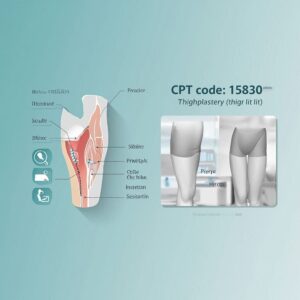
CPT Code for Thighplasty
What Is Thighplasty? A Quick Refresher
Before we dive into the numbers, let us make sure we are talking about the same procedure. Thighplasty is a body contouring surgery that removes excess skin and fat from the inner, outer, or anterior (front) thigh.
There are different types of thigh lifts, and the type you have will directly influence which CPT code your surgeon uses.
-
Inner thigh lift (medial thighplasty): The most common type. It targets the loose skin on the inside of the thighs.
-
Outer thigh lift (lateral thighplasty): Often combined with a lower body lift or buttock lift. It addresses the outer saddlebag area.
-
Anterior thigh lift: Removes skin from the front of the thighs.
-
Spiral thigh lift: A more advanced technique that removes skin from both the inner and outer thigh in a single continuous incision.
Important note for readers: Thighplasty is not a weight loss procedure. It is a body contouring procedure. That distinction matters enormously for insurance coverage.
The Primary CPT Code for Thighplasty: 15832
Let us answer the main question directly.
The most common and accurate CPT code for a standard thighplasty is 15832.
Here is the official descriptor from the American Medical Association (AMA) CPT manual:
15832: Excision, excessive skin and subcutaneous tissue (including lipectomy); thigh.
That is it. One code, clear and simple.
When a surgeon performs a bilateral thighplasty (both thighs), they will typically report 15832 with modifier 50 (bilateral procedure) or list two units of the code depending on the payer’s rules.
What Does 15832 Actually Include?
This code covers the surgical excision of excess skin and fat from the thigh region. It includes:
-
The design and marking of incisions
-
The removal of the skin and subcutaneous tissue
-
The undermining (lifting) of the skin flaps
-
The closure of the incisions in layers
It does not include significant liposuction performed as a separate, distinct procedure. If your surgeon performs aggressive liposuction in addition to the excision, you may need an add-on code, which we will cover in a moment.
When Is 15832 Not the Right Code?
You cannot use 15832 for:
-
A small scar revision or minor skin excision
-
Liposuction alone (that is 15877 or 15879, depending on the area)
-
A procedure performed on the lower leg or knee
If the surgeon only removes a small ellipse of skin under local anesthesia in an office setting, a different code (like 11400 series for benign lesion removal) might be more appropriate. But for a true thigh lift, 15832 is your code.
Add-On Code: 15879 – When Liposuction Is Performed
Here is where many people get confused.
Sometimes, during a thighplasty, the surgeon will also perform suction-assisted lipectomy (liposuction) to further contour the thigh. This is especially common in the outer thigh or the area just above the knee.
If the liposuction is performed in a different anatomical region than the skin excision, you can report an add-on code.
The correct add-on code for liposuction performed with a thighplasty is 15879.
Official descriptor:
15879: Suction assisted lipectomy; thigh.
But pay close attention to the rules.
The Bundling Rule You Must Know
According to CPT guidelines and National Correct Coding Initiative (NCCI) edits, you cannot report 15879 if the liposuction is performed on the same anatomical area as the excision.
In plain English:
-
If the surgeon removes skin from the inner thigh and then does liposuction on the inner thigh (the same area), the liposuction is considered part of the primary procedure. You cannot bill separately.
-
If the surgeon removes skin from the inner thigh and then does liposuction on the outer thigh or knee area (a different region), you can bill 15879 as an add-on.
This is a very common reason for claim denials. Many billers incorrectly append 15879 for liposuction performed directly under the excision site. Do not make that mistake.
Example Scenario
Case: A patient undergoes a bilateral medial thigh lift. The surgeon removes a large ellipse of skin from the inner thigh. Then, using a cannula, the surgeon performs liposuction on the lateral (outer) thighs to reduce saddlebag contours.
Correct coding:
-
15832-50 (Bilateral medial thighplasty)
-
15879-50 (Bilateral liposuction of the thighs, distinct area)
Incorrect coding:
-
15832-50
-
15879-50 for liposuction of the medial thigh
The Panniculectomy Code: 15830 – A Common Confusion
Here is another area where people accidentally use the wrong code.
Some patients need a thighplasty and an abdominal panniculectomy (removal of the abdominal apron of skin) at the same time. The CPT code for panniculectomy is 15830.
Official descriptor:
15830: Excision, excessive skin and subcutaneous tissue (including lipectomy); abdomen, infraumbilical panniculectomy.
Do not use 15830 for a thighplasty. It is for the abdomen only. However, it is common for these two procedures to be performed together during a lower body lift.
If your surgeon performs both:
-
15830 (Panniculectomy)
-
15832 (Thighplasty)
You will report them separately, but be aware that Medicare and many commercial insurers have multiple procedure payment reductions. The second procedure will be paid at a reduced rate (typically 50% of the allowable amount).
Quick Reference Table: Thighplasty CPT Codes
| CPT Code | Procedure | Typical Use | Bilateral Modifier |
|---|---|---|---|
| 15832 | Excision, thigh | Standard inner or outer thigh lift | Yes (Modifier 50) |
| 15879 | Suction assisted lipectomy, thigh | Add-on liposuction in a different thigh region | Yes (Modifier 50) |
| 15830 | Panniculectomy, abdomen | Separate abdominal procedure (not thigh) | No (midline) |
| 15877 | Suction assisted lipectomy; trunk | Liposuction of abdomen/flanks (not thigh) | No |
Does Insurance Cover Thighplasty? The Honest Answer
This is the question that matters most to patients. And the honest answer is: usually no, but sometimes yes.
Most thighplasty procedures are considered cosmetic by insurance companies, including Medicare and Medicaid. Cosmetic means the procedure is intended to improve appearance rather than restore function or treat disease.
However, there are specific circumstances where a thighplasty may be considered medically necessary.
When Insurance Might Cover Thighplasty
Insurance may cover a thigh lift if you can document all of the following:
-
Chronic, intertriginous dermatitis (a rash caused by skin rubbing on skin) in the thigh fold that has failed aggressive medical management for at least three to six months.
-
Recurrent fungal or bacterial infections (candidiasis, cellulitis) documented by a primary care physician or dermatologist.
-
Documented failure of conservative treatment, including:
-
Topical antifungal or antibiotic creams
-
Barrier creams (zinc oxide, etc.)
-
Keeping the area clean and dry
-
Weight maintenance for at least six months after major weight loss
-
-
Significant functional impairment, such as difficulty walking, chafing that limits daily activities, or inability to exercise.
If your surgeon submits a prior authorization request with this documentation, you have a fighting chance. But even then, coverage is not guaranteed.
Medicare’s Stance on Thighplasty (LCDs)
Medicare does not have a single national coverage determination for thighplasty. Instead, each Medicare Administrative Contractor (MAC) issues Local Coverage Determinations (LCDs).
Most MACs consider thighplasty non-covered because it is deemed cosmetic. However, some MACs will cover it if the patient meets strict medical necessity criteria, including:
-
A body mass index (BMI) of less than 30 (or stable weight for six months after massive weight loss)
-
Documentation of chronic rash with skin breakdown
-
Failure of medical therapy for at least three months
Note for readers: Never assume Medicare will cover a thighplasty. Always request a prior authorization in writing before scheduling surgery.
Realistic Out-of-Pocket Costs
If insurance denies coverage (which is the most common outcome), you will pay out of pocket. Here is a realistic range for thighplasty costs in the United States (2026 data):
-
Surgeon’s fee: $4,000 – $8,000
-
Anesthesia fee: $1,000 – $2,500
-
Facility fee (surgical center or hospital): $2,000 – $5,000
-
Total average cost: $7,000 – $15,000
Bilateral procedures cost more than unilateral. Adding liposuction (15879) will increase the price by $1,500 to $3,000.
“Patients often ask me why thighplasty is so expensive. The truth is, it is a technically demanding procedure that takes two to four hours under general anesthesia. You are paying for the surgeon’s training, the operating room team, and the safety protocols. Cheap surgery is not good, and good surgery is not cheap.” — Board-certified plastic surgeon, Texas
Important Coding and Billing Tips for Medical Professionals
If you are a coder or biller, these practical tips will save you from denials and audits.
1. Always Check the Operative Report
Do not code from the scheduler’s note or the clinic note. You need the full operative report to confirm:
-
The exact location of the excision (medial, lateral, anterior)
-
Whether liposuction was performed in the same or different anatomical region
-
The length and size of the excision (though no specific size requirement exists for 15832)
2. Modifier 50 vs. Modifier RT/LT
For bilateral thighplasty, you have two options:
-
Modifier 50 (Bilateral procedure): One line item with modifier 50. This is preferred by Medicare.
-
Modifier RT (right) and LT (left): Two line items, one with RT and one with LT. Some commercial payers prefer this.
Check each payer’s policy. When in doubt, modifier 50 is safe for Medicare.
3. Do Not Report 15832 with 15877
CPT 15877 is for liposuction of the trunk (abdomen, flanks, back). It is not for the thigh. Using 15877 for a thighplasty is a categorical error and will result in an outright denial.
4. Global Period Awareness
CPT 15832 has a 90-day global period. This means that all routine post-operative care (follow-up visits, removal of sutures, management of minor complications) is included in the surgical fee. You cannot bill separately for E/M services during the global period unless there is a distinct, unrelated problem.
5. Unlisted Procedure Code? Almost Never
Some coders panic and reach for 15999 (Unlisted procedure, excision, excessive skin and subcutaneous tissue). Do not do this. 15832 is the correct code. Using an unlisted code for a standard thigh lift will delay payment and invite questions.
Only use 15999 if the surgeon performs a truly novel technique that does not fit the descriptor of 15832. That is extremely rare.
Recovery and What to Expect After Thighplasty
Understanding recovery helps you appreciate why the CPT code and billing matter. A thigh lift is not a minor procedure.
Typical Recovery Timeline
-
Days 1-7: Significant swelling, bruising, and discomfort. You will wear compression garments. Drains may be placed. Walking is limited to short trips to the bathroom.
-
Weeks 2-4: Sutures or drains removed. You can return to a desk job after two to three weeks. Swelling begins to subside but is still noticeable.
-
Weeks 6-8: Most patients can resume light exercise (walking, stationary bike). No heavy lower body workouts.
-
Months 3-6: Final results become visible. Scars begin to mature (pink to white).
-
Month 12: Scars are fully healed. Final contour is apparent.
Common Complications
-
Seroma (fluid collection)
-
Wound dehiscence (incision opens)
-
Infection
-
Scarring that is wider or more raised than expected
-
Asymmetry
-
Numbness of the inner thigh (often temporary)
Note for readers: The skill of your surgeon directly affects your complication risk. Do not choose a surgeon based on price alone. Verify board certification from the American Board of Plastic Surgery.
FAQ: Your Thighplasty Coding Questions Answered
Q1: What is the exact CPT code for a medial thigh lift?
A: The exact code is 15832. The term “medial” simply specifies the location, but CPT does not have separate codes for medial vs. lateral. 15832 covers both.
Q2: Can I bill for a bilateral thighplasty with one code?
A: Yes. You report 15832 with modifier 50 appended. On the claim form, you will enter one line item with the code, the modifier, and the total charge for both thighs.
Q3: Is liposuction always included in 15832?
A: No. Liposuction is only included if it is performed on the same anatomical area as the skin excision. If liposuction is performed on a different area (e.g., outer thigh during an inner thigh lift), you can add 15879.
Q4: Does Medicare cover thighplasty?
A: Generally, no. Medicare considers thighplasty cosmetic. However, if you have documented chronic, treatment-resistant rashes with skin breakdown, some Medicare Administrative Contractors (MACs) may cover it after prior authorization. This is the exception, not the rule.
Q5: What is the difference between 15832 and 15830?
A: 15832 is for the thigh. 15830 is for the abdomen (panniculectomy). They are not interchangeable. Many patients need both after massive weight loss, but they are billed separately.
Q6: Can a surgeon bill for the excision and the liposuction on the same thigh?
A: Only if the liposuction is performed on a different region of the same thigh. For example, skin excision on the medial thigh and liposuction on the lateral thigh of the same leg is separately reportable with 15879.
Q7: What happens if my insurance denies the thighplasty claim?
A: First, file an appeal. Provide the operative report, photos, and documentation of medical necessity (rashes, infections, failed conservative care). If the appeal fails, you are responsible for the full cost. Many surgeons offer payment plans or financing options like CareCredit.
Q8: Is there a separate CPT code for scar revision after thighplasty?
A: Yes, but with strict rules. If a scar from a previous thighplasty becomes hypertrophic or keloid and requires revision, you would use a scar revision code (e.g., 13160 for secondary closure or 11400 series for excision of scar). This is a separate procedure performed at least three to six months after the original surgery.
Q9: What is the CPT code for a thighplasty performed on a child or teenager?
A: The same codes apply (15832, 15879). There are no separate pediatric codes for body contouring. However, insurance is even less likely to cover thighplasty in minors unless there is severe functional impairment.
Q10: How do I find a surgeon who uses the correct coding?
A: Ask directly during your consultation. A transparent surgeon will say, “I use 15832 for the thigh lift. If we add liposuction to the outer thigh, I will add 15879.” If the surgeon hesitates or gives a vague answer, consider that a red flag.
Additional Resource: Where to Go for More Information
You do not have to navigate this alone. Here are trusted, non-sales resources for further reading and verification.
-
American Society of Plastic Surgeons (ASPS) – Thigh Lift Information
Link: plasticsurgery.org (search “thigh lift”)
This is the patient-facing resource from the leading professional organization. It includes realistic before-and-after photos, recovery guides, and questions to ask your surgeon. -
CMS National Correct Coding Initiative (NCCI) Edits
Link: cms.gov (search “NCCI edits”)
If you are a coder or biller, this is your official source for bundling rules. Download the quarterly procedure-to-procedure (PTP) edit file. -
Find a Board-Certified Plastic Surgeon
Link: abplasticsurgery.org (search “find a surgeon”)
Verify any surgeon’s credentials before you book a consultation. Do not rely on patient reviews alone.
Conclusion:
Thighplasty is a transformative body contouring procedure, and the primary CPT code you need to remember is 15832 for skin excision, with 15879 reserved for liposuction performed on a different thigh region. Insurance coverage is rare but possible if you have documented, treatment-resistant rashes and functional impairment, though most patients pay out of pocket between $7,000 and $15,000. Always verify coding with your surgeon’s billing office before surgery, and never assume a procedure is covered without prior authorization in writing.
Disclaimer: This article is for informational and educational purposes only. Medical coding, billing, and insurance policies vary widely and change frequently. Always consult with a qualified medical coder, your insurance provider, and your board-certified plastic surgeon for advice specific to your situation.
Author: Surgical Coding & Billing Team
Date: APRIL 10, 2026