If you have ever tried to sort through the CPT manual for ankle trauma codes, you know it can feel like solving a puzzle in the dark.
The syndesmosis is a tricky structure. It is not a single ligament. Instead, it is a complex union between the tibia and fibula. When it gets disrupted—often during a high ankle sprain or fracture—surgeons have to step in to stabilize it.
But here is the question that causes the most confusion: What is the correct CPT code for repair of syndesmosis disruption?
The short answer is that you will usually look at CPT 27829 or CPT 27830. However, the real world is never that simple. Surgeons also use hardware, treat fractures at the same time, and perform open versus closed procedures.
This guide walks you through everything you need to know. We will keep the language simple, the examples practical, and the advice realistic.
Let us get started.
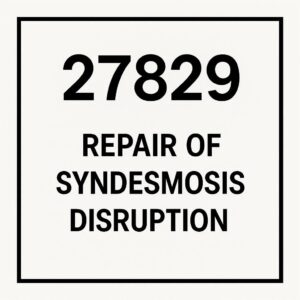
CPT Code for Repair of Syndesmosis Disruption
Understanding the Syndesmosis: A Quick Primer
Before we talk about codes, let us talk about the injury itself.
The syndesmosis connects the distal tibia and fibula. Think of it as a shock absorber and stabilizer for the ankle mortise. When this structure tears, the ankle becomes unstable. The fibula can actually shift away from the tibia.
This is not your average ankle sprain.
Patients with syndesmosis disruption often cannot bear weight. They experience pain above the ankle joint. And in many cases, this injury requires surgical intervention to restore alignment.
Surgeons have two main goals here:
-
Reduce the diastasis (the abnormal gap between the tibia and fibula).
-
Hold the bones in place while the ligaments heal.
That is where the coding gets interesting.
The Primary CPT Codes for Syndesmosis Repair
Let us cut to the chase. The American Medical Association (AMA) provides specific codes for this procedure. However, you will notice that the language in the CPT manual is a bit old-school.
CPT 27829: Open treatment of distal tibiofibular joint (syndesmosis) disruption, includes internal fixation, when performed
This is your workhorse code.
What it includes:
-
An open surgical incision.
-
Direct visualization of the syndesmosis.
-
Reduction of the joint.
-
Placement of screws or other hardware (usually one or two syndesmotic screws).
-
Repair of the ligament if possible.
When to use it:
Use 27829 when the surgeon makes an incision specifically to address the syndesmosis. This often happens alongside a fibular fracture repair, but if the fracture repair is billed separately (like with a plate and screws for a lateral malleolus fracture), you will need to check for bundling edits.
Important note: Many coders ask if 27829 includes the fracture repair. It does not. If the patient has a Weber B or C fracture, you typically bill the fracture code (e.g., 27792 for distal fibula) plus 27829 for the syndesmosis repair. However, check your modifier -59 or XU to show distinct procedures.
CPT 27830: Closed treatment of distal tibiofibular joint (syndesmosis) disruption; without manipulation
This code is less common.
What it includes:
-
No surgical incision.
-
The surgeon stabilizes the joint externally (e.g., with a cast or boot).
-
No manipulation of the joint (meaning no active reduction maneuver).
When to use it:
Use 27830 for non-surgical management. This is rare for true syndesmosis disruptions because most require surgery. However, for very mild cases (Grade I or II injuries), this might apply.
CPT 27831: Closed treatment of distal tibiofibular joint (syndesmosis) disruption; with manipulation
This code involves a closed reduction.
What it includes:
-
The surgeon manually manipulates the ankle to bring the tibia and fibula back into alignment.
-
No incision is made.
-
Often followed by casting or splinting.
When to use it:
Use 27831 when the surgeon performs a conscious sedation or manipulation in the emergency room or clinic to reduce the diastasis without opening the joint.
CPT 27832: Open treatment of distal tibiofibular joint (syndesmosis) disruption, includes internal fixation, when performed, with fibular fracture
Caution: This code exists in older versions of CPT and some payer policies, but modern CPT guidelines often consider this bundled into 27829 plus the fracture code. Always verify your CPT manual edition.
For the sake of clarity, most surgeons today report:
-
Fracture code (e.g., 27786, 27792, 27814)
-
27829 for the syndesmosis repair
-
Modifier -59 (Distinct Procedural Service) or -XU (Unusual non-overlapping service)
Comparison Table: Open vs. Closed Syndesmosis Repair
| CPT Code | Procedure Type | Incision | Manipulation | Hardware | Typical Use Case |
|---|---|---|---|---|---|
| 27829 | Open | Yes | N/A | Yes (screws) | Surgical stabilization with hardware |
| 27830 | Closed | No | No | No | Minimal disruption, non-operative |
| 27831 | Closed | No | Yes | No | ER reduction of diastasis |
| 27832 | Open | Yes | N/A | Yes | Historical code for fracture + syndesmosis |
When Surgeons Use Screws: CPT and Hardware
Here is a common scenario.
The surgeon performs an open reduction internal fixation (ORIF) of the syndesmosis. They place one or two screws from the fibula into the tibia. These are called syndesmotic screws.
Some payers ask: Is the screw placement included in 27829?
Yes. The code language says “includes internal fixation, when performed.” That means you cannot bill separately for the screw insertion. The screw is part of the procedure.
But what about screw removal?
That is a different code.
-
CPT 20680: Removal of deep hardware (e.g., syndesmotic screw). This is a separate procedure performed weeks or months later.
Do not bill screw removal with the initial repair. They are separate encounters.
Real-World Scenarios: Matching Codes to Operative Notes
Let us walk through three patient cases. This will help you see the code selection in action.
Scenario 1: Isolated Syndesmosis Disruption (No Fracture)
Operative note excerpt:
“The patient sustained a high ankle sprain with diastasis on stress view. We made a lateral incision over the syndesmosis. The AITFL was torn. We reduced the syndesmosis with a large pointed reduction clamp. Two 3.5 mm syndesmotic screws were placed from the fibula into the tibia. The ligament was not primarily repaired due to poor tissue quality.”
Correct CPT code: 27829
Why? Open treatment. Internal fixation. No separate fracture code because there was no fracture.
Scenario 2: Syndesmosis Disruption with Lateral Malleolus Fracture
Operative note excerpt:
“A Weber C fracture of the distal fibula was identified. The syndesmosis was also disrupted with 4 mm of diastasis. The fibula fracture was plated with a one-third tubular plate and screws (CPT 27792). The syndesmosis was then repaired via the same incision using a single 4.0 mm syndesmotic screw.”
Correct CPT codes:
-
27792 (ORIF distal fibula fracture)
-
27829 (Syndesmosis repair)
-
Modifier -59 (or -XU) appended to 27829
Why two codes? The fracture repair and the syndesmosis repair are distinct anatomical structures. The National Correct Coding Initiative (NCCI) sometimes bundles them, but a modifier is allowed when the syndesmosis repair is performed in addition to the fracture repair.
Pro tip: Some coders use 27814 (ORIF of bimalleolar ankle fracture) when both the medial and lateral sides are fractured. But that code does not specifically include syndesmosis repair. If the syndesmosis requires separate work, add 27829.
Scenario 3: Closed Reduction in the Emergency Department
Operative note excerpt:
“Under conscious sedation, the ankle was manipulated to reduce the distal tibiofibular diastasis. A well-padded short leg cast was applied. Post-reduction X-rays showed excellent alignment.”
Correct CPT code: 27831
Why? Closed treatment with manipulation. No incision. No hardware.
The Role of HCPCS and Hardware Codes
Surgeons sometimes ask about billing for the syndesmotic screw itself.
In the hospital outpatient setting (facility), you may report HCPCS C1712 (Screw, fixation, absorbable or non-absorbable) for the implant. But this is for the facility’s charge master, not for the professional fee (the surgeon’s bill).
For the professional component (surgeon’s work), the screw is included in CPT 27829. Do not bill C1712 on the CMS-1500 form for the surgeon.
In ambulatory surgery centers (ASCs), hardware is typically packaged into the facility payment.
Common Billing Mistakes and How to Avoid Them
Let me share a few pitfalls I see regularly.
Mistake #1: Using an “Unlisted Procedure” Code
Some coders panic and reach for CPT 27899 (Unlisted procedure, leg or ankle). Do not do this unless the procedure truly has no specific code.
27829 exists. Use it.
Unlisted codes invite medical records requests, delays, and denials. Only use 27899 for novel techniques (e.g., a new suture-button device that is not yet described by an existing code—more on that below).
Mistake #2: Forgetting the Modifier for Multiple Procedures
If you bill 27792 and 27829 on the same claim without a modifier, many payers will deny 27829 as bundled.
Add Modifier -59 (Distinct Procedural Service) or the more specific -XU (Unusual non-overlapping service).
Example:
-
27792
-
27829 -59
Mistake #3: Billing for Ligament Repair Separately
You might see “repair of AITFL” in the op note. Do not add a separate ligament repair code (like 27695 for ankle ligament repair). The syndesmosis repair code includes the ligamentous work.
Newer Techniques: Suture-Button Devices (TightRope, etc.)
Traditional syndesmosis repair uses rigid screws. But more surgeons are now using flexible suture-button devices (e.g., Arthrex TightRope, Zimmer Biomet Syndesmosis TightRope).
Here is the challenge: There is no specific CPT code for these devices.
What do you do?
You have two options:
-
Use 27829 (if the AMA and your payer consider the suture-button device as “internal fixation”). Many payers accept this.
-
Use unlisted code 27899 and submit the op note.
Most coding experts recommend trying 27829 first. The work is the same: open exposure, reduction, and placement of a fixation device. The device type (screw vs. suture) does not change the surgeon’s effort significantly.
However, check your local coverage determinations (LCDs). Some Medicare contractors explicitly say 27829 is for screws only. If that is the case, you must use 27899.
Comparison: Screw Fixation vs. Suture-Button
| Feature | Screw (27829) | Suture-Button (27899 likely) |
|---|---|---|
| Hardware removal | Usually required (20680) | Not required |
| Compliance with code | Clear match | Off-label use of 27829 |
| Payer acceptance | High | Variable |
| Reimbursement | Established | Negotiated (with notes) |
Documentation Requirements for Syndesmosis Repair
To get paid, your operative note must tell a clear story.
Here is what auditors look for:
-
Mechanism of injury: High ankle sprain? Fracture?
-
Imaging findings: Diastasis measurement on stress view or CT.
-
Surgical approach: Open vs. closed. Incision location.
-
Reduction technique: Clamp type. Confirmation of reduction (fluoroscopy?).
-
Fixation method: Number and type of screws or suture-button.
-
Post-op plan: Weight-bearing status. Cast or boot.
Quotation from a medical auditor:
“If I cannot find the words ‘syndesmosis’ and ‘reduction’ in the op note, I am denying 27829. Be explicit.”
Global Period and Post-Op Care
CPT 27829 has a 90-day global period.
That means the surgeon’s fee covers all routine post-operative care for 90 days. This includes:
-
Office visits
-
Cast changes
-
Removal of sutures
-
X-rays (unless separately billable under the technical component)
If the patient returns for syndesmotic screw removal at 12 weeks, that is a separate procedure (20680). But if the screw removal happens within the 90-day global period for a complication (e.g., broken screw), you may not be able to bill it separately.
Always check your payer’s global surgery rules.
Medicare and Commercial Payer Variations
Medicare is straightforward most of the time. They accept 27829 for open syndesmosis repair.
But commercial payers vary.
-
UnitedHealthcare: Generally follows NCCI. Allows 27829 with modifier -59 alongside fracture codes.
-
Aetna: Requires medical records for 27829 if billed with an ankle fracture code. They want to see that the syndesmosis repair was “significant and separate.”
-
Blue Cross Blue Shield (varies by state): Some plans bundle 27829 into the fracture code automatically. Others pay separately.
Best practice: Before you schedule the case, check the patient’s benefits. If you are unsure, submit a prior authorization with both codes.
Frequently Asked Questions (FAQ)
1. Is CPT 27829 the same as a “high ankle sprain” repair?
Yes. A high ankle sprain is a syndesmosis injury. If surgery is required, 27829 is the correct code for open repair.
2. Can I bill 27829 with an arthroscopy code?
Sometimes. If the surgeon performs an ankle arthroscopy (CPT 29899) to evaluate the syndesmosis and then performs an open repair, you can bill both. Use modifier -59 on 27829. However, if the arthroscopy is done through the same incision and is not significant, it may be bundled.
3. What about CPT 27814 (bimalleolar fracture ORIF)? Does that include the syndesmosis?
No. 27814 includes medial and lateral malleolus fractures. It does not automatically include syndesmosis repair. If the op note specifically describes syndesmosis reduction and fixation, add 27829.
4. How do I code syndesmosis repair in an ASC?
The facility will bill using their own coding (often C1712 for the screw). The surgeon still bills 27829 on the professional claim. The ASC payment is packaged.
5. What if the surgeon only places one screw?
The code does not specify the number of screws. One screw or three screws, it is still 27829.
6. Is there a separate code for “syndesmosis reconstruction” for chronic instability?
No specific code exists. For chronic cases (e.g., malreduced syndesmosis from an old injury), you would use 27829 for the open reduction or an unlisted code if the procedure involves ligament reconstruction with graft. For graft reconstruction, consider 27698 (ligamentous reconstruction, ankle) but that is more for lateral ankle ligaments. This is a gray area.
Additional Resource
For the most current NCCI edits and bundling rules, visit the CMS Correct Coding Initiative webpage:
https://www.cms.gov/medicare/coding/national-correct-coding-initiative-ncci-tools
Bookmark that link. It saves you from denials.
A Realistic Look at Reimbursement
Let us be honest. Reimbursement for 27829 is not the highest among ankle procedures. But it is fair.
In 2026, the national average physician payment for 27829 (non-facility) is roughly $450 to $550. Facility reimbursement (when performed in a hospital) is lower for the professional fee—around $250 to $350—because the hospital bills the facility fee separately.
If you add 27829 to a fracture code (e.g., 27792), expect to receive about 50% to 70% of the fee for the second procedure due to multiple procedure reductions.
That is normal. Do not let that stop you from billing correctly. The work is real, and you deserve to be paid for it.
Summary Table: Quick Reference
| If the surgeon does this… | Use this CPT code |
|---|---|
| Open incision, places screws or suture-button for syndesmosis | 27829 |
| Same as above, plus a fibula fracture | 27792 + 27829 -59 |
| No incision, no manipulation (rare) | 27830 |
| Closed reduction in ER or clinic | 27831 |
| Screw removal months later | 20680 |
| Novel device not accepted as 27829 | 27899 (with op note) |
Important Note for Readers
Coding for syndesmosis repair is one of the most audited areas in orthopedic surgery. Do not assume that a fracture code automatically includes the syndesmosis work. If the op note explicitly describes reduction and fixation of the distal tibiofibular joint, you must bill 27829. Leaving it out is leaving money on the table—and it is also incorrect coding.
Conclusion
In three lines: The primary CPT code for open repair of syndesmosis disruption is 27829, which includes internal fixation. For closed treatment without or with manipulation, use 27830 or 27831. Always document the syndesmosis work separately from fracture repairs, and append modifier -59 when billing both to avoid denials.