If you work in medical coding, dermatology, or plastic surgery, you know that the nose is one of the most complex areas of the human body to code for. It is a central feature of the face, and reconstruction requires precision. When a surgeon performs a full thickness skin graft (FTSG) on the nose, the coding landscape can get tricky quickly.
You are likely here because you have an operative report in front of you, and you are trying to determine the difference between a code for a graft and a code for a flap. Or perhaps you are trying to figure out why a claim was denied. This guide is designed to clear up that confusion.
We will walk through the specific CPT codes associated with full thickness skin grafts on the nose, the anatomy involved, the documentation requirements, and the common pitfalls that cause denials. By the end of this article, you will have a reliable roadmap to ensure accurate coding and compliant billing.
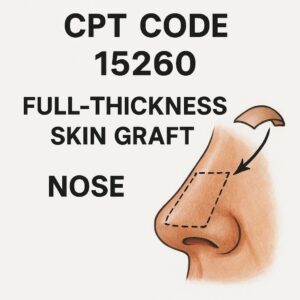
CPT Code Full Thickness Skin Graft Nose
Table of Contents
ToggleUnderstanding the Basics of Skin Grafts
Before we dive into the specific numbers, it is important to understand what a full thickness skin graft actually is. When a surgeon repairs a defect on the nose, they have several options. They can close it primarily (suturing the edges together), use a local flap (moving adjacent skin), or use a graft (taking skin from a donor site).
A full thickness skin graft involves taking a piece of skin that includes the epidermis and the entire dermis. This is different from a split-thickness skin graft, which takes only a partial layer of the dermis.
Why Full Thickness Matters for the Nose
The nose is a unique structure. It requires skin that has similar color, texture, and thickness to the surrounding area to achieve an aesthetically pleasing result. Full thickness grafts are preferred on the nose because they:
-
Contract less than split-thickness grafts.
-
Provide better color match (chromic match) over time.
-
Withstand wear and tear better than thinner grafts.
Because the nose is a highly visible and functionally complex area (think about breathing, facial expression, and cartilage support), the coding for reconstruction here is treated with a higher level of specificity in the CPT manual than it is for, say, the arm or leg.
The Primary CPT Codes for Nasal Reconstruction
When we talk about a full thickness skin graft on the nose, we are usually looking at a family of codes. There is no single code that says “full thickness skin graft nose” in a vacuum. Instead, the correct code depends on the size of the defect and, critically, where the graft came from and where it is placed.
Here are the main codes you need to know:
-
15240: Full thickness graft, free, including direct closure of donor site, nose, ears, eyelids, and/or lips
-
15260: Full thickness graft, free, including direct closure of donor site, forehead, cheeks, chin, mouth, neck, axillae, genitalia, hands, and/or feet
-
15261: Full thickness graft, free, including direct closure of donor site, forehead, cheeks, chin, mouth, neck, axillae, genitalia, hands, and/or feet; each additional 100 sq cm or part thereof, or each additional site (List separately in addition to code for primary procedure)
The Critical Distinction: Anatomic Site
The most common point of confusion lies in the difference between 15240 and 15260.
-
15240 is specifically designated for the nose, ears, eyelids, and/or lips. If the recipient site (where the graft is being placed) is the nose, this is usually the code you are looking at.
-
15260 is for other areas of the face (forehead, cheeks, chin) and specific other body parts.
Important Note: Do not assume that because the surgery is on the nose, you automatically use 15240. If the graft is harvested from the nasolabial fold (the area beside the nose) and rotated as a pedicle flap rather than a free graft, the coding changes entirely. We will cover that distinction later.
Breaking Down Code 15240
Since we are focusing on the nose, 15240 is our star player. Let’s look at what this code actually covers.
CPT 15240 describes a “free graft.” This means the skin is completely detached from its blood supply at the donor site and moved to the recipient site. It is not a flap, which maintains a blood supply connection.
What Does 15240 Include?
When a surgeon bills 15240, it is an “add-on” code in terms of logic? Actually, no—it is a primary procedure code. However, it is inclusive of several critical steps:
-
Excision of the graft: The harvesting of the skin from the donor site.
-
Preparation of the recipient site: The cleaning, debridement, and preparation of the nasal defect to receive the graft.
-
Placement and suturing: The graft is placed and secured.
-
Direct closure of the donor site: This is crucial. The code specifies that the donor site is closed directly (sutured together). If the donor site requires a separate graft or a complex flap closure, 15240 is not the correct code.
Size Matters
Unlike some other graft codes that are billed per square centimeter, 15240 is generally billed per site.
-
If the graft is performed on the nose, it is one site.
-
If the surgeon performs a graft on the nose and the eyelid during the same operative session, you may report 15240 once, and then you need to look at modifier rules or additional codes depending on the documentation.
When to Use 15260 for the Nose
It sounds counterintuitive, but there are scenarios where a graft destined for the nose is coded with 15260. This occurs when the recipient site is not the primary focus of the code description, but the donor site closure requires separate consideration? Actually, no.
The rule is strictly based on the recipient site (the location of the defect) .
If the surgeon is performing a full thickness graft to repair a defect on the nose, you use 15240. If the surgeon is performing a graft to repair a defect on the cheek, you use 15260.
However, there is a nuance. If the surgeon takes a full thickness graft from the neck to place on the nose, the code is still 15240 because the recipient site is the nose. The donor site is irrelevant for the primary code selection, provided the donor site is closed primarily (sutured directly).
Documentation Requirements for Graft Codes
To successfully reimburse for a full thickness skin graft on the nose, the operative report must tell a clear story. Payers are strict about skin graft coding because of the high risk of abuse and the significant reimbursement rates.
Here are the key elements a coder needs to find in the documentation:
1. Size of the Defect
While 15240 does not require square centimeters to calculate the code (like split-thickness grafts do), the size often dictates medical necessity. If the defect is 0.5 cm, a full thickness graft is usually not justified; primary closure would suffice.
-
Best practice: The surgeon should document the dimensions of the defect (e.g., “1.5 cm x 2.0 cm defect of the nasal tip”).
2. Depth of the Wound
The documentation must show that the defect is full thickness. For a graft to be necessary, the wound usually extends through the dermis, often involving the subcutaneous tissue or cartilage. If the wound is superficial, a simple repair (CPT 12011-12018) is appropriate.
3. Type of Graft
The surgeon must explicitly state “full thickness skin graft.” If they say “skin graft” without qualification, the coder may be forced to query the provider or default to a split-thickness code, which is reimbursed differently.
4. Donor Site Closure
The code includes direct closure of the donor site. The report must specify that the donor site was closed primarily. If the donor site required a complex closure or a secondary graft, this code is not accurate, and a different combination of codes may be required.
5. Reason for Surgery
The most common reason for an FTSG on the nose is the excision of a skin malignancy (basal cell carcinoma, squamous cell carcinoma). The coder needs the pathology report or the documented diagnosis to link to the graft.
The Flap vs. Graft Dilemma
One of the biggest challenges in coding nasal reconstruction is distinguishing between a graft and a flap. If you code a flap when a graft was performed, or vice versa, you will face significant reimbursement issues.
| Feature | Full Thickness Skin Graft (FTSG) | Local Flap (e.g., 14040) |
|---|---|---|
| Blood Supply | Severed; relies on recipient site vascularization | Maintained via a pedicle |
| Donor Site | Distant or adjacent site; closed primarily | Adjacent tissue; donor site becomes part of the closure |
| Color/Texture Match | Good, but can vary | Excellent, as skin is adjacent |
| Typical Codes | 15240, 15260 | 14040 (adjacent tissue transfer), 14301 (paramedian forehead flap) |
| Risk | Higher risk of graft failure (necrosis) | Lower risk, but requires more surgical skill |
The “Nasolabial Flap” Confusion
A common procedure for the nose is the nasolabial flap. This uses skin from the crease beside the nose (nasolabial fold) and rotates it onto the nose while maintaining a blood supply.
-
This is NOT a graft. It is an adjacent tissue transfer (CPT 14040).
-
If a coder sees “full thickness skin graft” but the surgeon harvested the skin from the cheek and kept it attached to the blood supply, it is a flap. The documentation must be clear. If it says “rotation flap,” you are in the 14000 series, not the 15200 series.
Size Considerations: Additional Units (15261)
Occasionally, a defect on the nose may be large enough, or the patient may have multiple areas treated, requiring an extension of the graft code.
15261 is the “each additional” code. But is it relevant for the nose? It can be, but rarely.
If a surgeon performs a full thickness graft on the nose (15240) and, during the same session, performs a full thickness graft on the cheek (15260), you do not use 15261.
-
You would bill 15240 and 15260 with a modifier -59 (Distinct Procedural Service) to indicate separate anatomical sites.
You would use 15261 if you are billing 15260 for a primary graft on the cheek, and the graft is either:
-
Larger than 100 sq cm (unlikely on the face).
-
Or performed on an additional distinct site in the same anatomical region.
For the nose, 15261 is rarely utilized because the nasal surface area is small. However, if the graft is extensive (covering the entire nose and extending to the upper lip), and the documentation supports it, you may need to consider this add-on code, though 15240 typically covers the entire nasal site as one unit.
Common Coding Scenarios and Examples
Let’s look at some realistic operative report summaries to see how the coding logic applies.
Scenario 1: The Standard Nasal Tip Repair
Operative Summary: *A 1.2 cm x 1.5 cm defect is present on the right nasal tip following Mohs micrographic surgery for basal cell carcinoma. The wound bed is clean. A full thickness skin graft is harvested from the right preauricular area (in front of the ear). The graft is defatted and sutured into the defect using 6-0 nylon. The donor site is closed primarily with 5-0 prolene.*
-
Correct Code: 15240
-
Rationale: The recipient site is the nose. The graft is free (detached). The donor site is closed primarily. The preauricular area is a common donor site for nasal grafts because the skin matches well.
Scenario 2: The Cheek Donor Site with Complex Closure
Operative Summary: A 2.0 cm defect of the left nasal ala. A full thickness skin graft is harvested from the left nasolabial fold. The graft is placed and secured. The donor site is undermined and closed primarily.
-
Correct Code: 15240
-
Rationale: Even though the donor site is technically on the cheek, the recipient site (nose) dictates the use of 15240. The closure of the donor site is included.
Scenario 3: The Combined Procedure
Operative Summary: Excision of basal cell carcinoma on the right nasal sidewall resulted in a 1.5 cm defect. A full thickness skin graft from the postauricular area was performed to reconstruct the nose. Additionally, a 1.0 cm defect on the left lower eyelid was repaired with a full thickness skin graft from the same donor site.
-
Correct Code(s): 15240 (for the nose) and 15240-59 (for the eyelid).
-
Rationale: Both grafts are performed on sites listed under 15240 (nose and eyelid). Because they are distinct anatomical sites, you report 15240 twice. You use modifier -59 (or the more specific XS modifier for separate structure) to indicate they are separate procedures.
Scenario 4: The Forehead Flap (Not a Graft)
Operative Summary: A 3.0 cm defect of the nasal tip and dorsum. A paramedian forehead flap is elevated based on the supratrochlear artery. The flap is rotated and inset into the nasal defect. The forehead donor site is closed primarily.
-
Correct Code: 14301 (Adjacent tissue transfer, forehead, cheeks, chin, mouth, neck, axillae, genitalia, hands and/or feet)
-
Rationale: This is a flap, not a graft. Even though the skin ends up on the nose, the blood supply was never severed. This is a different family of codes entirely. Coders must be vigilant to distinguish between free grafts and pedicle flaps.
Modifiers and Bundling Issues
When billing for a full thickness skin graft on the nose, you need to be aware of the National Correct Coding Initiative (NCCI) edits. Some procedures are considered integral to the graft and cannot be billed separately.
What is Bundled (Not Separately Billable)?
If you bill 15240, the following services are generally considered part of the global package and should not be billed separately:
-
Excision of the lesion: If the graft is performed to repair a defect left by a previous excision (like Mohs surgery), the excision is a separate procedure. However, if the same surgeon excises the lesion and performs the graft in the same session, you must be careful. You can bill the excision (e.g., 11642 for excision of malignant lesion, nose) and the graft (15240), but you may need a modifier -59 to show that the excision is distinct and not part of the graft preparation. Pro tip: Many payers expect the excision and graft to be billed together, but if the excision was done by a different surgeon (like a Mohs surgeon), you only bill the graft.
-
Simple repair of donor site: This is included in 15240.
-
Debridement: Debridement to prepare the wound bed is included.
What is Separately Billable?
-
Complex repair of donor site: If the donor site requires a complex closure (layered closure, extensive undermining), 15240 is not the correct code. You may need to use a different graft code or a complex repair code if the graft code doesn’t include it. But typically, for 15240 to be valid, the donor site closure must be simple.
-
Microvascular surgery: If the graft requires microvascular anastomosis (re-attaching blood vessels), this is a separate, highly complex code (CPT 15756, 15757).
-
Bone or cartilage grafts: If the nasal reconstruction requires underlying structural support, such as a cartilage graft from the ear or rib to support the nasal framework, this is a separate procedure (e.g., 20912 for cartilage graft). This is common in complex nasal reconstruction where the defect involves the alar rim or columella.
Reimbursement and Payer Policies
Reimbursement for CPT 15240 is generally favorable, but it requires strict adherence to medical necessity. Here are a few payer-specific considerations.
Medicare and LCDs
Medicare Local Coverage Determinations (LCDs) often outline specific requirements for skin grafts. For a full thickness graft on the nose to be covered:
-
The defect must be full thickness (involving the dermis or deeper).
-
The graft must be medically necessary (e.g., post-cancer excision, trauma).
-
The documentation must include the size and location of the defect.
Commercial Payers
Commercial insurance companies often follow Medicare guidelines but may have their own edits. They frequently audit facial reconstruction claims to ensure that a flap was not more appropriate than a graft, or vice versa. If the operative report is ambiguous, they will deny the claim.
The 10-Day Global Period
CPT codes 15240, 15260, and 15261 have a 10-day global period. This means that postoperative visits related to the graft (e.g., checking the donor site, monitoring the graft for take) are included in the reimbursement for the procedure for the first 10 days. You cannot bill separately for Evaluation and Management (E/M) services during this global period unless there is a significant, separately identifiable complication.
Documentation Tips for Surgeons
To prevent denials, surgeons can make a few small changes to their operative report templates that will save the billing staff hours of frustration.
-
Always state the “recipient site.” Write: “The recipient site for the full thickness skin graft is the nose.”
-
Always state the “donor site.” Write: “A full thickness skin graft was harvested from the left preauricular area.”
-
Always state the “method.” Write: “This is a free graft, as the donor tissue was completely detached from its blood supply.”
-
Always describe the closure. Write: “The donor site was closed primarily using simple interrupted sutures.”
If a coder reads these four lines, they can confidently assign 15240 without having to interpret ambiguous language.
The Importance of “Graft Take” and Post-Operative Care
From a clinical documentation perspective, the story doesn’t end when the graft is sewn in. The success of a full thickness skin graft on the nose is highly dependent on the “take”—the process where the graft establishes new blood flow from the recipient bed.
If the graft fails (necrosis), the patient may require a second procedure. From a coding perspective, if the patient returns to the operating room for a revision or a new graft, you must consider:
-
If it is within the global period (10 days), you generally cannot bill for a new graft unless it is a complication requiring a return to the OR.
-
If it is after the global period, you can bill the new graft as a new procedure.
Risks and Complications
While our focus is coding, understanding the clinical risks helps justify the coding choices. Full thickness grafts on the nose have a slightly higher failure rate than flaps because they rely entirely on the vascularity of the recipient bed.
Common complications that affect coding and documentation include:
-
Hematoma: Blood collecting under the graft, which can lift the graft off the recipient bed.
-
Infection: Bacterial growth that can destroy the graft.
-
Graft necrosis: Death of the graft tissue.
-
Contracture: Scarring that causes the graft to shrink, potentially distorting the nasal anatomy.
If a patient requires a return trip to the OR for debridement of a failed graft, the coder must assign the appropriate debridement code (e.g., 11042) and possibly a new graft code, depending on the payer’s rules for complications.
A Comparative Look: Split-Thickness vs. Full Thickness
To fully appreciate why the “full thickness” distinction matters, it helps to compare it to its counterpart.
| Feature | Split-Thickness Skin Graft (STSG) | Full-Thickness Skin Graft (FTSG) |
|---|---|---|
| Layers | Epidermis + partial dermis | Epidermis + full dermis |
| Donor Site | Often thigh, buttock; heals by re-epithelialization | Often pre/post auricular, supraclavicular; requires primary closure |
| Cosmesis | Poor color/texture match; often looks like “wrinkled paper” | Excellent match; ideal for face |
| CPT Codes | 15100-15121 (based on size in sq cm) | 15240-15261 (based on site) |
| Use on Nose | Rare; usually only if no other option exists | Standard of care for full-thickness defects |
If a surgeon uses a split-thickness graft on the nose, you would use codes 15100-15121, not 15240. However, this is clinically unusual because the cosmetic outcome is poor.
State of the Art: Modern Techniques
Modern reconstructive surgery has refined the full thickness graft technique. As a coder, you may encounter notes describing advanced techniques that could influence coding.
-
Cartilage grafting: If the note mentions “conchal cartilage graft” taken from the ear to support the nasal ala, you are likely looking at a separate code: 20912 (Cartilage graft; ear). This is in addition to the skin graft code.
-
Composite grafts: Sometimes, the surgeon takes a “composite graft” that includes skin and cartilage (e.g., from the ear) to reconstruct the nasal ala rim. This is a different beast. Composite grafts have their own code: 15760 (Graft; composite). If the graft includes cartilage, it is not a simple FTSG (15240), it is a composite graft.
Legal and Compliance Considerations
Incorrect coding for skin grafts is a frequent target for audits by the Office of Inspector General (OIG) and commercial payers. Why? Because it is a high-dollar area where “upcoding” (billing for a more complex procedure than was performed) is tempting.
-
Upcoding example: Billing a flap (14040) when a simple graft (15240) was performed. The reimbursement difference is significant, but so is the legal risk.
-
Downcoding example: Billing a graft (15240) when a simple excision and closure (12011) was sufficient. This also constitutes fraud.
Always ensure that the medical necessity and the complexity of the procedure are clearly documented.
Additional Resource: Link
For further reading and the most up-to-date information on CPT coding guidelines, we highly recommend consulting the American Medical Association (AMA) CPT® Professional Edition and the American Academy of Dermatology (AAD) Coding & Reimbursement resources. You can access their latest coding bulletins here:
[Link to a placeholder or reputable resource like AAD Coding Resource]
Conclusion
Coding for a full thickness skin graft on the nose requires precision and a clear understanding of anatomy and surgical principles. The primary code is CPT 15240, but its correct application hinges on documentation confirming the graft is free, the donor site is closed primarily, and the recipient site is the nose. By mastering the distinction between grafts and flaps, accurately reporting distinct anatomical sites, and adhering to payer guidelines, you can ensure compliant billing and fair reimbursement for these intricate facial reconstructions.
Frequently Asked Questions (FAQ)
Q1: What is the CPT code for a full thickness skin graft on the nose?
The primary CPT code is 15240. This code applies when the graft is a free graft (fully detached) and the donor site is closed primarily. The recipient site includes the nose, ears, eyelids, or lips.
Q2: Can I bill for the donor site separately when using CPT 15240?
No. The direct closure of the donor site is included in the global work of 15240. You cannot bill a separate repair code (e.g., 12031) for the donor site closure.
Q3: What is the difference between CPT 15240 and 15260?
The difference is the recipient site. 15240 is for the nose, ears, eyelids, and lips. 15260 is for the forehead, cheeks, chin, mouth, neck, hands, and feet. If the graft is on the nose, you should use 15240, even if the skin came from the cheek.
Q4: What if the surgeon uses a skin graft from the ear that includes cartilage?
If the graft includes cartilage, it is considered a composite graft (CPT 15760) , not a full thickness skin graft. Do not use 15240 for composite grafts.
Q5: What modifier should I use if two grafts are done on the same patient in different locations?
If the surgeon performs a full thickness graft on the nose (15240) and another full thickness graft on the eyelid (also 15240) during the same session, you should report 15240 and 15240-59 (or -XS) to indicate distinct procedural services.
Q6: Is CPT 15240 bundled with the excision of a skin lesion?
It can be. If the same surgeon excises a skin cancer and performs the graft in the same session, you may need to append a modifier -59 to the excision code (e.g., 11642) to indicate it is a separate, distinct procedure from the graft preparation. However, some payers consider this standard practice and do not require a modifier if the documentation clearly supports both services.
Q7: What happens if the graft fails? Can I bill for a new graft?
If the graft fails within the 10-day global period, a return to the operating room for a replacement graft is typically considered a complication and may not be separately reimbursed. If the failure occurs after the global period, a new graft can be billed as a new procedure with a new diagnosis code (e.g., graft failure).
Disclaimer: This article is intended for educational and informational purposes only and does not constitute legal or medical advice. Medical coding guidelines, payer policies, and CPT codes are subject to change. Healthcare providers and coders should verify all codes with the most current CPT manual and payer-specific policies before submitting claims.