If you work in a women’s health practice, you already know that coding can sometimes feel like learning a second language. You are not alone. Many billers, coders, and clinicians find the list of numbers and rules a bit overwhelming at first.
The good news is that once you understand the logic behind the codes, everything becomes clearer. This guide walks you through the most common CPT codes for obstetrics and gynecology. We keep the language simple, avoid confusing jargon, and focus on what you really need to know to get paid accurately and ethically.
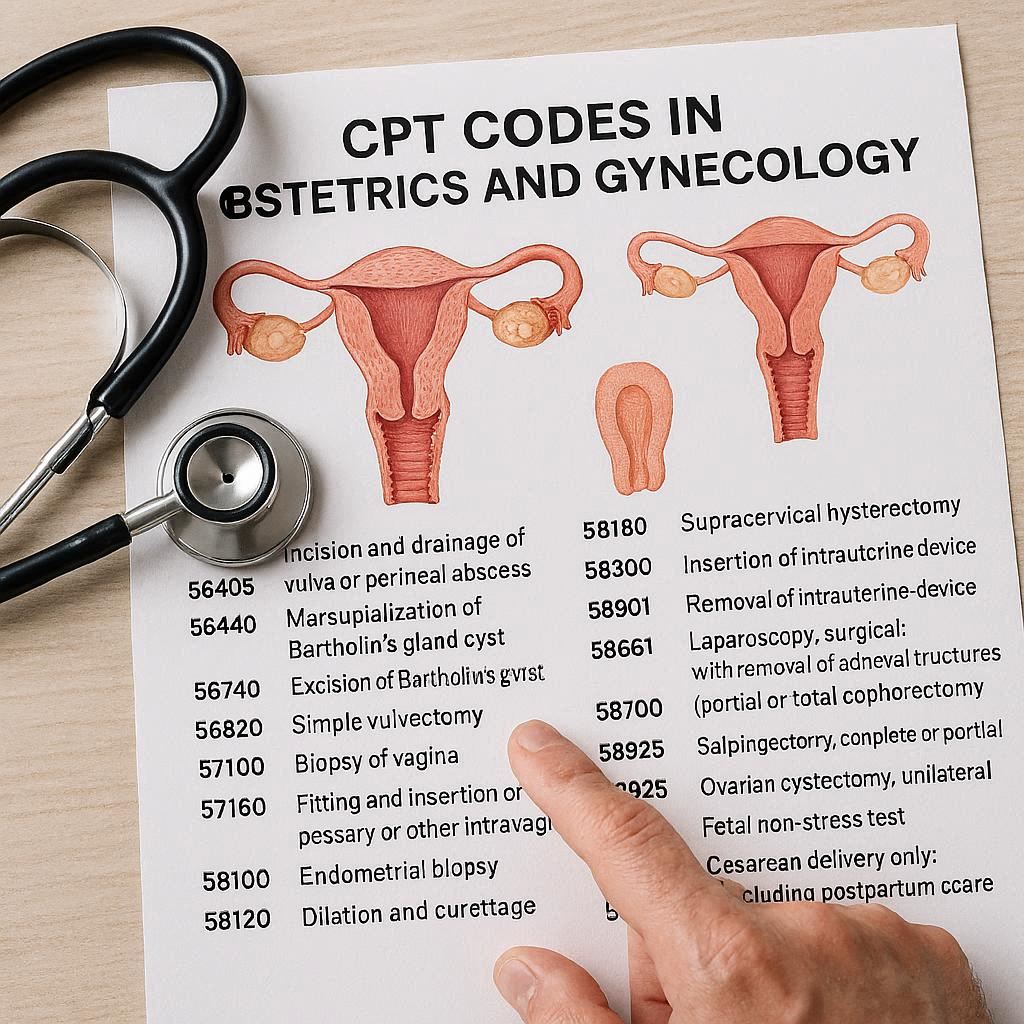
Why Accurate Coding Matters in Women’s Health
Before we dive into specific numbers, let us talk about why precision is so important. Obstetrics and gynecology (OB-GYN) is unique. You often manage long-term patient relationships, pregnancy care that spans months, and surgical procedures that range from simple to highly complex.
A small coding mistake can lead to a denied claim, a delayed payment, or even a compliance audit. On the other hand, clean and accurate coding helps you:
- Get reimbursed faster.
- Reduce administrative headaches.
- Show the true value of the care you provide.
- Stay compliant with payer rules.
Think of this article as your roadmap. You do not need to memorize everything today. Instead, use it as a reference whenever you feel stuck.
What Are CPT Codes? A Quick Refresher
CPT stands for Current Procedural Terminology. These five-digit codes describe every medical service or procedure a healthcare provider performs. The American Medical Association (AMA) maintains and updates these codes every year.
For obstetrics and gynecology, you will encounter three main categories of CPT codes:
- Evaluation and Management (E/M) codes – for office visits, consultations, and hospital care.
- Surgical procedure codes – for surgeries like hysterectomies, laparoscopies, and repairs.
- Maternity care codes – which include global packages for routine prenatal care, delivery, and postpartum follow-up.
Understanding how these groups interact is the first step to mastering OB-GYN coding.
The Structure of OB-GYN Coding: A Bird’s Eye View
To make things easier, let us visualize how codes are organized. The table below shows the main code ranges you will use most often.
Note for readers: Always verify code descriptors in the current year’s CPT manual. Payers update policies frequently, and your codes must match the specific service you provide.
Now, let us explore each group in detail.
Part 1: Evaluation and Management (E/M) Codes in OB-GYN
E/M codes are the backbone of any outpatient practice. You use them every day for routine gynecologic exams, problem-focused visits, and follow-up appointments.
Since January 2021, E/M coding for office visits has changed significantly. The goal was to reduce administrative burden. Here is what you need to know.
New Patient vs. Established Patient Visits
A new patient is someone who has not received any professional service from your practice (or the same group practice and specialty) within the past three years. Everyone else is an established patient.
New patient office visit codes (outpatient):
- 99202 – Straightforward medical decision making (MDM) or low level.
- 99203 – Low MDM.
- 99204 – Moderate MDM.
- 99205 – High MDM.
Established patient office visit codes:
- 99211 – May not require presence of a physician (nurse visit).
- 99212 – Straightforward MDM.
- 99213 – Low MDM.
- 99214 – Moderate MDM.
- 99215 – High MDM.
You choose the level based on medical decision making or total time on the date of the encounter. This flexibility is one of the best recent changes.
Common Gynecologic E/M Scenarios
Let us look at real-life examples.
Scenario 1: Annual wellness exam
A 32-year-old patient comes in for her routine preventive visit. No specific complaints. You perform a breast exam, pelvic exam, and collect a Pap smear. This is typically billed with a preventive medicine code (99381–99397), not a problem-oriented E/M code.
Scenario 2: Problem-focused visit
A 45-year-old patient reports heavy menstrual bleeding for three months. You take a focused history, perform a relevant exam, and order labs. This is usually a 99213 or 99214, depending on the complexity.
Scenario 3: Postoperative follow-up
You saw a patient two weeks after a laparoscopic cystectomy. The visit is related to the surgery. Do not bill an E/M code. Postoperative care is included in the global surgical package unless the patient develops a new, unrelated problem.
Preventive Medicine Codes vs. Problem-Oriented Visits
Many providers ask: “Can I bill both a preventive visit and a problem-oriented visit on the same day?”
Yes, but only under specific conditions. You must document a separately identifiable service. For example, a patient comes for her annual Pap smear but also mentions new pelvic pain. You perform the preventive exam and then address the pain. Append modifier 25 to the E/M code (e.g., 99213-25) and bill the preventive code as well.
Important note: Payers will deny the E/M code if your documentation does not clearly show the extra work. Be honest. Only bill both when the problem-oriented service goes above and beyond the preventive visit.
Part 2: Maternity Care and Delivery Coding
This is where things get interesting. Obstetric care is not billed visit by visit. Instead, payers expect a global package for most routine pregnancies.
The Global Obstetric Package Explained
The global package includes three phases of care:
- All routine prenatal visits (typically 13–15 visits for an uncomplicated pregnancy).
- Delivery (vaginal or cesarean, including the admission to the hospital).
- Postpartum care (usually one visit at 4–6 weeks after delivery).
You bill one single code for the entire package when the same provider or group delivers all the care.
Common global obstetric codes:
When Not to Bill the Global Package
Sometimes, you cannot or should not use a global code. Common exceptions include:
- The patient transfers into your care during the second or third trimester. You bill for the remaining prenatal visits and delivery separately.
- The patient transfers out of your care. Bill a reduced set of prenatal codes.
- You only provide postpartum care. Do not use the global package.
- The patient requires a prolonged hospital stay beyond the normal postpartum period. Some payers allow separate E/M codes for those days.
Coding for Antepartum Care Only
If you manage a pregnancy but do not perform the delivery (e.g., the patient moves or changes providers), use antepartum care codes:
- 59425 – Antepartum care only, 4–6 visits.
- 59426 – Antepartum care only, 7 or more visits.
These codes cover all prenatal care provided up to the point of transfer. Do not add E/M codes for each visit.
Vaginal Delivery Codes: Breaking Down 59400
Code 59400 is your workhorse for uncomplicated vaginal deliveries. It includes:
- All prenatal visits (routine).
- The delivery itself, including episiotomy if performed.
- Forceps or vacuum assistance if needed.
- Postpartum care (one global visit).
You do not separately bill for the hospital admission or daily hospital visits after delivery. Everything is bundled.
Cesarean Delivery Codes: Understanding 59510
Code 59510 works the same way but for a planned or unplanned cesarean section. It includes:
- All routine prenatal care.
- The cesarean delivery procedure.
- Postpartum care.
Remember: If you convert a vaginal delivery attempt to a C-section, you still use the cesarean global code. Do not use two separate delivery codes.
VBAC and Other Complex Deliveries
Codes 59610 (VBAC) and 59618 (C-section after failed VBAC) exist because these deliveries require more attention and carry higher risk. The global package still applies, but the code reflects the additional complexity.
Postpartum Care Only
If you only see a patient for the postpartum visit (e.g., she delivered at another hospital), use:
- 59430 – Postpartum care only (includes one visit).
Do not use the global package. This scenario is common with unplanned out-of-hospital births or transfers from other facilities.
Part 3: Gynecologic Surgery Coding
Surgical coding in gynecology can feel detailed, but it follows predictable rules. Most procedures fall into a 10-day or 90-day global period. During that time, you cannot bill separate E/M codes for routine postoperative visits.
Laparoscopic Procedures
Laparoscopic surgery is common in modern gynecology. Here are some key codes:
- 49320 – Laparoscopy, diagnostic, with or without collection of fluid.
- 58661 – Laparoscopy, surgical; with removal of adnexal structures (e.g., salpingectomy, oophorectomy).
- 58662 – Laparoscopy, surgical; with excision of ovarian cyst.
- 58541 – Laparoscopy, surgical, supracervical hysterectomy.
- 58571 – Laparoscopy, surgical, total hysterectomy (with or without removal of tube(s) and/or ovary(s)).
Hysteroscopy Codes
Hysteroscopy allows you to look inside the uterus and perform minor procedures:
- 58555 – Hysteroscopy, diagnostic.
- 58558 – Hysteroscopy, surgical; with sampling (biopsy) and/or polypectomy.
- 58561 – Hysteroscopy, surgical; with removal of leiomyomata (fibroids).
- 58563 – Hysteroscopy, surgical; with endometrial ablation.
Colposcopy and Biopsy
Colposcopy is an office-based procedure to examine the cervix, vagina, or vulva under magnification.
- 57452 – Colposcopy of the cervix, including upper vagina.
- 57454 – Colposcopy with biopsy(s) of the cervix and endocervical curettage (ECC).
- 57455 – Colposcopy with biopsy(s) of the cervix.
- 57460 – Colposcopy with loop electrode biopsy (LEEP) of the cervix.
Friendly reminder: Do not separately bill a colposcopy and a Pap smear on the same day if the Pap was the reason for the colposcopy. The colposcopy code includes the interpretation of the prior Pap result.
Endometrial Biopsy
Code 58100 – Endometrial biopsy, with or without curettage (not under ultrasound guidance).
This is a common office procedure for abnormal bleeding. Do not confuse it with a dilation and curettage (D&C) performed in an operating room.
Hysterectomy Coding: A Closer Look
Hysterectomy codes depend on the approach. The table below summarizes your options.
Each code includes the basic postoperative care for the global period (usually 90 days for major surgery).
Part 4: Ultrasound and Imaging Codes
Obstetric and gynecologic ultrasound is essential for modern care. You must use the correct code based on the trimester and the complexity of the exam.
Obstetric Ultrasound Codes
- 76801 – Ultrasound, pregnant uterus, real time with image documentation, fetal and maternal evaluation, first trimester (<14 weeks 0 days), single or first gestation.
- 76805 – Ultrasound, pregnant uterus, real time with image documentation, fetal and maternal evaluation, second or third trimester, single or first gestation.
- 76810 – Ultrasound, pregnant uterus, fetal and maternal evaluation, second or third trimester, each additional gestation (list separately in addition to 76805).
- 76811 – Ultrasound, pregnant uterus, detailed fetal anatomic examination, second or third trimester.
- 76817 – Ultrasound, transvaginal, pregnant uterus, first trimester.
Important note: Code 76811 is for high-risk or detailed anatomy scans. Do not use it for routine growth scans. Use 76805 instead.
Gynecologic Ultrasound Codes
- 76830 – Ultrasound, transvaginal.
- 76856 – Ultrasound, pelvic (nonobstetric), real time with image documentation; complete.
- 76857 – Ultrasound, pelvic (nonobstetric), limited or follow-up.
A complete pelvic ultrasound includes evaluation of the uterus, endometrium, adnexa, and cul-de-sac. A limited exam checks a specific structure, such as a known ovarian cyst.
Part 5: Gynecologic Pathology and Laboratory Coding
You cannot talk about women’s health without discussing Pap smears and HPV testing. These codes are often overlooked but critical for revenue.
Pap Smear Coding
The Pap smear itself is a laboratory test. The collection is part of the E/M or preventive visit. Do not bill separately for the collection.
Common pathology codes:
- 88141 – Cytopathology, cervical or vaginal, with manual screening and physician interpretation.
- 88142 – Cytopathology, liquid-based (e.g., ThinPrep), with manual screening.
- 88143 – Cytopathology, liquid-based, with manual screening and rescreening.
- 88174 – Cytopathology, liquid-based, automated screening.
- 88175 – Cytopathology, liquid-based, automated screening with manual rescreening.
Medicare and many commercial payers cover a Pap smear every 12 to 24 months depending on risk factors.
HPV Testing
- 87624 – Infectious agent detection by nucleic acid (DNA or RNA); Human Papillomavirus (HPV), high-risk types.
HPV testing is often performed on the same sample as the Pap smear. Some payers allow both. Others require specific medical necessity.
Part 6: Modifiers You Must Know
Modifiers tell the payer that something changed the service. Two modifiers are especially important in OB-GYN.
Modifier 25 – Significant, Separately Identifiable E/M Service
Use modifier 25 when you perform a significant E/M service on the same day as a minor procedure or another E/M service. For example: a patient has an annual exam (preventive code) and you also treat a urinary tract infection (E/M code 99213). You append modifier 25 to 99213.
Do not use modifier 25 just to bill two E/M codes for the same problem. That is fraud.
Modifier 59 – Distinct Procedural Service
Use modifier 59 when you perform two procedures that are normally bundled but are truly separate. For example, you perform a colposcopy (57452) and an endometrial biopsy (58100) during the same session for different reasons. Appending modifier 59 to the biopsy code tells the payer these are distinct.
Modifiers for Bilateral Procedures
Some gynecologic procedures are performed on both sides (e.g., bilateral salpingectomy). Use modifier 50. The payer will adjust payment accordingly.
Part 7: Common Coding Mistakes and How to Avoid Them
Even experienced coders make errors. Here are the most frequent pitfalls in OB-GYN coding.
Mistake #1: Using Global Codes for Fragmented Care
You cannot bill a global delivery code if you did not provide all three phases of care (prenatal, delivery, postpartum). If a patient transfers at 30 weeks, use antepartum codes (59425 or 59426). Do not use 59400.
Mistake #2: Billing E/M Codes During Global Periods
After a vaginal delivery (global period 90 days), you cannot bill separate E/M visits for routine postpartum issues. Exceptions include new problems unrelated to the pregnancy, such as a respiratory infection.
Mistake #3: Unbundling Ultrasound Services
Some providers bill the transvaginal ultrasound (76817) plus a complete pelvic ultrasound (76856) on the same day. Most payers consider these bundled. Choose the code that best describes the primary reason for the exam.
Mistake #4: Incorrect Use of Modifier 25
Modifier 25 is overused. If the E/M service is not significant and separately identifiable, do not append it. The preventive visit already includes some degree of history and exam.
Part 8: Telehealth in OB-GYN
Telehealth is here to stay. Many routine gynecologic and some obstetric visits work well virtually.
Telehealth E/M codes (audio/video):
Use the same E/M codes as in-person visits (99202–99215). Append modifier 95 or place of service (POS) 02 depending on the payer.
Telephone visits (audio only):
- 99441 – Telephone E/M, 5–10 minutes.
- 99442 – Telephone E/M, 11–20 minutes.
- 99443 – Telephone E/M, 21–30 minutes.
Check each payer’s telehealth policy. Medicare and many commercial plans have different rules for audio-only services.
Part 9: A Practical Guide to Documentation
Good coding starts with good documentation. You cannot code what you did not write down.
The SOAP Note for OB-GYN
Keep your notes clear, concise, and complete. Every note should include:
- Subjective: The patient’s chief complaint, history, review of systems.
- Objective: Vital signs, exam findings, ultrasound results, lab values.
- Assessment: Your diagnosis or differential diagnosis (use specific ICD-10 codes).
- Plan: What you will do next (medications, follow-up, procedures, referrals).
Linking ICD-10 to CPT Codes
A CPT code without an ICD-10 code is incomplete. The diagnosis must justify the procedure.
For example:
- CPT 59400 (vaginal delivery) needs an appropriate pregnancy code (O80 for uncomplicated delivery).
- CPT 58100 (endometrial biopsy) needs a diagnosis like N93.8 (abnormal uterine bleeding).
Do not use unspecified codes unless truly necessary. Payers often deny unspecified codes.
Quick Reference Table: OB-GYN CPT Codes by Service Type
This table helps you find the right code quickly.
Part 10: Staying Compliant and Avoiding Audits
Audits are stressful, but they do not have to be scary. The key is consistency and honesty.
Red Flags for Payers
Certain patterns trigger audits. Avoid these:
- Billing a high-level E/M code (99215) for every patient.
- Using modifier 25 on a high percentage of visits.
- Billing global delivery codes for patients you saw only once or twice.
- Unbundling codes that should be reported together.
Internal Audits
Perform a small internal audit every quarter. Pick 10 random charts and check:
- Does the CPT code match the documentation?
- Is the ICD-10 code specific and supported?
- Is the modifier used correctly?
- Are global periods respected?
Catch your own mistakes before a payer does.
Resources for Ongoing Education
Coding changes every year. Stay updated with:
- AMA CPT® Assistant – official guidance from the AMA.
- ACOG Coding Manual – tailored for obstetrics and gynecology.
- CMS Medlearn – free Medicare training materials.
Part 11: Real-World Coding Scenarios (With Solutions)
Let us test your knowledge with five common situations.
Scenario 1: Routine prenatal care, uncomplicated vaginal delivery
You see a low-risk patient for 14 prenatal visits. She delivers vaginally at 39 weeks. You see her once at 6 weeks postpartum.
Answer: 59400 (global vaginal delivery).
Scenario 2: Patient transfers at 32 weeks
A patient moves to your city at 32 weeks pregnant. You manage her care for the remaining 7 prenatal visits. She delivers vaginally at another hospital (not your group).
Answer: 59426 (antepartum care only, 7+ visits). You do not bill the delivery.
Scenario 3: Annual exam with a new problem
A patient comes for her annual Pap. During the visit, she reports dyspareunia (pain with intercourse). You perform a pelvic exam and diagnose vaginitis.
Answer: 99395 (preventive visit) AND 99213-25 (problem-oriented E/M). Append modifier 25 to the 99213.
Scenario 4: Postoperative visit after hysterectomy
A patient returns 3 weeks after a total laparoscopic hysterectomy (58571). She feels well. No new issues.
Answer: Do not bill an E/M code. The visit is included in the 90-day global surgical package.
Scenario 5: Colposcopy with multiple biopsies
You perform a colposcopy, take three cervical biopsies, and perform an endocervical curettage (ECC).
Answer: 57454 (colposcopy with biopsy(s) and ECC). One code covers all the work.
Conclusion (Three Lines)
CPT codes for obstetrics and gynecology follow clear patterns once you understand global packages, surgical periods, and E/M guidelines. Accurate coding protects your revenue, reduces denials, and demonstrates the value of comprehensive women’s health care. Use this guide as your daily reference, stay curious, and always document the full story of the patient encounter.
Frequently Asked Questions (FAQ)
1. Can I bill a global delivery code if I only saw the patient for the third trimester?
No. The global package assumes you provide all routine prenatal care. If you only manage the third trimester, use antepartum care codes 59425 or 59426 (depending on the number of visits). Do not use 59400.
2. How do I bill a C-section that started as a vaginal delivery?
Use the cesarean global code (59510). Do not bill two separate delivery codes. The global package covers the entire delivery event, regardless of how it started.
3. What is the difference between 76805 and 76811?
Code 76805 is a standard obstetric ultrasound in the second or third trimester for fetal growth and maternal evaluation. Code 76811 is a detailed fetal anatomic examination reserved for high-risk pregnancies or suspected anomalies.
4. Can I bill a colposcopy and an endometrial biopsy on the same day?
Yes, if they are performed for different reasons and are truly separate. Append modifier 59 to the endometrial biopsy code (58100-59). Document clearly why each procedure was medically necessary.
5. How often can I bill a preventive medicine visit (well-woman exam)?
Most payers cover one preventive visit per calendar year. Some allow every 12 months. Check your specific payer contracts. Medicare covers an annual wellness visit, but it uses different HCPCS codes (G0438, G0439).
6. Do I need to use a modifier when I bill an office visit on the same day as a minor procedure (e.g., IUD insertion)?
Yes, if the office visit is for a separate, significant problem. Append modifier 25 to the E/M code. If the visit is only to discuss the IUD or for preoperative clearance, do not bill a separate E/M code.
7. What is the global period for a vaginal delivery?
The global period for vaginal delivery is 90 days. This includes all routine prenatal visits, delivery, and the postpartum visit. Do not bill separate E/M codes for routine care during those 90 days.
8. How do I code a telehealth visit for a routine gynecologic concern?
Use the same E/M code as you would for an in-person visit (e.g., 99213). Append modifier 95 and use place of service 02 (telehealth) if required by the payer. Check each payer’s policy because rules vary.
Additional Resource
For the most current and official guidance on CPT coding, visit the American College of Obstetricians and Gynecologists (ACOG) Coding Resource Center:
👉 ACOG Coding and Reimbursement Resources
Note: ACOG members have access to exclusive coding quizzes, monthly Q&As, and a coding hotline. Non-members can still access many free articles and fact sheets.
Disclaimer: This article is for educational purposes only. Coding rules, payer policies, and regulations change frequently. Always consult the current CPT manual, your local payer contracts, and a certified professional coder before submitting claims. The author and publisher assume no responsibility for billing errors, denials, or compliance issues arising from the use of this information.