Navigating the world of medical billing requires precision. When a provider performs an excision of a vulvar lesion, selecting the correct CPT code is critical for reimbursement and compliance. This decision is not always a simple one-and-done lookup. The anatomical location, the size of the lesion, and the pathology results all dictate which code you ultimately select.
This article provides a deep, authoritative dive into the Current Procedural Terminology (CPT) codes associated with the excision of vulvar lesions. You will learn how to distinguish between integumentary and genital system codes, how to properly measure and document for maximum accuracy, and how to avoid the most common coding pitfalls that lead to denials.
We will structure this guide to move from the basic, most common scenarios to the more complex and nuanced ones. By the end, you will have a lasting reference that clarifies the coding pathway for almost any vulvar lesion excision you encounter.
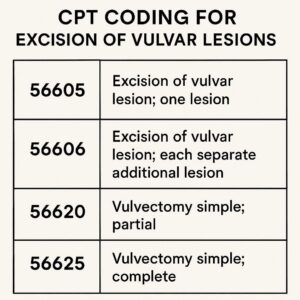
CPT Coding for Excision of Vulvar Lesions
Foundational Concepts: The Two Coding Pathways
Before looking up a specific code, you must understand a fundamental split in how the American Medical Association (AMA) classifies these procedures. The excision of a vulvar lesion falls into one of two distinct coding families. The first is the Integumentary System, and the second is the Female Genital System. Your journey begins by choosing the correct pathway.
The Integumentary System Route
This pathway treats the excision much like removing a skin lesion from an arm or a leg. The codes reside in the 11400-11646 range. You use these codes when the provider excises a lesion confined to the skin and subcutaneous tissue of the vulva. The key driver here is the lesion’s pathology: benign or malignant, and its exact clinical diameter.
The Female Genital System Route
This pathway uses codes from the 56405-58999 range. You select these when the procedure is more extensive, involving deeper structures of the vulva. A classic example is a radical vulvectomy or a partial excision that goes deep into the underlying tissue. The code’s descriptor, not the size, primarily drives this selection.
Critical Note: The surgeon’s intent and the final pathology report are the ultimate arbiters. If the surgeon removes a lesion suspected of being malignant but the pathology comes back benign, you typically code for a benign lesion excision. Code what was done and what was found.
Deep Dive: Integumentary Excision Codes (The 11400-11646 Range)
In most common clinical scenarios, a surgeon removing a mole, cyst, or small lesion from the labia majora or perineum will use an integumentary code. The AMA organizes these codes by two factors: the lesion’s clinical presentation and its size at its widest point.
Understanding Benign vs. Malignant Coding
The difference is binary but essential.
-
Benign Lesions (11420-11426): Cysts, seborrheic keratoses, skin tags, and moles without atypia.
-
Malignant Lesions (11620-11626): Basal cell carcinoma, squamous cell carcinoma, melanoma, and any lesion with malignant pathology.
For each category, you must add to your operative note the exact size of the excised lesion, plus the smallest necessary margin required to remove it entirely.
Master Code Table for Vulvar Integumentary Excision
This table provides your quick-reference grid. Each code specifies the location (noted in the descriptor for trunk, scalp, neck, hands, feet, genitalia) and the size. The vulva falls under this “genitalia” designation.
| CPT Code | Lesion Type | Size (Greatest Clinical Diameter plus Margins) |
|---|---|---|
| 11420 | Benign | 0.5 cm or less |
| 11421 | Benign | 0.6 to 1.0 cm |
| 11422 | Benign | 1.1 to 2.0 cm |
| 11423 | Benign | 2.1 to 3.0 cm |
| 11424 | Benign | 3.1 to 4.0 cm |
| 11426 | Benign | Over 4.0 cm |
| 11620 | Malignant | 0.5 cm or less |
| 11621 | Malignant | 0.6 to 1.0 cm |
| 11622 | Malignant | 1.1 to 2.0 cm |
| 11623 | Malignant | 2.1 to 3.0 cm |
| 11624 | Malignant | 3.1 to 4.0 cm |
| 11626 | Malignant | Over 4.0 cm |
A Note on the Missing CPT Code 11425
Sharp-eyed coders notice a gap in the benign range. CPT code 11425 does not exist. For a benign lesion on the trunk, arms, or legs, codes exist in that sequence, but for the specific anatomical grouping including the vulva, the progression jumps from 11424 (3.1 to 4.0 cm) directly to 11426 (over 4.0 cm). You must never mistakenly bill a non-existent code.
Intermediate and Complex Repairs
Often, the excision requires more than a simple single-layer closure. An intermediate repair (layered closure of deeper subcutaneous tissue) or complex repair (scar revision, extensive undermining) may be bundled. Do not separately bill a layered closure. The CPT manual considers an intermediate repair as an inclusive component of an excision code. You may bill a repair separately only under very specific conditions, such as an extensive repair on a separate injury not related to the lesion removal.
The Genital System Route: Deep and Radical Procedures
When the surgeon’s work goes beyond the skin, you leave the 11400-11600 series and enter the Female Genital System subsection. This typically occurs with chronic, extensive, or deeply infiltrating conditions.
CPT 56605: Biopsy of Vulva or Perineum
Sometimes, a provider removes a piece of a lesion, not the whole thing. This is a biopsy, not an excision. For a simple vulvar biopsy, use CPT 56605, biopsy of the vulva or perineum (one or more separate lesions). You use this code for a single biopsy or multiple biopsies in the same anatomical area. Do not use an excision code here, as the intent was diagnostic tissue sampling, not complete removal with margins.
CPT 56620: Simple Vulvectomy
When a provider removes the entire vulva—skin and mucosa—for extensive benign disease like chronic vulvar lichen sclerosus or severe condyloma, the correct code is CPT 56620, simple vulvectomy. This procedure is a full-thickness removal, but it does not go down to the deep fascia.
CPT 56630-56640: Radical Vulvectomy
When invasive cancer is the diagnosis, a radical vulvectomy becomes necessary. This procedure removes the entire vulva down to the deep fascia, perineal body, and often includes the inguinal lymph nodes. The codes are:
-
56630: Radical hemivulvectomy (unilateral)
-
56631: Radical hemivulvectomy with unilateral inguinal lymph node dissection
-
56633: Radical complete vulvectomy
-
56634: Radical complete vulvectomy with bilateral inguinal lymph node dissection
These codes tell a story of extensive, oncologic surgery. You will not use these for a skin lesion that a provider can remove in an office setting.
A Comparative Analysis: Simple Excision vs. Extensive Procedure
To solidify your understanding, this table contrasts the key features of the two main coding pathways.
| Feature | Integumentary Excision (11420-11426 / 11620-11626) | Female Genital Excision (56605-56640) |
|---|---|---|
| Primary Driver | Lesion diameter (including margins) and pathology | Extent of dissection and anatomical structures removed |
| Depth of Tissue | Skin and subcutaneous tissue only | Subcutaneous tissue, fascia, muscle, or full organ |
| Typical Indication | Isolated mole, cyst, basal cell carcinoma | Extensive benign disease, in situ or invasive carcinoma |
| Repair Coding | Simple repair included; layered closure included | Not typically separately reported; wound closure is part of the major procedure |
| Pathology Report | Guides benign vs. malignant selection | Guides radicality (simple vs. radical vulvectomy) |
| Setting | Often office or outpatient | Almost always hospital or ambulatory surgery center |
“The depth of the defect is not the primary factor in choosing between integumentary and genital codes. It is the extent of the disease and the approach. A deep subcutaneous lesion of the vulva excised with full margins can still be an integumentary code if it does not involve a partial vulvectomy.”
Documentation Essentials: What the Operative Note Must State
Coders cannot select a valid code from a sparse note that reads, “Vulvar lesion was excised.” Specificity in documentation is the only shield against an audit. Your operative reports must be pristine.
1. The Exact Location
The note must specify the location on the vulva. Examples:
-
Left labia majora
-
Right periclitoral area
-
Perineum
-
Posterior fourchette
2. The Clinical Size of the Lesion
The surgeon must measure the lesion in situ before excision. This is the greatest clinical diameter.
3. The Final Excised Diameter
The surgeon must describe the margins taken and measure the entire excised specimen. For example: “The lesion measured 0.8 cm. A 0.2 cm margin was drawn. The total excised specimen diameter was 1.2 cm.” For an integumentary code, you select the CPT based on the 1.2 cm total.
4. The Depth of the Excision
The note must state the deepest layer. “Excision was carried through the dermis into the subcutaneous fat.” This confirms the integumentary nature of the procedure. If the surgeon goes through the dartos layer or down to the fascia, this signals a deeper, more extensive procedure.
5. The Type of Closure
Simple, layered (intermediate), or flap/graft (complex). This context clarifies the work performed, even though the closure is bundled with the excision code.
6. The Histology
A preliminary guess is useful, but the final, pathological diagnosis is mandatory. Your final code selection for benign (11420-11426) versus malignant (11620-11626) hinges entirely on the pathology report.
The Role of Pathology in Final Code Assignment
A common scenario: a surgeon excises a suspicious pigmented lesion from the vulva. The surgeon documents “Excision of suspicious vulvar lesion, 1.5 cm total diameter.” The patient leaves. A week later, the pathology report arrives.
If the diagnosis is “Compound melanocytic nevus,” you code CPT 11422 (benign, 1.1 to 2.0 cm).
If the diagnosis is “Superficial spreading melanoma,” you code CPT 11622 (malignant, 1.1 to 2.0 cm).
The size is identical. The code changes based on the benign or malignant nature of the cells. You must hold your claim for the final pathology report if the procedure had diagnostic uncertainty. Premature billing without the pathology result is a leading cause of incorrect coding and a compliance risk.
Modifier Mastery for Vulvar Lesion Excision
Clinical practice frequently presents scenarios where a single procedure code is not enough. Modifiers provide the granular detail to explain the full picture to the payer.
Modifier -LT or -RT: Anatomical Specificity
The vulva has bilateral structures. While some payers may not strictly require a lateral modifier for a midline perineal lesion, applying -LT (Left) or -RT (Right) to a labial lesion is a best practice. It unequivocally states the location and can prevent a duplicate claim denial if another lesion is removed from the opposite side at a different time.
Modifier -59 or -XS: Distinct Procedural Service
This is the most potent and most frequently misused modifier pair in lesion coding. You use these when a surgeon excises two distinct and separate lesions.
Scenario: A surgeon removes a 0.4 cm benign mole from the left labia majora and a separate, 0.8 cm benign cyst from the right labia majora.
Incorrect: CPT 11420, CPT 11421
Correct: CPT 11420-LT, CPT 11421-XS-RT (or -59).
The -XS (Separate Structure) modifier is the most specific, indicating the procedures were on separate organs or anatomical structures. The -59 (Distinct Procedural Service) modifier is a broader declaration that the second procedure was distinct and independent. You should never append these modifiers just because you have two codes. The operative note must explicitly document two separate incisions or distinct, non-contiguous lesions.
Modifier -51: Multiple Procedures
Some payers prefer the -51 modifier for multiple surgical procedures at the same session rather than the -59/-XS route. This instructs the payer to apply their multiple surgery reduction rule, often paying the first code at 100% and subsequent ones at 50%. Always know your payer’s specific preference, as a mismatch here will trigger a rejection. Most government payers process multiple procedures without requiring -51, but many commercial carriers still demand it.
Common Scenarios and Step-by-Step Coding
Theory is vital, but applying it to real-world cases solidifies your skill. Let’s walk through several common scenarios.
Scenario 1: The Simple Office Excision
Note: “A 0.4 cm raised, fleshy lesion on the right labia majora. A 0.1 cm margin was drawn elliptically. Total excised diameter 0.6 cm. Excision through dermis. Layered closure with 3-0 Vicryl. Pathology: Squamous papilloma (benign).”
-
Pathway: Integumentary, Benign.
-
Total Size: 0.6 cm.
-
Code: 11421-RT.
-
Closure: Bundled, not separately billed.
Scenario 2: The Malignant Lesion
Note: “A 1.0 cm ulcerated lesion on the left labia minora, suspicious for basal cell. A 0.3 cm margin drawn. Total excised diameter 1.6 cm. Subcutaneous tissue removed. Closure complex, requiring adjacent tissue advancement. Pathology: Infiltrating basal cell carcinoma.”
-
Pathway: Integumentary, Malignant.
-
Total Size: 1.6 cm.
-
Code: 11622-LT.
-
Closure: The complex repair (adjacent tissue transfer, 14000s) is separately billable here. The complexity of closure for a malignant lesion excision is often inherently higher, and if the surgeon meets the criteria for a complex repair, you may report both with a -51 modifier.
Scenario 3: Multiple Lesions
Note: “Lesion A: 0.5 cm seborrheic keratosis on right labia majora, 0.5 cm excised diameter. Lesion B: a separate 1.5 cm cyst on the perineum, 2.0 cm excised diameter. Both are benign, simple closures.”
-
Pathway: Integumentary, Benign.
-
Lesion A Code: 11420-RT.
-
Lesion B Code: 11422 (perineum).
-
Modifier: Append -XS or -59 to CPT 11422 to indicate it was a distinct service from 11420-RT. The operative note must clearly state the two lesions were not contiguous.
Scenario 4: The Biopsy, Not an Excision
Note: “A punch biopsy of the vulvar lesion was performed. A 3 mm sample was taken from the edge of the lesion. Hemostasis achieved. Specimen sent for pathology.”
-
Pathway: This is not a complete excision.
-
Code: 56605.
-
Rationale: The intent was to sample, not to remove with curative margins. Even if the pathology report later says “benign skin tag,” you code a biopsy, not an excision, as the entire lesion was not removed.
Navigating the CCI Edits and Bundling Rules
The National Correct Coding Initiative (CCI) prohibits billing for services that are inherently part of a comprehensive procedure. For vulvar excision, the most critical edits center on the closure.
Closure Bundles
You cannot report a simple or layered closure separately. The work of closing the wound is an integral part of an excision. CCI bundling edits permanently pair simple repair codes (12001-12007) and intermediate repair codes (12031-12037) with all integumentary excision codes. An attempt to unbundle these is a billable error that flags an audit.
Exploration and Hemostasis
Controlling bleeding with suture ligature or electrocautery is part of the procedure. You cannot bill a “surgical exploration and ligation of bleeders” separately.
Separate Procedures
If the provider performs a vulvar lesion excision and a totally unrelated procedure, such as a hysteroscopy, the CCI edits may not bundle them. However, always consult your real-time CCI checker software. A common bundle exists between a vulvar excision and a vaginal lesion excision at the same session if they are in close proximity. A -59 modifier may bypass the edit, but only with strong documentation of separate sites and incisions.
Medical Necessity and ICD-10-CM Linkage
Payer reimbursement hangs on the diagnosis code you link to the CPT. You must show medical necessity for the excision. A cosmetic removal of a perfectly benign, asymptomatic mole is not covered.
Common Benign Diagnoses
-
D28.0: Benign neoplasm of vulva
-
N90.89: Other specified noninflammatory disorders of vulva (covers cysts, vulvar tags)
-
B07.8: Other viral warts (condyloma acuminatum)
-
L72.9: Cyst of skin, unspecified
-
L82.1: Other seborrheic keratosis
Common Malignant Diagnoses
-
C51.0: Malignant neoplasm of labium majus
-
C51.1: Malignant neoplasm of labium minus
-
C51.9: Malignant neoplasm of vulva, unspecified
-
C44.510: Basal cell carcinoma of skin of trunk (verify specific vulvar skin C44 codes for the latest ICD-10 specificity)
-
C79.82: Secondary malignant neoplasm of genital skin
Always link the most specific ICD-10 code available. A code of “N90.9, unspecified noninflammatory disorder of the vulva” is weak. A code for “N90.7, vulvar cyst” is strong. Strength of diagnosis coding directly impacts your clean claim rate.
Advanced Considerations: Lymph Node Biopsy and Mohs Surgery
Your coding journey may lead you beyond a simple excision into surgical oncology and specialized dermatology procedures.
Sentinel Lymph Node Biopsy
A radical vulvectomy for cancer frequently includes a sentinel lymph node biopsy (SLNB). For a vulvar lesion, the regional nodes are the inguinal lymph nodes. You will report the SLNB with CPT codes 38531 (injection of radioactive tracer) and 38900 (intraoperative identification of sentinel node), alongside the specific lymph node excision codes (e.g., 38760-38765 for superficial inguinal lymphadenectomy). This is complex, multispecialty coding that demands a detailed, separate paragraph in the operative report dedicated to the node dissection.
Mohs Micrographic Surgery
Dermatologists often treat ill-defined or recurrent basal or squamous cell carcinomas of the vulva with Mohs surgery. The Mohs surgeon acts as both the surgeon and the pathologist. The CPT codes for this are entirely separate from the standard excision codes.
-
17311: Mohs, 1st stage, head/neck/hands/feet/genitalia
-
17312: Each additional stage
-
17315: Mohs, 1st stage, trunk/arms/legs
You bill for each stage of tissue removal and microscopic examination. If a different surgeon closes the Mohs defect, that surgeon bills the appropriate repair code. An excision code (11400/11600 series) is never reported for Mohs surgery.
Common Billing Pitfalls and How to Avoid Them
Coding errors are predictable. By recognizing them, you can build a process that systematically avoids them.
| Pitfall | The Risk | The Solution |
|---|---|---|
| Billing Before Pathology is Final | Submitting a malignant code (11600) when the path shows benign, or vice versa. This is an incorrect claim that must be rebilled. | Hold the claim for 5-7 days until the final pathology is signed out. |
| Coding a Biopsy as an Excision | The code 56605 exists for a reason. Billing an excision for a punch biopsy is upcoding and a classic False Claims Act risk. | Ask: “Did the provider remove the entire visible lesion with intent for cure?” If no, it’s likely a biopsy. |
| Using the Missing Code 11425 | This code does not exist in the CPT manual for the vulvar anatomical grouping. The claim will reject. | Always go directly from 11424 (3.1-4.0 cm) to 11426 (over 4.0 cm). |
| Upcoding a Vulvectomy | Billing a simple vulvectomy (56620) for a wide local skin excision of the labia. | A vulvectomy removes the full skin and mucosa of the vulva. A wide local excision, even a large one, is an integumentary code. |
| Failing to Append Modifiers for Multiple Lesions | A single payment for two distinct procedures. The payer bundles the two line items, paying only the higher-valued one. | Append -XS or -59 with clear documentation of separate anatomical structures or incisions. |
“An audit flag is raised not by the complexity of the case, but by a pattern of mismatch between the operative note and the code. A 5 cm benign lesion coded as 11424 (a 3.1-4.0 cm code) is an immediate red flag.”
The Financial Reimbursement Landscape
Understanding the relative value unit (RVU) hierarchy for these codes helps set accurate financial expectations and explains why accurate coding matters to a practice’s bottom line. (Values are illustrative and based on the Medicare Physician Fee Schedule; consult your MAC for local rates).
| CPT Code | Description | Non-Facility Total RVUs (Approx.) |
|---|---|---|
| 11420 | Exc B9 lesion 0.5 cm or less | 1.85 |
| 11422 | Exc B9 lesion 1.1-2.0 cm | 2.65 |
| 11602 | Exc Mal lesion 1.1-2.0 cm | 4.10 |
| 56605 | Biopsy of vulva/perineum (one or more) | 1.60 |
| 56620 | Simple vulvectomy | 14.50 |
| 56633 | Radical complete vulvectomy | 32.00 |
The jump from a simple integumentary excision to a radical genital procedure represents a twenty-fold increase in work and practice expense RVUs. This is why the documentation must impeccably support the level of intensity and skill used.
Building an Audit-Proof Process
A single coder is a check. A system of coding is a solution. To make this article a truly lasting reference, you need a workflow.
The Seven-Step Workflow for Vulvar Lesion Coding
-
Receive Operative Note: Do not code from a superbill. Pull the full note.
-
Identify Procedure Intent: Biopsy? Complete excision? Radical resection?
-
Determine Depth and Structures Removed: Skin/subcut only (Integumentary) or deeper/entire vulva (Genital)?
-
Measure the Lesion: Find the statement of total excised diameter. If missing, query the physician immediately.
-
Wait for Final Pathology: Place a hold. Do not release the claim.
-
Select Benign or Malignant Code: Based on the final path report, select from the 11420-11426 or 11620-11626 range with the correct size.
-
Apply Modifiers and Diagnoses: Link the most specific ICD-10 code(s), append -LT/-RT and any distinct service modifier, and submit a clean claim.
Essential Quotations for Your Coding Library
These authoritative statements distill complex coding principles into single, actionable rules.
-
From the AMA CPT Assistant on Integumentary Excision: “Code selection is determined by measuring the greatest clinical diameter of the apparent lesion plus that margin required for complete excision.”
-
AAD (American Academy of Dermatology) on Benign vs. Malignant: “If the preoperative diagnosis is uncertain, it is appropriate to wait for the pathology report to assign the correct benign (11400-11446) or malignant (11600-11646) CPT code.”
-
ACOG (American College of Obstetricians and Gynecologists) on Vulvar Procedures: “Simple vulvectomy (56620) involves removal of the skin and mucosa of the vulva and should not be reported for a skin lesion excision.”
Frequently Asked Questions (FAQ)
What is the single most accurate CPT code for a routine vulvar mole removal?
There is no single code. The most common code is 11421 or 11422, for a benign lesion excision. You must select the final code based on the total excised diameter (lesion plus margins).
Can I bill an E/M service with a vulvar excision on the same day?
Yes, but only with a modifier -25. The evaluation and management service must be a significant, separately identifiable service. The decision to perform surgery is part of the pre-service work for a minor procedure. You need a separate diagnosis or distinct complaint for an E/M to be billable. For example, managing the patient’s diabetes and then deciding to remove the vulvar lesion would be documented separately.
How do I code a shave removal of a vulvar lesion?
A shave removal is not an excision. For a shave, use codes 11300-11313. Shave codes are for removal of epidermal or dermal lesions without a full-thickness incision and closure. An excision involves a full-thickness cut and closure (stitches). The operative note stating a “shave technique” or “no closure” is your clue.
Does the CPT code for an excision include the local anesthetic?
Yes. The administration of local anesthetic is considered part of the surgical package and is not separately reportable.
What modifier do I use for a bilateral vulvar excision?
If identical lesions are excised from both the left and right side, use the appropriate code with modifiers -LT and -RT on separate lines. This clearly signals a bilateral procedure, which often results in payment at 150% of the unilateral rate (100% for the first side, 50% for the second).
Additional Resources
For the most definitive coding guidance, always consult the primary sources. The AMA is the keeper of the CPT code set.
-
AMA CPT Professional Edition: This is the essential source. It contains parenthetical notes, guidelines, and the official code descriptors discussed in this guide. No article can replace a current-year, spiral-bound copy of the code book.
-
Link to Resource: AMA Store – CPT Books
Conclusion
Selecting the correct CPT code for excision of a vulvar lesion requires a systematic approach that integrates operative note details, precise measurements, and final pathology. The choice pivots on the simple yet critical distinction between an integumentary procedure, coded by size and type in the 11420-11626 range, and a more radical genital procedure coded by extent in the 56605-56640 series. By mastering these pathways and implementing a strict documentation-to-claim workflow, you ensure full, compliant reimbursement while eliminating the risk of audit flags and denials.