If you have ever stared at a claim denial and wondered why a perfectly good procedure was not paid, you already know how important modifiers are. They are the secret heroes of medical billing.
Modifiers tell a fuller story. They show that something changed, something was shared, or something unusual happened during a service. Without them, payers see only part of the picture. And that often leads to rejected or reduced payments.
This guide gives you a clear, usable CPT modifier code list. You will learn what each modifier means, when to attach it, and where things can get tricky.
Let us start with the basics.
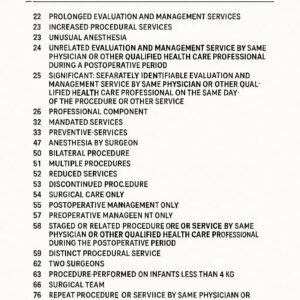
CPT Modifier Code List
What Are CPT Modifiers and Why Do They Matter?
CPT modifiers are two-character codes added to a five-digit CPT procedure code. They can be numeric, alphanumeric, or two letters. You place them after the main CPT code, separated by a hyphen.
Their job is simple: adjust the description of a service without changing the procedure code itself.
For example, a modifier might say:
-
The procedure took longer than usual.
-
The work was shared between two surgeons.
-
Only part of a service was performed.
Without modifiers, claims look identical even when the real work is different. That confuses payers and hurts your revenue cycle.
“Modifiers are the difference between a clean claim and a confused payer. Use them right, and you get paid fairly. Use them wrong, and you invite audits.” – Senior Revenue Cycle Consultant
How to Use This CPT Modifier Code List
This list focuses on the most commonly used modifiers across physician offices, outpatient hospitals, and ambulatory surgery centers.
We will cover:
-
Each modifier’s full name
-
What it means in plain English
-
When to use it (and when to avoid it)
-
Real‑world examples
-
Important payer notes
Some modifiers look similar but mean very different things. Pay close attention to those sections.
Part 1: Surgical and Procedural Modifiers
These modifiers change how payers view surgical procedures, especially when multiple procedures happen on the same day or with unusual circumstances.
Modifier 22 – Increased Procedural Services
Use this when a procedure requires significantly more work than typical. The extra work must be documented clearly.
When to use:
-
Unusual anatomy (scarring, obesity, prior surgery)
-
Unexpected difficulty during the procedure
-
Longer time far beyond the normal range
When not to use:
-
Slightly longer time without documentation
-
Just because you want more money
Example:
A gallbladder removal that takes 3 hours due to dense adhesions from a prior surgery. Append the 22 modifier and submit operative notes.
Payer note: Many payers require a separate report or notes. Some automatically reduce payment. Check your local MAC policy.
Modifier 47 – Anesthesia by Surgeon
Rare but important. Use it when the surgeon provides regional or general anesthesia without a separate anesthesia provider.
When to use:
-
Surgeon administers anesthesia for a procedure
-
No anesthesiologist or CRNA involved
Do not use for local anesthesia (the surgeon always provides that).
Example:
A surgeon performs a nerve block before a hand procedure in an office setting without an anesthesia team.
Modifier 50 – Bilateral Procedure
Use this when a procedure is performed on both sides of the body (left and right) during the same session.
Some codes are already bilateral by definition. Do not add modifier 50 to those.
Example:
Knee arthroscopy on both the left and right knee in one operative session.
Payer note:
Medicare and many payers have specific bilateral payment rules. Some automatically pay 150% of the fee schedule. Others require modifier 50 on a single line instead of two lines.
Modifier 51 – Multiple Procedures
This tells the payer you performed more than one procedure during the same surgical session. The primary procedure is paid at 100%. Secondary procedures are often reduced (typically 50%).
When to use:
-
Multiple distinct procedures
-
Same patient, same day, same session
When not to use:
-
Add‑on codes (they already have reduced payment built in)
-
Certain code pairs designated as “mutually exclusive”
Example:
Removal of a skin lesion (11400) and repair of a laceration (12031) during the same visit.
Important note: Many commercial payers now ask you not to use modifier 51 because their systems automatically apply multiple procedure reductions. Check each payer’s policy.
Modifier 52 – Reduced Services
Use this when a procedure is partially reduced or discontinued due to circumstances beyond your control, but you still performed some of the work.
When to use:
-
Procedure stopped due to patient intolerance
-
Anatomical limitation prevents completion
-
Equipment failure
Do not use for elective termination or lack of medical necessity.
Example:
Colonoscopy that cannot advance past the splenic flexure due to severe looping and patient discomfort. Partial exam performed.
Documentation tip: Always note why the service was reduced. Attach a brief note to the claim.
Modifier 53 – Discontinued Procedure
This is different from modifier 52. Use 53 when you start a procedure but stop it before anesthesia is induced or before the patient is prepped? Wait, that is not correct. Let us clarify.
Actually:
-
Modifier 53 is for procedures discontinued after anesthesia is administered but before the procedure is completed due to circumstances threatening the patient’s well‑being.
Example:
Patient has a reaction to sedation before the surgeon makes the first incision. Procedure is stopped.
Payer note: Some payers prefer modifier 52 for discontinued services. Medicare has specific guidelines. Always check.
Modifier 54 – Surgical Care Only
Use this when one provider performs the surgery but another provider handles the postoperative care.
Common scenario:
A locum tenens surgeon performs an operation and then leaves town. The patient’s regular surgeon takes over postoperative management.
Modifier 55 – Postoperative Management Only
The reverse of modifier 54. One provider handles only the postoperative care, and another performed the surgery.
Example:
Patient transfers care after surgery to a local specialist for all follow‑up visits.
Modifier 56 – Preoperative Management Only
Less common. Used when one provider performs preoperative evaluation and management but another does the surgery and postoperative care.
Modifier 57 – Decision for Surgery
Use this on an E/M service (evaluation and management) when the decision for major surgery happens during that visit. Major surgery typically has a 90‑day global period.
When to use:
-
Office visit or emergency department visit
-
Same day or day before a major procedure
-
The visit includes the decision to operate
Example:
Patient comes to the ER with appendicitis. Surgeon evaluates, orders imaging, and decides to perform an appendectomy that same evening. Append modifier 57 to the ER E/M code.
Modifier 58 – Staged or Related Procedure
Use this when the same surgeon performs a second procedure during the postoperative period that was:
-
Planned prospectively (staged)
-
More extensive than the original
-
A return to the operating room for a related procedure
Example:
First stage: insertion of tissue expander. Second stage (three weeks later): removal of expander and permanent implant. Append modifier 58 to the second procedure.
Modifier 59 – Distinct Procedural Service
This is one of the most used – and most audited – modifiers. Use it to show that a procedure was separate and distinct from another procedure on the same day.
When to use:
-
Different session
-
Different procedure
-
Different site
-
Different lesion
-
Different injury
Do not use just to bypass a National Correct Coding Initiative (NCCI) edit. Use a more specific modifier when available (e.g., XE, XS, XP, XU).
Example:
Removal of a lesion on the right arm and a completely separate lesion on the left leg during the same encounter.
Important note: Medicare has replaced many 59 modifier uses with the “X” modifiers (XE, XS, XP, XU). These are more specific and preferred. Use 59 only when no X modifier applies.
Modifier 62 – Two Surgeons
Use this when two surgeons (each with different skills) work together as primary surgeons for a single procedure. Each bills the same procedure code with modifier 62.
Example:
A neurosurgeon and an orthopedic surgeon together perform a complex spinal fusion. Each bills the fusion code with modifier 62. Medicare pays each 62.5% of the fee schedule amount.
Key rule: Both must be actively performing the procedure. One cannot simply assist.
Modifier 66 – Surgical Team
Rare. Used for procedures requiring a team of more than two surgeons, often in transplant or highly complex cases. Prior approval may be needed.
Modifier 76 – Repeat Procedure by Same Physician
Use this when the same physician repeats a procedure on the same day because the first attempt was incomplete or the patient required a second attempt.
Example:
First attempt at cardioversion fails. A second attempt is made later the same day. Append 76 to the second charge.
Modifier 77 – Repeat Procedure by Another Physician
Same as 76, but a different physician performs the repeat procedure on the same day.
Modifier 78 – Unplanned Return to the OR
Use this when a patient returns to the operating room during the postoperative period for a related procedure. This is unplanned.
Example:
Patient develops a hematoma after abdominal surgery. Two days later, the surgeon returns to the OR to evacuate it. Append 78 to the return procedure.
Payment note: Paid at a reduced rate (typically the intraoperative service only).
Modifier 79 – Unrelated Procedure by Same Physician
Use this when a patient is in the postoperative period of one surgery, but a new, completely unrelated procedure is needed.
Example:
Patient is recovering from knee surgery (global period). Falls and breaks a wrist. Surgeon performs wrist fracture repair. Append 79 to the wrist procedure. It is paid separately.
Part 2: Evaluation and Management (E/M) Modifiers
These modifiers are attached to office, hospital, and other E/M codes.
Modifier 24 – Unrelated E/M During Postoperative Period
Use this on an E/M code during a global surgical period when the visit is for a problem unrelated to the surgery.
Example:
Patient had gallbladder removal two weeks ago. Now comes in with a new ear infection. Append 24 to the office visit code for the ear infection.
Modifier 25 – Significant, Separately Identifiable E/M
Use this when a procedure (with its own 0‑ or 10‑day global period) is performed on the same day as an E/M service. The E/M must be above and beyond the usual pre‑procedure work.
When to use:
-
Patient has a problem that requires an independent E/M
-
The E/M is not part of the procedure’s typical workup
Example:
Patient arrives for a scheduled mole removal. During the visit, they also report chest pain. The physician does a full cardiac workup separately. Append 25 to the E/M code.
Modifier 27 – Multiple Outpatient Hospital E/M Services
Used by hospitals, not physicians. Indicates a patient received E/M services from different hospital providers on the same day.
Part 3: The “X” Modifiers (Medicare Specific)
These are more precise than modifier 59. Medicare encourages their use.
| Modifier | Meaning | Best used when |
|---|---|---|
| XE | Separate encounter | Procedure performed during a distinct patient encounter on the same day |
| XS | Separate structure | Procedure performed on a different organ or anatomical site |
| XP | Separate practitioner | Different provider performs the service |
| XU | Unusual non‑overlapping service | Service is distinct and does not overlap usual components of the primary procedure |
Example of XS:
Injection into left knee and injection into right knee. Use XS on the second injection.
Part 4: Anesthesia Modifiers
These are required for anesthesia claims, especially when medically directing CRNAs or residents.
| Modifier | Meaning |
|---|---|
| AA | Anesthesia personally performed by anesthesiologist |
| QK | Medical direction of two to four concurrent cases |
| AD | Medical supervision of more than four concurrent cases |
| G8 | Monitored anesthesia care for deep complex case |
| G9 | Monitored anesthesia care for patient with history of severe cardiopulmonary disease |
Part 5: Place of Service and Liability Modifiers
These affect payment based on where or how a service is performed.
Modifier 26 – Professional Component
Use this when billing only the physician’s interpretive work for a diagnostic test. The technical component (equipment, supplies, tech) is billed separately by the facility.
Example:
Radiologist interprets an X‑ray performed at an outpatient imaging center. Bill the radiology code with modifier 26.
Modifier TC – Technical Component
The reverse of 26. Used when a facility bills only the equipment and technical staff portion of a test.
Modifier 33 – Preventive Service
Use this when a service is primarily preventive in nature and should be exempt from patient cost‑sharing under the Affordable Care Act.
Example:
A screening colonoscopy that turns into a polypectomy. Modifier 33 can still apply to the screening portion.
Modifier GA – Waiver of Liability
Use this when the patient has signed an Advance Beneficiary Notice (ABN) for a service that Medicare may not cover.
Modifier GY – Statutorily Excluded
Use this for services that are never covered by Medicare by law (e.g., routine physical exams).
Modifier GZ – Expected Denial
Use this when you believe Medicare will deny a service as not reasonable and necessary, and the patient has not signed an ABN.
Part 6: Quick Reference Tables
Most Common Modifiers at a Glance
| Modifier | Name | Typical Use |
|---|---|---|
| 22 | Increased services | Extra work, documented |
| 25 | Significant E/M | Separate E/M same day as procedure |
| 50 | Bilateral | Both sides, same session |
| 51 | Multiple procedures | Second+ procedure |
| 52 | Reduced services | Partial procedure |
| 59 | Distinct service | Separate procedure, same day |
| 76 | Repeat same physician | Same day repeat |
| 78 | Unplanned return to OR | Post‑op complication |
| 79 | Unrelated procedure | During post‑op period |
Modifier 59 vs. X Modifiers
| Scenario | Preferred Modifier |
|---|---|
| Different patient encounter, same day | XE |
| Different anatomical structure | XS |
| Different provider | XP |
| Distinct, no better match | XU or 59 |
Part 7: Common Mistakes to Avoid
Even experienced billers make these errors. Avoid them to reduce denials.
Mistake #1: Using modifier 25 for every same‑day procedure
Modifier 25 requires a separately identifiable E/M. A quick “Are you okay?” before a injection does not count.
Mistake #2: Adding modifier 51 to everything
Many payers now ignore 51 and apply automatic reductions. Adding it can actually cause confusion.
Mistake #3: Using modifier 59 when XS or XE would work better
Medicare audits 59 heavily. Switch to X modifiers whenever possible.
Mistake #4: Forgetting to document the modifier’s justification
A modifier without documentation is just a denial waiting to happen.
Part 8: Real‑World Examples
Example 1 – Orthopedic Clinic
A patient sees an orthopedist for right knee pain. The physician performs an E/M (99203) and decides to inject the knee (20610). The injection is planned during the same visit.
Correct: Append modifier 25 to 99203. Bill 20610 without modifier.
Wrong: Bill 99203 without 25 (denied as bundled).
Example 2 – General Surgery
A surgeon removes two skin lesions: one on the back (11402) and one on the chest (11400).
Correct: Bill the higher value code first. Append modifier 59 or XS to the second lesion.
Wrong: Bill both without modifier (second denied as duplicate).
Example 3 – Emergency Department
A patient presents with abdominal pain. The ED physician does a detailed E/M (99284) and decides to perform an appendectomy that night.
Correct: Append modifier 57 to 99284. Do not append modifier 25.
Wrong: Using 25 instead of 57 leads to incorrect payment.
Important Notes for Readers
-
Always check payer policies. Private insurers often modify Medicare rules.
-
Modifier rules change. The American Medical Association (AMA) releases CPT changes annually.
-
Software helps, but judgment matters. No encoder replaces clinical knowledge.
-
When in doubt, add a note. A clear narrative on the claim prevents many denials.
-
Audit yourself regularly. Run reports for modifier 59 and 25 usage.
Additional Resource
For the most current official CPT modifier guidelines, visit the AMA CPT Network:
https://www.ama-assn.org/practice-management/cpt (Direct link to AMA’s official CPT resources. Always verify you are viewing the latest year’s version.)
Conclusion
A solid CPT modifier code list helps you turn accurate documentation into proper reimbursement. Modifiers are not just billing shortcuts. They are essential communication tools between your practice and the payer. Use them clearly, document them well, and always verify payer‑specific rules. Master the common modifiers first – 25, 59, 22, 76, and 78 – then expand your knowledge from there.
Frequently Asked Questions (FAQ)
1. Do I always need a modifier for multiple procedures?
No. Some code pairs are bundled by NCCI edits. A modifier is only needed when the edit allows a modifier to bypass the bundle and the service is truly distinct.
2. Can I use modifier 22 on every complex case?
Only if the work is significantly above the typical range and you have strong documentation. Overuse triggers audits.
3. What is the difference between modifier 52 and 53?
Modifier 52 = reduced service (some work performed). Modifier 53 = discontinued after anesthesia but before procedure completion. Some payers discourage 53.
4. Which modifier replaces 59 for different anatomical sites?
Use XS (Separate Structure) for different organs or sites.
5. Can a hospital bill modifier 25?
No. Modifier 25 is for physicians and qualified health professionals. Hospitals use different modifiers.
6. How do I find each payer’s modifier rules?
Check each payer’s medical policy manual or provider portal. For Medicare, review your local MAC’s LCDs and NCCI guidelines.
Author: Professional Medical Coding Team
Date: April 01, 2026
Disclaimer: This content is for general informational purposes only and does not constitute legal or compliance advice. Coding and billing requirements vary. Always consult official sources and qualified professionals.