If you have ever looked at a dermatology bill and felt confused, you are not alone. One of the most common questions people ask is: What is the correct CPT code for a dermatology office visit?
The short answer is that dermatologists most often use Evaluation and Management (E/M) codes from the range 99202 to 99215. These codes describe the work your doctor does to listen, examine, think, and plan your care. But the real question is: which specific code applies to you?
This guide walks you through everything you need to know. You will learn how dermatology visits are coded, what factors change the code level, and how to read your bill with confidence. No medical degree required.
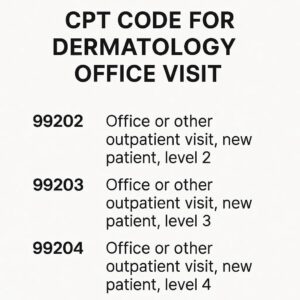
CPT Code for Dermatology Office Visit
Why the Right CPT Code Matters for Your Dermatology Visit
Many people think a visit is just a visit. But in medical billing, every office visit is scored like a short test. The score (the CPT code) decides two big things:
-
How much you or your insurance pays – Higher codes mean higher payments.
-
How your doctor documents care – Proper coding shows medical necessity.
A simple acne checkup might use a lower code. A full-body skin exam with a biopsy decision might use a higher one. Understanding this helps you avoid surprise bills and ask better questions at checkout.
Note for patients: You do not choose the code. Your dermatologist or their biller does. But you can ask which code was used and why. That is always your right.
The Core CPT Codes for Dermatology Office Visits (New vs. Established Patients)
Dermatology uses the same E/M codes as other clinics, but with one important twist: skin exams take time, and dermatologists often look at multiple areas. The AMA (American Medical Association) updated E/M codes in 2021 and 2023. Here are the ones you will see most often.
For New Patients (First visit to this dermatologist)
| CPT Code | Level of Service | Typical Dermatology Example |
|---|---|---|
| 99202 | Straightforward | Mild acne, first visit, no prescription change, 15-29 min |
| 99203 | Low | New mole check, single lesion, low-risk plan, 30-44 min |
| 99204 | Moderate | Full-body skin exam + 2-3 suspicious lesions + biopsy decision, 45-59 min |
| 99205 | High | Complex rash + prior treatment failure + multiple biopsies + medication management, 60-74 min |
For Established Patients (Return visits within 3 years)
| CPT Code | Level of Service | Typical Dermatology Example |
|---|---|---|
| 99212 | Straightforward | Refill topical cream, no exam, stable condition, 10-19 min |
| 99213 | Low | Follow-up acne, quick face exam, no change in meds, 20-29 min |
| 99214 | Moderate | Psoriasis follow-up + new patch on arm + treatment adjustment, 30-39 min |
| 99215 | High | Severe eczema flare + secondary infection + oral steroid plan + 2-week follow-up, 40-54 min |
Important: Time includes face-to-face time with the doctor. For dermatology, also includes time reviewing records, writing notes, and ordering tests on the same day.
How a Dermatologist Chooses the Correct Code: Medical Decision Making (MDM)
Most dermatology offices today use Medical Decision Making (MDM) to pick the level of service. MDM looks at three things:
-
Problems addressed – How many? New or stable? Is it a suspicious mole or routine acne?
-
Data reviewed – Did the doctor look at old records, photos, or outside biopsies?
-
Risk – What is the chance of complications? (Example: a facial mole removal near the eye is higher risk than one on the back.)
Example in Real Life
You come in for a new itchy rash on both arms. The dermatologist:
-
Asks 5 questions (duration, triggers, allergies)
-
Looks at your arms with a dermatoscope
-
Says it looks like contact dermatitis
-
Prescribes a medium-strength steroid cream
-
No tests, no biopsy, no old records
Likely code: 99203 (new patient, low MDM) or 99213 (established patient, low MDM).
Now imagine the same rash but:
-
You tried two creams already
-
The rash is now infected
-
The doctor takes a skin scraping for fungal culture
Likely code: 99204 (new patient, moderate MDM) or 99214 (established patient, moderate MDM).
Time-Based Coding: When Minutes Matter
Dermatologists can also code based on total time on the date of the encounter. This includes:
-
Preparing to see you
-
Examining you
-
Explaining findings
-
Writing the note
-
Ordering labs or referrals
Time thresholds for new patients (2026 rules)
| Code | Minimum time (minutes) |
|---|---|
| 99202 | 15 |
| 99203 | 30 |
| 99204 | 45 |
| 99205 | 60 |
Time thresholds for established patients
| Code | Minimum time (minutes) |
|---|---|
| 99212 | 10 |
| 99213 | 20 |
| 99214 | 30 |
| 99215 | 40 |
Realistic note: Most routine dermatology follow-ups last 10–15 minutes. That fits 99212 or 99213. A full new patient skin exam often runs 25–35 minutes, which supports 99203 or 99204.
Do not expect a 99215 for a simple wart check. That code is for complex, time-consuming cases.
Special Dermatology Situations That Affect Coding
1. Same-Day Sick Visit + Routine Exam
You schedule a routine mole check but also mention a new painful cyst. The doctor treats both. In this case, the dermatologist can bill one E/M code at the highest level supported. They do not split into two separate visits.
2. Office Visit + Minor Procedure (Biopsy, Cryotherapy, Shave Removal)
This is where many patients get confused. If your dermatologist does a biopsy during the same visit, you will see two charges on your bill:
-
An E/M code (for the evaluation part – looking, thinking, deciding)
-
A procedure code (e.g., 11102 – punch biopsy)
However, if the main reason for the visit is the procedure (e.g., you come just to have a known wart frozen), the E/M code may not be billed separately. This is called a “procedure-only” visit.
Common procedure codes in dermatology (for reference only)
| Service | CPT Code (approx) |
|---|---|
| Shave removal of benign lesion | 11300–11313 |
| Punch biopsy | 11102–11104 |
| Cryotherapy (up to 15 lesions) | 17000 |
| Destruction of actinic keratosis (first 15) | 17000 |
| Excision of malignant lesion | 11600–11646 |
Key point: Do not be alarmed if you see both an E/M code and a procedure code. That is normal when the doctor evaluates a new or changing problem and then treats it.
Proactive Skin Exams vs. Problem-Focused Visits
Many people come to dermatology for a full-body skin exam (also called total body skin exam or TBSE). That is a preventive service. Under many insurance plans, a yearly skin exam is covered at 100% with no copay if coded as a preventive visit.
But here is the catch: if the doctor finds anything suspicious and treats it, the visit can switch from preventive to problem-oriented. Then you may owe a copay or deductible.
Example
You schedule a “full body mole check” (preventive code: 99381–99399). The doctor finds one atypical mole, biopsies it, and also treats a separate wart. Now the visit is no longer purely preventive. Many offices will bill the E/M code (99203–99214) plus the biopsy code.
Always ask the front desk before your visit: “Will this be billed as preventive or as a problem visit?”
Common Billing Mistakes Patients Should Watch For
Even good dermatology offices make errors. Look for these red flags on your explanation of benefits (EOB):
| Red Flag | What It Means |
|---|---|
| 99205 for a 10-minute visit | Unlikely – time probably doesn’t match |
| E/M code + “prolonged service” without explanation | Usually needs special documentation |
| Two E/M codes on same day from same doctor | Almost always an error (except specific rare cases) |
| 99214 for stable acne with no exam | Too high – should be 99212 or 99213 |
If you see a code that seems too high or too low, call the billing department and ask: “Can you explain why this level of code was chosen for my visit?”
How to Prepare for a Dermatology Visit to Get Fair Coding
You cannot control what code the doctor uses, but you can help them document correctly. Good documentation = accurate coding = fewer surprises.
Before your visit
-
Write down one main concern and any changes since last visit
-
List all current skin medications (including over-the-counter)
-
Bring photos of any rash that comes and goes
-
Know if you have had a biopsy before
During the visit
-
Say: “I have three things today – my acne, a new mole on my back, and a nail change.”
-
Let the doctor examine each area fully
-
Ask: “Do you need to see any old records or outside biopsy slides?”
After the visit
-
Ask the checkout person: “What CPT code will be billed for today?”
-
Write it down. Then compare with your EOB later.
Patient Rights and Insurance Reality
You have the right to request an itemized bill with CPT codes and descriptions. You also have the right to ask for a coding review if you believe the level is wrong.
But also understand this: insurance companies sometimes downcode – they pay for a lower level than the doctor billed. That does not mean the doctor made a mistake. It means the insurer disagreed with the medical necessity.
If that happens, do not panic. Call your dermatology billing office. They may appeal or adjust the charge.
Quick Reference: CPT Code for Dermatology Office Visit by Common Scenario
| What happened at your visit | Likely CPT code (established patient) |
|---|---|
| “Just refill my tretinoin. No new problems.” | 99212 |
| “My acne is the same. Quick look. Same prescription.” | 99213 |
| “Psoriasis is worse. Showed you my knees and scalp. Changed biologic.” | 99214 |
| “New rash all over + fever + possible infection. You spent 40 minutes with me.” | 99215 |
| What happened at your visit | Likely CPT code (new patient) |
|---|---|
| “One small mole I have had for years. Just want it checked.” | 99202 or 99203 |
| “Full skin exam. You found two spots to watch. No biopsy today.” | 99203 |
| “New patient. Three separate concerns. You took a biopsy from one and reviewed outside records.” | 99204 |
Conclusion (Three-Line Summary)
The correct CPT code for a dermatology office visit is usually an E/M code from 99202 to 99215, chosen based on medical decision making or total time. New patients and complex cases use higher codes; routine follow-ups use lower ones. Understanding these codes helps you read your bill, avoid overcharges, and have better conversations with your dermatologist’s billing team.
Frequently Asked Questions (FAQ)
1. What is the most common CPT code for a routine dermatology follow-up?
99213 is the most common for established patients with low-complexity issues like stable acne or a single wart check.
2. Can a dermatologist bill both an office visit and a procedure on the same day?
Yes, if the visit includes a significant, separately identifiable evaluation before the procedure. Example: evaluating a new mole and then deciding to biopsy it.
3. Does insurance always cover a full-body skin exam?
Many plans cover one preventive skin exam per year at 100% if billed with preventive codes (99381–99399). However, if the doctor treats anything, it may switch to a problem visit with a copay.
4. How can I find out which CPT code was used for my visit?
Look at your Explanation of Benefits (EOB) from your insurance or request an itemized bill from the dermatology office.
5. What if my dermatologist bills a higher code than I expected?
Call the billing office and ask for a coding review. You can say: *“I was seen for a 10-minute acne refill, but code 99214 was billed. Can you explain?”*
6. Is there a different CPT code for tele-dermatology?
Yes. For live video visits, dermatologists often use 99202–99215 with modifier 95 or place of service code 02. Rules vary by payer.
7. Do all dermatologists use the same CPT codes?
Yes, all licensed providers in the US use AMA CPT codes. However, private equity-owned practices may code more aggressively. Always verify.
Additional Resource
For the most current and official CPT code guidelines, visit the American Medical Association (AMA) CPT® website:
https://www.ama-assn.org/cpt
For patient-friendly help with medical bills, see the Patient Advocate Foundation:
https://www.patientadvocate.org
Disclaimer (repeated for clarity):
This information reflects general coding practices as of April 2026. CPT codes, payer policies, and insurance rules change frequently. Always confirm with your specific dermatology office and health plan.