If you work in a dermatology practice, you already know one thing for sure: coding can feel like a second language. You spend your day looking at rashes, moles, and lesions, not flipping through a massive codebook. But when it comes time to bill for that shave biopsy or cryotherapy session, getting the right dermatology CPT codes matters more than almost anything else.
A single wrong code can mean a denied claim, a delayed payment, or even a compliance headache. The good news is that you do not need to memorize every single number. You just need a clear, practical guide that walks you through the most common scenarios.
This guide is for medical coders, billers, nurses, and even dermatologists who want to double-check their own work. We will focus on the real world—what you actually see in the exam room. Let us break down the most frequently used derm CPT codes in a way that makes sense.
Why Getting Derm CPT Codes Right Matters More Than You Think
Before we jump into the numbers, let us take a quick look at why accuracy is non-negotiable. Insurance companies audit dermatology claims at a high rate. Why? Because many skin lesion codes look very similar. A shave removal and a biopsy are not the same thing, but a computer might not catch the difference. A human auditor will.
When you choose the wrong code, three things usually happen. First, the claim gets denied, and you have to resubmit. Second, you might get a partial payment when you expected full reimbursement. Third, in the worst case, repeated errors can trigger a formal audit or accusations of upcoding.
So, accuracy protects your revenue and your reputation. The good news is that most dermatology coding follows clear patterns. Once you learn the logic, the codes start to feel less random and more like a system.
Understanding the Structure of CPT Codes in Dermatology
CPT stands for Current Procedural Terminology. The American Medical Association (AMA) updates these codes every year. In dermatology, the codes usually fall into several categories.
You will see codes for:
- Biopsy (taking a small sample)
- Excision (removing the whole lesion with margins)
- Destruction (burning, freezing, or lasering)
- Mohs surgery (specialized layer-by-layer removal)
- Repair (suturing after a removal)
- Shave removal (scraping off a raised lesion)
Each category has its own set of rules. For example, an excision code depends on the size of the lesion plus the margins. A biopsy code depends on the technique—shave, punch, or incisional.
Important note: You cannot use an excision code if you did a shave biopsy. You also cannot use a destruction code if you performed a surgical excision. Always match the code to the exact procedure you performed.
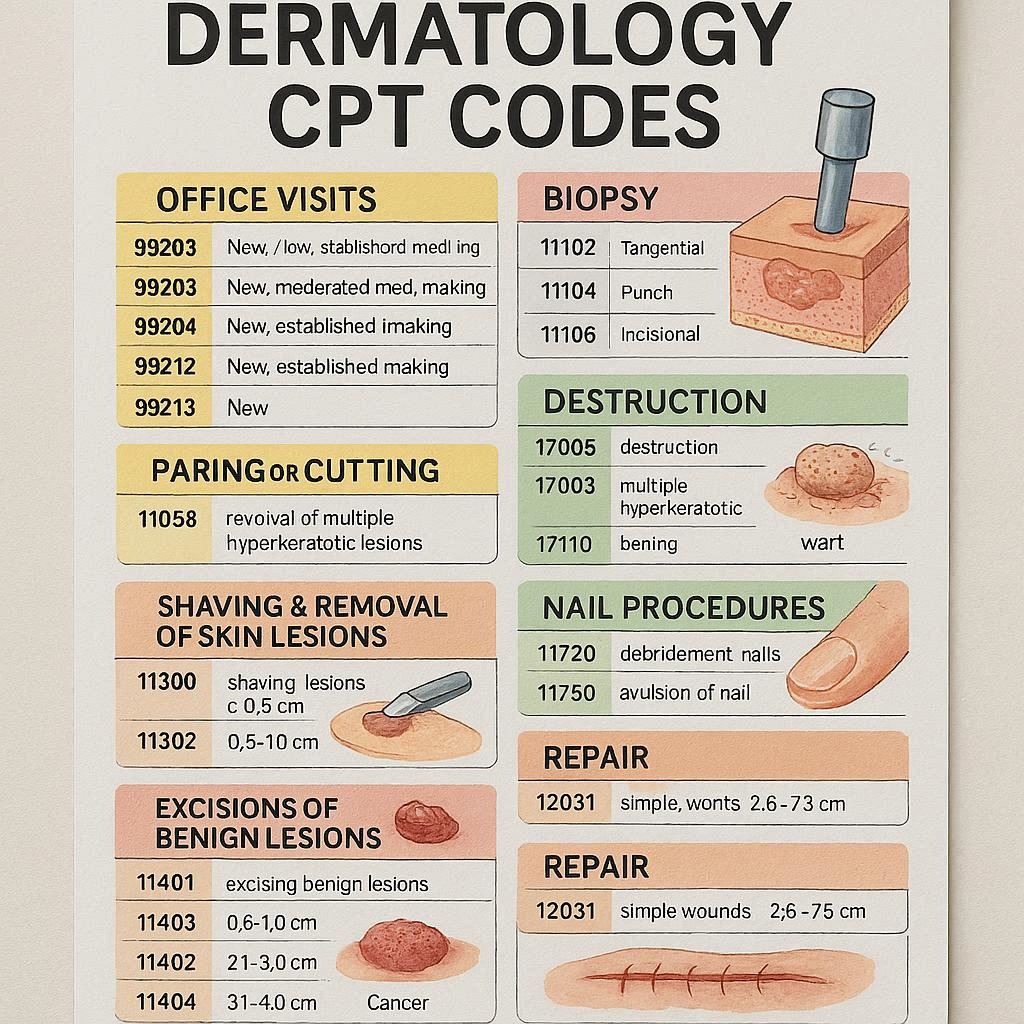
The Most Common Derm CPT Codes at a Glance
Let us start with a quick reference table. This will give you the big picture before we dive deeper.
| Procedure | CPT Code(s) | Key Rule |
|---|---|---|
| Shave biopsy | 11300–11313 | Based on lesion diameter |
| Punch biopsy | 11104–11107 | Based on number of biopsies |
| Excision, benign | 11400–11446 | Based on excised diameter (lesion + margins) |
| Excision, malignant | 11600–11646 | Based on excised diameter (lesion + margins) |
| Destruction, benign | 17110–17111 | Per lesion, not per session |
| Cryotherapy (warts) | 17110 (1–14 lesions) | Includes all lesions in that range |
| Mohs surgery | 17311–17315 | Based on stages and sites |
| Repair (suturing) | 12031–12057 | Based on wound length and complexity |
Keep this table nearby when you are reviewing your encounter notes. It will save you time.
Biopsy Codes in Dermatology: Punch, Shave, and Incisional
Biopsies are the bread and butter of dermatology. You see a suspicious spot, you sample it, and you send it to pathology. But the code depends heavily on how you take the sample.
Shave Biopsy Codes (11300–11313)
A shave biopsy removes a raised lesion at the level of the skin surface. You do not go deep into the dermis. These codes are based on the diameter of the lesion, not the depth.
Here is how they break down:
| Code | Lesion Diameter | Location |
|---|---|---|
| 11300 | 0.5 cm or less | Face, ears, eyelids, nose, lips |
| 11301 | 0.6–1.0 cm | Face, ears, eyelids, nose, lips |
| 11302 | 1.1–2.0 cm | Face, ears, eyelids, nose, lips |
| 11303 | 2.1 cm or more | Face, ears, eyelids, nose, lips |
| 11305 | 0.5 cm or less | Trunk, arms, legs |
| 11306 | 0.6–1.0 cm | Trunk, arms, legs |
| 11307 | 1.1–2.0 cm | Trunk, arms, legs |
| 11308 | 2.1 cm or more | Trunk, arms, legs |
Real-world example: You shave off a 0.8 cm seborrheic keratosis from a patient’s back. You would use code 11306.
Punch Biopsy Codes (11104–11107)
Punch biopsies take a cylindrical sample of full-thickness skin. These codes changed a few years ago, so be careful if you learned the old system. The new codes are based on the number of biopsies, not the size of the punch.
| Code | Number of Biopsies |
|---|---|
| 11104 | 1 biopsy |
| 11105 | 2–3 biopsies |
| 11106 | 4–5 biopsies |
| 11107 | 6 or more biopsies |
Important: If you do a single punch biopsy, you use 11104. If you do three separate punches on three different lesions, you still use 11105 because the code covers 2–3 biopsies. You do not report 11104 three times.
Incisional Biopsy (11100 – older, but still in use)
Some payers still recognize 11100 for an incisional biopsy that removes a wedge of tissue. However, for most modern practices, punch and shave biopsies cover the majority of cases. Always check with your specific payer before using older codes.
Excision Codes: Benign vs. Malignant Lesions
Excision means you cut out the entire lesion plus a rim of normal skin (the margin). You close the wound with sutures. The coding here is different from biopsy because the size includes both the lesion and the margin.
Benign Excision (11400–11446)
Use these codes when the pathology later confirms the lesion was benign. But here is the tricky part: you do not know the pathology at the time of the procedure. Most coders recommend using the benign code based on the clinical suspicion. If the pathology comes back malignant, you can appeal and recode.
Benign excision codes depend on:
- The excised diameter (lesion + narrowest margin)
- The location on the body
| Code | Excised Diameter | Typical Location |
|---|---|---|
| 11400 | 0.5 cm or less | Trunk, arms, legs |
| 11401 | 0.6–1.0 cm | Trunk, arms, legs |
| 11402 | 1.1–2.0 cm | Trunk, arms, legs |
| 11403 | 2.1–3.0 cm | Trunk, arms, legs |
| 11404 | 3.1–4.0 cm | Trunk, arms, legs |
| 11406 | 4.1 cm or more | Trunk, arms, legs |
| 11420 | 0.5 cm or less | Face, ears, eyelids, nose, lips |
| 11421 | 0.6–1.0 cm | Face, ears, eyelids, nose, lips |
| 11422 | 1.1–2.0 cm | Face, ears, eyelids, nose, lips |
| 11423 | 2.1–3.0 cm | Face, ears, eyelids, nose, lips |
| 11424 | 3.1–4.0 cm | Face, ears, eyelids, nose, lips |
| 11426 | 4.1 cm or more | Face, ears, eyelids, nose, lips |
Malignant Excision (11600–11646)
The structure is identical to benign excision, but the codes are different. You use these when you know the lesion is malignant (e.g., a recurrent basal cell carcinoma or a known melanoma).
| Code | Excised Diameter | Location |
|---|---|---|
| 11600 | 0.5 cm or less | Trunk, arms, legs |
| 11601 | 0.6–1.0 cm | Trunk, arms, legs |
| 11602 | 1.1–2.0 cm | Trunk, arms, legs |
| 11603 | 2.1–3.0 cm | Trunk, arms, legs |
| 11604 | 3.1–4.0 cm | Trunk, arms, legs |
| 11606 | 4.1 cm or more | Trunk, arms, legs |
| 11640 | 0.5 cm or less | Face, ears, eyelids, nose, lips |
| 11641 | 0.6–1.0 cm | Face, ears, eyelids, nose, lips |
| 11642 | 1.1–2.0 cm | Face, ears, eyelids, nose, lips |
| 11643 | 2.1–3.0 cm | Face, ears, eyelids, nose, lips |
| 11644 | 3.1–4.0 cm | Face, ears, eyelids, nose, lips |
| 11646 | 4.1 cm or more | Face, ears, eyelids, nose, lips |
Key tip: Always measure the excised diameter. That means the lesion plus the narrowest margin. Draw a diagram in the chart if you need to. Many denials happen because the coder used the lesion size instead of the excision size.
Destruction Codes: Cryotherapy, Electrodessication, and Laser
Destruction means you destroy tissue without sending it to pathology. Common methods include cryotherapy (liquid nitrogen), electrodessication, and laser ablation.
Benign Lesion Destruction (17110–17111)
These codes cover the destruction of benign lesions like seborrheic keratoses, actinic keratoses, or warts.
| Code | Number of Lesions |
|---|---|
| 17110 | 1–14 lesions |
| 17111 | 15 or more lesions |
Example: A patient comes in with five common warts on their hand. You freeze all five. You report 17110 once. You do not report five separate codes.
What is not included: Destruction of malignant lesions requires a different set of codes (17260–17286). Also, if you biopsy a lesion and then destroy it in the same session, you only bill the biopsy.
Destruction of Malignant Lesions (17260–17286)
These codes are rarely used because most malignant lesions get excised or treated with Mohs. However, for small superficial basal cell carcinomas treated with cryotherapy or curettage, you might need them.
These codes are based on the lesion diameter and location, similar to excision codes.
Mohs Micrographic Surgery Codes (17311–17315)
Mohs surgery is a specialized technique for removing certain skin cancers. The surgeon acts as both the surgeon and the pathologist, examining margins while the patient waits.
First Stage (17311)
Code 17311 covers the first stage of Mohs on the head, neck, hands, feet, or genitals. This includes up to five tissue blocks.
Additional Stages (17312)
Add code 17312 for each additional stage after the first, up to five blocks per stage.
Trunk and Extremities (17313–17315)
- 17313: First stage, trunk or extremities, up to five blocks
- 17314: Each additional stage, trunk or extremities
- 17315: Each additional block beyond five in any single stage
Real-world example: A patient has a basal cell carcinoma on the nose. The first stage takes five blocks (17311). The surgeon needs a second stage, which takes three more blocks (17312). The claim would include 17311 and one unit of 17312.
Important note: You cannot bill an excision code with a Mohs code for the same lesion. The Mohs code includes the removal.
Repair Codes (Suturing) in Dermatology
After an excision, you often need to close the wound. Repair codes are separate from the excision codes. You bill both.
Repair codes depend on:
- Complexity: Simple, intermediate, or complex
- Length: Measured in centimeters
- Location: Face vs. trunk vs. extremities
Intermediate Repairs (12031–12057)
Most dermatology excisions fall into intermediate repair. This includes layered closure of subcutaneous tissue.
| Code | Wound Length | Location |
|---|---|---|
| 12031 | 2.5 cm or less | Scalp, neck, axillae, external genitalia, trunk, extremities |
| 12032 | 2.6–7.5 cm | Same as above |
| 12034 | 7.6–12.5 cm | Same as above |
| 12035 | 12.6–20.0 cm | Same as above |
| 12036 | 20.1 cm or more | Same as above |
| 12051 | 2.5 cm or less | Face, ears, eyelids, nose, lips |
| 12052 | 2.6–5.0 cm | Face, ears, eyelids, nose, lips |
| 12053 | 5.1–7.5 cm | Face, ears, eyelids, nose, lips |
| 12054 | 7.6–12.5 cm | Face, ears, eyelids, nose, lips |
| 12055 | 12.6 cm or more | Face, ears, eyelids, nose, lips |
Example: You excise a 1.5 cm benign lesion from a patient’s back. The excised diameter (lesion + margins) is 2.2 cm. You close the wound with layered sutures. The wound length is 2.2 cm. You would bill the excision (11402) and the repair (12031).
Biopsy Add-On Codes and Modifiers You Should Know
Sometimes a procedure is more complex than a simple biopsy. That is when you need add-on codes and modifiers.
Modifier -59 (Distinct Procedural Service)
Use modifier -59 when you perform two separate procedures on the same day in different anatomical sites. For example, you biopsy a lesion on the nose and a different lesion on the back. You would report 11104 (nose) and 11104-59 (back).
Modifier -25 (Significant, Separately Identifiable E/M Service)
If you perform an evaluation and management (E/M) service on the same day as a procedure, you may need modifier -25. This tells the payer that the E/M was separate from the procedure.
Example: A patient comes in for a rash. During the visit, you also freeze a wart. The rash evaluation is separate. You would bill the E/M code with modifier -25 plus the destruction code.
How to Measure Lesions Correctly: A Step-by-Step Guide
Measuring errors are the number one cause of denied derm claims. Here is how to get it right every time.
- Measure the lesion itself in its longest diameter.
- Add the narrowest margin on both sides. If you take a 0.2 cm margin all around, add 0.4 cm to the lesion diameter.
- The total is your excised diameter.
- Document the measurement in the procedure note. Write: “Excised diameter = 2.0 cm (1.2 cm lesion + 0.4 cm margin + 0.4 cm margin).”
Do not guess. If you do not document it, it did not happen.
Common Coding Mistakes and How to Avoid Them
Even experienced coders make mistakes. Here are the most common ones we see in dermatology.
Mistake #1: Using Excision Codes for Shave Biopsies
A shave biopsy is not an excision. You cannot use 11400 for a shave. Use 11300–11313 instead.
Mistake #2: Billing Destruction Codes per Lesion
Code 17110 covers 1–14 lesions. You bill it once, not 14 times. The only exception is when you have more than 14 lesions, then you use 17111.
Mistake #3: Forgetting the Repair Code
You excised the lesion. You closed the wound. You need both codes. Many new coders forget the repair.
Mistake #4: Using the Wrong Location Category
Codes for the face are different from codes for the trunk. Always check the code descriptor. A code that works for the arm will not work for the nose.
CPT Codes for Special Dermatology Procedures
Beyond biopsies and excisions, dermatologists perform many other procedures. Here is a quick look at other common codes.
Cryotherapy for Actinic Keratoses
- 17000: Destruction of first actinic keratosis
- 17003: Destruction of 2–14 actinic keratoses (per lesion)
- 17004: Destruction of 15 or more actinic keratoses
Notice the difference from benign lesion destruction (17110). Actinic keratoses have their own codes.
Curettage
- 11310–11313: Curettage of lesions (often used for superficial basal cell carcinoma)
Laser Surgery
Laser codes vary widely based on the indication. For example:
- 17106–17108: Laser treatment of cutaneous vascular lesions (port wine stains)
- 17280–17286: Laser destruction of malignant lesions
A Note on Payment and Reimbursement Rates
This guide focuses on coding, not pricing. However, you should know that reimbursement varies by region, payer, and contract. A code that pays 150inonestatemightpay90 in another.
Medicare publishes a fee schedule every year. Private payers often use Medicare as a baseline. To get accurate numbers for your practice, check your specific payer contracts or use a fee schedule analyzer.
Do not use online “average reimbursement” lists. They are often outdated. Always verify with your actual payers.
Documentation Requirements Every Dermatology Practice Needs
Good documentation supports good coding. Here is what your procedure notes should always include.
- Location: Be specific. “Left cheek” is better than “face.”
- Size: Pre-procedure lesion size and post-procedure excised diameter.
- Method: Shave, punch, excision, destruction, etc.
- Margins: Width of normal skin removed (for excisions).
- Closure method: Sutures, staples, or left open.
- Number of lesions: If you treat more than one, list each one.
Without these details, your codes are just guesses. And payers do not pay for guesses.
How to Stay Updated on CPT Code Changes
CPT codes change every year. What is correct today might be outdated next January. The AMA releases changes in the fall, effective January 1st.
Here is how to stay current.
- Subscribe to an AAPC newsletter (American Academy of Professional Coders)
- Follow dermatology coding blogs from reputable sources
- Attend one coding webinar per year to catch updates
- Review your top 20 codes each January to check for changes
Do not rely on memory alone. Coding is a skill you have to practice and update.
Quick Reference: Derm CPT Codes by Body Area
Sometimes you need to find a code fast. Here is a cheat sheet organized by body area.
Face, Ears, Eyelids, Nose, Lips
- Shave biopsy: 11300–11303
- Punch biopsy: 11104–11107 (any location)
- Benign excision: 11420–11426
- Malignant excision: 11640–11646
- Repair, intermediate: 12051–12055
Trunk, Arms, Legs
- Shave biopsy: 11305–11308
- Punch biopsy: 11104–11107 (any location)
- Benign excision: 11400–11406
- Malignant excision: 11600–11606
- Repair, intermediate: 12031–12036
Hands, Feet, Genitals
- Mohs first stage: 17311
- Mohs additional stage: 17312
Frequently Asked Questions (FAQ)
1. Can I bill an E/M code on the same day as a biopsy?
Yes, if the E/M service is separately identifiable. For example, a patient comes for a full skin exam and you find a suspicious mole that you biopsy. The exam itself is part of the biopsy decision. You cannot bill separately. But if the patient has a rash on their legs that you evaluate and treat in addition to the biopsy, you can bill the E/M with modifier -25.
2. What is the difference between 17110 and 17000?
Code 17110 is for benign lesions like warts and seborrheic keratoses. Code 17000 is specifically for actinic keratoses. Do not mix them.
3. How many biopsies can I bill with 11105?
Code 11105 covers 2–3 punch biopsies. You cannot bill it for a single biopsy (use 11104) or for four biopsies (use 11106).
4. Do I need a separate CPT code for the pathology?
Yes. The procedure code (biopsy, excision) is for the surgeon’s work. The pathology code (88305, 88331, etc.) is for the lab’s work. If your practice owns the lab, you bill both. If you send out to an external lab, they bill their own codes.
5. What happens if I use the wrong code?
The claim may deny. You can appeal with corrected documentation. Repeated errors may flag your practice for an audit. Always double-check your codes before submitting.
6. Are there different codes for pediatric dermatology?
In most cases, no. The same CPT codes apply to all ages. However, some payers have special rules for pediatric patients. Check your specific contracts.
7. How do I code for a procedure I started but did not finish?
If you attempted a biopsy but could not complete it due to patient intolerance or anatomical issues, you may still bill for the work performed. Use the appropriate biopsy code with modifier -52 (reduced services). Document why you could not finish.
Additional Resources
For more detailed information, visit the American Academy of Dermatology’s coding resource center at:https://www.aad.org/member/practice/coding
This page offers free webinars, coding guides, and updates specific to dermatology.
Conclusion
Mastering derm CPT codes comes down to three key actions: measure lesions correctly, match the code to the exact procedure performed, and document every detail. Biopsies, excisions, destructions, and repairs each follow clear rules based on size, location, and method. When you apply these principles consistently, you will see fewer denials, faster payments, and fewer compliance headaches.
Disclaimer: This article provides general coding guidance for educational purposes. CPT codes and payer policies change frequently. Always verify codes with the current AMA CPT manual and your specific payer contracts before submitting claims.