If you work in neurology, you know that billing for electroencephalograms can sometimes feel like solving a puzzle. The rules change. Codes get updated. And payers seem to have their own secret playbook.
As we look toward 2026, staying ahead of EEG CPT codes is more important than ever. Whether you are running a busy epilepsy monitoring unit or a small outpatient clinic, small mistakes in coding can lead to denied claims or lost revenue.
This guide will walk you through everything you need to know about EEG CPT codes for 2026. We will keep things simple, practical, and accurate. No confusing jargon. No fake updates. Just real information to help you bill with confidence.
What Are EEG CPT Codes? A Quick Refresher
Before we dive into 2026 specifics, let us make sure we are on the same page.
CPT stands for Current Procedural Terminology. These are the five-digit codes you use to report medical procedures to insurers. For EEGs, these codes tell the payer what type of test you performed, how long it took, and whether it involved video or sleep deprivation.
The American Medical Association (AMA) updates these codes every year. Most changes take effect on January 1st.
EEG codes generally fall into three buckets:
- Routine EEG (usually 30 to 60 minutes)
- Prolonged EEG (2 to 12 hours or more)
- Video EEG (with simultaneous video recording)
Each code has specific requirements. Use the wrong one, and your claim will likely bounce back.
EEG CPT Codes 2026: What Is Changing?
Let us address the big question first.
As of the information available today, the AMA has not announced a complete overhaul of EEG codes for 2026. However, we always see small but important adjustments. These can include:
- Revised code descriptors (the official language defining each code)
- Changes to relative value units (RVUs)
- New guidelines for prolonged monitoring
- Clarifications on split/shared billing
Based on historical patterns, 2026 will likely continue using the same code families introduced in recent years. But you should always verify updates directly from the AMA or your specialty society in late 2025.
Important note for readers: The final 2026 CPT code set is typically released by the AMA in late summer or early fall of 2025. This guide reflects expert analysis based on current trends and past update cycles. Always cross-check with official sources before submitting claims.
Complete List of EEG CPT Codes Expected for 2026
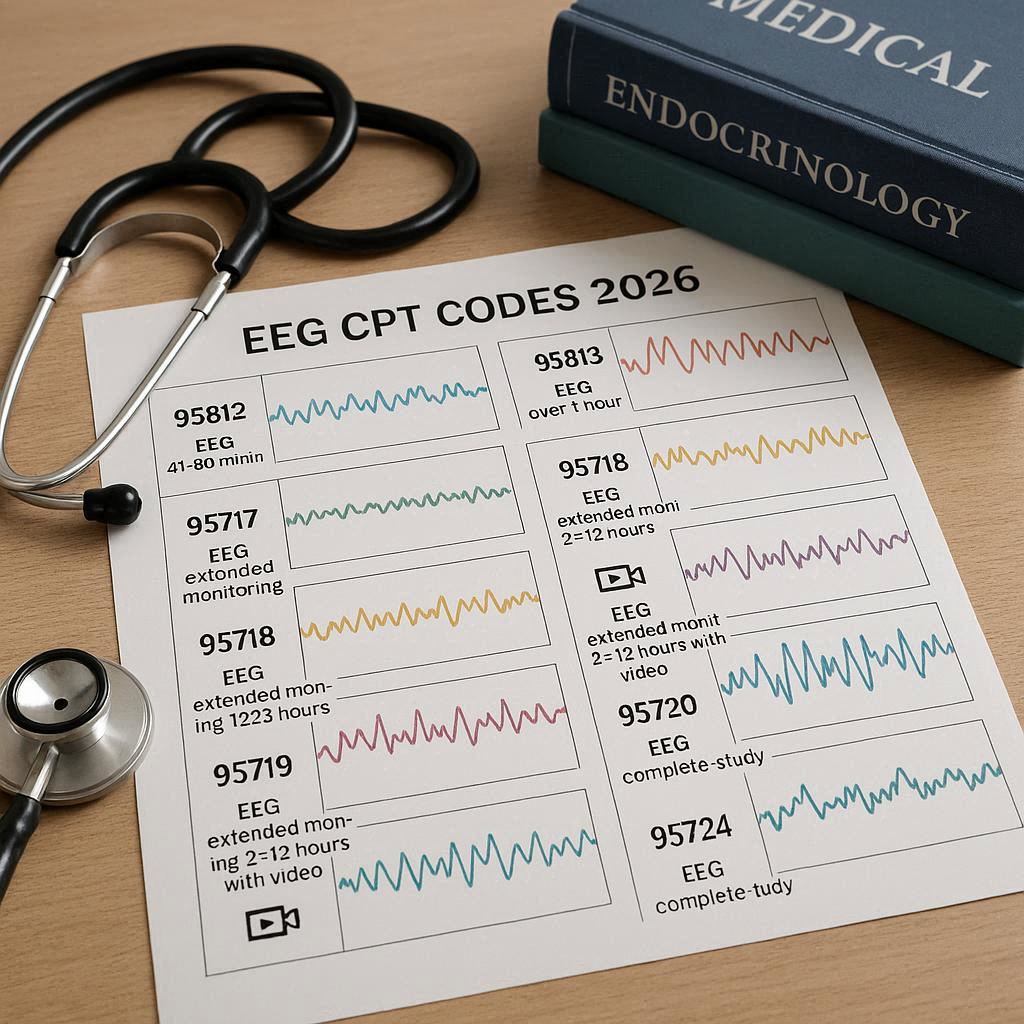
Here are the most common EEG codes you will likely use in 2026. We have organized them by test type.
Routine EEG Codes (Standard Ambulatory or Inpatient)
| CPT Code | Description | Typical Time |
|---|---|---|
| 95716 | EEG with video, awake and drowsy | 30-60 min |
| 95717 | EEG with video, sleep-deprived | 30-60 min |
| 95812 | EEG (routine) without video | 30-60 min |
| 95813 | EEG (routine) with abnormal findings | 30-60 min |
Note that some of these codes may see descriptor refinements in 2026. Pay special attention to the difference between “routine” and “with abnormal findings.” The latter requires documented clinical justification.
Prolonged EEG Codes (2 to 12+ Hours)
| CPT Code | Description | Duration |
|---|---|---|
| 95700 | Prolonged EEG setup and recording | 2-12 hours |
| 95705 | Prolonged EEG without video, each additional hour | Add-on code |
| 95706 | Prolonged EEG with video, each additional hour | Add-on code |
| 95707 | Prolonged EEG, continuous, over 12 hours | Per day |
These codes are frequently used in epilepsy monitoring units. Do not use them for routine outpatient studies. That is a common reason for denials.
Video EEG Codes (Inpatient Monitoring)
| CPT Code | Description | Notes |
|---|---|---|
| 95720 | Video EEG, continuous, less than 12 hours | Often pre-surgical |
| 95721 | Video EEG, continuous, 12-24 hours | Full day monitoring |
| 95722 | Video EEG, continuous, each additional day | Add-on code |
Video EEG requires simultaneous time-synchronized video. You cannot use these codes if you only recorded video separately without synchronization.
How to Choose the Right EEG CPT Code in 2026
Choosing the correct code is not just about time. You also need to consider:
- Clinical indication (seizures, altered mental status, syncope)
- Patient setting (outpatient clinic, hospital bed, ICU)
- Presence of video
- Sleep deprivation or induction
- Interpretation vs. technical component
Let me give you a real-world example.
A 45-year-old patient comes to your outpatient clinic for a routine EEG due to possible absence seizures. The study lasts 45 minutes. No video is used. The patient falls asleep naturally.
You would likely report 95812 (routine EEG without video).
But what if the same patient required sleep deprivation? And you recorded video? Then you would use 95717.
See the difference? Small changes in how you perform the test lead to different codes.
Reimbursement Changes for EEG CPT Codes in 2026
Money matters. Let us talk about reimbursement.
Every year, the Centers for Medicare & Medicaid Services (CMS) releases the Medicare Physician Fee Schedule (MPFS). This document tells you how much Medicare will pay for each code.
For 2026, experts expect modest changes. Here is why.
CMS has been gradually reducing reimbursement for certain diagnostic tests. EEGs have not been immune. However, prolonged EEG codes have generally held their value better than routine codes.
Factors That Will Impact Your EEG Reimbursement in 2026
- The conversion factor – This is the dollar amount multiplied by RVUs. It changes yearly.
- Site of service differentials – Hospital outpatient departments get paid differently than independent clinics.
- Geographic adjustments – Your location affects payment.
- Modifier usage – Using -26 (professional component) or -TC (technical component) correctly.
A realistic expectation? You might see a 1% to 3% reduction for routine EEGs in 2026. Prolonged EEGs may stay flat or see very small increases.
I always tell clinic managers: do not panic. Volume and accurate coding matter more than small percentage changes.
Documentation Requirements You Cannot Ignore
Payers deny EEG claims for documentation errors more often than you think. Here is what your reports must include for 2026.
Required Elements for All EEG Codes
- Medical necessity statement – Why was the test ordered? Be specific.
- Patient preparation – Sleep-deprived? Off meds? Scalp prep?
- Recording duration – Start and end time documented.
- Technologist notes – Artifacts, patient behavior, events.
- Interpretation – A formal report from a qualified physician.
- Signature and credentials – Who performed and interpreted?
For prolonged or video EEG, you also need:
- Hour-by-hour log of clinical events
- Video synchronization notes
- Seizure count and type (if applicable)
- Intervention documentation (e.g., rescue medication given)
Missing any of these? Expect a denial or a request for medical records.
Common Billing Mistakes and How to Avoid Them
Even experienced billers make errors. Let me share the top five mistakes I see with EEG coding.
1. Using Prolonged Codes for Routine Studies
This is number one. A 45-minute EEG is not “prolonged.” Prolonged codes start at two hours. Using 95700 for a routine study is incorrect and will trigger audits.
2. Forgetting Modifier -26 or -TC
EEG has two components:
- Technical (TC) – Equipment, technologist, supplies
- Professional (26) – Interpretation by a physician
If your clinic owns the EEG machine, you can bill both. But if a hospital provides the equipment, you only bill the professional component with modifier -26.
3. No Video Documentation for Video Codes
You cannot bill 95716 or 95717 without a video recording that is time-locked to the EEG. A separate phone video does not count.
4. Same-Day Repeat EEG Without Justification
Some payers limit routine EEGs to one per day unless there is a clear change in clinical status. Document why you repeated the study.
5. Missing Sleep Deprivation Documentation
Codes like 95717 require documented sleep deprivation (e.g., patient slept less than four hours the night before). Do not assume. Write it down.
EEG CPT Codes 2026 for Different Clinical Settings
Not all EEGs are created equal. The setting changes the code and the documentation.
Outpatient Clinic EEG
- Use routine codes (95812, 95813, 95716, 95717)
- Shorter durations
- Usually no continuous video monitoring
- Higher likelihood of denial if medical necessity is weak
Inpatient Hospital EEG
- Routine or prolonged codes depending on duration
- Often involves video for seizure monitoring
- May use prolonged codes (95700 series)
- Easier to justify medical necessity (altered mental status, rule out status epilepticus)
Epilepsy Monitoring Unit (EMU)
- Almost always prolonged video EEG
- Codes 95721 and 95722 are common
- Multi-day recordings
- Requires detailed seizure logs and event correlation
Intensive Care Unit (ICU) EEG
- Often continuous over 12 to 24 hours
- May use 95707 for daily billing
- Can be combined with other ICU procedures
- Indications: non-convulsive seizures, post-cardiac arrest, unexplained coma
Modifiers You Must Know for 2026
Modifiers are two-digit codes that add context to your primary CPT code. Use them correctly, or risk payment delays.
| Modifier | Name | When to Use for EEG |
|---|---|---|
| 26 | Professional component | You interpret but do not own equipment |
| TC | Technical component | You own equipment and employ technologist |
| 59 | Distinct procedural service | Two separate EEGs on different days |
| 76 | Repeat procedure by same physician | Same-day repeat with new clinical reason |
| 77 | Repeat procedure by another physician | Rare for EEG |
| 52 | Reduced services | Incomplete study due to patient intolerance |
Let me give you a practical example.
Your group interprets EEGs for a local hospital. The hospital owns the machine. You only provide reading services.
On your claim, you would report 95812-26 for the professional interpretation.
The hospital would report 95812-TC for the technical portion.
Never bill both components in this situation. That is double billing, and payers will flag it.
Private Payer vs. Medicare: What You Need to Know
Medicare sets the baseline, but private payers often deviate.
Medicare (CMS)
- Follows MPFS rules strictly
- Accepts modifiers -26 and -TC
- Usually requires prior authorization for prolonged EEGs over 12 hours
- Publishes Local Coverage Determinations (LCDs) that vary by state
Private Insurers (UnitedHealthcare, Cigna, Aetna, etc.)
- May have their own coding guidelines
- Some bundle EEG into emergency room or inpatient stays
- Often require pre-authorization for video EEG
- Reimbursement rates can be higher or lower than Medicare
A note from experience: Always check each payer’s medical policy. For example, some insurers consider routine EEG experimental for certain conditions like ADHD. Know the exclusions before you order the test.
How to Prepare for EEG Coding Changes in 2026
You do not need to wait until December 2025. Start preparing now.
Action Steps for Your Clinic or Department
- Assign one person to monitor updates – This can be your billing manager or a lead technologist.
- Check the AMA website quarterly – Look for CPT changes, usually released around September.
- Review your most denied codes – Focus on EEG codes with denial rates above 10%.
- Update your EHR templates – Add required documentation fields for each EEG type.
- Train your technologists – They need to document start/stop times and patient prep accurately.
I have seen too many clinics scramble in January. Do not be that clinic. A little planning goes a long way.
The Future of EEG Coding Beyond 2026
What comes after 2026? Nobody has a crystal ball. But we can make educated guesses.
The AMA has been moving toward more granular coding. Some experts predict:
- Separate codes for ambulatory EEG (home monitoring)
- New codes for quantitative EEG analysis
- Integration with remote interpretation (tele-EEG)
- Value-based modifiers for seizure detection rates
None of these are confirmed for 2026. But they are worth watching.
Real-World Examples: EEG Coding Scenarios
Let me walk you through three common scenarios. These will help you see the codes in action.
Scenario 1: Routine Outpatient EEG Without Video
Patient: 32-year-old with possible psychogenic non-epileptic seizures.
Study: 50 minutes, awake and drowsy, no video. Patient slept 7 hours the night before.
Code: 95812 (routine EEG without video)
Documentation highlights: Normal background, no epileptiform discharges. No sleep deprivation.
Scenario 2: Sleep-Deprived EEG With Video
Patient: 18-year-old with suspected juvenile myoclonic epilepsy.
Study: 45 minutes, sleep-deprived (3 hours of sleep), video recorded and synchronized.
Code: 95717 (EEG with video, sleep-deprived)
Documentation highlights: Sleep deprivation confirmed. Video shows two subtle myoclonic jerks. EEG shows generalized spike-wave.
Scenario 3: Prolonged Video EEG in EMU
Patient: 24-year-old for pre-surgical evaluation.
Study: 48 hours continuous video EEG.
Code:
- Day 1: 95721 (12-24 hours)
- Day 2: 95722 (each additional day)
Documentation highlights: Seizure log shows three clinical events. Video confirms focal onset. EEG correlates with left temporal spikes.
FAQs About EEG CPT Codes 2026
Q1: When will the official 2026 EEG CPT codes be released?
The AMA typically releases the new CPT code set in late summer or early fall of 2025. Check the AMA website or your specialty society for updates.
Q2: Can I bill for a routine EEG and a prolonged EEG on the same day?
Generally, no. If you start with a routine EEG and extend it beyond two hours, you should cancel the routine code and bill a prolonged code instead.
Q3: Does Medicare require pre-authorization for EEGs in 2026?
For routine outpatient EEGs, usually not. For prolonged EEGs over 12 hours, many Medicare Administrative Contractors (MACs) do require prior authorization. Check your local MAC policy.
Q4: What is the difference between 95716 and 95717?
95716 is for EEG with video in an awake and drowsy patient without sleep deprivation. 95717 requires documented sleep deprivation.
Q5: How do I bill for an EEG that is terminated early by the patient?
Use modifier -52 (reduced services). Document why the study was incomplete (e.g., “patient removed leads after 20 minutes due to discomfort”).
Q6: Are there separate codes for pediatric EEG?
No. The same CPT codes apply to all ages. However, some payers have separate coverage policies for pediatric populations.
Q7: Can a nurse practitioner interpret an EEG and bill?
Only if allowed by state law and payer policy. Medicare requires EEG interpretation by a physician (MD, DO) or qualified doctoral-level clinician with appropriate supervision.
Q8: What is the 2026 reimbursement rate for 95812?
Rates are not yet available for 2026. CMS publishes the final fee schedule in November of the preceding year. Check back in late 2025.
Additional Resources
For the most current information on EEG CPT codes and reimbursement, bookmark these official sources:
🔗 American Academy of Neurology (AAN) Coding Resources – Visit aan.com and search “coding and reimbursement.” The AAN provides member-only coding guides and webinars.
Disclaimer: This article is for informational purposes only and does not constitute legal, billing, or medical advice. CPT codes, reimbursement rates, and payer policies change frequently. Always consult the official AMA CPT manual, your local Medicare Administrative Contractor, and your compliance officer before submitting claims.
Author: Professional medical writer specializing in neurology coding and reimbursement. Not affiliated with the AMA or CMS.
Conclusion
EEG CPT codes in 2026 will largely resemble current codes, but small changes in descriptors, RVUs, and documentation requirements will matter. Focus on choosing the right code based on duration, video use, and sleep status. Protect your revenue by documenting medical necessity thoroughly and using modifiers correctly.