Hospital beds and safety accessories sit at a confusing intersection in durable medical equipment (DME) billing. You might view a bed rail as a simple safety device to prevent a fall. Medicare and other insurers see a coded, strictly defined piece of medical equipment with rigid coverage rules.
Getting the HCPCS code wrong on a claim isn’t just a clerical error. It can mean an automatic denial, a frustrated patient, and a revenue cycle headache. For suppliers, caregivers, and billing professionals, precision in coding is not optional. It is the bedrock of a compliant practice.
This article serves as your comprehensive reference. We move beyond simple code lists. We explore the clinical narratives behind the codes, the statutory coverage exclusions that trip up suppliers, and the exact documentation that keeps an audit at bay.
Let’s bring clarity to the codes that define bed rail safety equipment.
Understanding Bed Rails in the DME Context
Before we dissect the alphanumeric codes, we must define the equipment itself. In the eyes of the Durable Medical Equipment Medicare Administrative Contractors (DME MACs), a “bed rail” is not a one-size-fits-all term. The classification splits into distinct categories based on the patient’s condition and the device’s physical structure.
This distinction matters because one category represents a covered benefit under specific medical conditions, while the other falls under a statutory exclusion that no amount of documentation can overturn.
The Clinical Definition vs. The Billing Definition
A nurse or a physical therapist looks at a bed rail and sees a fall prevention tool, a mobility aid for repositioning, or a barrier against nighttime confusion. The billing office must translate that clinical need into a code that represents a distinct product category.
The Healthcare Common Procedure Coding System (HCPCS) Level II codes for bed rails describe durable, reusable items. They are classified under the Durable Medical Equipment benefit. Because they are DME, they must withstand repeated use, serve a medical purpose, be appropriate for use in the home, and be useful in the absence of an illness or injury.
The Core Distinction: Side Rails vs. Safety Enclosures
Medicare coverage hinges on a simple question: Is the device a partial assist for a beneficiary with a defined mobility need, or is it a full barrier designed to keep a person from voluntarily exiting the bed?
- Side Rails (Partial Assist): These attach to a hospital bed and do not fully encircle the patient. They provide a hand-hold for positioning and a partial barrier against accidentally rolling out.
- Safety Enclosures (Full Barrier): These systems often involve fabric or mesh walls attached to a frame that completely surrounds the mattress. The patient enters through a zippered opening. Their primary function is to prevent voluntary or involuntary ambulation out of bed.
The first category, when properly documented, leads to coverage. The second category leads almost universally to a non-covered denial based on the “convenience item” and “physical restraint” exclusion in Medicare law.
Primary HCPCS Codes for Bed Rails
The HCPCS system gives us a structured language to describe these devices. You will encounter two primary codes for partial side rails and one for a specific type of partial enclosure. Memorizing the numbers is useless without understanding the narrative each code tells an auditor.
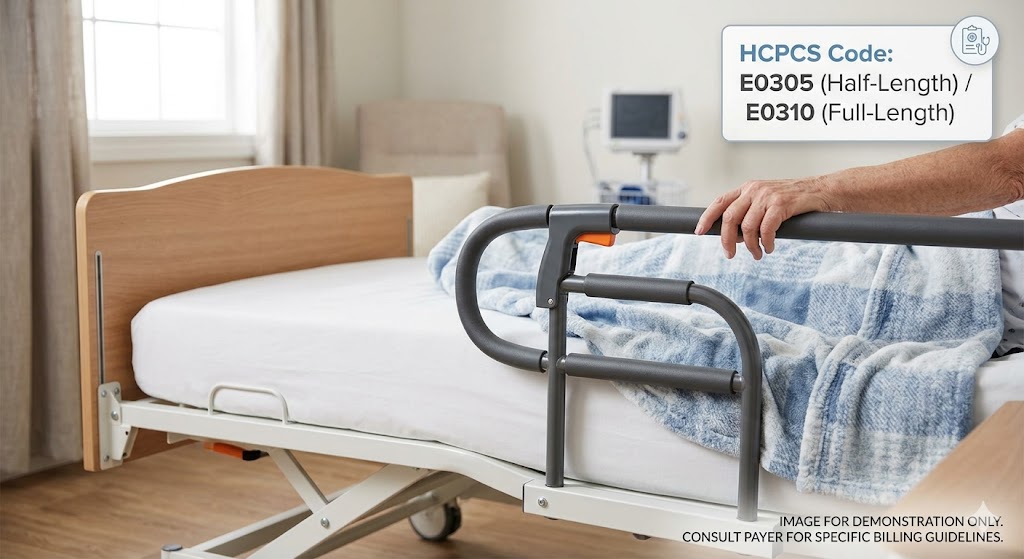
HCPCS Code E0305: Side Rails, Full Length
E0305 represents side rails that run the full length of the bed. Think of a typical two-rail system for a standard semi-electric hospital bed. One rail lines each side of the mattress, extending from the head to the foot end. They often feature two crossbars to prevent a patient from sliding through the gap.
Clinical Applications and Typical Users
The full-length rail makes sense for a patient with a seizure disorder who needs a barrier along the entire side of the bed. It also suits a patient with spastic quadriplegia whose involuntary muscle contractions could throw a limb or their body off the edge of the mattress. A person with advanced multiple sclerosis who can no longer sense the edge of the bed is another candidate.
The key clinical point is the need for continuous protection along the side. The patient does not just need a hand-hold at the head; they need a guard from pillow to feet.
Billing Units and Reimbursement Notes
The billing unit for E0305 is one pair. You bill one unit, and the code covers both the left and right rails for a standard bed. Medicare fee schedules reflect a purchase price. These are not commonly rented, as rails are integral to the bed setup. Payment is usually based on a state fee schedule under the DME benefit, subject to the annual deductible and 20% coinsurance.
HCPCS Code E0310: Side Rails, Half Length
E0310 describes a shorter rail system. These rails attach only to the head section of the bed. They typically extend from the headboard to roughly the mid-point of the mattress. In a bariatric or standard hospital bed setup, these allow the patient to grasp the rail for leverage when moving from a lying to a sitting position, then from sitting to standing.
Differentiating from Full-Length Rails
The length dictates the function. A half-length rail assists with repositioning and bed mobility. A full-length rail adds continuous roll-off protection. An auditor will expect the medical necessity documentation to explain why the patient needs the assistive half-rail but does not require the full-length protection, or conversely, why a half-rail is insufficient. The choice is clinical, not arbitrary.
A patient recovering from hip surgery with upper body strength might only need E0310 rails to pull themselves up. They do not require the lower body barrier. Another patient with a cognitive impairment might lean out of bed at the hip, making a gap in a half-rail system a danger, thus requiring E0305.
Coverage Criteria Specifics
The criteria remain the same as for full-length rails: the patient must have a medical condition requiring positioning assistance or protection from falling out of bed, and a hospital bed must already be medically necessary. You cannot bill E0310 for a regular bed. The rail is an accessory to the covered hospital bed.
HCPCS Code E0306: Safety Enclosure Frame/Canopy
This code occupies a unique and often misunderstood space. E0306 describes a total body enclosure that attaches to a hospital bed. It uses a frame and a canopy. The beneficiary is fully contained within the enclosure. The material typically uses soft mesh to prevent injury from limbs striking the frame.
The “Total Body Enclosure” Definition
The term “total” is what separates this from E0305. The device completely surrounds the mattress on all four sides. Access is via a zipper or similar secure closure. This code applies when a patient’s uncontrolled movements, severe cognitive impairment, or extreme agitation make partial rails ineffective and dangerous. The risk is not simply rolling out; it is climbing over a rail or thrashing violently.
Where It Fits and Where It Doesn’t
The crucial compliance point is this: E0306 is not a convenience code for wandering. Medicare explicitly states that safety enclosures used primarily to restrain a patient who can voluntarily leave the bed are not medically necessary in the statutory sense. If the patient can walk and tries to get up, the enclosure becomes a restraint, not a protective barrier for an involuntary movement condition.
A valid scenario for E0306 is a young adult with severe athetoid cerebral palsy who thrashes uncontrollably during sleep and has fallen through traditional rail gaps. An invalid scenario is an elderly patient with Alzheimer’s who wanders at night. The former is a medical necessity; the latter is a restraint for convenience, which Medicare does not cover.
Comparative Table: E0305 vs. E0310 vs. E0306
A quick reference table helps you select the right code at a glance. Use this as a navigation tool, not a substitute for reading the full clinical record.
| Feature | E0305 (Full Length) | E0310 (Half Length) | E0306 (Enclosure) |
|---|---|---|---|
| Primary Function | Continuous fall-off barrier & mobility aid | Positioning assist & partial barrier | Total body containment for uncontrolled movements |
| Length | Full mattress length | Head section to mid-bed | Fully surrounds mattress |
| Typical Patient | Seizures, spastic quadriplegia, sensory loss | Hip fracture rehab, mild mobility deficit | Severe athetosis, uncontrolled thrashing |
| Restraint Status | Partial assist | Partial assist | Potential restraint (document carefully) |
| Billing Unit | 1 pair | 1 pair | 1 system |
| Key Audit Risk | Document why half-rail is insufficient | Document why full-rail isn’t needed | Document that patient cannot voluntarily exit safely |
Secondary and Related HCPCS Codes
The DME ecosystem is interconnected. You rarely bill a bed rail in isolation. The rail is an accessory to a base, and the base is a covered hospital bed. Before you can get to E0305, you must be on solid ground with the bed codes.
E0260: Semi-Electric Hospital Bed
This is the most common base code paired with rails. The head and knee sections adjust electrically, while the height is manual. If a patient needs a semi-electric bed for a cardiac or pulmonary condition requiring elevation of the head, and they also have a condition that makes them liable to fall out, the E0305 rail becomes a covered accessory.
E0265: Total Electric Hospital Bed
This bed adjusts head, knee, and height electrically. The same logic applies. If the height adjustment is medically necessary—perhaps for a caregiver with a back condition performing transfers—the covered bed allows for the covered rail accessory.
E0271: Mattress, Alternating Pressure
A patient with a pressure ulcer might have an E0271 group 2 support surface on an E0260 bed. Adding rails to this setup requires caution. The rail must mount securely without interfering with the mattress function. Some alternating pressure mattresses compress at the edges, creating entrapment risks with rigid rails. Document the compatibility assessment.
E0630: Pediatric Crib, Hospital Grade
Children present a different coding scenario. A pediatric hospital crib (E0630) comes with built-in high sides. You generally do not bill separate bed rails for a crib. The enclosure is inherent to the code. Attempting to add E0305 to an E0630 will result in a denial for unbundling.
The principle is clear: start with the bed code, establish medical necessity for the base equipment, then justify the accessory. The chain of logic must be unbroken.
Coverage Determination: The “Three-Legged Stool” of Medical Necessity
A HCPCS code is just a key. The lock it must open is the coverage policy. Medicare Local Coverage Determinations (LCDs) for hospital beds and accessories build a three-legged stool. If any leg is missing, the claim collapses under audit scrutiny.
The Underlying Hospital Bed Necessity
The bed itself must be a medical necessity. A rail is not covered for a standard bed in the home. The patient’s records must show they need the positioning of a hospital bed to alleviate a medical condition. Common qualifiers include the need for elevation of the head due to congestive heart failure, chronic obstructive pulmonary disease, or risk of aspiration. Without this foundation, the rail is a non-starter.
The Specific Rail Necessity
You cannot take a “might as well” approach. Because a patient qualifies for a hospital bed does not mean they automatically need rails. The physician’s order and the clinical notes must articulate a second, distinct need. The documentation should answer the question: What happens to this patient if the rail is not present? The answer must be specific, probable, and negative.
Example phrasing from a defensible medical record: “Patient with severe Parkinson’s disease experiences REM sleep behavior disorder. He violently acts out dreams. Full-length side rails are needed to prevent him from propelling himself off the bed, which has resulted in two prior falls from a standard bed causing contusions.”
The Restraint Exclusion
Here is the single greatest reason for denials. The Social Security Act does not provide coverage for items that serve primarily as restraints. A restraint, for Medicare purposes, is a device that restricts a patient’s freedom of movement when they are otherwise capable of purposeful movement. If a patient with Alzheimer’s tries to get out of bed to use the bathroom, but a full enclosure traps them inside, Medicare views this device as a restraint and not a covered medical device.
The only path to coverage for a barrier is proving the patient lacks the capability to make purposeful, safe voluntary exit, and that the uncontrolled movements are the danger, not the ambulation itself. This is a high clinical bar to clear. Failing to understand this distinction leads to suppliers absorbing the cost of expensive equipment.
Step-by-Step: Choosing the Correct Code
How does a billing specialist approach a new order for “bed rails” without seeing the patient? They cannot. The process must be a reverse-engineered investigation of the medical record. Follow this sequence every time.
- Verify the Base: Confirm the patient has a documented, covered hospital bed. If no bed order exists, stop. Do not pass go. The rail order cannot proceed independently.
- Read the Clinical Notes: Ignore the order form for a moment. Go to the office visit notes, the hospital discharge summary, or the therapy evaluation. Look for the narrative of fall risk, positioning difficulty, or involuntary movement.
- Assess the Movement Type: Is the danger involuntary (seizure, spasm, thrashing) or voluntary (confused ambulation, restlessness)? This is the fork in the road between a potential E0306 and a likely non-covered item.
- Measure the Need: If the movement is involuntary, does the patient need protection only at the head and torso? That suggests E0310. Do they need protection along the entire side because the legs also spasm off the bed? That suggests E0305.
- Check for Restraint Indicators: If the word “wandering,” “confusion,” or “sundowning” appears as the primary driver, pause. Prepare the patient for the likelihood of a non-coverage Advance Beneficiary Notice (ABN).
- Draft the Narrative: Write a short summary for your own file connecting the clinical condition to the specific code. If you cannot write this summary logically, the claim is not ready to submit.
Documentation That Survives an Audit
An auditor does not read your mind. They read the paper. The paper must contain the story. A checklist approach—”needs rails”—is an invitation for a denial and a potential overpayment demand.
Physician’s Order: Required Elements
The detailed written order must contain the beneficiary’s name, the physician’s name and signature, the date of the order, and a description of the item. For rails, a generic “E0305” is insufficient alone. The description should read, “Full-length side rails for hospital bed,” or the brand and model if it is a specific enclosure. The order date must be on or before the delivery date.
Medical Records: Telling the Story
The progress notes provide the “why.” A physical therapy note stating, “Patient unable to reposition independently; half rails provide necessary leverage for bed mobility,” is gold. An occupational therapy note detailing, “Patient slides down in bed due to spasticity and requires full-length barrier to maintain safe position,” is gold. Auditors look for functional assessments, not just diagnosis codes.
Supplier-Produced Documentation
The delivery slip must note the brand, model, and HCPCS code of the delivered rails. A photograph, stored in the patient file, of the completed setup showing the rails properly attached to the hospital bed reduces any question of whether the correct item was delivered. This takes minutes but can save thousands in a Targeted Probe and Educate (TPE) audit.
The Advance Beneficiary Notice (ABN)
If you have any doubt about coverage—specifically for E0306 or any enclosure that could be viewed as a restraint—issue an ABN. The ABN shifts potential financial liability to the patient, but only if it is properly executed. Explain the specific reason you believe Medicare will deny. Do not use vague language like “Medicare may not pay.” Use, “Medicare usually denies claims for bed enclosures when the patient’s primary risk is wandering. Your doctor indicated your condition includes wandering risk.” This transparency is legally required and ethically sound.
Common Denial Scenarios and How to Appeal
Denials follow predictable patterns. When you know them, you can write your initial claim to preemptively refute them. When a denial arrives, a targeted appeal is more effective than a scattergun approach.
Denial: Not Medically Necessary
The additional documentation request (ADR) results in a denial letter stating the records did not support medical necessity. Your appeal must provide the missing functional assessment. Request a statement from the physical therapist. Submit a detailed timeline of falls. Send a revised certificate of medical necessity. Show the reviewer the consequence of not having the device.
Denial: Restraint Exclusion
The claim for E0306 comes back denied, citing the statutory exclusion of restraints. Your appeal faces an uphill battle because you are arguing against a legal exclusion, not just a clinical one. To win, you must prove the patient is not capable of voluntary egress. You might submit video evidence (with consent) from a sleep study showing thrashing movements. You submit nursing notes from a facility demonstrating the patient’s lack of purposeful ambulation. The burden of proof is entirely on the supplier.
Denial: Billing for a Convenience Item
This is a variation of the restraint argument. The reviewer argues the rail makes it easier for the caregiver, not medically necessary for the patient. Your counter-argument must pivot back to the patient’s physical condition. “The caregiver’s ease is incidental. The patient’s diagnosis of myoclonic jerks makes this a medical safety requirement, not a convenience.”
Appeal Strategy: The Redetermination
Always start with a redetermination. Do not skip to an Administrative Law Judge hearing. The redetermination is your chance to add documentation. Write a clear cover letter. Bullet point the three reasons the policy criteria are met. Quote the specific LCD language that supports your position. Attach the indexed medical records, highlighting the critical sentences. Make the reviewer’s job easy.
Bariatric and Pediatric Considerations
Standard codes may apply to non-standard patient populations, but the documentation demands increase.
Bariatric Rails (E0305/E0310 for Heavy-Duty Beds)
A bariatric patient on a heavy-duty bed (E0302, for example) may need reinforced rails. The standard codes still apply, but the order must specify the weight capacity. Standard rails might not support a 400-pound patient heaving sideways. If a specific heavy-duty rail is required, you may need to use a miscellaneous code (E1399) and describe it. However, if the manufacturer’s rails are billed under E0305 and built for the weight, use E0305. The danger is using a standard rail on a bariatric bed, creating an entrapment risk. The supplier is responsible for matching the accessory to the bed’s weight capacity.
Pediatric Enclosures (E0306 Nuances)
For children, the restraint argument shifts slightly. A crib (E0630) is inherently a full enclosure and is covered for pediatric patients with medical necessity. The E0306 code is more commonly used for older children or smaller adults who have outgrown a crib but still require a total enclosure on a standard hospital bed. The documentation must reflect the developmental stage and the specific involuntary movement disorder. “Child has outgrown crib, but due to Lennox-Gastaut syndrome with frequent atonic drop seizures during sleep, a full enclosure on a hospital bed is the only safe sleep surface.”
The Role of Product Classification in Code Selection
A device’s FDA classification does not dictate HCPCS billing, but it informs the documentation. Many safety enclosures are registered as Class I medical devices, exempt from premarket notification. A PMD (protective medical device) designation can support the argument for medical necessity, but the Medicare LCD remains the final coverage authority.
Don’t assume that because a product has an FDA listing, Medicare automatically covers it. The Medicare standard is “reasonable and necessary.” A product can be a legally marketed medical device and still be considered a non-covered restraint by Medicare. Your role is to bridge the product’s intended use with the patient’s specific medical need in your documentation.
Practical Billing Checklist
A concise checklist keeps your process clean. Print this and attach it to every bed rail file.
- Hospital Bed Order: Is there a valid, signed order for the base hospital bed?
- Rail Order: Does the detailed written order specify the rail type and correlate with the bed?
- Clinical Narrative: Do the records describe involuntary movement or a physical inability to safely maintain bed position?
- Restraint Check: Is the documented need freedom from danger, or restriction of freedom? If the latter, ABN is mandatory.
- Code Match: E0305 for full-length, E0310 for half-length, E0306 for total enclosure with documented uncontrolled movement.
- Delivery Proof: Does the file contain a delivery slip with the model, serial number, and date of service?
Conclusion
HCPCS codes for bed rails represent a strict clinical and legal framework, not just a billing convenience. Success in this area requires distinguishing between an assistive partial rail and a non-covered restraint, building a documentation package that proves the bed’s underlying necessity, and articulating the specific involuntary physical danger the rail prevents. By treating each code as a conclusion drawn from a patient’s story, suppliers can maintain compliance, survive audits, and ethically serve those truly in need of this protective equipment.
FAQ: HCPCS Coding for Bed Rails
Q: What is the main HCPCS code for standard full-length bed side rails?
A: E0305. It covers a pair of side rails that run the full length of a hospital bed and are used as a barrier and mobility aid.
Q: Is a bed enclosure covered by Medicare?
A: Rarely. HCPCS code E0306 exists for total body safety enclosures, but Medicare usually denies them as “restraints” unless you can prove the patient’s uncontrolled involuntary movements make a partial rail ineffective and they cannot safely exit the bed voluntarily.
Q: Can I bill for bed rails if the patient doesn’t have a hospital bed?
A: No. E0305, E0310, and E0306 are accessories. Medicare will only cover them if the patient already meets the medical necessity criteria for a covered hospital bed (like E0260).
Q: What is the difference between E0305 and E0310?
A: E0305 rails extend the full length of the bed, protecting from head to toe. E0310 rails are half-length, extending from the headboard to roughly the middle of the bed, and are primarily for repositioning assistance rather than continuous fall-off protection.
Q: What documentation do I need to avoid a denial for a bed rail claim?
A: You need a detailed physician’s order for the specific rail, clinical records showing the medical necessity for positioning or involuntary movement protection, proof that a hospital bed is needed, and a delivery confirmation. If the device could be seen as a restraint, a signed Advance Beneficiary Notice (ABN) is crucial.
Additional Resource: CMS Medicare Coverage Database
For the most current Local Coverage Determinations (LCDs) and Policy Articles related to Hospital Beds and Accessories, visit the official CMS Medicare Coverage Database.
Link: https://www.cms.gov/medicare-coverage-database/search.aspx
Navigate to this site and search for “Hospital Beds” to find your specific DME MAC jurisdiction’s binding policy documents.
Disclaimer: This article provides general information and is for educational purposes only. It does not constitute legal, coding, or billing advice. HCPCS codes and Medicare policies change frequently. Always consult your specific DME MAC’s Local Coverage Determination (LCD) and a qualified billing professional before submitting claims.