In the vast, interconnected ecosystem of modern healthcare, where patient narratives are translated into data, a single alphanumeric sequence holds immense power. It can influence treatment pathways, determine resource allocation, shape public health statistics, and dictate financial reimbursement. This is the world of medical classification, governed by the International Classification of Diseases, Tenth Revision, Clinical Modification (ICD-10-CM). Within this elaborate codex, one code—E87.5—Hyperkalemia—serves as a critical pivot point for understanding a common yet potentially lethal electrolyte disturbance. Hyperkalemia, an elevated concentration of potassium in the blood, is not merely a lab anomaly; it is a biochemical alarm bell that can whisper of chronic kidney disease, scream of acute medication toxicity, or herald a sudden cardiac arrest. This article embarks on a detailed exploration of ICD-10-CM code E87.5, venturing far beyond its basic definition. We will dissect its clinical roots, unpack the imperative of meticulous documentation, navigate its complex relationship with other codes, and illuminate the profound, systemic consequences of its accurate—or inaccurate—application. For clinicians, coders, healthcare administrators, and informed patients alike, understanding the story behind this code is to understand a fundamental mechanism of how healthcare communicates, learns, and functions.
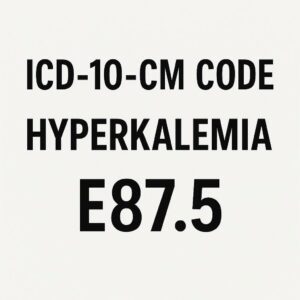
ICD-10-CM code for Hyperkalemia E87.5
2. Understanding Hyperkalemia: The Silent Electrolyte Storm
To appreciate the code, one must first understand the condition. Potassium (K+) is the principal intracellular cation, a key player in maintaining cellular resting membrane potential. This role makes it absolutely indispensable for the normal functioning of excitable tissues, most critically neuromuscular and cardiac cells. The normal serum potassium range is tightly regulated, typically between 3.5 and 5.0 mmol/L. Hyperkalemia is defined as a serum potassium level exceeding 5.0 mmol/L, and is stratified by severity:
-
Mild: 5.1 – 5.9 mmol/L
-
Moderate: 6.0 – 6.9 mmol/L
-
Severe: ≥ 7.0 mmol/L
The pathophysiology of hyperkalemia generally stems from three core mechanisms: 1) Impaired Renal Excretion (e.g., chronic kidney disease, acute kidney injury, hyp aldosteronism, certain diuretics like spironolactone), 2) Transcellular Shift (movement of potassium from inside cells to the extracellular fluid, seen in acidosis, tissue breakdown like rhabdomyolysis or tumor lysis syndrome, and insulin deficiency), and 3) Excessive Potassium Intake (often iatrogenic, through IV fluids or supplements, especially in the context of impaired excretion).
Clinically, hyperkalemia can be insidious. Symptoms are often neuromuscular and non-specific—fatigue, weakness, paresthesia (tingling), and palpitations. The true danger lies in its cardiotoxicity. As potassium levels rise, the cardiac membrane becomes unstable, leading to characteristic electrocardiogram (ECG) changes that can progress lethally: peaked T waves, shortened QT interval, widening of the QRS complex, sine wave pattern, and ultimately, asystole or ventricular fibrillation. This silent progression from a vague weakness to a life-threatening arrhythmia is precisely why hyperkalemia demands swift recognition, urgent intervention, and precise coding to track its prevalence and causes.
3. The ICD-10-CM System: A Language of Precision
ICD-10-CM is not a simple list of diseases; it is a sophisticated, multi-axial taxonomic system. It provides a standardized vocabulary that allows the complex narrative of a patient’s illness to be condensed into coded data for universal comprehension. This data fuels everything from individual hospital billing to global epidemiological research. The structure is hierarchical. Codes begin with an alphabetic character (representing a chapter), followed by numeric digits, with increasing specificity offered by additional characters. The “E” chapter (Codes E00-E89) is dedicated to Endocrine, Nutritional, and Metabolic Diseases. Within this, the block E70-E88 covers “Metabolic Disorders.” Code E87.5 sits within this block, which deals with other disorders of fluid, electrolyte, and acid-base balance.
4. The Designated Code: E87.5 – A Deconstruction
ICD-10-CM Code: E87.5 – Hyperkalemia
This is the fundamental, parent code for a confirmed diagnosis of high serum potassium. Its placement is crucial:
-
Chapter: Endocrine, Nutritional, and Metabolic Diseases (E00-E89)
-
Block: Other disorders of fluid, electrolyte, and acid-base balance (E87-)
-
Specific Code: E87.5
Coding Notes and Instructions: Official coding guidelines are paramount. Crucially, code E87.5 should be assigned only when hyperkalemia is documented by the provider as a confirmed diagnosis, not merely as a lab finding. A solitary elevated potassium level on a lab report, without a physician’s statement linking it to the patient’s condition, may not be sufficient for coding. The coder must rely on the provider’s assessment.
Excludes1 Notes: These are critical directives indicating that the conditions listed are mutually exclusive and should not be coded together with E87.5. For hyperkalemia, the Excludes1 note is: hyperkalemic periodic paralysis (G72.3-). This is a distinct genetic disorder where hyperkalemia is episodic and linked to paralytic attacks; it is coded differently in the chapter for diseases of the nervous system.
Required Specificity: While E87.5 itself does not have further sub-classifications for severity (e.g., mild, moderate, severe), the coder’s responsibility is to capture the etiology if known and documented. This is where the power of additional codes comes into play.
5. Clinical Documentation: The Foundation of Accurate Coding
The adage “if it wasn’t documented, it didn’t happen” is the bedrock of medical coding. For E87.5 to be assigned appropriately, the medical record must contain unambiguous provider documentation. Key phrases include:
-
“Diagnosis: Hyperkalemia”
-
“Hyperkalemia due to [cause, e.g., acute kidney injury]”
-
“Patient admitted for management of severe hyperkalemia.”
-
“The patient’s weakness is attributed to hyperkalemia.”
Conversely, phrases like “potassium elevated to 6.2” or “high K+” in the lab section alone are insufficient. The coder requires the provider’s synthesis of that data into a diagnosis. Furthermore, documenting the cause is essential for capturing the full clinical picture and enabling the use of combination codes or sequencing rules.
6. Differential Diagnosis and Comorbidities: The Web of Connections
Hyperkalemia is rarely an isolated event. It is typically a symptom or complication of another underlying condition. Accurate coding involves creating a meaningful narrative through multiple codes. The sequencing (which code is listed first) is guided by the ICD-10-CM Official Guidelines for Coding and Reporting, particularly the rules for “Codes for Signs and Symptoms” and “Two or more interrelated conditions.”
Common Etiologies of Hyperkalemia and Corresponding ICD-10-CM Codes
| Etiological Category | Specific Cause / Condition | Primary ICD-10-CM Code | Sequencing with E87.5 (Hyperkalemia) |
|---|---|---|---|
| Renal & Adrenal | Chronic Kidney Disease, Stage 4 | N18.4 | N18.4 as primary, E87.5 as secondary |
| Acute Kidney Injury | N17.9 | N17.9 as primary, E87.5 as secondary | |
| Hypoaldosteronism | E27.49 | E27.49 as primary, E87.5 as secondary | |
| Medication-Induced | Adverse effect of ACE inhibitor | T46.4X5A (initial encounter) | T46.4X5A as primary, E87.5 as secondary |
| Adverse effect of potassium-sparing diuretic | T50.2X5A (initial encounter) | T50.2X5A as primary, E87.5 as secondary | |
| Tissue Breakdown | Rhabdomyolysis | M62.82 | M62.82 as primary, E87.5 as secondary |
| Tumor Lysis Syndrome | E88.3 | E88.3 as primary, E87.5 as secondary | |
| Metabolic | Diabetic Ketacidosis with hyperkalemia | E10.11 (Type 1) or E11.11 (Type 2) | E1x.11 is a combination code that includes hyperkalemia. DO NOT add E87.5 separately. |
| Other | Excessive Dietary/IV Intake | – | E87.5 may be primary if this is the main reason for encounter. |
Example Sequencing Scenarios:
-
A patient with end-stage renal disease (ESRD) on dialysis presents with hyperkalemia. Primary diagnosis: N18.6 (ESRD), Secondary diagnosis: E87.5.
-
A patient develops hyperkalemia due to an adverse effect of lisinopril (an ACE inhibitor). Primary diagnosis: T46.4X5A (Adverse effect of ACE inhibitor), Secondary diagnosis: E87.5, and an additional code for the hyperkalemia manifestation.
-
A patient is admitted in diabetic ketoacidosis (DKA) with documented hyperkalemia. Primary diagnosis: E10.11 (for Type 1 DKA). This single code captures both the DKA and the hyperkalemia. Coding E87.5 separately would be incorrect and considered “unbundling.”
7. The Consequences of Miscoding: Financial, Clinical, and Ethical Implications
An error in assigning E87.5, or its related codes, creates ripples across the healthcare system.
-
Financial: Under-coding (failing to code a documented hyperkalemia) leads to loss of legitimate reimbursement, as the complexity and resource use (e.g., ECG monitoring, Kayexalate, emergency dialysis) are not fully captured. Over-coding (assigning E87.5 when not documented or using it with a combination code like E10.11) constitutes fraud and abuse, risking hefty penalties, audits, and legal action.
-
Clinical & Quality: Inaccurate coding distorts clinical databases. It can skew hospital quality metrics, obscure the true incidence of medication adverse effects, and corrupt the data used for clinical research and public health surveillance. If hyperkalemia as a complication of a drug isn’t coded correctly, its risk profile may be underestimated.
-
Ethical: Accurate coding is a component of ethical patient care. It ensures the patient’s medical record truthfully represents their condition, which is vital for future care. It also upholds the integrity of the healthcare data ecosystem that researchers and policymakers rely on to improve care for all.
8. Case Studies: E87.5 in Real-World Scenarios
Case Study 1: The Missed Complication. A 72-year-old male with heart failure (I50.9) and CKD (N18.3) is admitted for shortness of breath. His labs show K+ 6.8. The treating physician documents “exacerbation of CHF, likely due to non-compliance with diuretics” but does not explicitly diagnose “hyperkalemia.” The coder, bound by documentation, cannot assign E87.5. The hospital is not reimbursed for treating this severe, resource-intensive electrolyte disorder, and the national data on hyperkalemia in CKD patients is incomplete.
Case Study 2: The Incorrect Duplication. A 45-year-old female with Type 1 diabetes is admitted with DKA and a potassium of 5.8. The physician correctly documents “Diabetic ketoacidosis with hyperkalemia.” A novice coder assigns E10.11 and E87.5. This is an error. Code E10.11 is a combination code explicitly including hyperkalemia. The addition of E87.5 is redundant (“double-dipping”) and would be flagged in an audit as incorrect coding, potentially leading to a denial of the claim for the redundant code.
9. The Future of Coding: ICD-11 and Beyond
The World Health Organization’s ICD-11, which some countries are beginning to implement, offers even greater granularity. In ICD-11, the code for hyperkalemia is 5C77.0. Its structure allows for more detailed etiological linkages through “post-coordination” (clinically combining multiple codes to describe a condition). While the US has not yet set a timeline for transitioning from ICD-10-CM to ICD-11, understanding this direction emphasizes the ongoing evolution toward more precise, data-rich clinical terminology.
10. Conclusion
ICD-10-CM code E87.5 for hyperkalemia is a vital tool in the healthcare lexicon, far transcending its simple alphanumeric form. It encapsulates a critical physiological imbalance, its accurate assignment hinging on impeccable clinical documentation and a deep understanding of its pathophysiological web. Correct application ensures precise reimbursement, valid public health data, and ultimately, supports a healthcare system that can accurately diagnose, treat, and learn from the silent electrolyte storm that is hyperkalemia.
11. Frequently Asked Questions (FAQs)
Q1: Can I code hyperkalemia if only the lab value is high, but the doctor hasn’t mentioned it in the assessment?
A: No. Per official coding guidelines, a code for a diagnosis should be assigned only when it is documented by the provider as established or confirmed. A lab value alone is not a diagnosis.
Q2: How do I code hyperkalemia if it’s caused by a medication?
A: You would use a combination of codes. First, assign a code from Chapter 19 (Injury, Poisoning) for the adverse effect of the specific drug (e.g., T46.4X5A for ACE inhibitors). Then, assign E87.5 for the hyperkalemia. Always follow the Table of Drugs and Chemicals in the ICD-10-CM index.
Q3: What is the difference between an Excludes1 and an Excludes2 note for E87.5?
A: E87.5 has an Excludes1 note for “hyperkalemic periodic paralysis (G72.3-)”. This means these two conditions are mutually exclusive and should never be coded together. There is no Excludes2 note for E87.5, which would indicate that the other condition is not part of it but may be coded concurrently if present.
Q4: Is there a separate code for the severity of hyperkalemia (mild, moderate, severe)?
A: No, ICD-10-CM code E87.5 does not have subclassifications based on severity. The severity should be discernible from the clinical documentation and may influence the selection of other procedure codes (e.g., for dialysis).
Q5: When is hyperkalemia considered a “complication” vs. a “co-existing condition”?
A: This is a matter of clinical context and documentation. If the hyperkalemia arises during an inpatient stay due to treatment (e.g., from IV fluids or a drug), it may be considered a complication. If it is present on admission and is a known issue related to a chronic disease like CKD, it is a co-existing condition. The physician’s documentation should clarify this relationship, which guides coding.
Disclaimer: The following article is intended for informational purposes only and does not constitute medical advice, diagnosis, or treatment. Always seek the advice of your physician or other qualified health provider with any questions you may have regarding a medical condition or coding. Medical coding is complex and subject to change; always consult the most current official ICD-10-CM coding guidelines and resources.
Date: December 20, 2025
Author: Clinical Coding Insights