Altered Mental Status (AMS) is one of the most common, yet most challenging, presentations in all of healthcare. It is not a disease itself, but a symptom—a distress signal from the brain indicating that something, somewhere, has gone profoundly wrong. For clinicians, it is a diagnostic puzzle, a race against time to decode a presentation that can range from subtle confusion to profound unresponsiveness, with causes spanning from a simple urinary tract infection in the elderly to a catastrophic intracranial hemorrhage. For medical coders, billers, and healthcare administrators, AMS represents a parallel labyrinth of rules, hierarchies, and specificities within the ICD-10-CM coding system. The stakes of navigating this labyrinth correctly are high: accurate coding drives appropriate reimbursement, fuels critical clinical research and epidemiology, and ensures a faithful reflection of the patient’s severity and the provider’s work in the health record. This comprehensive guide aims to bridge the clinical and administrative worlds, offering a detailed, human-written exploration of how to accurately and ethically code for Altered Mental Status. We will move beyond the default “R41.82” to understand when to use it, when to avoid it, and how to hunt for the more precise codes that tell the true story of the patient’s condition.
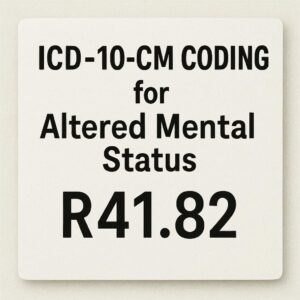
ICD-10-CM Coding for Altered Mental Status
Chapter 1: Understanding Altered Mental Status – More Than Just “Confusion”
Before a single code can be assigned, one must grasp the clinical terrain. AMS is an umbrella term for any deviation from a patient’s normal baseline level of awareness, cognition, attention, or arousal. It is intentionally broad because its causes are extraordinarily vast.
Key Domains of Alteration:
-
Arousal/Consciousness: This ranges from lethargy (drowsy but responsive) to obtundation (aroused only with vigorous stimulation) to stupor (responsive only to pain) and coma (unresponsive).
-
Attention: The inability to focus, maintain, or shift attention. A hallmark of delirium.
-
Cognition: Deficits in memory, orientation (to person, place, time, situation), language, and executive function.
-
Perception: The presence of hallucinations (false perceptions) or illusions (misinterpretations of real stimuli).
-
Psychomotor Activity: Can be agitated/hyperactive (picking at sheets, restless) or hypoactive (sluggish, apathetic)—the latter is often missed.
The Differential Diagnosis Mnemonic: “AEIOU TIPS”
Every clinician learns this mnemonic, and coders should understand its breadth:
-
A – Alcohol, Acid-base/electrolytes, Anoxia
-
E – Encephalopathy (metabolic, septic, hepatic), Endocrine (hypo/hyper-glycemia, thyroid)
-
I – Infection (CNS: meningitis; systemic: UTI, pneumonia), Intracranial (stroke, bleed, tumor)
-
O – Overdose/Opiates, Oxygen deficiency (hypoxia, CO poisoning)
-
U – Uremia (renal failure)
-
T – Trauma (head injury), Temperature (hypo/hyperthermia)
-
I – Insulin (diabetic emergencies), Intussusception (in pediatrics)
-
P – Psychiatric, Poisoning (drugs, toxins)
-
S – Shock, Seizure (post-ictal state), Space-occupying lesion
This vast differential is why coding simply “AMS” is often insufficient—it’s like labeling a mechanical problem as “car won’t start” instead of identifying a dead battery versus a seized engine.
Chapter 2: The Philosophy of ICD-10-CM: Specificity is King
The transition from ICD-9 to ICD-10-CM was a quantum leap in granularity. The system is built on a fundamental principle: code to the highest degree of specificity known at the time of the encounter. This means:
-
Code Established Conditions: If a definitive cause for the AMS is known, that cause gets coded, not the symptom.
-
Symptom Codes as Last Resort: Chapter 18 (Symptoms, Signs, and Abnormal Clinical and Laboratory Findings, Not Elsewhere Classified) codes, like R41.82, are used only when:
-
A more precise diagnosis cannot be established.
-
The symptom is the reason for the encounter and no definitive cause is treated or investigated.
-
-
The “Unspecified” Designation: Codes with “unspecified” are acceptable when clinical information is lacking, but they are often targets for audit. They should not be used if more specific information is available in the record.
Chapter 3: The Primary Culprit – Code R41.82 “Altered Mental Status, Unspecified”
This is the go-to code when AMS is the documented diagnosis without further specification. It belongs to the category R41: “Other symptoms and signs involving cognitive functions and awareness.”
-
Code: R41.82 – Altered mental status, unspecified.
-
Official Description: Use this code for documented “altered mental status” where no further clarification (e.g., delirium, disorientation) is provided and no underlying etiology is diagnosed as the cause for the encounter.
When is R41.82 Appropriate?
-
In the emergency department, for a patient found down, briefly evaluated, and transferred without a clear cause established.
-
For an initial encounter where workup (labs, imaging) is pending and the provider’s final assessment is literally “AMS.”
-
When the documentation does not support a more specific cognitive disturbance code (e.g., the note says “confused” but doesn’t meet criteria for delirium).
Crucial Distinction: R41.82 is NOT for:
-
Delirium (coded to F05 or R41.0)
-
Dementia (coded to F01-F03, G30-)
-
Coma (R40.2-)
-
Transient alteration of awareness like syncope (R55)
Chapter 4: The Critical Search for a Definitive Etiology
This is the heart of accurate coding. When a cause for AMS is identified, that underlying condition becomes the principal diagnosis (for inpatient) or first-listed diagnosis (for outpatient), and the AMS becomes a symptom that is not separately coded, unless it meets specific criteria for additional code reporting.
Common Etiologies of AMS and Their Corresponding ICD-10-CM Codes
| Etiologic Category | Specific Condition / Example | Primary ICD-10-CM Code(s) | Chapter & Notes |
|---|---|---|---|
| Metabolic | Diabetic Ketoacidosis with Coma | E10.11 (Type 1) / E11.11 (Type 2) | Endocrine (E00-E90). The coma is included in the code. |
| Hyponatremia | E87.1 | Code the electrolyte disorder. | |
| Hepatic Encephalopathy | K72.91 | Digestive (K00-K95). A common cause in cirrhosis. | |
| Uremic Encephalopathy | G93.41 | Nervous System (G00-G99). Due to renal failure. | |
| Infectious | Sepsis with AMS/Delirium | A41.9 (Sepsis) + R65.20 (Severe sepsis w/o shock) | Infection (A00-B99). Code sepsis first. AMS is a key sign of severe sepsis (R65.20). |
| Urinary Tract Infection | N39.0 | Genitourinary (N00-N99). A classic cause of delirium in elderly. | |
| Bacterial Meningitis | G00.9 | Nervous System. AMS is a key symptom. | |
| Neurologic | Acute Ischemic Stroke | I63.9 | Circulatory (I00-I99). AMS common in large strokes. |
| Intracranial Hemorrhage | I61.9 (Nontraumatic) / S06.36- (Traumatic) | Circulatory or Injury (S00-T98). | |
| Post-ictal State (after seizure) | G40.909 (Epilepsy) + R41.0 (if disorientation is focal) | Code the epilepsy. Post-ictal confusion is inherent. | |
| Toxic | Acute Alcohol Intoxication | F10.129 (with intoxication) | Mental Disorders (F01-F99). |
| Opioid Overdose | T40.2X1A (Poisoning, accidental) | Injury/Poisoning (S00-T98). Use external cause codes. | |
| Drug-induced Delirium | F05 (if specified) or poisoning code | ||
| Other | Hypoxia/Respiratory Failure | J96.00 (Acute) | Respiratory (J00-J99). |
| Severe Dehydration | E86.0 |
Note: This table is illustrative, not exhaustive. Always verify code selection with the current year’s code set and guidelines.
Coding Rule: In most cases, DO NOT code R41.82 alongside a definitive etiology like those above. The AMS is an integral part of the disease process. Coding both would be considered “unbundling.”
Chapter 5: Coding for Specific Neurological and Psychiatric Presentations
Sometimes, the presentation is more specific than “AMS” but is not yet linked to an underlying disease.
-
R41.0 – Disorientation, unspecified: For isolated disorientation to time, place, or person.
-
R41.1 – Anterograde amnesia: Inability to form new memories.
-
R41.2 – Retrograde amnesia: Loss of pre-existing memories.
-
R41.3 – Other amnesia: Includes amnesia NOS.
-
R41.81 – Age-related cognitive decline: Use only for benign age-related decline, not dementia.
-
R40.0 – Somnolence: Sleepiness.
-
R40.1 – Stupor: A deeper state of impaired consciousness.
-
R40.2 – Coma: Requires specific subcoding (e.g., R40.21 for Glasgow Coma Scale 3-8).
Chapter 6: The Intersection of AMS, Delirium, and Dementia
This is a critical area of confusion. Delirium (Acute Confusional State) is a specific medical diagnosis of acutely altered consciousness and cognition with a fluctuating course, usually due to an underlying medical condition. Dementia is a chronic, progressive decline.
-
Coding Delirium:
-
F05 – Delirium due to known physiological condition: This is the most common and correct code. It requires two components:
-
The underlying condition (e.g., UTI N39.0, dehydration E86.0).
-
Code F05 as an additional code to specify the type of delirium. The causal relationship is indicated.
-
-
R41.0 – Disorientation: A less specific alternative if the documentation mentions confusion/disorientation but does not formally diagnose “delirium.”
-
-
Coding Dementia with Behavioral Disturbance: A patient with underlying dementia (e.g., F03.90 Unspecified dementia) may develop an acute delirium (e.g., from infection). In this case:
-
Principal diagnosis: The acute condition causing the delirium (e.g., N39.0 UTI).
-
Additional codes: F05 (Delirium) AND F03.91 (Unspecified dementia with behavioral disturbance) if the dementia is exacerbated.
-
Chapter 7: Documentation: The Clinician-Coder Partnership
Accurate coding is impossible without clear documentation. Coders cannot infer or assume. Clinicians must document:
-
The Patient’s Baseline: “Patient’s family reports baseline cognitive status is intact.”
-
Specific Behaviors: “Patient is disoriented to year and location, is having visual hallucinations of insects on the wall, and his attention waxes and wanes.”
-
The Diagnostic Impression: Avoid sole documentation of “AMS.” Progress to “AMS likely secondary to urosepsis” or “Acute delirium due to hyponatremia.”
-
Cause and Effect: Clearly link the symptom to the underlying condition.
Chapter 8: Case Studies in Complexity: Applying the Codes
Case 1: The Elderly Fall
-
Presentation: 82F with known Alzheimer’s (F02.80) found on floor by family, confused and agitated. In ED, she is disoriented, agitated, and has a fever. UA positive for infection. Diagnosis: UTI-induced delirium in a patient with dementia.
-
Coding: N39.0 (UTI – principal), F05 (Delirium due to UTI), F02.81 (Dementia in Alzheimer’s disease with behavioral disturbance).
Case 2: The Diabetic Emergency
-
Presentation: 45M with known Type 1 DM brought in by ambulance obtunded. Blood glucose 850, anion gap elevated, pH 7.1. Diagnosis: Diabetic ketoacidosis with coma.
-
Coding: E10.11 (Type 1 DM with DKA and coma). Do NOT code R41.82 or R40.2-.
Case 3: The Unknown Intoxication
-
Presentation: 30M found unresponsive in park. Responds to naloxone, becomes agitated and confused. No further history available. Discharge Diagnosis: Altered mental status, likely opioid intoxication, ruled out other causes.
-
Coding: R41.82 (Altered mental status, unspecified) is appropriate here because the cause is “likely” but not confirmed, and the presentation was nonspecific. If the provider documents “Opioid intoxication,” then T40.2X1A would be principal.
Chapter 9: The Consequences of Inaccurate Coding
-
Financial: Undercoding (using R41.82 for a coded case of septic encephalopathy) leads to lost revenue. Overcoding (coding R41.82 with a definitive Dx) can lead to claim denials or audits.
-
Clinical/Research: Inaccurate data skews public health statistics, disease tracking, and clinical research on conditions causing AMS.
-
Audit Risk: Overuse of unspecified codes (R41.82) is a red flag for payers and can trigger audits, leading to recoupments and penalties.
-
Patient Care: Poor documentation and coding can fragment the patient’s story across healthcare systems.
Conclusion
Accurate ICD-10-CM coding for Altered Mental Status transcends mere billing; it is an exercise in clinical precision translated into data. Moving reflexively to R41.82 often overlooks the richer, more definitive narrative within the medical record. By understanding the clinical underpinnings of AMS, adhering to the ICD-10-CM mandate for specificity, and fostering clear documentation, coders and clinicians together ensure that the patient’s complex story is accurately told, driving appropriate reimbursement, robust data, and ultimately, better-informed patient care.
Frequently Asked Questions (FAQs)
Q1: Can I code R41.82 with a diagnosis of delirium?
A: No. If the provider documents “delirium,” you must use a delirium code (F05 or, if unspecified, R41.0). R41.82 is for unspecified AMS.
Q2: A patient with dementia is admitted for pneumonia and is more confused than usual. What do I code?
A: Code the pneumonia (J18.9) as principal. Then, code the dementia with the appropriate behavioral disturbance code (e.g., F03.91). If the provider specifically diagnoses superimposed delirium, also add F05.
Q3: When is it mandatory to use an “additional code” for the symptom?
A: Primarily when a symptom (like AMS/R41.82) is an integral part of a code’s definition but the code requires more detail (e.g., some encephalopathy codes). Most often, for definitive etiologies, the symptom is not separately coded. Always follow the Tabular instruction that says “Code also” or “Use additional code.”
Q4: The provider only wrote “AMS” in the assessment, but the note describes a clear UTI and dehydration. Can I code the UTI instead?
A: No. Coders must code based on the provider’s final diagnostic statement. You cannot “upcode” based on clinical findings. This is a critical opportunity for provider education and query. You should query the provider to clarify the cause of the AMS.
Q5: What is the difference between R41.82 and R41.0?
A: R41.82 is broader, encompassing any change in mental status. R41.0 is specifically for disorientation (to time, place, person). If the documentation only says “confused” or “altered,” R41.82 may be safer. If it specifies “disoriented,” R41.0 is more accurate.
Additional Resources
-
The Official Source: CMS ICD-10-CM Official Guidelines for Coding and Reporting (FY 2025): https://www.cms.gov/medicare/coding-billing/icd-10-cm-official-guidelines-coding-and-reporting
-
Code Browser: CDC ICD-10-CM Browser: https://www.cdc.gov/nchs/icd/icd10cm.htm
-
Clinical Reference: UpToDate or DynaMed entries on “Delirium and Acute Confusional States” for clinical context.
-
Professional Organizations: American Health Information Management Association (AHIMA) (www.ahima.org) and American Academy of Professional Coders (AAPC) (www.aapc.com) for coding clinics, forums, and continuing education.
-
Pocket Guide: Consider a current-year ICD-10-CM coding handbook from a reputable publisher like AMA or AAPC for quick reference.
Date: December 18, 2025
Author: Medical Coding Insights Team
Disclaimer: This article is intended for educational and informational purposes only. It is not a substitute for professional medical coding advice, official coding guidelines, or clinical judgment. Always consult the current year’s ICD-10-CM Official Guidelines for Coding and Reporting and the complete code set for definitive coding decisions. The author and publisher are not responsible for any coding errors or subsequent financial impacts.