Blurred vision is one of the most common complaints heard in ophthalmology clinics, optometry practices, emergency departments, and primary care offices worldwide. It is a deceptively simple phrase that can represent a vast spectrum of underlying conditions, ranging from a mundane, correctable refractive error to the first warning sign of a life-threatening neurological event. For the patient, it is a source of anxiety, frustration, and a tangible degradation of their quality of life. For the clinician, it is a diagnostic puzzle. But for the medical coder, biller, and healthcare administrator, “blurred vision” is a specific clinical term that must be translated into the precise, universal language of the International Classification of Diseases, Tenth Revision (ICD-10).
This translation is not merely an administrative exercise. Accurate ICD-10 coding for blurred vision is the linchpin that connects patient care to the financial and operational realities of modern medicine. It drives appropriate reimbursement, ensures compliance with payer rules, prevents audit-related takebacks, and contributes invaluable data to public health tracking and research. A miscoded case of blurred vision can lead to claim denials, delayed treatments, and a skewed understanding of disease prevalence. This article serves as a definitive, exhaustive guide to navigating the intricate world of ICD-10 code for blurred vision. We will move beyond simply identifying the correct code and delve into the clinical reasoning, documentation requirements, and complex scenarios that define accurate and effective coding practice.
2. Understanding the Foundation: The ICD-10 Coding System
Before we address blurred vision specifically, it is crucial to understand the ecosystem in which ICD-10 codes exist. The ICD-10 is a medical classification system created by the World Health Organization (WHO). In the United States, the Centers for Disease Control and Prevention (CDC) and the Centers for Medicare & Medicaid Services (CMS) maintain the clinical modification (ICD-10-CM) used for diagnostic coding.
The system is alphanumeric and highly hierarchical. Codes range from three to seven characters, with each character adding a layer of specificity. The first character is always alphabetic, the second is numeric, and characters three through seven can be either alphabetic or numeric. The structure is as follows:
-
Chapter: The first three characters define the category of the disease or condition (e.g., H53 for Visual disturbances).
-
Subcategory: Characters four through six provide more detail about the etiology, anatomical site, or severity.
-
Extension: The seventh character is often used for encounter specifics, such as initial, subsequent, or sequela.
This granularity is the core strength of ICD-10. It allows for a precise description of a patient’s condition, which is essential for modern healthcare analytics, value-based care models, and specialized treatment pathways.
3. The Primary Code: H53.8 – Other Visual Disturbances
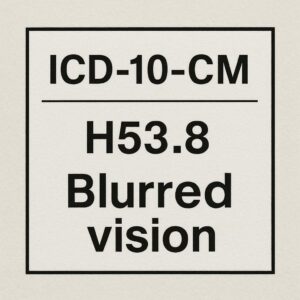
For the vast majority of patients presenting with blurred vision where the cause is not immediately identified as a refractive error or a more specific neurological condition, the primary code is H53.8 – Other visual disturbances.
Deconstructing H53.8: Specificity and Clinical Meaning
H53.8 is a “bucket” code within the larger category of H53 (Visual disturbances). It is used when the blurred vision does not fit into a more specific subcategory like diplopia (H53.2) or visual field defects (H53.4). To use this code correctly, you must append a fourth digit to specify the nature of the disturbance. The most relevant for “blurred vision” are:
-
H53.8X – Other visual disturbances
-
H53.81 – Visual aura: This is not for the blur itself, but for the neurological phenomenon that often precedes a migraine, which can include shimmering lights, zigzag lines, and scotomas that cause a blurring or loss of vision.
-
H53.89 – Other visual disturbances: This is the most commonly used code for generalized, non-specific blurred vision. It captures complaints like “hazy vision,” “cloudy vision,” “poor focus,” and “generalized blur.”
-
Documentation is Key: What Your Notes Must Include
The use of H53.89 demands robust clinical documentation. Simply writing “blurred vision” in the chart is insufficient and can lead to coding challenges or downcoding. The medical record should elaborate on:
-
Onset: Sudden vs. gradual.
-
Duration: Constant vs. intermittent.
-
Laterality: Unilateral vs. bilateral.
-
Associated Symptoms: Pain, redness, headache, floaters, photophobia.
-
Aggravating/Alleviating Factors: Is it worse at near? Does it improve with squinting?
This level of detail not only justifies the use of H53.89 but also guides the clinician’s differential diagnosis and helps the coder identify if a “code first” scenario is present.
4. Beyond the Obvious: Differentiating Blurred Vision from Other Visual Complaints
Patients may use “blurred vision” to describe a variety of visual phenomena. The coder must rely on the clinician’s documentation to distinguish between them.
-
Diplopia (Double Vision) vs. Blurred Vision: Diplopia (H53.2) is the simultaneous perception of two images of a single object. While a patient might call this “blurry,” it is a distinct condition, often related to cranial nerve palsies, myasthenia gravis, or thyroid eye disease. Documentation stating “seeing double” should lead to H53.2, not H53.89.
-
Visual Field Defects vs. Generalized Blur: A visual field defect (H53.4-) is a loss of part of the visual field, such as a hemianopsia or scotoma. This is different from a generalized blur where the entire field of view is out of focus. Codes under H53.4 are highly specific (e.g., H53.46 – Homonymous bilateral field defects).
-
Photopsia and Photophobia: Photopsia (H53.1-), the perception of flashes of light, and photophobia (H53.1-), abnormal sensitivity to light, are coded separately. They may accompany blurred vision but are distinct symptoms.
5. The Critical Role of Laterality: Is It One Eye or Both?
ICD-10 places a strong emphasis on laterality. Many codes, including those in the H53 series, require a 6th character to specify which eye is affected. The options are:
-
1 – Right side
-
2 – Left side
-
3 – Bilateral
-
9 – Unspecified side
For H53.89, the complete code would be:
-
H53.891 – Other visual disturbances, right eye
-
H53.892 – Other visual disturbances, left eye
-
H53.893 – Other visual disturbances, bilateral
-
H53.899 – Other visual disturbances, unspecified eye
The “unspecified” code (H53.899) should be used sparingly and only when the medical record genuinely does not specify which eye is affected. In most clinical encounters, this information is ascertained and documented.
6. When Blurred Vision is a Symptom, Not a Diagnosis: The “Code First” Rule
This is arguably the most critical concept in coding blurred vision. Often, blurred vision is not a standalone condition but a direct symptom of a known, underlying disease. ICD-10 guidelines include a “code first” note for these instances. This means you must code the underlying disease FIRST, and then you may code the blurred vision (H53.89) as a secondary code to indicate the presenting symptom.
The Diabetes Connection: E11.3x with H53.8
Diabetic retinopathy is a leading cause of vision loss. The primary code is from the E11.3- series (Type 2 diabetes mellitus with ophthalmic complications). You must use additional codes to specify the type of retinopathy (e.g., E11.319 – Type 2 diabetes mellitus with unspecified diabetic retinopathy without macular edema). Blurred vision (H53.89-) is then listed as a secondary code to fully capture the clinical picture.
-
Correct Coding: E11.319, H53.893
Hypertensive Retinopathy: I10 with H53.8
For a patient with hypertension and blurred vision due to hypertensive retinopathy, the primary code is I10 (Essential (primary) hypertension). There is no specific code for hypertensive retinopathy in ICD-10-CM; it is implied by the combination of I10 and the eye code. Blurred vision is coded secondarily.
-
Correct Coding: I10, H53.89-
Cataracts: H25.- and H26.- with H53.8
Cataracts are a common cause of gradual, painless blurred vision. The primary code is the specific type of cataract (e.g., H25.13 – Age-related cataract, nuclear sclerosis, bilateral). Blurred vision (H53.89-) is a secondary code.
-
Correct Coding: H25.13, H53.893
Macular Degeneration: H35.3- with H53.8
Age-related macular degeneration (AMD) causes central vision blurring. The primary code is H35.3- (e.g., H35.32 – Exudative age-related macular degeneration, left eye). Blurred vision is a secondary code.
-
Correct Coding: H35.32, H53.892
7. The Alphabet of Refractive Errors: H52.0-H52.3
It is vital to understand that simple, uncorrected refractive errors are NOT coded with H53.89. They have their own distinct category.
-
H52.0 – Hypermetropia (Farsightedness)
-
H52.1 – Myopia (Nearsightedness)
-
H52.2 – Astigmatism
-
H52.3 – Anisometropia and Aniseikonia
-
H52.4 – Presbyopia
If a patient’s blurred vision is fully explained by a refractive error that is diagnosed during the encounter, you code the refractive error. H53.89 would be inappropriate in this context.
8. Low Vision and Blindness: Navigating the H54 Series
When blurred vision is severe and constitutes legal or functional blindness, a different set of codes applies. The H54 series is used for blindness and low vision and is based on measurements of visual acuity and visual field. These codes are complex and often combine both eyes into a single code.
Simplified Guide to H54 Blindness and Low Vision Codes
| Visual Impairment Category | Visual Acuity (Snellen) | Visual Field | Example ICD-10 Code | Description |
|---|---|---|---|---|
| Moderate Visual Impairment | Worse than 20/60 to 20/200 | H54.41 | Blindness, right eye, low vision left eye | |
| Severe Visual Impairment | 20/200 to 20/400 | OR ≤ 20 degrees | H54.8 | Legal blindness (USA definition) |
| Profound Visual Impairment | 20/500 to 20/1000 | OR ≤ 10 degrees | H54.11 | Blindness, right eye, normal vision left eye |
| Near-Total Blindness | CF@1ft to Light Perception | H54.2 | Blindness, both eyes | |
| Total Blindness | No Light Perception | No Light Perception | H54.0 | Blindness, both eyes |
CF = Count Fingers. This table is a simplification; official coding requires precise measurements from the medical record.
9. Blurred Vision in the Emergency Department: A Symptom of Something Sinister
Sudden, acute blurred vision can be an ophthalmologic or neurologic emergency. Coding in these scenarios must reflect the urgency and the underlying cause.
-
Stroke (I63.-, I69.3-): A cerebrovascular accident (CVA) affecting the visual pathways can cause homonymous hemianopsia or cortical blindness. The primary code is the specific type of stroke (e.g., I63.9 – Cerebral infarction, unspecified). The visual defect (e.g., H53.46 – Homonymous bilateral field defects) is coded secondarily.
-
Transient Ischemic Attack (G45.9): If blurred vision is a transient symptom of a TIA, the primary code is G45.9 (Transient cerebral ischemic attack, unspecified).
-
Giant Cell Arteritis (M31.6): This is a medical emergency due to the risk of permanent blindness. The primary code is M31.6 (Other giant cell arteritis). Sudden vision loss (H53.13- – Sudden visual loss) would be a secondary code.
-
Optic Neuritis (H46): Often associated with Multiple Sclerosis, optic neuritis causes painful, usually unilateral vision loss. It is coded directly with H46.
10. The Unspecified Code: H53.9 – A Necessary Evil or a Documentation Failure?
The code H53.9 – Unspecified visual disturbance exists for rare situations where no information is available to assign a more specific code. Its use is strongly discouraged in routine practice. Relying on H53.9 is often a sign of poor documentation and can be a red flag for payers, potentially leading to audits and denials. The goal should always be to code to the highest level of specificity supported by the clinical record.
11. Case Studies: Putting Theory into Practice
Case Study 1: The Diabetic Patient with Fluctuating Vision
-
Scenario: A 55-year-old patient with Type 2 diabetes presents with complaints of fluctuating blurred vision in both eyes over the past few months. The clinician documents “blurred vision likely due to unstable blood sugars and early non-proliferative diabetic retinopathy.”
-
Coding:
-
Primary: E11.319 – Type 2 diabetes mellitus with unspecified diabetic retinopathy without macular edema.
-
Secondary: H53.893 – Other visual disturbances, bilateral.
-
-
Rationale: The blurred vision is a symptom of the underlying diabetic retinopathy, so the diabetes code is sequenced first.
Case Study 2: The Post-Cataract Surgery Patient
-
Scenario: A 72-year-old patient is seen for a follow-up one month after uncomplicated cataract surgery on the left eye. They report that the vision is still “a little hazy.” The clinician diagnoses “post-operative cystoid macular edema” and “blurred vision.”
-
Coding:
-
Primary: H59.03- – Cystoid macular edema following cataract surgery. (A 7th character for laterality is required).
-
Secondary: H53.892 – Other visual disturbances, left eye.
-
-
Rationale: The hazy vision is a symptom of the specific post-operative complication (CME).
Case Study 3: The Patient with Sudden, Painless Vision Loss
-
Scenario: A 60-year-old patient presents to the ER with sudden, painless loss of vision in the right eye, described as “a curtain coming down.” The diagnosis is Central Retinal Artery Occlusion (CRAO).
-
Coding:
-
Primary: H34.13- – Central retinal artery occlusion, unilateral. (A 6th character for laterality is required).
-
Secondary: H53.13- – Sudden visual loss. (A 6th character for laterality is required).
-
-
Rationale: The CRAO is the etiology. The “sudden visual loss” code provides more specific information about the nature of the symptom than the generic H53.89.
Case Study 4: The Child with Squinting
-
Scenario: An 8-year-old child is brought in because they squint to see the board at school. A cycloplegic refraction confirms myopia.
-
Coding:
-
Primary: H52.10 – Myopia, unspecified eye.
-
-
Rationale: The blurred vision is fully explained by the refractive error. H53.89 is not used.
12. The Impact of Accurate Coding: Billing, Reimbursement, and Public Health
Precise ICD-10 coding for blurred vision is not an abstract concept; it has real-world consequences.
-
Billing and Reimbursement: Insurance payers use ICD-10 codes to determine if a service (e.g., a comprehensive eye exam, an OCT scan) is medically necessary. Coding H53.893 for a patient with diabetic blurred vision, without the primary E11.319 code, will almost certainly result in a claim denial, as the medical necessity for monitoring the diabetic complication is not established.
-
Public Health and Research: Aggregated ICD-10 data helps government agencies and researchers track the prevalence of eye diseases, identify at-risk populations, and allocate resources for public health initiatives. Inaccurate coding distorts this data, hindering our ability to understand and combat vision loss on a large scale.
-
Quality Metrics: In value-based care models, coding accuracy is directly tied to quality reporting and provider performance scores. Properly coded conditions reflect appropriate diagnosis and management.
13. Conclusion: Clarity in Coding, Clarity in Vision
Navigating the ICD-10 landscape for a common symptom like blurred vision requires a meticulous, knowledge-based approach. The journey begins with understanding that “blurred vision” is not a single code but a clinical descriptor that must be mapped to a precise alphanumeric identifier based on etiology, laterality, and context. The correct application of H53.89, the disciplined adherence to “code first” rules for systemic conditions, and the clear distinction from refractive errors and blindness codes are the pillars of accurate coding. By achieving this clarity in our coding practices, we not only ensure the financial health of healthcare providers but also contribute to the higher goals of optimal patient care and robust public health intelligence. Ultimately, clear documentation leads to clear coding, which supports the fundamental mission of preserving and restoring the precious gift of sight.
14. Frequently Asked Questions (FAQs)
Q1: What is the direct ICD-10 code for blurred vision?
There is no single code that says “blurred vision.” The most accurate and commonly used code is H53.89 – Other visual disturbances. You must add a fifth digit for laterality: H53.891 (right), H53.892 (left), H53.893 (bilateral), or H53.899 (unspecified).
Q2: When should I not use H53.89 for blurred vision?
You should not use H53.89 when the blurred vision is due to:
-
A refractive error (use H52.0-H52.4).
-
A confirmed underlying disease like diabetes or cataracts (code the underlying disease first).
-
A more specific visual disturbance like double vision (H53.2) or sudden vision loss (H53.13-).
Q3: How do I code blurred vision for a diabetic patient?
This is a “code first” scenario.
-
First, code the diabetes with ophthalmic complications (e.g., E11.319 for Type 2 diabetes with retinopathy).
-
Second, code the symptom of blurred vision (H53.89-). This demonstrates the medical necessity for the encounter.
Q4: What is the difference between H53.89 and H53.9?
H53.89 (“Other visual disturbances”) is used for a documented, specific complaint of blurred vision. H53.9 (“Unspecified visual disturbance”) is a nonspecific code used only when the medical record provides no detail about the nature of the visual problem. H53.9 should be avoided whenever possible.
Q5: Can I use a blurred vision code as a primary diagnosis?
Yes, but only if the blurred vision is the reason for the encounter and a definitive underlying cause has not been established. For example, if a patient comes in for a routine eye exam complaining of blurry vision and you diagnose myopia, you would use H52.10 as the primary code, not H53.89. If the cause remains unknown after examination, H53.89- would be appropriate.
15. Additional Resources
-
CDC ICD-10-CM Official Guidelines for Coding and Reporting: The definitive source for coding rules and conventions.
https://www.cdc.gov/nchs/icd/icd-10-cm.htm -
American Academy of Ophthalmology (AAO) Coding Resources: Provides specialty-specific guides, webinars, and updates.
https://www.aao.org/practice-management/coding -
American Health Information Management Association (AHIMA): A leading source for health information management education and best practices.
https://www.ahima.org/ -
Find-A-Code Browser: A useful online tool for searching and verifying ICD-10 codes and their guidelines.
https://www.findacode.com/