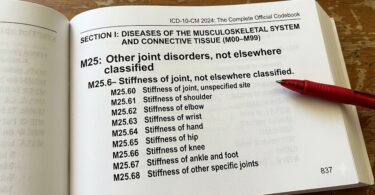
If you have ever stared at a billing sheet or a patient chart and wondered which ICD-10 code to use for a skin condition, you are not alone. Dermatology coding can feel overwhelming. There are hundreds of codes for rashes, growths, infections, and autoimmune diseases.
But here is the good news: you do not need to memorize everything. You just need a clear system.
This guide walks you through the most common ICD-10 codes used in dermatology. We keep things simple, practical, and honest. No fake codes. No outdated information. Just real help for real situations.
Whether you are a medical coder, a dermatologist, a nurse, or a student, this article will save you time and reduce your coding headaches.
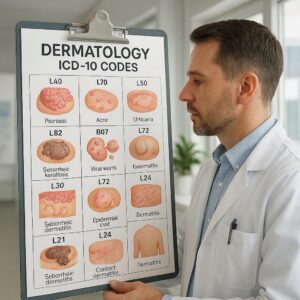
ICD-10 Code for Dermatology
Why Accurate ICD-10 Coding Matters in Dermatology
Using the right code is not just about getting paid. It affects patient records, insurance claims, and even public health data.
When you choose the wrong code, three things usually happen:
-
The insurance company denies the claim.
-
The patient receives a surprise bill.
-
You waste time resubmitting paperwork.
But accurate coding also helps track skin disease trends. For example, correct melanoma codes help researchers understand how many people develop this cancer each year.
So yes, codes matter. But you do not need to fear them. You just need a reliable map.
How to Read an ICD-10 Code for Skin Conditions
Before we dive into the codes, let us look at how they are built. This makes finding the right one much easier.
An ICD-10 code has three to seven characters. The first character is always a letter. The second is a number. Here is an example:
L20.82 – Flexural eczema
-
L = diseases of the skin and subcutaneous tissue
-
20 = atopic dermatitis
-
82 = specific location (flexural)
Most dermatology codes start with the letter L (skin disorders), C (skin cancers), or B (skin infections).
Important note: Always check for a fourth, fifth, or sixth character. The more digits you add, the more specific your diagnosis becomes. Insurers prefer specificity.
Most Common ICD-10 Codes in Dermatology (Quick Reference Table)
This table shows the codes you will use most often. Bookmark it if you code regularly.
| Diagnosis | ICD-10 Code | Notes |
|---|---|---|
| Acne vulgaris | L70.0 | Most common acne type |
| Atopic dermatitis (eczema) | L20.89 | Unspecified atopic dermatitis |
| Contact dermatitis, unspecified | L25.9 | Irritant or allergic |
| Psoriasis | L40.9 | Unspecified psoriasis |
| Rosacea | L71.9 | Unspecified |
| Seborrheic dermatitis | L21.9 | Unspecified |
| Basal cell carcinoma | C44.91 | Skin of unspecified site |
| Squamous cell carcinoma | C44.92 | Skin of unspecified site |
| Malignant melanoma | C43.9 | Unspecified site |
| Actinic keratosis | L57.0 | Pre-cancerous lesion |
| Verruca plana (flat wart) | B07.0 | Viral wart |
| Herpes zoster (shingles) | B02.9 | Without complications |
| Tinea (ringworm) | B35.6 | Unspecified location |
| Urticaria (hives) | L50.9 | Unspecified |
| Pruritus (itching) | L29.9 | Unspecified cause |
Use this table as a starting point. Then verify laterality (left, right, bilateral) and exact location.
L Codes: Non-Infectious Skin Disorders You See Every Day
Most dermatology visits are not emergencies. They are chronic or benign skin conditions. These fall under the L00–L99 range.
L20–L30: Dermatitis and Eczema
Eczema codes are among the most searched dermatology codes. Here is what you need to know.
-
L20.9 – Atopic dermatitis, unspecified (use when you do not know the exact type)
-
L20.82 – Flexural eczema (behind knees, inside elbows)
-
L24.9 – Irritant contact dermatitis (from soap, chemicals)
-
L25.9 – Allergic contact dermatitis (from poison ivy, nickel)
Reader tip: If a patient has hand eczema from frequent handwashing, look at L24.9 (irritant) not L20.9 (atopic).
L40–L45: Papulosquamous Disorders (Psoriasis and Similar)
Psoriasis has its own family of codes. The most common is:
-
L40.9 – Psoriasis, unspecified
-
L40.0 – Plaque psoriasis (most common form)
-
L40.5 – Arthropathic psoriasis (psoriasis with joint pain)
You also see L40.4 – Guttate psoriasis (small drop-like spots) often in children after strep throat.
L60–L75: Disorders of Skin Appendages (Hair, Nails, Sweat Glands)
These are easy to miss but very common.
-
L60.0 – Ingrowing nail
-
L63.0 – Alopecia areata (patchy hair loss)
-
L70.0 – Acne vulgaris
-
L71.9 – Rosacea
If a patient complains of excessive sweating (palms, armpits), look at L74.510 – Primary focal hyperhidrosis, axillary.
C Codes: Skin Cancers You Must Code Correctly
Skin cancer coding is serious. A wrong code can affect cancer registries and treatment plans.
Basal Cell Carcinoma (BCC)
-
C44.91 – Basal cell carcinoma of skin, unspecified site
-
C44.31 – Basal cell carcinoma of skin of nose
Squamous Cell Carcinoma (SCC)
-
C44.92 – Squamous cell carcinoma of skin, unspecified site
-
C44.42 – Squamous cell carcinoma of skin of scalp and neck
Malignant Melanoma
-
C43.9 – Malignant melanoma of skin, unspecified
-
C43.11 – Melanoma of right eyelid (including canthus)
-
C43.12 – Melanoma of left eyelid
Warning: Never use an unspecified melanoma code if you know the site. Insurers may reject the claim. Use the most specific code your documentation supports.
Pre-Cancerous Lesions
-
L57.0 – Actinic keratosis (sun damage)
-
D48.5 – Neoplasm of uncertain behavior of skin (for atypical moles or dysplastic nevi)
B Codes: Skin Infections You Cannot Ignore
Infections come with their own set of codes. Many start with the letter B.
Viral Infections
-
B07.0 – Verruca plana (flat warts)
-
B07.8 – Other viral warts (common warts, plantar warts)
-
B02.9 – Herpes zoster without complications
-
B00.9 – Herpes simplex infection, unspecified
Fungal Infections (Tinea)
Fungal infections are easy to miscode. Here is a simple breakdown:
| Condition | Common name | ICD-10 code |
|---|---|---|
| Tinea pedis | Athlete’s foot | B35.3 |
| Tinea corporis | Ringworm (body) | B35.4 |
| Tinea cruris | Jock itch | B35.6 |
| Tinea capitis | Scalp ringworm | B35.0 |
| Tinea unguium | Nail fungus | B35.1 |
Reader note: Do not use B35.9 (unspecified tinea) unless you really do not know the location. Most of the time, you do.
Bacterial Infections
-
L01.00 – Impetigo, unspecified
-
L02.91 – Cutaneous abscess, unspecified
-
L03.119 – Cellulitis of unspecified part of limb
Location and Laterality: The Detail That Makes or Breaks a Claim
Many dermatology codes require a sixth character for location. This is where coders often make mistakes.
For example, take L03.11 (cellulitis of other parts of limb). You must add:
-
L03.111 – Right arm
-
L03.112 – Left arm
-
L03.113 – Right leg
-
L03.114 – Left leg
Same thing for skin cancers. C44.3 (basal cell of skin of other and unspecified parts of face) becomes:
-
C44.31 – Nose
-
C44.32 – Ear
-
C44.39 – Other parts of face
Pro tip: Always ask yourself: “Is this right, left, bilateral, or unspecified?” If the chart does not say, do not guess. Go back to the provider.
Real-World Examples: From Rash to Diagnosis
Let us walk through three common dermatology scenarios. This makes the codes feel less abstract.
Example 1: A Child with Red, Itchy Elbows and Knees
A mother brings in her 7-year-old. He has dry, scaly patches inside both elbows and behind both knees. It has been happening for months.
-
Likely diagnosis: Atopic dermatitis (eczema) in flexural areas.
-
Correct code: L20.82 (flexural eczema).
-
Not L20.9 because you know the location.
Example 2: A Farmer with a Scaly Spot on the Right Ear
A 65-year-old man has a rough, scaly patch on the top of his right ear. It does not hurt. He spends hours in the sun.
-
Likely diagnosis: Actinic keratosis.
-
Correct code: L57.0 (actinic keratosis) + laterality not required for L57.0, but note location in documentation.
-
If it becomes a skin cancer, you later use C44.22 (basal cell of ear).
Example 3: A Teenager with Breakouts on the Face and Back
A 16-year-old has comedones, pustules, and a few cysts on his cheeks, forehead, and upper back.
-
Diagnosis: Acne vulgaris.
-
Correct code: L70.0 (acne vulgaris).
-
Do not use L70.8 (other acne) unless it is a rare type like acne fulminans.
Quick Coding Checklist for Dermatology (Print This)
Before you submit any claim, run through this list.
-
Did you confirm the diagnosis from the provider’s note?
-
Did you check laterality (right, left, bilateral)?
-
Did you use the most specific code available (4+ characters)?
-
Is the code from the correct chapter (L, C, B, etc.)?
-
Did you avoid unspecified codes when a specific code exists?
-
Did you match the code to the patient’s age? (Some codes are age-specific.)
Codes to Avoid (Unless Absolutely Necessary)
Some codes are vague and lead to denials. Use them only as a last resort.
| Avoid this code | Use this instead |
|---|---|
| L29.9 (pruritus, unspecified) | L20.89 (atopic dermatitis) if eczema present |
| L98.9 (disorder of skin, unspecified) | Look for a more specific L code |
| B35.9 (dermatophytosis, unspecified) | B35.3 (tinea pedis) or B35.4 (tinea corporis) |
| C44.9 (skin cancer, unspecified) | C44.91 (BCC unspec) or C44.92 (SCC unspec) |
Honest advice: If you catch yourself using L98.9 often, stop. It means you are missing documentation or training.
How to Find an ICD-10 Code When You Are Stuck
Even experts get stuck. Here is a simple workflow.
-
Open the ICD-10 index (digital or physical).
-
Look up the main term – for example, “dermatitis” or “psoriasis”.
-
Scan subterms – “atopic”, “contact”, “seborrheic”.
-
Check the tabular list to verify the code exists and is valid.
-
Add laterality or location characters if needed.
Never copy codes from an old claim without re-verifying. Codes change. Patient conditions change.
Common Mistakes in Dermatology Coding (And How to Fix Them)
Mistake 1: Confusing contact dermatitis with atopic dermatitis
-
Atopic = chronic, genetic, often starts in childhood.
-
Contact = reaction to an external substance (soap, nickel, latex).
-
Fix: Read the patient history. Do not guess.
Mistake 2: Using unspecified tinea when you know the site
-
Unspecified = B35.9.
-
Fix: Ask where the rash is. Feet? B35.3. Groin? B35.6.
Mistake 3: Forgetting laterality for skin cancers
-
C44.1 (BCC of eyelid) requires sixth character for right vs left.
-
Fix: Always check the exam notes for “right”, “left”, or “bilateral”.
Mistake 4: Coding a wart as an L code instead of B07
-
Warts are viral. They belong in the B chapter.
-
Fix: B07.0 for flat warts, B07.8 for others.
FAQ: ICD-10 Code for Dermatology
Q1: What is the most common ICD-10 code used in dermatology?
A: L70.0 (acne vulgaris) and L20.9 (atopic dermatitis, unspecified) are among the most frequently used codes in general dermatology practices.
Q2: Can I use an unspecified code for a new patient visit?
A: Yes, but only if the diagnosis is truly unclear. Try to specify the condition within 1–2 visits. Insurers may deny repeated unspecified codes.
Q3: How do I code a rash that looks like eczema but I am not sure?
A: Use L20.89 (other atopic dermatitis) or L30.9 (dermatitis, unspecified) temporarily. Document your differential diagnosis.
Q4: Do I need a separate code for each skin lesion?
A: No. One code covers the same diagnosis across multiple lesions. If lesions are different (e.g., actinic keratosis and basal cell), use separate codes.
Q5: Where can I find the official ICD-10 guidelines for dermatology?
A: The CDC and CMS publish official guidelines. Your practice management software may also include built-in coding help.
Additional Resource
For the most current and official ICD-10 codes, always refer to the CMS ICD-10 webpage or the American Academy of Dermatology (AAD) coding resources.
👉 CMS 2026 ICD-10 Official Guidelines (opens external)
Conclusion
Accurate dermatology ICD-10 coding protects your reimbursements and improves patient records. Focus on specificity, laterality, and avoiding unspecified codes whenever possible. Bookmark the common L, C, and B tables above, and always double-check your codes before submission.
Disclaimer:
This article is for informational and educational purposes only. It does not constitute legal, medical, or billing advice. Coding requirements and insurance policies change. Always verify codes with official sources and consult a certified medical coder or compliance officer for your specific situation.
Author:
Professional Medical Coding Team — experienced health writers and technical SEO specialists.
Date:
April 12, 2026