Navigating the world of medical coding can often feel like searching for a specific destination without a map. In the vast landscape of the International Classification of Diseases, 10th Revision, Clinical Modification (ICD-10-CM), precision is everything. If you are a medical coder, a billing specialist, or a healthcare professional trying to locate the exact ICD-10 code for duodenitis unspecified, this guide will provide clear, reliable, and practical answers.
When a physician diagnoses a patient with inflammation of the duodenum but does not specify whether it is acute, chronic, or caused by a specific underlying agent, you must rely on an “unspecified” diagnostic code. Let’s break down exactly how to find, assign, and validate this code to ensure accurate billing, compliance, and smooth insurance reimbursement.
ICD-10 Code for Duodenitis Unspecified
The Core Diagnostic Codes for Duodenitis
In the ICD-10-CM classification system, duodenitis falls under Chapter 11, which covers Diseases of the Digestive System (K00-K95). More specifically, it sits within the block dedicated to Diseases of the Esophagus, Stomach, and Duodenum (K20-K31), under the subcategory category K29 (Gastritis and duodenitis).
When documentation lists “duodenitis” without any further descriptive modifiers (such as “acute” or “chronic”), the coding pathway leads directly to a 4-character subcategory code, which then requires a 5th character to denote the absence or presence of bleeding.
The Non-Billable Category vs. Billable Subcategory
It is a common mistake in medical billing to attempt to submit a broader code that lacks the necessary clinical specificity. In ICD-10-CM, K29.8 is the specific subcategory code designated for Duodenitis. However, K29.8 by itself is a non-billable code.
To receive reimbursement and maintain an accurate clinical record, you must expand the code to its fifth digit to state whether the condition is presenting with or without hemorrhage (bleeding).
-
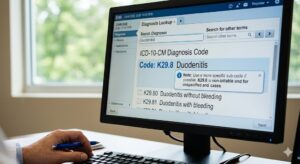
K29.80 (Duodenitis without bleeding): This is the correct, fully specified, and billable ICD-10 code for duodenitis unspecified when no active gastrointestinal bleeding or hemorrhage is documented by the clinician.
-
K29.81 (Duodenitis with bleeding): This billable code is used if the physician explicitly states that the unspecified duodenitis is accompanied by bleeding or hemorrhage.
Important Coding Rule: Never submit a 4-character code like K29.8 on an insurance claim form. Doing so will result in an automated front-end rejection because the code lacks the highest level of specificity required by HIPAA guidelines.
Comparing Gastritis, Duodenitis, and Related Codes
Because the lining of the stomach (gastrium) and the first part of the small intestine (duodenum) are physically continuous, inflammation frequently occurs in both locations simultaneously. When this happens, physicians often document a diagnosis of “gastroduodenitis.”
To ensure you choose the right code for your clinical documentation, it is highly useful to review how unspecified duodenitis compares to neighboring codes within the K29 family.
| ICD-10 Code | Clinical Description | Billable Status | Clinical Usage Note |
| K29.80 | Duodenitis without bleeding | Yes (Billable) | Use for unspecified, isolated duodenitis with no documented hemorrhage. |
| K29.81 | Duodenitis with bleeding | Yes (Billable) | Use for unspecified, isolated duodenitis when active bleeding is documented. |
| K29.70 | Gastritis, unspecified, without bleeding | Yes (Billable) | Use when inflammation is strictly limited to the stomach lining. |
| K29.90 | Gastroduodenitis, unspecified, without bleeding | Yes (Billable) | Use when both the stomach and duodenum are inflamed without further detail. |
| K29.00 | Acute hemorrhagic gastritis without bleeding | Yes (Billable) | Use for sudden-onset stomach inflammation explicitly marked as acute. |
Anatomy of the Code: Breaking Down K29.80
Understanding how a code is structured helps remove the guesswork from medical billing. Let’s dissect the characters of K29.80 to see exactly how the classification system builds this specific diagnosis code:
-
K: Identifies the chapter of the ICD-10 manual (Chapter 11: Diseases of the Digestive System).
-
29: Specifies the category of the condition (Gastritis and duodenitis).
-
8: Represents the subcategory for other specified conditions, which explicitly isolates “Duodenitis” away from standard stomach-focused gastritis codes.
-
0: The fifth character indicating “without bleeding.”
 K  29 . 8  0
 │   │   │  └── Fifth Character: Without bleeding (Hemorrhage)
 │   │   └───── Fourth Character: Duodenitis
 └─┬─┘
   └─────────── Category: Gastritis and duodenitis (Digestive System)
Clinical Documentation Requirements for Accurate Coding
To safely assign K29.80 as the primary or secondary diagnosis on an insurance claim, the provider’s clinical documentation must support the code choice. While “unspecified” is used when more specific details are unavailable, the record must still paint a clear clinical picture.
Key Details Needed in the Medical Record:
-
Diagnostic Confirmation: A formal documentation of duodenitis in the assessment, plan, progress notes, or an esophagogastroduodenoscopy (EGD) report.
-
Status of Hemorrhage: A clear statement regarding whether or not bleeding is present. If the provider notes “no bleeding,” “no hematemesis,” or “melena absent,” or simply remains silent on bleeding while documenting standard inflammation, K29.80 is appropriate.
-
Lack of Acuity Modifiers: The notes should not explicitly label the condition as purely “acute” or “chronic” if you are defaulting to an unspecified classification, though in many institutional systems, isolated duodenitis naturally maps to K29.80 regardless of duration unless a specific underlying cause (like H. pylori) is documented.
Underlying Causes and Symptoms of Unspecified Duodenitis
When a claim is processed under an unspecified code, it implies that the exact root cause has either not yet been determined or was left unrecorded. In clinical practice, an inflamed duodenum can stem from a wide variety of daily triggers or systemic medical issues.
Common Clinical Triggers
-
NSAID Medication Overuse: Regular use of non-steroidal anti-inflammatory drugs like ibuprofen, naproxen, or high-dose aspirin can erode the protective mucosal layer of the upper GI tract.
-
Bacterial Infections: Helicobacter pylori (H. pylori) is a leading cause of upper digestive tract irritation, often necessitating an additional code if an active infection is confirmed.
-
Lifestyle Factors: Excessive alcohol consumption, chronic physical or psychological stress, and heavy tobacco use can irritate the small intestine’s mucosal lining.
-
Excessive Gastric Acid: Conditions that cause the stomach to overproduce acid can overwhelm the duodenum’s natural buffering capabilities.
Symptoms Frequently Documented alongside Duodenitis
Patients presenting with this inflammation often exhibit classic upper gastrointestinal distress symptoms. If a definitive diagnosis of duodenitis has not yet been confirmed by an EGD or imaging, coders must bill the signs and symptoms instead. However, once the physician documents unspecified duodenitis, these symptoms are considered integral to the condition and are typically not coded separately:
-
Epigastric pain or a burning sensation in the upper abdomen.
-
Nausea, abdominal bloating, and occasional vomiting.
-
Early satiety (feeling full too quickly during a meal).
-
Indigestion or persistent acid reflux.
Essential Coding Rules: Excludes1 and Excludes2 Notes
A crucial part of using the ICD-10 code for duodenitis unspecified correctly is adhering to formatting instructions known as Excludes1 and Excludes2 notes. These notes determine whether two codes can be billed together on the same claim for the same patient encounter.
Excludes1 Notes (Not Coded Here)
An Excludes1 note indicates an absolute exclusion. It means that the code listed cannot, under any circumstances, be used at the same time as the code you are viewing because they represent mutually exclusive conditions. For category K29, this includes:
-
Eosinophilic gastritis or gastroenteritis (K52.81)
-
Zollinger-Ellison syndrome (E16.4)
If a patient has an established diagnosis of Zollinger-Ellison syndrome causing their duodenal inflammation, you must code the underlying syndrome rather than defaulting to an unspecified duodenitis code.
Excludes2 Notes (Not Included Here)
An Excludes2 note indicates that a specific condition is not part of the code block, but the patient may suffer from both conditions simultaneously. If both are present, it is acceptable to report both codes on the claim form. For upper GI conditions, always check for concurrent diagnoses such as Gastroesophageal Reflux Disease (GERD) with or without esophagitis (K21.0, K21.9) or Duodenal Ulcers (K26.-).
Summary of the Article’s Content
This guide outlines how to accurately select the billable ICD-10-CM code for unspecified duodenitis (K29.80), emphasizing that the four-character code (K29.8) is non-billable. It details the structural format of the code, provides comparisons to related gastric codes, and reviews critical documentation and coding instructions like Excludes notes to prevent claim denials.
Frequently Asked Questions (FAQ)
Is K29.80 a billable ICD-10 code?
Yes, K29.80 is a fully specified, 5-character billable diagnosis code used for reporting duodenitis without bleeding.
What is the difference between K29.80 and K29.81?
Both codes represent duodenitis, but K29.80 specifies that the condition presents without bleeding, whereas K29.81 indicates that the condition is accompanied with active bleeding or hemorrhage.
Can I use K29.8 as a final diagnosis code on a claim form?
No. K29.8 is a non-billable subcategory code. If submitted on an institutional or professional insurance claim, it will be automatically rejected for a lack of diagnostic specificity. You must choose either K29.80 or K29.81.
What should I code if the physician documents both gastritis and duodenitis?
If the provider documents both gastritis and duodenitis as unspecified and without bleeding, you should use the combined code K29.90 (Gastroduodenitis, unspecified, without bleeding) rather than reporting separate codes for each individual condition.
Do I need a separate code for an H. pylori infection if it caused the duodenitis?
Yes. If an active Helicobacter pylori infection is documented as the underlying cause of the inflammation, you should assign K29.80 alongside code B96.81 (Helicobacter pylori as the cause of diseases classified elsewhere) to provide a complete clinical picture.
Additional Resource
For official coding guidelines, index lookups, and tabular listings regarding digestive disorders, visit the Centers for Disease Control and Prevention (CDC) ICD-10-CM Browser. This resource provides the most up-to-date, federally validated tabular indexes for ensuring absolute compliance with current coding revisions.
Date: June 4, 2026
Author: Medical Coding & Editorial Team
Disclaimer: The information provided in this article is for educational and informational purposes only. It should not be used as a substitute for professional medical advice, diagnosis, treatment, or official medical coding and billing guidance. Always consult with a qualified healthcare provider or a certified medical coder for specific clinical and documentation inquiries.