In the intricate world of medical coding, precision is everything. For healthcare providers, medical coders, and billing specialists, using the correct diagnosis code is not just a matter of administrative housekeeping—it is the linchpin of accurate reimbursement, compliance, and quality patient data tracking. When it comes to liver health, few diagnostic tools are as fundamental as the hepatitis panel. However, a common point of confusion arises when trying to translate this laboratory test into the language of the International Classification of Diseases, 10th Revision (ICD-10).
If you have ever found yourself staring at a lab order for a “Hepatitis Panel” and wondering what diagnosis code to attach, you are not alone. The simple search for the “icd 10 code for hepatitis panel” often leads to frustration because there is no single code for the test itself. Instead, the codes must reflect the reason for performing the test.
This comprehensive guide is designed to demystify the process. We will explore the nuances of ICD-10 coding for hepatitis screening and diagnosis, moving beyond the simple question to provide a robust framework for accurate coding. Whether you are dealing with acute symptoms, chronic conditions, or routine screenings, this article will serve as your roadmap.
ICD-10 Code for Hepatitis Panel and Related Diagnoses
Table of Contents
ToggleUnderstanding the Difference: The Test vs. The Diagnosis
Before we dive into the specific alphanumeric codes, it is crucial to understand a fundamental principle of medical coding: ICD-10 codes are for diagnoses and symptoms, not for procedures or lab tests.
When a physician orders a hepatitis panel, they are ordering a procedure. This procedure is billed using Current Procedural Terminology (CPT) codes. The hepatitis panel CPT code (often a code like 80074, which includes hepatitis A antibody (IgM), hepatitis B core antibody (IgM), hepatitis B surface antigen, and hepatitis C antibody) tells the insurance company what test was done.
The ICD-10 code, on the other hand, tells the insurance company why the test was done. It answers the question: What is the patient’s symptom, condition, or diagnosis that necessitates this blood work?
Therefore, searching for a single “icd 10 code for hepatitis panel” is a misnomer. Instead, you must select the code that best represents the patient’s clinical picture at the time of the order.
The “Z” Codes: Screening for Viral Hepatitis
One of the most common reasons for ordering a hepatitis panel is screening. Screening involves testing for a disease in individuals who do not have any signs or symptoms. The ICD-10 system has a dedicated category for this, known as “Z codes” (Factors influencing health status and contact with health services).
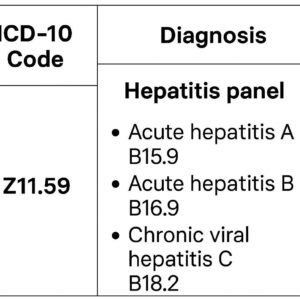
For viral hepatitis screening, the primary code is Z11.5.
-
Z11.5: Encounter for screening for viral hepatitis.
This code is used when a patient, often during a routine check-up or as part of a preventive care visit, is tested for hepatitis exposure. There are no specific complaints, no jaundice, and no known exposure; the test is simply being done as a precautionary measure.
When to Use Z11.5:
-
Routine Physicals: A patient comes in for their annual wellness exam, and the physician orders a hepatitis panel as part of standard preventive care based on age or risk factors (though risk factors might push it into counseling codes).
-
Pre-Operative Clearance: A surgeon orders a hepatitis panel before a scheduled surgery to establish a baseline and ensure safety, and the patient has no liver disease symptoms.
-
Insurance or Employment Requirements: A patient needs a hepatitis test for a new job or life insurance policy and is asymptomatic.
Important Note: While Z11.5 is for screening, if the patient has a specific risk factor (like IV drug use or exposure to a infected individual), the encounter might be coded for counseling or as a suspected condition, which we will discuss later.
Coding for Suspected Exposure: When a Patient Encounters a Carrier
Sometimes, a patient is not being screened randomly. They may have had a specific, known exposure to the hepatitis virus. Perhaps a healthcare worker sustained a needlestick injury from a high-risk patient, or an individual had close contact with someone diagnosed with hepatitis.
In these scenarios, the patient is currently asymptomatic but is worried because of the exposure. The correct coding falls under the category of “Encounter for observation for suspected diseases and conditions ruled out.”
The codes you will use depend on the specific virus involved:
-
Z20.5: Contact with and (suspected) exposure to viral hepatitis.
-
Z20.6: Contact with and (suspected) exposure to human immunodeficiency virus [HIV] (Note: This is for HIV, included here for distinction).
-
Z20.828: Contact with and (suspected) exposure to other viral communicable diseases.
For a general hepatitis exposure, Z20.5 is your go-to code. This indicates that the reason for the encounter—and the hepatitis panel—is to rule out an infection following a known contact.
Coding for Symptoms: When the Patient is Sick
This is where clinical evaluation meets coding accuracy. A patient presents with signs and symptoms suggestive of hepatitis. They aren’t being screened, and they don’t have a known exposure. They are simply feeling unwell, and the physician is using the hepatitis panel as a diagnostic tool to find out why.
In this case, you code the symptom first. The hepatitis panel results will then either confirm or rule out hepatitis as the cause.
Common symptom codes that prompt a hepatitis panel include:
-
R17: Unspecified jaundice.
-
R16.0: Hepatomegaly, not elsewhere classified (enlarged liver).
-
R16.1: Splenomegaly, not elsewhere classified (enlarged spleen).
-
R10.84: Generalized abdominal pain.
-
R11.2: Nausea with vomiting, unspecified.
-
R53.83: Other fatigue.
-
R18.8: Other ascites (fluid in the abdomen).
-
R74.01: Elevation of levels of liver transaminases (abnormal liver enzymes found on a previous basic metabolic panel).
Example Scenario:
A patient comes in complaining of severe fatigue, nausea, and notes that their eyes look yellowish. The physician, suspecting a liver issue, orders a comprehensive hepatitis panel.
-
Correct Coding: R17 (Jaundice), R11.2 (Nausea with vomiting), R53.83 (Fatigue). The hepatitis panel is ordered to investigate these symptoms.
The Definitive Codes: Diagnosing Viral Hepatitis
Once the hepatitis panel results come back positive, the diagnosis shifts from a symptom or exposure to a confirmed disease. The ICD-10 codes for viral hepatitis are highly specific and are categorized by the type of virus and the stage of the infection (acute or chronic).
It is vital to use the specific codes once a diagnosis is confirmed, as this paints the most accurate picture of the patient’s health.
Hepatitis A (HAV)
Hepatitis A is almost always an acute infection. There is no chronic form coded in ICD-10.
-
B15.0: Hepatitis A with hepatic coma.
-
B15.9: Hepatitis A without hepatic coma.
Hepatitis B (HBV)
Hepatitis B can be acute or chronic, and the coding distinguishes between these states, as well as the presence or absence of the delta agent (a defective virus that requires HBV to exist).
-
Acute Hepatitis B:
-
B16.0: Acute hepatitis B with delta-agent (coinfection) with hepatic coma.
-
B16.1: Acute hepatitis B with delta-agent (coinfection) without hepatic coma.
-
B16.2: Acute hepatitis B without delta-agent with hepatic coma.
-
B16.9: Acute hepatitis B without delta-agent and without hepatic coma.
-
-
Chronic Hepatitis B:
-
B18.0: Chronic viral hepatitis B with delta-agent.
-
B18.1: Chronic viral hepatitis B without delta-agent.
-
Hepatitis C (HCV)
Like Hepatitis B, Hepatitis C is primarily coded based on its chronicity. While acute HCV exists, it is often asymptomatic and underdiagnosed, leading to the vast majority of cases being coded as chronic.
-
B17.1: Acute hepatitis C.
-
B18.2: Chronic viral hepatitis C.
Hepatitis D (HDV)
Hepatitis D is an unusual virus that only occurs in conjunction with Hepatitis B.
-
B16.0: Acute hepatitis B with delta-agent (coinfection) with hepatic coma.
-
B16.1: Acute hepatitis B with delta-agent (coinfection) without hepatic coma.
-
B18.0: Chronic viral hepatitis B with delta-agent.
Hepatitis E (HEV)
Similar to Hepatitis A, Hepatitis E is typically an acute, self-limiting illness.
-
B17.2: Acute hepatitis E.
A Closer Look: The Hepatitis Panel CPT Code (80074)
To complete the picture, it is helpful to understand the procedural side. While this article focuses on ICD-10, knowing what the panel entails provides context for the diagnoses.
The most common CPT code for a hepatitis panel is 80074. This panel typically includes the following components:
| Component Test | What It Detects | Clinical Significance |
|---|---|---|
| Hepatitis A Antibody (IgM), HAV | IgM antibodies | Indicates an acute or recent Hepatitis A infection. |
| Hepatitis B Core Antibody (IgM), HBcAb | IgM antibodies to the core | Indicates an acute Hepatitis B infection. |
| Hepatitis B Surface Antigen, HBsAg | The surface protein of the virus | Indicates an active Hepatitis B infection (acute or chronic). |
| Hepatitis C Antibody, HCV | Antibodies to Hepatitis C | Indicates exposure to Hepatitis C. A positive result usually requires a follow-up PCR test to confirm active infection. |
Practical Scenarios: Putting It All Together
Theory is helpful, but application is key. Let’s walk through a few realistic patient encounters to see how the coding logic flows.
Scenario 1: The Pre-Surgical Screening
A 55-year-old male is scheduled for a knee replacement. The surgeon’s protocol requires a hepatitis panel to establish a baseline and ensure patient safety. The patient has no liver-related symptoms and no known risk factors.
-
The Reason: Routine pre-operative screening.
-
The ICD-10 Code: Z11.5 (Encounter for screening for viral hepatitis).
-
The CPT Code: 80074.
Scenario 2: The Needlestick
A nurse accidentally pricks her finger with a needle used on a patient known to have Hepatitis C. She comes to the employee health clinic, asymptomatic, for baseline testing and follow-up.
-
The Reason: Known exposure to a viral disease.
-
The ICD-10 Code: Z20.5 (Contact with and (suspected) exposure to viral hepatitis).
-
The CPT Code: 80074.
Scenario 3: The Symptomatic Patient
A 30-year-old woman presents with dark urine, yellowing of the skin, and right upper quadrant pain for the past three days. The physician orders a hepatitis panel.
-
The Reason: Investigating specific signs and symptoms of liver dysfunction.
-
The ICD-10 Code: R17 (Jaundice) and R10.1 (Pain localized to upper abdomen). List the symptom codes first.
-
The CPT Code: 80074.
Scenario 4: The New Diagnosis (Post-Panel)
Following up on Scenario 3, the hepatitis panel results return positive for the Hepatitis B surface antigen (HBsAg) and IgM core antibody (HBcAb). The physician diagnoses her with acute Hepatitis B.
-
The Reason: A confirmed disease diagnosis.
-
The ICD-10 Code: B16.9 (Acute hepatitis B without delta-agent and without hepatic coma).
-
Note: For this follow-up visit, you are no longer coding the symptoms (jaundice, pain) because a definitive diagnosis has been made.
Scenario 5: The Established Chronic Condition
A patient with a known history of chronic Hepatitis C returns to the hepatologist for a routine six-month check-up and viral load monitoring.
-
The Reason: Follow-up care for a chronic condition.
-
The ICD-10 Code: B18.2 (Chronic viral hepatitis C).
-
The CPT Code: This visit would likely involve an Evaluation and Management (E/M) code (like 99213 or 99214) for the office visit, and a separate CPT code for the quantitative HCV RNA PCR test, not the screening panel 80074.
Important Note for Coders: Always remember the “coding cascade.” Start with symptoms or suspicion. Once a definitive diagnosis is confirmed by the panel, you switch to the specific B-code for that hepatitis type. Do not code both the symptoms and the definitive diagnosis together in a chronic care setting unless the symptoms are unrelated to the hepatitis.
Common Coding Pitfalls and How to Avoid Them
Even experienced coders can stumble. Here are some frequent errors associated with hepatitis panel coding and how to steer clear of them.
Pitfall 1: Using a Non-Specific Code
Using B19.10 (Unspecified viral hepatitis B without hepatic coma) or B19.20 (Unspecified viral hepatitis C) should be a last resort. These codes indicate that the medical record lacks documentation to specify whether the infection is acute or chronic.
How to Avoid: Always query the provider if the lab results and notes don’t clearly indicate the stage of the infection. Accurate coding relies on specific documentation.
Pitfall 2: Confusing Screening with Diagnostic Testing
This is the most common mistake. If a patient has jaundice and the doctor orders a panel, it is diagnostic, not screening. Using Z11.5 in this scenario would be incorrect and could be viewed as fraudulent, as it misrepresents the medical necessity for the test.
How to Avoid: Ask yourself: “Why is this test being done right now?” If the answer is because the patient feels sick, it’s diagnostic. If it’s because it’s “that time of year” or a standard protocol without symptoms, it’s screening.
Pitfall 3: Ignoring the Lab Results
A coder might attach a diagnosis code for “exposure” (Z20.5) even after the positive panel results are back and documented in the chart. The coding must reflect the most current and specific information available.
How to Avoid: Never code from a lab order alone. Wait for the final lab report and the provider’s interpretation and diagnosis in the encounter note.
Pitfall 4: Incomplete Documentation for Chronic Cases
For a patient with chronic Hepatitis C (B18.2), the provider may also need to document any associated conditions, such as cirrhosis (K74.60) or liver cancer (C22.0), if present.
How to Avoid: Ensure that all manifestations of the disease are coded to capture the full complexity of the patient’s health status.
The Importance of Accurate Coding
Why does all of this matter? Why can’t we just have one “icd 10 code for hepatitis panel”?
-
Reimbursement: Payers determine coverage and payment based on medical necessity. A screening code (Z11.5) might be covered at 100% as preventive care under the Affordable Care Act, while a symptom code might apply to the patient’s deductible. Using the wrong code can lead to denied claims or incorrect patient billing.
-
Public Health Data: ICD-10 codes are used for epidemiological tracking. Public health officials rely on accurate data to track outbreaks of acute Hepatitis A or monitor the prevalence of chronic Hepatitis C in the population. Using unspecified codes muddies this data.
-
Quality of Care Metrics: Health systems are often measured on their screening rates for certain conditions. Accurate coding ensures that a health system gets proper credit for the preventive care it delivers.
-
Legal Compliance: Submitting claims for tests without the proper supporting diagnosis code that proves medical necessity can be considered a false claim, leading to audits, fines, and legal repercussions.
Additional Resources for Coders and Clinicians
Navigating the complexities of ICD-10 is an ongoing process. Here are some trusted resources to keep your coding accurate and up-to-date.
-
The Official ICD-10-CM Guidelines: These are the rules. Published by the CDC and CMS, they provide the definitive instructions for coding. [Link to CMS ICD-10 Website]
-
The American Academy of Professional Coders (AAPC): A leading association for coders, offering forums, certifications, and resources. [Link to AAPC Website]
-
The American Health Information Management Association (AHIMA): Another key professional organization focused on medical records and coding best practices. [Link to AHIMA Website]
-
CDC’s Viral Hepatitis Division: For clinical information on hepatitis strains, transmission, and prevention, which can provide context for the codes. [Link to CDC Viral Hepatitis Site]
Conclusion: Mastering the Nuance
To answer the question, “What is the icd 10 code for a hepatitis panel?” we must reframe our thinking. There is no single magic code. The correct code is a variable that depends entirely on the clinical circumstances. It could be the screening code Z11.5, the exposure code Z20.5, a symptom code like R17, or a definitive diagnosis code such as B18.2 for chronic Hepatitis C.
Mastering this distinction is the hallmark of a skilled medical coder. By focusing on the patient’s story and the medical necessity for the test, you can ensure accurate billing, support public health efforts, and contribute to a more efficient and effective healthcare system.
Frequently Asked Questions (FAQ)
1. Is there a specific ICD-10 code for a “hepatitis panel”?
No. ICD-10 codes are for diagnoses and symptoms. The hepatitis panel is a lab test (procedure) billed with a CPT code. You must use an ICD-10 code that explains why the test was ordered (e.g., screening, exposure, or symptoms).
2. What is the CPT code for the hepatitis panel?
The most common CPT code for a hepatitis panel is 80074. This usually includes tests for Hepatitis A, B, and C. Always verify with your specific lab, as panels can vary.
3. What ICD-10 code should I use for routine hepatitis screening?
For a routine screening where the patient is asymptomatic, you should use Z11.5 (Encounter for screening for viral hepatitis).
4. My patient was exposed to hepatitis and I’m testing them. What code do I use?
If the patient is currently well but was exposed (e.g., needlestick, contact with an infected person), use Z20.5 (Contact with and (suspected) exposure to viral hepatitis).
5. What is the difference between B18.2 and B17.1?
B18.2 is for Chronic viral hepatitis C, indicating a long-standing infection. B17.1 is for Acute hepatitis C, indicating a new, recent infection.
6. Can I code a symptom like jaundice along with a confirmed hepatitis diagnosis?
Generally, no. Once a definitive diagnosis (e.g., B16.9 for acute Hepatitis B) is confirmed, you code the diagnosis, not the symptoms. The symptoms are inherent to the disease. An exception would be if the patient has a separate, unrelated condition causing additional symptoms.
7. What does the ICD-10 code Z11.5 mean?
Z11.5 stands for “Encounter for screening for viral hepatitis.” It signifies that the patient is being tested for hepatitis in the absence of symptoms or known exposure.