Dealing with sciatica is tough. That sharp, burning pain that starts in your lower back and shoots down your leg can stop you in your tracks. Whether you are a patient trying to understand a recent diagnosis, a student, or a new medical coder, figuring out the paperwork can feel just as painful as the condition itself.
You might be staring at a billing statement or a doctor’s note, wondering what all those letters and numbers mean.
The good news is that the medical world has a very specific way to classify this condition. The focus of our discussion today is the ICD 10 code for sciatica nerve pain. This code is the key that unlocks proper treatment plans, ensures accurate medical records, and helps with insurance claims.
In this guide, we will walk through everything you need to know about this code. We will keep it simple, clear, and practical. Let’s demystify the jargon so you can understand exactly what is being communicated about your health.
ICD 10 Code for Sciatica Nerve Pain
What is Sciatica? Understanding the Condition First
Before we jump into the codes, it helps to understand what sciatica actually is. Many people use the term to describe any kind of leg pain, but it is more specific than that.
Sciatica isn’t a disease itself. It is a set of symptoms caused by something else pressing on or irritating the sciatic nerve. This nerve is the largest in your body. It runs from your lower spine, through your buttocks, and down the back of each leg to your foot.
When something goes wrong, you might feel:
-
A dull ache in the lower back or buttock.
-
A sharp, electric shock-like pain that makes it hard to sit.
-
Tingling or “pins and needles” in your foot or toes.
-
Numbness along the leg.
-
Weakness in the affected leg or foot.
It is usually a one-sided issue, meaning it affects only one leg. The root cause is often a herniated disk, a bone spur, or spinal stenosis.
The Core Code: Decoding the ICD 10 for Sciatica
In the world of medical billing and diagnosis, precision is everything. That is where the ICD-10 (International Classification of Diseases, 10th Revision) comes in.
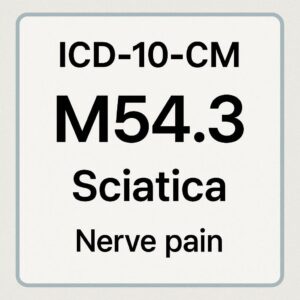
If you search for the ICD 10 code for sciatica nerve pain, you will likely land on one primary category: M54.3-
This is the parent code for “Sciatica.” However, you will almost never use just “M54.3” on a claim. The ICD-10 system requires a high level of detail. To be accurate, you need to add a sixth character to specify which side of the body is affected.
Here is the breakdown:
-
M54.30 : Sciatica, unspecified side
-
M54.31 : Sciatica, right side
-
M54.32 : Sciatica, left side
Which one should you use?
If your doctor’s notes say you have sciatica in your left leg, the correct code is M54.32. If it is in the right leg, you use M54.31. Only use M54.30 if the medical record does not specify which leg is affected. Insurance companies prefer the specific codes because they paint a clearer picture of the patient’s condition.
Why Specificity Matters in Coding
You might wonder why it matters if the code says “right” or “left.” Isn’t sciatica just sciatica?
In the medical field, the details matter a lot. Using a specific code like M54.31 tells a complete story at a glance.
-
For Treatment: It confirms that the doctor examined you and determined the exact pathway of your pain.
-
For Insurance: It reduces the chance of a claim being denied. Insurers look for consistency. If the doctor’s notes say “left leg pain” and the code is for the right side, the claim might be rejected.
-
For Research: Specific data helps researchers track how many people suffer from left-sided vs. right-sided sciatica, which can lead to better understanding of causes.
Beyond M54.3: Other Related Codes for Nerve Pain
Sometimes, sciatica is a symptom of a larger problem. In these cases, the doctor might diagnose the cause rather than the symptom itself. When that happens, a different ICD 10 code for sciatica nerve pain might be used.
For example, if the sciatica is caused by a specific issue with a disk, the coder will look at those codes first. Here are some common related diagnoses:
| Condition Description | ICD-10 Code | Notes |
|---|---|---|
| Sciatica caused by intervertebral disc disorder | M51.1- | This is used when a herniated or displaced disc is pinching the nerve. Like M54.3, it requires a side specification (e.g., M51.16 for lumbar region). |
| Lumbago with sciatica | M54.4- | This code is used when the patient has both general lower back pain (lumbago) and the radiating leg pain of sciatica. It also needs a side specifier. |
| Other dorsopathies, not elsewhere classified | M53.3 | This covers sacral and coccygeal disorders that might affect the sciatic nerve, though it is less specific to the classic “nerve pain” symptom. |
| Nerve root and plexus compressions | G55.1 | This is used in specific circumstances, often in a hospital setting, to indicate compression of nerve roots in disorders classified elsewhere. |
Important Note: You will rarely use two codes for the same condition. If the sciatica is due to a herniated disc (M51.1-), you code the herniated disc, not the sciatica separately. The “sciatica” is considered a symptom of the disc problem.
A Visual Guide: Mapping the Pain to the Code
To make this even clearer, let’s look at a simple flowchart of how a medical coder thinks when they see a patient with leg pain.
-
Patient Reports: “I have a sharp pain shooting down the back of my right leg.”
-
Doctor Examines: The doctor determines the pain follows the path of the sciatic nerve and notes “Right-sided sciatica” in the file.
-
Coder Reviews Notes: The coder looks for the root cause. Is there mention of a herniated disc?
-
If YES (e.g., “Herniated disc L5-S1 causing right sciatica”) -> Code M51.17 (Lumbosacral intervertebral disc disorder).
-
If NO (e.g., “Idiopathic right-sided sciatica”) -> Code M54.31 (Sciatica, right side).
-
How to Talk to Your Doctor About Coding
As a patient, you don’t need to be an expert coder. But understanding this system can help you ask better questions. When your doctor explains your diagnosis, you can ask:
-
“Is this pain caused by a disc problem, or is it primarily a nerve issue?”
-
“Did you note in my chart that the pain is primarily on my left side?”
This helps ensure your medical records are accurate from the start, which prevents headaches with insurance later.
Common Mistakes to Avoid with Sciatica Codes
Even professionals make mistakes. Here are the most common pitfalls when looking for the ICD 10 code for sciatica nerve pain:
-
Using the unspecified code (M54.30) by default. Always check the chart for “right” or “left.” If it isn’t written down, ask the doctor for clarification.
-
Confusing Sciatica with General Back Pain. Lower back pain alone (lumbago) has a different code (M54.5-). Sciatica specifically involves the leg.
-
Double Coding. As mentioned above, do not code both the cause (disc disorder) and the symptom (sciatica) if they are directly related. Code the cause.
-
Forgetting the 6th Character. M54.3 is not a valid billable code. It must have that sixth digit (0, 1, or 2).
The Importance of Accurate Documentation
Why do we put so much emphasis on finding the exact ICD 10 code for sciatica nerve pain? Because your medical record is your health story. Every code is a word in that story.
If the story is wrong, the treatment could be wrong.
-
Insurance Authorization: If you need physical therapy or an MRI, the insurance company reviews your diagnosis code to see if it justifies the request. A vague code like M54.30 might be seen as less urgent than a specific one.
-
Tracking Progress: Over time, these codes create a history. If your sciatica moves from the right side to the left side, the codes will reflect that change, prompting a doctor to investigate why.
Treatment Options for Sciatica
Knowing the code is the first step. The next is understanding what happens next. Treatment for sciatica varies widely depending on the severity and cause.
Conservative Treatments (Usually First-Line)
Most people with sciatica get better without surgery. Doctors often recommend:
-
Physical Therapy: Exercises to improve posture, strengthen the back, and improve flexibility.
-
Hot and Cold Packs: Heat can relax muscles, while cold can reduce inflammation.
-
Medication: Over-the-counter pain relievers like ibuprofen or naproxen, or prescription muscle relaxants and nerve pain medications (like gabapentin).
Interventional Treatments
If pain persists, a doctor might suggest:
-
Epidural Steroid Injections: Steroids are injected into the area around the nerve root to reduce inflammation and ease pain. This is a temporary measure to help you participate in physical therapy.
Surgery
This is reserved for cases where there is significant weakness, loss of bladder or bowel control (a medical emergency known as cauda equina syndrome), or pain that doesn’t improve with other treatments. The most common surgery is a microdiscectomy, where the piece of disc pressing on the nerve is removed.
Sciatica vs. Piriformis Syndrome: A Note on Diagnosis
Sometimes, the ICD 10 code for sciatica nerve pain isn’t used because the problem isn’t in the spine at all.
Piriformis syndrome is a condition where the piriformis muscle (located in the buttocks) spasms and irritates the sciatic nerve. The symptoms feel exactly like sciatica because the same nerve is involved. However, the cause is muscular, not spinal.
In this case, the correct code would be something like G57.0 (Lesion of sciatic nerve) or a code related to the muscle issue. This is a perfect example of why a proper medical exam is crucial. Treating a muscular problem like a spinal problem won’t be effective.
Living with Sciatica: Practical Tips for Daily Life
While we focus on the technical side of coding, the human side is dealing with the pain. Here are some realistic tips for managing daily life if you are experiencing sciatic nerve pain.
-
Don’t sit for long periods. Sitting can put extra pressure on the sciatic nerve. If you work at a desk, set a timer to stand up and walk around for a minute or two every 30 minutes.
-
Sleep smart. If you are a side sleeper, try sleeping on the side that doesn’t hurt. Place a pillow between your knees to keep your hips aligned. If you sleep on your back, put a pillow under your knees.
-
Watch your lifting technique. Never bend at the waist to pick something up. Squat down, keeping your back straight, and use your leg muscles to stand up.
-
Gentle movement helps. Complete bed rest is rarely recommended anymore. Short, frequent walks can help keep the muscles from stiffening up.
Frequently Asked Questions (FAQ)
Here are some of the most common questions people have about sciatica and its medical codes.
Q1: What is the most common ICD-10 code for sciatica?
A: The most common code used is likely M54.31 (Sciatica, right side) or M54.32 (Sciatica, left side), as doctors usually specify which leg is affected.
Q2: Is M54.30 a valid code for insurance claims?
A: Yes, M54.30 (Sciatica, unspecified side) is a valid code. However, it is considered less specific. Many insurers prefer the more specific codes, but M54.30 is accepted when the side is truly unknown or undocumented.
Q3: Can sciatica be a sign of something more serious?
A: In rare cases, yes. If you experience sudden numbness or weakness in your leg, or loss of bladder or bowel control, you should seek immediate medical attention. This could be a sign of Cauda Equina Syndrome, a medical emergency.
Q4: What is the difference between M54.3 and M54.4?
A: M54.3- is specifically for sciatica (nerve pain radiating down the leg). M54.4- is for lumbago with sciatica, meaning the patient has both general lower back pain and the radiating leg pain.
Q5: How long does sciatica usually last?
A: For most people, an acute episode of sciatica resolves within 4 to 6 weeks with conservative care. However, it can become a chronic issue for some, requiring long-term management.
Q6: Why did my doctor use a code for a herniated disc instead of sciatica?
A: This is a matter of medical hierarchy. The herniated disc is the underlying disease. The sciatica is a symptom of that disease. In coding, we code the diagnosis (the disc problem) first, as it is the root cause.
Conclusion
Navigating the world of medical codes can feel overwhelming, but it doesn’t have to be. By now, you should have a clear understanding of the ICD 10 code for sciatica nerve pain. Remember the core category M54.3-, and always pay attention to the sixth character that specifies the side: .30 for unspecified, .31 for right, and .32 for left.
Understanding this code does more than just satisfy curiosity. It empowers you to have better conversations with your healthcare provider, ensures your medical records are accurate, and helps the billing process go smoothly. Sciatica is a painful condition, but dealing with the paperwork for it doesn’t have to be.
Additional Resources
For more detailed information on the conditions that cause sciatica, you can visit the American Academy of Orthopaedic Surgeons at orthoinfo.aaos.org.
Disclaimer: This article is for informational purposes only and is not a substitute for professional medical advice, diagnosis, or treatment. Always seek the advice of your physician or another qualified health provider with any questions you may have regarding a medical condition. Never disregard professional medical advice or delay in seeking it because of something you have read here. For coding specifics, always consult the latest ICD-10 manuals and guidelines.