If you work in a medical practice, manage billing, or simply want to understand the paperwork behind your yearly check-up, you have likely encountered the confusion surrounding the “ICD 10 code for Medicare Annual Wellness Visit.”
It is one of the most common—and most frequently misunderstood—aspects of preventive care coding. Unlike a standard physical, the Medicare Annual Wellness Visit (AWV) is a specific type of appointment with strict documentation and coding rules.
Getting this code wrong can lead to denied claims, delayed payments, or even compliance audits. But do not worry. We are going to walk through this step by step, using simple language and practical examples.
By the end of this guide, you will know exactly which codes to use, when to use them, and how to distinguish the AWV from other types of visits.
ICD-10 Code for the Medicare Annual Wellness Visit
What Exactly is a Medicare Annual Wellness Visit?
Before we type a single code into a billing system, we need to understand what this appointment actually is. The Medicare Annual Wellness Visit is not a head-to-toe physical examination. This is a critical distinction.
The AWV is a yearly appointment designed to develop or update a personalized prevention plan. Its goal is to prevent disease and disability based on your current health and risk factors.
Key components of the AWV include:
-
A review of your medical and family history.
-
A list of current providers and suppliers.
-
Measurement of height, weight, body mass index (BMI), and blood pressure.
-
A review of potential risk factors for depression.
-
A review of functional ability and level of safety.
-
A screening schedule (like shots and tests).
-
A written plan or checklist.
Important Note: Medicare covers this visit once every 12 months. If you have had Part B for longer than 12 months, you are eligible for an AWV.
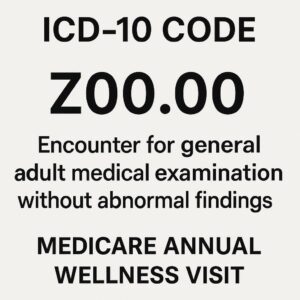
The Primary ICD-10 Code: Z00.00
When we talk about the ICD 10 code for Medicare Annual Wellness Visit, we are primarily discussing the Z00 code series. These codes fall under the category of “Factors influencing health status and contact with health services.” In plain English, these are codes for visits that happen when a person is not necessarily sick.
The most accurate code for a first-time or subsequent AWV is often debated, but the standard is Z00.00.
-
Code: Z00.00
-
Description: Encounter for general adult medical examination without abnormal findings.
This code is used when the visit is a routine exam and, during the course of that specific visit, no new health issues are discovered or addressed.
When to Use Z00.00
You would use Z00.00 for a straightforward Medicare AWV where:
-
The patient comes in for their yearly wellness planning.
-
All measurements are taken.
-
The health risk assessment is completed.
-
No new complaints are discussed.
-
No pre-existing conditions are actively managed (beyond noting them in the history).
When NOT to Use Z00.00
If the patient mentions a new symptom—for example, “I’ve been feeling dizzy lately”—and the provider evaluates that symptom, Z00.00 is no longer the correct primary code. The visit is no longer a simple wellness encounter.
The Secondary Code: Z00.01
Sometimes, things come up. Even during a wellness visit, a patient might mention something new, or the provider might find something concerning during the routine measurements.
-
Code: Z00.01
-
Description: Encounter for general adult medical examination with abnormal findings.
If the doctor finds an elevated blood pressure that requires a new care plan, or if the patient brings up a new issue that requires a small evaluation, the code shifts.
When to Use Z00.01
You would use Z00.01 for the AWV if:
-
A new, undiagnosed problem is identified (even if it is minor).
-
An abnormal finding is documented that requires further attention.
-
The provider orders a diagnostic test based on a finding during the AWV.
A Critical Billing Rule: If a problem is identified and it requires significant work—meaning the provider has to perform a full evaluation and management (E/M) service—you cannot just use Z00.01. In this case, you would bill the AWV (using G0438 or G0439) and the appropriate office visit code (like 99213-99215) with a Modifier 25, and then use the specific diagnosis code (e.g., E11.9 for Type 2 diabetes) as the primary diagnosis for the sick visit portion. The Z00.01 would still be used for the AWV portion.
A Tale of Two Visits: AWV vs. Initial Preventive Physical Exam (IPPE)
To really understand the coding landscape, we have to distinguish the AWV from the “Welcome to Medicare” visit.
| Feature | Initial Preventive Physical Exam (IPPE) | Annual Wellness Visit (AWV) |
|---|---|---|
| Nickname | “Welcome to Medicare” Visit | Yearly Wellness Visit |
| When | Within the first 12 months of Medicare Part B. | After you have had Part B for more than 12 months. |
| Focus | An introduction to preventive services and a baseline physical. | Updating your prevention plan and health risk assessment. |
| Components | Includes an EKG, review of education, and preventive services. | Focuses on functional ability, cognition, and risk factors. |
| HCPCS Code | G0402 | G0438 (First) / G0439 (Subsequent) |
| ICD-10 Code | Z00.00 or Z00.01 | Z00.00 or Z00.01 |
As you can see, the ICD-10 diagnosis codes (Z00.00 and Z00.01) are the same for both types of visits. The difference lies in the procedure codes (G-codes) you submit to Medicare.
Step-by-Step: How to Choose the Right Code
Let’s make this practical. Imagine you are at the front desk or in the billing office. Here is a simple decision tree to follow when assigning the ICD 10 code for Medicare Annual Wellness Visit.
Step 1: Identify the Visit Type
Confirm the appointment is scheduled as an AWV. The patient should be aware that this is for wellness planning, not for discussing major new illnesses.
Step 2: During the Encounter
As the provider sees the patient, they must document everything.
-
Was there a discussion of a new complaint?
-
Was there an abnormal finding?
Step 3: Check the Documentation
-
If the documentation shows no new problems and no abnormal findings that require management, select Z00.00.
-
If the documentation shows an abnormal finding (like a heart murmur) or a new problem (like occasional chest pain) that was evaluated, but did not constitute a separately billable service, select Z00.01.
Step 4: Check for a Separate Problem
If the provider had to treat a chronic condition (e.g., adjust medication for hypertension) or evaluate a significant new problem, the visit is split. You will use:
-
The specific ICD-10 code (e.g., I10 for hypertension) for the problem-focused part of the visit.
-
Z00.01 for the AWV portion of the visit.
-
You will bill this with a Modifier 25 on the E/M code.
Common Mistakes to Avoid
Even experienced billers slip up sometimes. Here are the most common pitfalls regarding the ICD 10 code for Medicare Annual Wellness Visit.
1. Using Z00.00 for Sick Visits
If a patient schedules a “check-up” but spends the whole time discussing their back pain, and the doctor only addresses the back pain, you cannot bill an AWV with Z00.00. This is a sick visit. Billing it as a wellness visit is a red flag for auditors.
2. Forgetting the “12-Month” Rule
Medicare is strict about the timeline. An AWV is covered once every 365 days (12 months). If you bill it too early, the claim will be denied, regardless of the ICD-10 code used.
3. Using V70.0 (Old Codes)
You might see old resources mentioning V70.0. Those codes are from the ICD-9 era and are no longer valid. You must use the Z00 codes.
4. Not Linking the Diagnosis to the Procedure
On the claim form, you must link the Z00.00 code to the AWV procedure code (G0438 or G0439). If you link it to a different procedure, the payer may be confused.
Why Accuracy Matters
You might be wondering, “Does it really matter if I use Z00.00 or Z00.01?”
Yes, it does.
-
Compliance: Medicare audits these visits frequently. Using the wrong code can be seen as upcoding or downcoding.
-
Medical Necessity: The Z00 codes justify why the visit happened. If the documentation says “abnormal findings” but you use Z00.00, the record is inconsistent.
-
Risk Adjustment: For Medicare Advantage plans (Part C), accurate coding helps reflect the patient’s health status. While Z00 codes are not risk-adjustable themselves, they set the stage for the encounter.
Frequently Asked Questions (FAQ)
Q: Can I use Z00.00 for a patient coming in for a physical who also has stable high blood pressure?
A: Yes, if the high blood pressure is stable, documented in the history, and the provider does not actively treat it during the visit. The focus remains on wellness. You would use Z00.00.
Q: What if the patient has a cold but insists on the AWV?
A: This is tricky. If the cold symptoms require evaluation, it is best to reschedule the AWV. If the provider briefly notes the cold but spends the entire time on the wellness visit, you could potentially use Z00.00, but it is safer to have a separate visit for acute issues. If they are combined, you must use the specific cold code (J00) for the problem and Z00.01 for the AWV.
Q: Is Z00.00 only for Medicare patients?
A: No. Z00.00 is a standard ICD-10 code used for all patients (commercial insurance, Medicaid, etc.) for routine exams. However, this article focuses on its specific application for the Medicare AWV.
Q: What is the difference between G0438 and Z00.00?
A: G0438 is a procedure code (HCPCS) that tells Medicare what service you performed (the first Annual Wellness Visit). Z00.00 is a diagnosis code (ICD-10) that tells Medicare why you performed it (a routine exam with no findings). You need both on the claim.
Additional Resources
For the most up-to-date information on Medicare preventive services, you should always refer to the official source. The Medicare Learning Network (MLN) publishes detailed booklets on the Annual Wellness Visit.
-
Resource: CMS.gov – Annual Wellness Visit (AWV) (This link leads to the official CMS page with fact sheets and billing codes).
Conclusion
Mastering the ICD 10 code for the Medicare Annual Wellness Visit is simpler than it appears. Remember that Z00.00 signifies a clean, routine visit, while Z00.01 accounts for unexpected findings during the appointment. By pairing these diagnosis codes with the correct G-codes (G0438 or G0439) and adhering to Medicare’s timeline, you ensure compliance and proper reimbursement.
Disclaimer: The information provided in this article is for general informational purposes only and does not constitute legal or professional medical advice. Coding and billing regulations are subject to change. Always consult with a qualified healthcare professional or billing expert for specific guidance related to your practice.