In the high-stakes environment of modern healthcare, few conditions test the limits of clinical acumen and administrative precision like septic shock. It is a medical emergency of terrifying speed and lethality, demanding rapid, decisive intervention from physicians and nurses. Yet, once the immediate crisis has passed, a parallel process of equal importance begins: the accurate translation of this complex clinical event into the structured language of medical codes. This is the domain of the medical coder and the Clinical Documentation Integrity (CDI) specialist, professionals who stand at the crucial intersection of patient care and health information management.
The International Classification of Diseases, Tenth Revision, Clinical Modification (ICD-10-CM) provides the vocabulary for this translation. Coding for septic shock is not merely an administrative task; it is a sophisticated process that requires a deep understanding of pathophysiology, a meticulous eye for detail in clinical documentation, and a firm grasp of constantly evolving official guidelines. An error in code assignment is not just a billing mistake. It can distort epidemiological data used to track public health trends, skew hospital performance metrics that inform quality improvement initiatives, and lead to significant financial repercussions for healthcare institutions.
This article aims to be the definitive guide for navigating the intricate landscape of ICD-10 code for septic shock. We will embark on a detailed journey, starting with the fundamental science of the condition, moving through the architecture of the coding system itself, and culminating in practical, step-by-step algorithms and real-world case studies. Whether you are a seasoned medical coder seeking to refine your expertise, a CDI specialist looking to enhance your querying strategies, a healthcare provider aiming to improve your documentation, or a student entering the field, this comprehensive resource is designed to equip you with the knowledge and confidence to handle this complex diagnosis with accuracy and integrity.
ICD-10 code for septic shock
2. Understanding the Pathophysiology: What is Septic Shock?
To code a condition correctly, one must first understand what it is. Septic shock is not a single disease but rather the most severe manifestation along a spectrum of the body’s dysregulated response to an infection.
From Infection to Organ Dysfunction: The Sepsis Cascade
The process begins with an infection, where a pathogen (bacteria, virus, fungus, or parasite) invades a normally sterile part of the body (e.g., lungs, urinary tract, bloodstream). The body’s immune system mounts a defensive response, releasing a cascade of inflammatory chemicals called cytokines. In a localized infection, this response is controlled. In sepsis, this inflammatory response becomes systemic and dysregulated. It spirals out of control, causing widespread inflammation and damage to the body’s own tissues and organs.
The Third International Consensus Definitions for Sepsis and Septic Shock (Sepsis-3) defines sepsis as “life-threatening organ dysfunction caused by a dysregulated host response to infection.” This organ dysfunction is identified clinically by an increase of 2 or more points in the Sequential [Sepsis-related] Organ Failure Assessment (SOFA) score.
Defining Shock: The Hemodynamic Collapse
When sepsis progresses, it can lead to severe damage to the cardiovascular system. The systemic inflammation causes vasodilation (widening of blood vessels), capillary leak (where fluid seeps out of blood vessels into tissues), and, in some cases, direct depression of heart muscle function. This leads to:
-
Profound hypotension (low blood pressure): Not enough pressure to perfuse vital organs.
-
Inadequate tissue perfusion: Despite sufficient blood volume, the dilated and “leaky” vascular system cannot deliver enough oxygen and nutrients to cells.
This state of circulatory and cellular/metabolic abnormality is septic shock. The Sepsis-3 criteria define it clinically as:
-
A vasopressor requirement to maintain a mean arterial pressure (MAP) of 65 mm Hg or greater.
-
AND a serum lactate level greater than 2 mmol/L (18 mg/dL) after adequate fluid resuscitation.
The elevated lactate is a critical marker. It indicates that cells have switched to anaerobic metabolism (producing energy without oxygen) due to the profound lack of perfusion, a state that is unsustainable and leads to cellular death and multi-organ failure.
The Role of Inflammatory and Anti-Inflammatory Mediators
The pathophysiology is a complex interplay between pro-inflammatory and anti-inflammatory pathways. The initial “cytokine storm” causes damage, but a subsequent compensatory anti-inflammatory response can also render the patient immunocompromised, leaving them vulnerable to secondary infections. This understanding is key because it explains the non-specific and often confusing clinical presentation of septic shock, which in turn impacts how it is documented and, ultimately, coded.
3. The ICD-10-CM Coding System: A Primer for the Uninitiated
Before deconstructing the specific codes for septic shock, it’s essential to understand the system in which they reside.
From ICD-9 to ICD-10: A Revolution in Specificity
The transition from ICD-9-CM to ICD-10-CM in 2015 was a monumental shift. ICD-9 codes were largely numeric and limited in detail (approximately 13,000 codes). ICD-10-CM is alphanumeric and boasts over 68,000 codes, allowing for unprecedented specificity regarding laterality, etiology, severity, and anatomic site. This specificity is crucial for conditions like septic shock, where the underlying cause dictates the code assignment.
Chapter Structure and the Importance of Code Organization
ICD-10-CM is divided into 22 chapters based on etiology or body system. The codes relevant to septic shock are primarily found in two chapters:
-
Chapter 1: Certain Infectious and Parasitic Diseases (A00-B99): This chapter contains the codes for the underlying infections (e.g., pneumonia, UTI) and the codes for sepsis (A41.-).
-
Chapter 18: Symptoms, Signs, and Abnormal Clinical and Laboratory Findings, Not Elsewhere Classified (R00-R99): This chapter contains the codes for septic shock (R65.21) and severe sepsis (R65.20). Codes in this chapter are generally not used as a principal diagnosis if a definitive diagnosis is known.
Understanding this structure is the first step in correct sequencing.
4. Deconstructing the Codes: The Foundation of Septic Shock Coding
The coding of septic shock rests on a tripod of components: the shock itself, the sepsis, and the underlying infection.
The R65.2- Series: A Closer Look
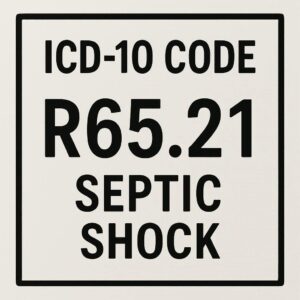
The code for septic shock is R65.21. Let’s break it down:
-
R65: Subcategory for “Systemic Inflammatory Response Syndrome (SIRS) of non-infectious origin” and “Severe sepsis.” It’s important to note that the code title can be misleading, as it also encompasses the infectious sequelae.
-
R65.2: “Severe sepsis”
-
R65.21: “Severe sepsis with septic shock”
This code is never reported alone. According to the ICD-10-CM Official Guidelines for Coding and Reporting, it must be assigned in conjunction with codes for the underlying systemic infection (sepsis) and the underlying localized infection.
The Underlying Infection: Navigating Chapter 1
The infection that started the cascade must be identified. This could be:
-
A41.9 Sepsis, unspecified organism: Used when the provider documents “sepsis” but does not specify the type of organism.
-
A41.51 Sepsis due to Escherichia coli [E. coli]: An example of a specified organism.
-
A40.9 Streptococcal sepsis, unspecified: An example of a specific type of sepsis.
-
A02.1 Salmonella sepsis: Another example.
Furthermore, the localized infection must be coded if known.
-
J18.9 Pneumonia, unspecified organism
-
N39.0 Urinary tract infection, site not specified
-
K35.20 Acute appendicitis with generalized peritonitis, without abscess
The Concept of “Code First” and “Use Additional Code”
The ICD-10-CM guidelines are filled with instructional notes. For the R65.21 code, the note is explicit: “Code first underlying infection, such as…” and “Use additional code to identify systemic infection…“
This is the heart of the sequencing logic. You must first code the underlying condition (the localized infection), then the systemic infection (sepsis), and then the severe sepsis with shock.
5. The Central Dilemma: Combination Codes vs. Separate Codes
A significant point of confusion in sepsis coding is the use of combination codes.
The A41.- Series (Sepsis) and its Implications
A code from A41.- indicates that the patient has a systemic infection—the pathogen is in the bloodstream or causing a systemic inflammatory response. It represents the clinical state of “sepsis.” In many cases, when a provider documents “urosepsis” or “pneumonia with sepsis,” the coder must determine if this is a true systemic illness or just a severe localized infection. A query is often necessary.
When is R65.21 Used? The Clear and Present Danger
The code R65.21 is assigned only when the provider specifically documents “septic shock” or the clinical criteria for septic shock (persistent hypotension requiring vasopressors and elevated lactate) are clearly met and documented. It is not assigned for uncomplicated sepsis or for shock due to other causes (e.g., cardiogenic shock, hypovolemic shock).
The official guidelines state that the code for septic shock (R65.21) is assigned in addition to the code for the underlying systemic infection (e.g., A41.9) and the code for any acute organ dysfunction. This is because R65.21 inherently includes the presence of both severe sepsis (organ dysfunction) and shock.
The T81.44XA Scenario: Postprocedural Sepsis
A special case arises when sepsis and septic shock develop as a complication of a medical procedure. In this instance, the coding changes.
-
The principal code becomes T81.44XA, Sepsis following a procedure.
-
This code requires additional codes for the underlying infection, the sepsis (A41.-), and the septic shock (R65.21).
-
An external cause code from Chapter 20 is not needed, as the “T” code already indicates the external cause.
6. A Step-by-Step Coding Algorithm for Septic Shock
To simplify the process, follow this logical algorithm:
Step 1: Identify the Underlying Infection
-
What is the source? Pneumonia (J18.9), UTI (N39.0), cellulitis (L03.90), etc.
Step 2: Confirm the Presence of Sepsis
-
Does the provider document “sepsis,” “septicemia,” or “bacteremia” with associated symptoms? If so, assign a code from A41.-.
Step 3: Establish the Diagnosis of Septic Shock
-
Does the provider explicitly document “septic shock”?
-
Is there documentation of vasopressor use (e.g., norepinephrine, vasopressin) to maintain blood pressure and an elevated lactate >2 mmol/L after fluid resuscitation?
-
If yes, assign R65.21.
Step 4: Sequence According to Official Guidelines
-
If not postprocedural: The underlying infection is the principal diagnosis. Then code the sepsis (A41.-), followed by R65.21.
-
If postprocedural: T81.44XA is the principal diagnosis. Then code the underlying infection, the sepsis (A41.-), and R65.21.
-
Always add additional codes for any acute organ dysfunctions (e.g., acute kidney failure, acute respiratory failure, encephalopathy).
This process can be visualized in the following flowchart:
7. The Power of Documentation: A Partnership Between Clinicians and Coders
Accurate coding is impossible without precise documentation. The medical record is the source of truth.
Key Phrases That Support Code Assignment
-
Strong Documentation: “Patient presents with urosepsis secondary to E. coli UTI, now in septic shock requiring vasopressor support. Lactate is 4.5. Developing acute hypoxic respiratory failure and acute kidney injury.”
-
Weak Documentation: “Patient is septic from a UTI. Blood pressure is low.” (This does not support “shock” and does not specify the organism.)
Querying the Provider: Best Practices and Ethical Considerations
When documentation is unclear, a physician query is essential. A query should be non-leading and based on clinical evidence in the record.
-
Poor Query: “Can we document septic shock to improve DRG coding?” (Leading and non-compliant).
-
Appropriate Query: “The patient required norepinephrine for hypotension and had a lactate of 4.8 mmol/L after 2L of fluid resuscitation. Please clarify if the diagnosis of septic shock is appropriate.”
The Role of the Clinical Documentation Integrity (CDI) Specialist
CDI specialists are trained professionals who work concurrently with the healthcare team to ensure documentation accurately reflects the patient’s clinical status, severity of illness, and risk of mortality. They are the bridge between clinicians and coders, facilitating the queries that lead to accurate code assignment.
8. Case Studies: Applying Knowledge to Real-World Scenarios
Let’s apply our knowledge to practical examples.
Case Study 1: Community-Acquired Pneumonia with Progression
-
Presentation: A 68-year-old male presents with fever, cough, and shortness of breath. Chest X-ray confirms right lower lobe pneumonia. He is admitted.
-
Day 2: He becomes hypotensive (80/50 mmHg) not responsive to 2L of IV fluids. He is started on levophed. Lactate is 3.8. The physician documents “Septic shock due to pneumococcal pneumonia.”
-
Coding:
-
J13 Pneumonia due to Streptococcus pneumoniae
-
A40.9 Streptococcal sepsis, unspecified
-
R65.21 Severe sepsis with septic shock
-
-
Rationale: The localized infection (J13) is the principal diagnosis. The sepsis (A40.9) is the systemic infection, and R65.21 captures the shock and organ dysfunction.
Case Study 2: Urosepsis and Septic Shock Post-Catheterization
-
Presentation: A 75-year-old female undergoes a cardiac catheterization. On day 3 post-procedure, she develops a fever and confusion. Urinalysis shows >100 white blood cells. Blood cultures are positive for Escherichia coli. She becomes hypotensive, requires vasopressin, and her lactate rises to 5.0. Diagnosis: “Post-procedural septic shock from E. coli urosepsis.”
-
Coding:
-
T81.44XA Sepsis following a procedure
-
N39.0 Urinary tract infection, site not specified
-
A41.51 Sepsis due to Escherichia coli
-
R65.21 Severe sepsis with septic shock
-
R41.0 Disorientation (to capture the encephalopathy)
-
-
Rationale: Because the sepsis is a direct consequence of the procedure, T81.44XA is sequenced first.
Case Study 3: Post-Operative Septic Shock Following Appendectomy
-
Presentation: A 22-year-old male undergoes an appendectomy for acute appendicitis. Two days later, he develops peritonitis, fever, and tachycardia. He is taken back to the OR for washout. Cultures from the peritoneum grow Pseudomonas aeruginosa. He requires vasopressors for hypotension and develops acute renal failure.
-
Coding:
-
T81.44XA Sepsis following a procedure
-
K35.32 Acute appendicitis with perforation and peritonitis (this is the underlying infection site)
-
A41.52 Sepsis due to Pseudomonas
-
R65.21 Severe sepsis with septic shock
-
N17.9 Acute kidney failure, unspecified
-
-
Rationale: The sepsis is a complication of the surgery. The underlying intra-abdominal infection is the perforated appendix.
9. Common Pitfalls and How to Avoid Them: A Coder’s Survival Guide
-
Pitfall 1: Coding “Sepsis” when it’s “SIRS.” SIRS (Systemic Inflammatory Response Syndrome) can be caused by non-infectious processes like pancreatitis or trauma. Coding A41.- for sepsis is incorrect in these cases. Use codes from R65.1- for non-infectious SIRS.
-
Pitfall 2: Using R65.21 for any shock. Septic shock is specific. If the shock is due to hemorrhage, use hypovolemic shock codes (R57.1). If due to a heart problem, use cardiogenic shock codes (R57.0).
-
Pitfall 3: Incorrect sequencing. Always remember the “code first” notes. The reason for the admission (the underlying infection) is typically the principal diagnosis, unless a coding guideline (like the one for postprocedural sepsis) dictates otherwise.
-
Pitfall 4: Forgetting to code organ dysfunctions. The gravity of septic shock is the multi-organ failure it causes. Always add codes for acute kidney failure (N17.-), acute respiratory failure (J96.0-), hepatic failure (K72.0-), encephalopathy (G93.41), coagulopathy (D65), etc. This completes the clinical picture.
10. The Financial and Reimbursement Impact: Why Accuracy Matters
Accurate coding for septic shock has direct financial implications through the Diagnosis-Related Group (DRG) system.
-
DRG Assignment and MS-DRG Shifts: A patient with simple pneumonia might fall into a lower-paying DRG (e.g., DRG 177: Respiratory Infections & Inflammations). However, when coded correctly with pneumonia, sepsis, and septic shock, the case will group to a much higher-paying DRG (e.g., DRG 871: Septicemia or Severe Sepsis with MV >96 hours or Septic Shock). This reflects the vastly increased resource utilization.
-
The Risk of Denials and Audits: If a coder assigns R65.21 without clear clinical documentation of vasopressor use and elevated lactate, the claim is a prime target for denial by auditors. Recovery Audit Contractors (RACs) frequently target sepsis and septic shock cases.
-
Quality Measures and Public Reporting: Hospital mortality rates for sepsis and septic shock are publicly reported quality measures. Accurate coding ensures that a hospital’s performance data is correct, which impacts its reputation and, in some payment models, its reimbursement.
11. The Future of Sepsis Coding: ICD-11 and Beyond
The World Health Organization has released ICD-11, which will eventually be adopted in the US (as ICD-11-CM). ICD-11 offers a more conceptually logical structure. Sepsis is primarily located in Chapter 1G, “Certain Infectious or Parasitic Diseases,” with a more direct parent-child relationship between the infection and the septic state. While the US implementation is years away, understanding the direction of coding helps professionals prepare for the future, where specificity and data interoperability will be even more critical.
12. Conclusion: Mastering the Code to Improve Patient Care and Data Integrity
The accurate ICD-10 coding of septic shock is a complex but vital process that sits at the nexus of clinical medicine, health information management, and healthcare finance. It requires a robust understanding of the condition’s pathophysiology, a meticulous approach to clinical documentation, and an unwavering commitment to following official coding guidelines. By mastering this process, medical coders, CDI specialists, and healthcare providers do more than ensure proper reimbursement—they contribute to the integrity of the health data that drives public health initiatives, quality improvement, and ultimately, better patient outcomes.
13. Frequently Asked Questions (FAQs)
Q1: Can I code R65.21 if the physician only documents “severe sepsis” but the patient was on vasopressors?
A: No. The assignment of R65.21 requires explicit clinical criteria. If the physician has not diagnosed “septic shock,” you must query. The coder cannot independently interpret clinical data (like vasopressor use) to assign a diagnosis. The provider’s clinical judgment must be documented.
Q2: What is the difference between “severe sepsis” (R65.20) and “septic shock” (R65.21)?
A: “Severe sepsis” refers to sepsis with acute organ dysfunction without refractory hypotension. “Septic shock” is a subset of severe sepsis where the organ dysfunction includes cardiovascular failure, requiring vasopressors and presenting with hyperlactatemia. R65.21 includes the concepts of both severe sepsis and shock.
Q3: How do I code a patient with sepsis and hypotension that resolves immediately with fluids?
A: This would typically be coded as sepsis (A41.9) and the underlying infection. The transient hypotension that is fluid-responsive does not meet the criteria for septic shock, which requires that hypotension persists despite adequate fluid resuscitation.
Q4: When a patient has septic shock and multiple organ failures, which organ failure code do I use?
A: You code all documented acute organ failures. There is no limit. Common ones include acute kidney failure (N17.9), acute respiratory failure (J96.00), and septic encephalopathy (G93.41). Capturing all of them is essential for accurately representing the patient’s severity of illness.
Q5: Is “bacteremia” the same as “sepsis” for coding purposes?
A: Not necessarily. Bacteremia means bacteria in the bloodstream. A patient can have transient bacteremia without a systemic inflammatory response (e.g., during tooth brushing). Sepsis implies a life-threatening organ dysfunction in response to an infection. If the provider documents “bacteremia” without signs of systemic inflammation or organ dysfunction, it may be coded as Z22.9 (Carrier of infectious disease) or a code for the localized infection. A query is often needed to clarify the clinical intent.
14. Additional Resources
-
Official ICD-10-CM Guidelines: https://www.cms.gov/medicare/coding-billing/icd-10-codes (The definitive source for coding rules).
-
AHA Coding Clinic for ICD-10-CM/PCS: The official publication for coding advice and guidance from the Central Office on ICD-10.
-
Society of Critical Care Medicine (SCCM): https://www.sccm.org/ (For the latest clinical definitions and guidelines, including Sepsis-3).
-
American Health Information Management Association (AHIMA): https://www.ahima.org/ (Provides resources, education, and professional support for coders and CDI specialists).
-
CDC ICD-10-CM Browser Tool: https://www.cdc.gov/nchs/icd/icd10cm.htm (A useful tool for looking up codes and official tabular listings).
Disclaimer: This article is intended for informational and educational purposes only. It is not a substitute for professional medical coding, billing, or clinical advice. Medical coding is complex and subject to change. Always consult the most current official ICD-10-CM coding guidelines, payer-specific policies, and clinical documentation for accurate code assignment. The author and publisher disclaim any liability arising directly or indirectly from the use of this information.
Date: October 26, 2025
Author: Dr. Eleanor Vance, MD, CCS, CDIP