
If you have ever looked at a lab report and seen a high platelet count, you know it can feel a bit alarming. Whether you are a medical coder trying to find the right billing code, a nurse double-checking a chart, or a patient curious about a diagnosis, understanding the terminology is the first step toward clarity.
One of the most common terms you will encounter in hematology is “thrombocytosis.” But what happens when the documentation doesn’t specify the exact type? That is where the unspecified code comes into play.
In the world of medical coding, precision is key. However, sometimes the clinical picture isn’t perfectly clear. This article is designed to be your friendly, reliable guide to the ICD-10 code for thrombocytosis unspecified. We will walk through exactly what this code means, when to use it, and how it fits into the larger picture of platelet disorders.
Let’s demystify the numbers and terms together.
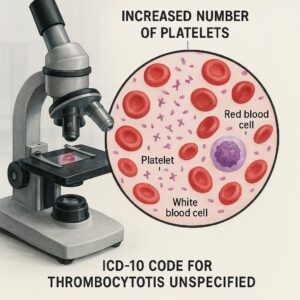
ICD-10 Code for Thrombocytosis Unspecified
What is Thrombocytosis? A Quick Overview
Before we dive into the coding weeds, let’s make sure we are all on the same page regarding the condition itself.
Thrombocytosis is a medical term that simply means you have a high number of platelets (also called thrombocytes) in your blood. Platelets are the tiny cell fragments that help your blood clot. If you cut yourself, platelets rush to the scene to form a plug and stop the bleeding.
A normal platelet count typically ranges from 150,000 to 450,000 per microliter of blood. When that number creeps above 450,000, a doctor might diagnose thrombocytosis.
However, not all high platelet counts are created equal. There are two main categories:
-
Reactive Thrombocytosis (Secondary): This is the most common form. It happens when another condition or external factor causes the platelet count to rise. Think of it as a secondary effect. Common causes include infection, inflammation (like arthritis), iron deficiency, or recovery from major surgery.
-
Essential Thrombocythemia (Primary): This is a rare blood disorder where the bone marrow itself produces too many platelets due to a genetic mutation. This is a myeloproliferative neoplasm and requires more specialized treatment.
Understanding this distinction is vital because the ICD-10 code for thrombocytosis unspecified fits into a very specific place within these two scenarios.
The Star of the Show: D75.839
So, what is the code you are here for?
The specific ICD-10-CM code for thrombocytosis unspecified is D75.839.
Let’s break that down:
-
D75: This places the code in the chapter for “Diseases of the blood and blood-forming organs and certain disorders involving the immune mechanism.” Specifically, it falls under “Other and unspecified diseases of blood and blood-forming organs.”
-
.839: This is the specific extension that denotes “Thrombocytosis, unspecified.”
This code lives in a small family of platelet-related codes:
-
D75.838: Other thrombocytosis
-
D75.839: Thrombocytosis, unspecified
Important Note for Readers: D75.839 is used when the physician has diagnosed thrombocytosis, but the medical record does not specify whether it is the reactive (secondary) type or essential (primary) type. It is also used for transient high platelet counts where the underlying cause is still being investigated.
When to Use the Unspecified Code (And When Not To)
Using an unspecified code can sometimes feel like a last resort, but in reality, it is a necessary and valid part of accurate coding—provided it is used correctly. Let’s look at some realistic scenarios.
Scenario A: The Right Time to Use D75.839
Imagine a patient comes into a clinic for a routine physical. They feel fine, but their blood work comes back showing a platelet count of 550,000. The doctor notes: “Thrombocytosis noted on CBC. Will repeat labs in one month to assess trend.”
In this case, the doctor has diagnosed thrombocytosis, but there is no further information about the cause or type. There is no mention of a myeloproliferative neoplasm, and no clear reactive cause has been identified yet. The correct code here is D75.839 (Thrombocytosis, unspecified) .
Scenario B: When You Need a More Specific Code
Now, imagine a different patient. They come in with a fever and cough. They are diagnosed with pneumonia. Their lab work shows a platelet count of 600,000. The doctor writes in the note: “Elevated platelets likely secondary to acute infection. Reactive thrombocytosis.”
Here, the physician has specified the type: reactive. You should not use the unspecified code. Instead, you would look for a code that captures the reactive nature of the condition. While D75.838 (Other thrombocytosis) might be used, the best practice is to code the underlying condition (the pneumonia) first, as the high platelets are a symptom of that infection.
Scenario C: The Distinction from Essential Thrombocythemia
If a hematologist performs a bone marrow biopsy and diagnoses a patient with Essential Thrombocythemia, you are now firmly out of the D75 category.
Essential Thrombocythemia has its own specific family of codes under myeloproliferative neoplasms:
-
D47.3: Essential (hemorrhagic) thrombocythemia
Using D75.839 for a confirmed case of Essential Thrombocythemia would be incorrect and could lead to claim denials or a misrepresentation of the patient’s health status.
Comparative Table: Thrombocytosis vs. Thrombocythemia
One of the biggest sources of confusion for newcomers is the difference between “thrombocytosis” and “thrombocythemia.” In casual conversation, they are often used interchangeably, but in the world of ICD-10, they have distinct meanings.
| Feature | Thrombocytosis | Thrombocythemia |
|---|---|---|
| Primary Meaning | A general term for a high platelet count. | Almost always refers to the primary, neoplastic condition. |
| Common Cause | Reactive or secondary to another condition (infection, inflammation). | A myeloproliferative neoplasm (bone marrow disease). |
| ICD-10 Category | Typically found in D75.8 (Other specified diseases of blood). | Typically found in D47.3 (Essential thrombocythemia). |
| Clinical Context | Often temporary. Resolves when the underlying cause is treated. | Chronic condition. Requires long-term management. |
| Risk Profile | Lower risk of blood clots related to the high count itself. | Higher risk of thrombosis and bleeding. |
As you can see, the ICD-10 code for thrombocytosis unspecified (D75.839) sits firmly in the left column. It is a placeholder for a high count that isn’t yet—or isn’t ever—classified as a bone marrow disease.
The Importance of the “Unspecified” Designation
In the age of value-based care and precise documentation, the word “unspecified” can sometimes carry a negative connotation. Payers and quality auditors often push for “specific” codes. So, why do we keep the unspecified codes around?
1. It Reflects the Reality of Diagnosis:
Medicine is a process. Patients don’t always walk out of the first visit with a concrete, specific diagnosis. They have symptoms and lab results. The unspecified code allows us to bill for the encounter accurately while the diagnostic journey is ongoing.
2. It Prompts Further Documentation:
Using an unspecified code can actually be a helpful flag. It tells the provider, “We need more information here.” It encourages the physician to add a note about the etiology—is it reactive? Is it primary? If they don’t know yet, that’s okay, but the code reflects that current state of knowledge.
3. It is a Billing Necessity:
You cannot bill for a service without a code that matches the documentation. If the doctor only documents “thrombocytosis,” you cannot invent a diagnosis of Essential Thrombocythemia just to get a “better” code. D75.839 is the honest and correct choice.
Clinical Nuances That Affect Coding
To truly master the use of this code, you need to understand the clinical context a little better. Here are some key points that a provider might document, which would guide you away from the unspecified code or confirm its use.
1. Transient vs. Persistent Thrombocytosis
-
Transient: A temporary spike. Maybe the patient is recovering from a major surgery or an acute blood loss. If the note mentions the temporary nature, you might look to code the surgical recovery or the cause of the blood loss, with the high platelets being an associated finding.
-
Persistent: If the high count is seen on multiple lab draws over several months, the physician is more likely to investigate further. They might still use “unspecified” until testing is complete.
2. The Role of Inflammation Markers
If the doctor notes that the patient has a high CRP (C-reactive protein) or high ESR (sed rate) along with the thrombocytosis, they might lean toward a diagnosis of “reactive thrombocytosis” secondary to inflammation. This would steer you away from D75.839.
3. Age of the Patient
Essential Thrombocythemia is more common in older adults. If a 70-year-old presents with a persistently high platelet count, a hematologist will be more suspicious of a primary bone marrow disorder. If a 3-year-old has a high count during an ear infection, it is almost certainly reactive. In the child’s case, if the doctor simply notes “thrombocytosis,” the unspecified code is appropriate until the infection resolves.
Step-by-Step Guide to Coding Thrombocytosis
If you are sitting in front of a patient chart and see “high platelets,” here is a simple workflow to follow to determine if D75.839 is your code.
Step 1: Read the Physician’s Note Carefully
Look for the exact wording. Did they write “Thrombocytosis” or “Essential Thrombocythemia”? This is your biggest clue.
Step 2: Look for a Cause
Is there a co-existing condition like:
-
Infection (Pneumonia, UTI)?
-
Inflammatory disease (Rheumatoid arthritis, IBD)?
-
Recent trauma or surgery?
-
Iron deficiency anemia?
If a cause is listed and linked to the high platelets, you likely have a reactive case.
Step 3: Check for Specific Terminology
Look for these keywords:
-
“Reactive”
-
“Secondary to”
-
“Essential”
-
“Myeloproliferative neoplasm”
-
“Clonal”
Step 4: Apply the Code
-
If it says Essential or Primary -> D47.3
-
If it says Reactive -> Code the cause first, and consider D75.838 if required, or simply let the cause code stand.
-
If it says Thrombocytosis with no other qualifiers -> D75.839
Common Mistakes to Avoid
Even seasoned coders can slip up. Here are the most common pitfalls related to the ICD-10 code for thrombocytosis unspecified.
-
Mistake #1: Coding D75.839 with a known cause. If the patient has a massive infection and reactive thrombocytosis, coding D75.839 is inaccurate. The platelets are a symptom; the infection is the diagnosis.
-
Mistake #2: Confusing the index. The alphabetic index in your coding manual might have multiple entries for “thrombocytosis.” Always verify the code in the tabular list to make sure you are in the right chapter (D75 vs D47).
-
Mistake #3: Coding from the lab report alone. You cannot code based solely on a lab value of 500,000 platelets. There must be a physician’s statement linking that value to a diagnosis. If the doctor hasn’t documented it, you cannot assume it.
-
Mistake #4: Using it for low platelets. Remember, “thrombocytosis” means high platelets. Low platelets is “thrombocytopenia” (code D69.6).
The Billing and Reimbursement Perspective
From a financial standpoint, using D75.839 is usually straightforward. It is a valid diagnosis code that most insurance payers accept. However, because it is “unspecified,” it may sometimes trigger a medical review.
An auditor might want to see if the provider truly lacked the information to make a more specific diagnosis, or if they simply forgot to document it. To ensure smooth sailing:
-
Ensure the note supports the code. The physician’s note should reflect that the type of thrombocytosis is unknown or not yet determined.
-
Link the diagnosis to the procedure. If you are billing for a CBC (blood count), make sure the medical necessity is clear. “Thrombocytosis” is a perfectly acceptable reason to order a blood test.
-
Look for supporting documentation. Notes about “further workup pending” or “will refer to hematology” support the use of an unspecified code during this initial phase.
A Patient-Friendly Explanation of the Code
If you are a patient reading this, you might be wondering what D75.839 means for your health record. Let’s translate the medical coding language into plain English.
Think of D75.839 as a temporary label your doctor uses that says: “Your platelets are high, and we are still figuring out exactly why.”
It doesn’t mean you have a serious blood cancer (like Essential Thrombocythemia). In fact, most of the time, high platelets are “reactive,” meaning they are just your body’s response to something else, like a cold, an injury, or low iron.
Your doctor used this code because, at that moment, the most accurate thing they could say about your blood was, “The platelet count is up.” As they run more tests and learn more—maybe the count goes back to normal, maybe it stays high—they will update your chart with a more specific code.
So, if you see D75.839 on your discharge papers or your “After Visit Summary,” don’t panic. It’s just the medical coding world’s way of saying, “We’re on the case, and here’s what we know right now.”
Additional Resources
Navigating the world of medical coding can be complex, but you don’t have to do it alone. For the most up-to-date information and official guidelines, the best place to go is the source.
-
CMS.gov (Centers for Medicare & Medicaid Services): They publish the official ICD-10-CM guidelines annually. This is the definitive rulebook for coders in the United States.
-
The AAPC (American Academy of Professional Coders): A great resource for articles, forums, and training on specific codes like D75.839.
[Link to CMS ICD-10 Homepage]
Frequently Asked Questions (FAQ)
Q1: What is the exact ICD-10 code for thrombocytosis unspecified?
A: The exact code is D75.839. It falls under the category of “Other specified diseases of blood and blood-forming organs.”
Q2: Is D75.839 the same as Essential Thrombocythemia?
A: No, absolutely not. D75.839 is for unspecified high platelets. Essential Thrombocythemia (ET) is a specific bone marrow disease coded as D47.3. ET is a type of thrombocytosis, but not all thrombocytosis is ET.
Q3: Can I use D75.839 if the thrombocytosis is caused by an infection?
A: Generally, no. If the cause is known (like an infection), the high platelet count is considered “reactive.” You should code the infection, and the high platelets are considered a symptom of that infection, not a separate unspecified diagnosis.
Q4: What does a normal platelet count look like compared to a count needing this code?
A: A normal platelet count ranges from 150,000 to 450,000. A diagnosis of thrombocytosis, which might warrant the use of D75.839, is typically considered when the count is persistently above 450,000.
Q5: What if the doctor just writes “high platelets” on the chart?
A: The diagnosis “high platelets” is synonymous with thrombocytosis. In this case, you would query the provider for clarification. If they confirm the diagnosis of thrombocytosis without further specification, D75.839 is the correct code.
Conclusion
Finding the right code in the vast landscape of ICD-10 can sometimes feel like searching for a needle in a haystack. But for thrombocytosis unspecified, the answer is clear: D75.839. This code serves a vital purpose in the diagnostic journey, bridging the gap between a lab finding and a final, specific diagnosis.
Remember, it is the code for “we know what, but not yet why.” By understanding the clinical nuances between reactive and primary thrombocytosis, you can use this code confidently and accurately. Always prioritize the physician’s documentation, and let it guide you to the most precise code possible. Whether you are a coding student, a practicing professional, or a curious patient, we hope this guide has made the world of platelet disorders a little less mysterious and a lot more manageable.
Disclaimer: This article is for informational purposes only and does not constitute medical or legal advice. Coding practices and guidelines are subject to change. Always refer to the official ICD-10-CM guidelines and consult with a certified professional for specific coding situations.


