Let’s be honest for a moment. Medical codes can feel like a foreign language. You walk into your doctor’s office for your annual checkup, they draw a few vials of blood, and weeks later you get an explanation of benefits filled with letters and numbers that make no sense.
If you have ever stared at a billing statement and wondered, “What is the ICD-10 code for yearly lab work?” you are not alone.
The short answer is that there isn’t just one single magic code. Instead, your doctor selects a code that tells the insurance company the reason for those lab tests. For a completely healthy person getting a routine physical, the most common code is Z00.00.
But here is where things get interesting. Most people over the age of 30 or those with existing health conditions rarely fall into that simple category. In this guide, we will walk through everything you need to know about medical coding for routine lab testing, why it matters for your wallet, and how to avoid surprise bills.
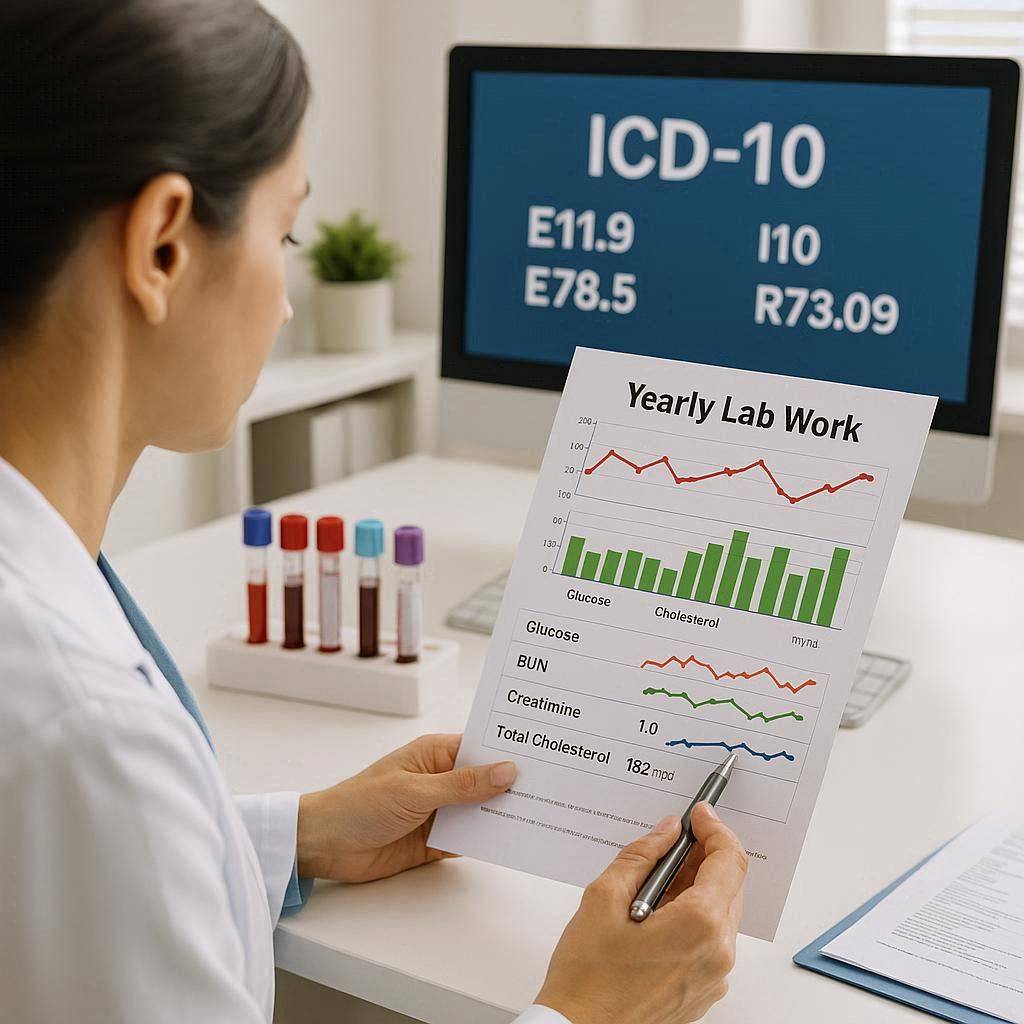
What Exactly Is an ICD-10 Code?
Before we dive into the specific numbers, let us take a step back. ICD-10 stands for the International Classification of Diseases, 10th Revision. These codes are created by the World Health Organization and adapted for use in the United States by the Centers for Medicare and Medicaid Services (CMS).
Think of an ICD-10 code as the “why” behind a medical service. If a lab runs a cholesterol test, the ICD-10 code explains why that test was necessary. Without a proper “why,” insurance companies will almost always deny payment.
The Difference Between ICD-10 and CPT Codes
This is a common source of confusion. You might hear people use these terms interchangeably, but they serve two very different purposes.
| Code Type | What It Answers | Example |
|---|---|---|
| ICD-10 Code | Why was the service performed? (Diagnosis or reason) | Z00.00 (Encounter for general adult medical exam) |
| CPT Code | What was done? (Procedure or service) | 80061 (Lipid panel) |
When you get yearly lab work, your doctor’s office submits both codes. The CPT code tells the insurer which tests you had. The ICD-10 code justifies why those tests were medically necessary. If either piece is missing or mismatched, your claim may be rejected.
Important Note: Insurance companies cover yearly lab work differently depending on the ICD-10 code used. A “routine physical” code might be covered at 100%, while a “screening for a specific condition” might apply to your deductible.
The Primary ICD-10 Code for Yearly Lab Work (Routine Exam)
For a healthy adult with no specific complaints, undergoing an annual physical examination that includes standard blood work, the correct code is:
Z00.00 – Encounter for general adult medical examination without abnormal findings
This code falls under the category “Factors influencing health status and contact with health services.” In plain English, it means you showed up for a checkup, you felt fine, and the doctor found no obvious problems during the physical exam.
When to use Z00.00:
- You are over 18 years old.
- You have no new symptoms or complaints.
- You are not managing a chronic disease like diabetes or high blood pressure.
- The lab work is truly preventive (complete blood count, basic metabolic panel, lipid panel, etc.).
What About Z00.01?
There is a close cousin to Z00.00 that you might see on your paperwork.
Z00.01 – Encounter for general adult medical examination with abnormal findings
This code is used when your doctor discovers something during the physical exam that requires attention. For example, if they listen to your heart and hear a murmur, or if they find a lump during a breast exam, they might switch to Z00.01 even before the lab results come back.
The key difference is that Z00.01 signals to the insurance company that this visit became slightly more complex than a pure routine checkup.
Real-World Scenarios: Which Code Applies to You?
Now that you understand the basics, let’s look at common situations. This is where many patients get confused, so take your time reading through these examples.
Scenario 1: The Healthy 28-Year-Old
You are 28 years old, exercise regularly, take no medications, and feel great. You schedule your annual physical because your job offers a free wellness visit. The doctor orders a standard panel of blood tests.
ICD-10 code on your lab order: Z00.00
Likely outcome: Your insurance covers the labs as preventive care with no cost-sharing (no copay or deductible).
Scenario 2: The 45-Year-Old with Well-Controlled High Blood Pressure
You have hypertension, but your primary care doctor says it is well-managed with a low-dose medication. You come in for your yearly checkup, and your blood pressure reading today is normal. The doctor orders a metabolic panel to check your kidney function (a standard precaution with blood pressure meds) plus the usual lipid panel.
ICD-10 code on your lab order: This gets tricky. Many offices will use Z00.00 for the preventive portion, but they may also add I10 (Essential hypertension) as a secondary code.
Likely outcome: Because you have a chronic condition, the labs might be billed as “monitoring” rather than “preventive.” Some insurers still cover this fully, but others may apply your deductible. Call your insurance company ahead of time to ask.
Scenario 3: The 60-Year-Old with New Fatigue
You are 60 years old, and you have a scheduled annual physical. However, you also mention to your doctor that you have felt unusually tired for the past two months. The doctor orders a more extensive lab workup, including thyroid tests, iron studies, and a vitamin D level.
ICD-10 code on your lab order: Most likely R53.83 (Other fatigue) as the primary code, possibly along with Z00.00 as a secondary code.
Likely outcome: Because you reported a symptom (fatigue), the labs are now considered “diagnostic” rather than “preventive.” Your deductible likely applies.
Scenario 4: The Patient with Diabetes Coming for Routine Labs
You have Type 2 diabetes. Your annual physical includes a hemoglobin A1c test, a lipid panel, and a urine microalbumin test.
ICD-10 code on your lab order: E11.9 (Type 2 diabetes mellitus without complications)
Likely outcome: These are monitoring tests for a known chronic condition. They are medically necessary, but they will usually fall under your standard medical benefits (deductible and coinsurance apply) rather than free preventive care.
A Complete List of Related ICD-10 Codes for Common Lab Panels
Yearly lab work is rarely a single test. Most doctors order a panel of tests. Here are the ICD-10 codes you are most likely to see attached to those lab orders, depending on your health status.
Preventive / Asymptomatic Codes
| ICD-10 Code | Description | When It Is Used |
|---|---|---|
| Z00.00 | Encounter for general adult medical exam without abnormal findings | Healthy adult, no complaints, routine physical |
| Z00.01 | Encounter for general adult medical exam with abnormal findings | Physical exam reveals something unusual |
| Z13.88 | Encounter for screening for disorder due to exposure to contaminants | Screening for lead or other environmental toxins |
| Z13.9 | Encounter for special screening examination, unspecified | General screening when no more specific code exists |
Screening Codes for Specific Conditions
If your doctor orders a specific screening test (like a colon cancer screening or a diabetes screening), they will often use a dedicated screening code instead of Z00.00.
| ICD-10 Code | Description | Associated Lab Test |
|---|---|---|
| Z13.1 | Encounter for screening for diabetes mellitus | Fasting blood glucose or A1c |
| Z13.220 | Encounter for screening for lipid disorders | Cholesterol panel (lipid panel) |
| Z13.21 | Encounter for screening for nutritional disorder | Vitamin D, B12, or iron studies |
| Z13.6 | Encounter for screening for cardiovascular disorders | High-sensitivity CRP, lipoprotein(a) |
| Z13.89 | Encounter for screening for other disorder | Thyroid screening (if no symptoms) |
Codes for Monitoring Chronic Conditions
If you already have a diagnosis, your yearly labs are often for monitoring that condition. In these cases, the chronic disease code takes priority.
| ICD-10 Code | Description | Typical Lab Tests |
|---|---|---|
| E11.9 | Type 2 diabetes mellitus without complications | Hemoglobin A1c, lipid panel, creatinine |
| I10 | Essential (primary) hypertension | Basic metabolic panel (for kidney function) |
| E78.5 | Hyperlipidemia, unspecified | Lipid panel |
| N18.1 | Chronic kidney disease, stage 1 | Creatinine, eGFR, urine albumin |
| E03.9 | Hypothyroidism, unspecified | TSH, free T4 |
Codes for Symptoms (When Labs Are Diagnostic)
Remember: if you mention a specific symptom, your labs become diagnostic. Your doctor must code for that symptom.
| ICD-10 Code | Description | Potential Lab Tests |
|---|---|---|
| R53.83 | Other fatigue | CBC, iron panel, thyroid panel, vitamin D |
| R63.4 | Abnormal weight loss | Comprehensive metabolic panel, thyroid tests |
| R11.2 | Nausea with vomiting | Basic metabolic panel (check electrolytes) |
| R79.89 | Other specified abnormal findings of blood chemistry | This is a catch-all for abnormal results |
Why Your Insurance Might Deny Coverage (And How to Prevent It)
You did everything right. You scheduled your yearly physical. You got your blood drawn. Then a bill arrives for $400. What went wrong?
Here are the most common reasons insurance denies coverage for yearly lab work, along with practical solutions.
Reason 1: The Wrong ICD-10 Code Was Used
Sometimes a billing specialist accidentally uses a code for a sick visit instead of a preventive code. For example, if they use Z02.89 (Encounter for other administrative examinations) instead of Z00.00, your claim might be denied.
What you can do: Call your doctor’s billing department and ask them to review the code. If it was a true preventive visit, ask them to submit a corrected claim with Z00.00.
Reason 2: You Mentioned a Symptom (And That Changed Everything)
This one surprises most patients. You go in for your “free” annual physical. During the visit, you mention that you have been feeling a little tired lately. The doctor adds a thyroid test. Because you reported fatigue, the entire visit can sometimes be reclassified as a problem-focused visit rather than a preventive one.
What you can do: Be strategic. If you have a separate health concern, consider scheduling a second appointment. Use your annual physical strictly for prevention. Schedule a “sick visit” or “follow-up” for your fatigue, knee pain, or other symptoms. This keeps your annual labs free of charge.
Reason 3: The Lab Test Is Not Considered Preventive
Not every blood test is considered preventive care under the Affordable Care Act (ACA). While a standard lipid panel and glucose test are usually covered, other tests like vitamin D, thyroid panels, and testosterone levels often are not.
What you can do: Ask your doctor’s office for a list of exactly which tests they are ordering. Then call your insurance company or check your online portal to see if those specific tests are covered as preventive for your age and gender.
Reason 4: You Have a Chronic Condition
Remember Scenario 2 and 4 from above. If you have diabetes, hypertension, or high cholesterol, your “yearly labs” are actually monitoring tests. The ACA’s free preventive care rules do not apply to monitoring existing conditions.
What you can do: Ask your doctor if they can order your monitoring labs during your annual physical or if those labs should be done at a separate visit. Some practices will run both preventive and monitoring labs at the same time, but you may owe cost-sharing on the monitoring portion.
A Step-by-Step Guide to Getting Your Yearly Labs Covered
Let’s turn this knowledge into action. Follow this checklist before your next annual physical.
Step 1: Schedule Your Appointment Correctly
When you call to book your appointment, clearly state: “I would like my annual preventive physical exam.” Do not say “I need to see the doctor because I have been feeling tired.”
Step 2: Ask About Lab Coding Ahead of Time
Before the appointment, ask the office manager or a nurse: “Which ICD-10 code will you use for my routine yearly lab work? Will it be Z00.00 or something else?”
Step 3: Keep a Symptom List Separate
If you have non-urgent concerns, write them down. At the appointment, ask your doctor: “I have a few minor concerns. Should we schedule a separate visit for these, or will discussing them today affect my preventive lab coverage?”
Most doctors will appreciate this question. It shows you understand the system, and they will often work with you to keep your preventive visit clean.
Step 4: Review Your Lab Order Before Leaving
Ask the doctor or nurse for a copy of the lab order. Look for the diagnosis code at the top. Does it say Z00.00? If it says something else, ask why.
Step 5: Call Your Insurance Company
After your visit but before the lab work is processed, call the member services number on the back of your insurance card. Say:
“I had an annual physical exam with code Z00.00. The doctor ordered a CBC, CMP, and lipid panel. Can you confirm these will be covered as preventive care with no cost-sharing?”
If the representative says yes, ask for a reference number for the call.
A Note on Medicare and Yearly Lab Work
Medicare is a different beast entirely. If you are 65 or older, the rules for yearly lab work change significantly.
Medicare’s “Welcome to Medicare” Visit
Within the first 12 months of enrolling in Medicare Part B, you are eligible for one “Initial Preventive Physical Examination” (IPPE). This is often called the “Welcome to Medicare” visit. It includes:
- A review of your medical history
- A physical exam
- Certain preventive screenings, including cardiovascular screenings (lipid panel every 5 years)
ICD-10 code used: Generally Z00.00 or a specific screening code like G0402 (this is a HCPCS code, not ICD-10, but it is worth knowing).
Medicare’s Annual Wellness Visit (AWV)
After your first year, Medicare covers an Annual Wellness Visit every 12 months. Here is the catch: the AWV is not a physical exam. It is a health risk assessment and personalized prevention plan. There is no traditional hands-on physical exam.
Lab coverage under AWV: Medicare does not automatically cover routine blood work with the AWV. Your doctor must order labs separately, and those labs are billed under the standard Part B benefit (you pay 20% after the deductible).
What this means for you: If you want a true physical exam and routine labs on Medicare, you may have to pay out of pocket for parts of it. Many Medicare patients choose to see their doctor for a separate “problem-focused” visit to get needed labs.
The Truth About “Free” Lab Work
You have probably heard that the Affordable Care Act (ACA) made preventive care free. That is mostly true, but the details matter.
Under the ACA, private insurance plans must cover certain preventive services without charging a copay, coinsurance, or deductible. These services are rated “A” or “B” by the U.S. Preventive Services Task Force (USPSTF).
For lab work, the following screenings are covered at no cost to you (if done during a preventive visit):
| Screening | Frequency | Age/Gender Group |
|---|---|---|
| Blood pressure screening | Annually | All adults |
| Cholesterol (lipid) screening | Every 5 years | Men 35+, women 45+ (or younger with risk factors) |
| Diabetes screening | Varies | Adults with high blood pressure or other risk factors |
| Colorectal cancer screening (fecal occult blood test) | Annually | Adults 45-75 |
What is NOT automatically free:
- Vitamin D testing
- Thyroid testing (without symptoms or risk factors)
- Comprehensive metabolic panels (without a chronic condition)
- Iron studies
- Testosterone levels
- Food allergy testing
If your doctor orders any of these “non-covered” tests during your yearly visit, you may receive a bill.
Frequently Asked Questions (FAQ)
Q1: Can I use Z00.00 for a child’s yearly lab work?
No. Z00.00 is specifically for adults. For children, use Z00.12 (Encounter for routine child health examination with abnormal findings) or Z00.11 (without abnormal findings), depending on the results.
Q2: What happens if my doctor uses the wrong ICD-10 code?
You will likely receive a denial from your insurance or a bill for the full cost of the labs. Contact your doctor’s billing office immediately. Ask them to review the chart and submit a corrected claim with the appropriate code.
Q3: Are there any ICD-10 codes that cover 100% of all yearly lab work?
No. There is no single code that guarantees free coverage for every possible lab test. Coverage depends on your specific insurance plan, your age, your gender, and which tests your doctor orders.
Q4: My insurance denied my labs because they said Z00.00 is not for lab work. Is that true?
That is a misunderstanding on the insurer’s part. Z00.00 is indeed the correct code for a routine physical exam, and labs ordered as part of that exam are typically covered as preventive. You may need to file an appeal. Write a letter explaining that the labs were ordered during a preventive visit with no symptoms present.
Q5: Can my doctor add multiple ICD-10 codes to one lab order?
Yes. This is very common and actually recommended. For example, a patient with hypertension and high cholesterol getting a yearly physical might have three codes: Z00.00 (preventive exam), I10 (hypertension), and E78.5 (hyperlipidemia).
Q6: Does the ICD-10 code change if my lab results come back abnormal?
No. The code is based on the reason for ordering the test, not the results. However, if your doctor schedules a follow-up lab test because the first result was abnormal, that second test will use a different code (usually the abnormal finding code, like R79.9 for abnormal blood chemistry).
Q7: What code is used for pre-employment or life insurance lab work?
That is Z02.1 (Encounter for pre-employment examination) or Z02.6 (Encounter for insurance examination). These are almost never covered by health insurance because they are not medically necessary.
Additional Resource: Where to Verify Preventive Lab Coverage
Navigating insurance coverage for yearly lab work can feel overwhelming. Instead of guessing, use this free, official resource:
🔗 U.S. Preventive Services Task Force (USPSTF) – A & B Recommendations
Note: The USPSTF publishes an up-to-date, searchable list of every preventive service (including lab tests) that private insurers must cover at no cost. Before your next appointment, visit their website and search for the specific lab test your doctor recommended. If the test is listed with an “A” or “B” grade, your insurance should cover it fully as part of your yearly preventive visit.
*Disclaimer: This article is for educational purposes only and does not constitute medical or billing advice. ICD-10 codes and insurance coverage policies change regularly. Always consult with your physician and insurance provider for guidance specific to your situation. The author and publisher are not liable for any claims, denials, or financial outcomes resulting from the use of this information.*
Conclusion: Three Key Takeaways
Finding the correct ICD-10 code for yearly lab work starts with Z00.00 for healthy adults, but chronic conditions or reported symptoms require different codes. Your insurance coverage depends entirely on that code—use the preventive code for free labs, but expect cost-sharing if you mention symptoms or have an existing diagnosis. Always verify coverage with your insurer before blood is drawn, and remember that a separate appointment for health concerns protects your free annual physical.