Imagine a world where we only recorded the broken bone, the concussion, or the laceration, but never the “why.” We would see a staggering number of hip fractures but remain blind to the icy patches on sidewalks that cause them. We would treat countless head injuries in children without understanding the role of poorly lit, cluttered staircases. In the vast and intricate tapestry of healthcare, the “what” of an injury is only half the story. The other half—the cause, the circumstance, the moment of impact—is what allows us to move beyond treatment and toward prevention. This is the realm of the International Classification of Diseases, Tenth Revision, Clinical Modification (ICD-10-CM), and within its detailed structure lies a quiet but powerful code: ICD-10-Code X58, “Exposure to other specified factors.”
Code X58 is not a code for a disease or an injury itself. It is a code for a story. It is the narrative of an accident, a chapter in the book of public health that explains the mechanism behind the harm. It captures exposures to environmental factors and circumstances that are not covered by more specific codes for things like transport accidents, falls from one level to another, or assaults. When a patient presents with a sprained ankle from tripping on a loose rug, or a contusion from bumping into an open cabinet door, X58 is the code that provides context. This article will embark on a comprehensive exploration of Code X58, dissecting its definition, its critical application in clinical and administrative settings, its profound implications for public health policy, and the nuanced art of using it correctly. Our journey will reveal that this seemingly mundane alphanumeric string is, in fact, a vital tool for building a safer, more informed world.
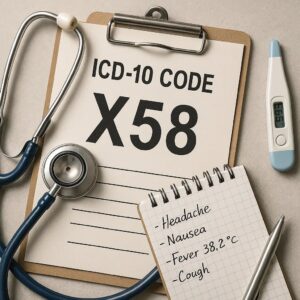
ICD-10-Code X58
2. Decoding the Classification: A Primer on the ICD-10-CM System
To fully appreciate Code X58, one must first understand the system it resides within. The ICD-10-CM is not merely a list of diseases; it is a sophisticated, hierarchical classification system used globally for morbidity (illness) and mortality (death) statistics, reimbursement systems, and public health decision-making.
The Purpose and Power of a Global Language for Disease
Developed by the World Health Organization (WHO) and adapted for clinical use in the United States, the ICD-10-CM serves several critical functions:
-
Standardization: It provides a common language that allows healthcare providers, researchers, and policymakers across the country and around the world to consistently communicate about health conditions.
-
Epidemiology and Public Health: By analyzing coded data, health agencies can track disease outbreaks, identify emerging health threats, and monitor injury trends. This data is the bedrock of preventative health campaigns.
-
Billing and Reimbursement: In the U.S., ICD-10-CM codes are directly linked to medical billing. They justify the medical necessity of services provided to insurers, including Medicare and Medicaid, determining reimbursement through systems like Diagnosis-Related Groups (DRGs).
-
Clinical Research: Researchers rely on aggregated coded data to study the effectiveness of treatments, understand the natural history of diseases, and identify risk factors for various conditions.
Structure of an ICD-10-Code: From Chapter to Extension
The ICD-10-CM is organized into 22 chapters, mostly based on body system or etiology. Codes are alphanumeric, beginning with a letter, followed by numbers. The structure can be broken down as follows:
-
Chapter: Code X58 falls within Chapter 20: External Causes of Morbidity (V00-Y99). This chapter is dedicated solely to classifying the environmental events, circumstances, and causes of injury and other health conditions. It is crucial to note that codes from Chapter 20 are supplementary and are intended to provide additional information about the cause of a condition classified elsewhere.
-
Category: The first three characters define the category. X58 is the category for “Exposure to other specified factors.”
-
Subcategory and Specificity: Many codes require additional characters (up to seven) to provide greater detail about the encounter.
3. A Deep Dive into Code X58: Exposure to Other Specified Factors
Now, let us focus our lens specifically on X58.
Official Description and Chapter Placement
-
ICD-10-CM Code: X58
-
Full Code Title: Exposure to other specified factors
-
Code Type: External cause of morbidity
-
Chapter: 20 (External Causes of Morbidity)
-
Block: Other external causes of accidental injury (W00-X58)
-
Category: This code is used to indicate an accident due to exposure to or contact with factors not covered by other, more specific codes in the ICD-10-CM classification.
The “Other Specified” Distinction: What It Encompasses and Excludes
The phrase “other specified factors” is the key to understanding this code’s scope. It acts as a catch-all for accidental exposures that are clearly defined but lack a dedicated, more precise code. Common examples include:
-
Tripping over an object on a walking surface (e.g., a toy, a curb, a loose rug).
-
Bumping into a stationary object (e.g., a door, a table, a wall).
-
Accidental contact with a sharp object not involved in a fall (e.g., a knife while washing dishes, a tool in a workshop).
-
Accidental exposure to environmental factors like a cluttered living space leading to a fall on the same level.
-
Accidental striking against another person during sports or recreational activities without intent to harm.
Crucially, X58 EXCLUDES:
-
Exposure to excessive natural heat (X30) or cold (X31): These have their own specific codes.
-
Falls from one level to another (W00-W19): A fall from a ladder or down a flight of stairs is coded differently.
-
Assault (X92-Y09): Injuries inflicted by another person with intent to harm.
-
Intentional self-harm (X71-X83): Self-inflicted injuries.
-
Transport accidents (V00-V99): Accidents involving any kind of vehicle.
The Crucial Role of the 7th Character: Encounter Specificity
Code X58 requires a 7th character to specify the type of encounter. This is a critical component for accurate coding and data tracking.
-
A: Initial encounter – Used for the first time the patient is receiving active treatment for the injury (e.g., emergency room visit, initial surgery, first doctor’s appointment).
-
D: Subsequent encounter – Used for routine follow-up care during the healing or recovery phase (e.g., cast change, physical therapy session, wound check).
-
S: Sequela – Used for complications or conditions that arise as a direct consequence of the initial injury, after the acute phase has passed (e.g., scar tissue management, chronic pain, permanent joint limitation resulting from the original accident).
Therefore, a complete, valid code would be X58.XXXA for an initial encounter.
4. Clinical Applications and Real-World Scenarios: When and How to Use X58
Understanding the theory is one thing; applying it is another. Let’s explore how X58 functions in a clinical setting through detailed case studies.
The Golden Rule: Never a Principal Diagnosis
The most important rule to remember is that an external cause code from Chapter 20, including X58, is never used as a principal (first-listed) diagnosis. It always provides supplementary information about the cause of an injury or condition that is coded from another chapter of ICD-10-CM, most often Chapter 19 (Injury, Poisoning, and Certain Other Consequences of External Causes, S00-T88).
Case Studies in Detail:
Case Study 1: The Icy Pavement – A Geriatric Hip Fracture
-
Scenario: An 82-year-old woman, Mrs. Jones, is walking to her mailbox on a cold winter morning. She slips on an icy patch on her driveway, falls, and lands on her side. She is brought to the Emergency Department via ambulance.
-
Clinical Findings: Severe pain in the right hip, shortened and externally rotated right leg. X-ray confirms a displaced intracapsular fracture of the right femoral neck.
-
Coding:
-
Principal Diagnosis: S72.011A (Displaced intracapsular fracture of right femur, initial encounter). This code comes from Chapter 19 and describes the injury itself.
-
External Cause Code: W00.0XXA (Fall on same level from slipping, tripping, and stumbling on ice and snow, initial encounter).
-
Why not X58? In this case, a more specific code exists for a fall on ice and snow. Using W00.0XXA provides richer data for public health officials tracking winter-weather-related injuries. X58 would be incorrect here because a more precise code is available.
-
Case Study 2: The Cluttered Stairwell – A Pediatric Head Injury
-
Scenario: A 6-year-old boy, Leo, is running down the carpeted stairs in his home to answer the doorbell. He trips over a backpack that was left on a middle step, falls forward, and strikes his forehead on the wooden banister.
-
Clinical Findings: A 3 cm laceration on the forehead and a mild concussion.
-
Coding:
-
Principal Diagnosis: S01.81XA (Laceration without foreign body of other part of head, initial encounter).
-
Additional Diagnosis: S06.0X0A (Concussion without loss of consciousness, initial encounter).
-
External Cause Code: X58.XXXA (Exposure to other specified factors, initial encounter).
-
Rationale for X58: This is a perfect use case for X58. The accident was not a fall from one level to another (he fell on the stairs, which is considered the same level), nor was it due to ice or a specific type of machinery. The factor was the “cluttered stairwell” or the “backpack on the step”—an “other specified factor” in his environment that led to the accident. The clinical documentation must clearly state “tripped over backpack on stairs” to justify the use of X58.
-
Case Study 3: The Slippery Supermarket Floor – A Soft Tissue Injury
-
Scenario: A 45-year-old man, Mr. Smith, is walking through a grocery store. An unmarked, recently mopped floor is wet and slippery. His feet slip out from under him, and he falls hard onto his left shoulder.
-
Clinical Findings: Pain and swelling in the left shoulder. Diagnosis: Rotator cuff tear.
-
Coding:
-
Principal Diagnosis: S46.011A (Strain of muscle(s) and tendon(s) of the rotator cuff of left shoulder, initial encounter).
-
External Cause Code: X58.XXXA (Exposure to other specified factors, initial encounter).
-
Rationale for X58: The “other specified factor” here is the “wet, slippery floor.” There is no specific ICD-10-CM code for “fall on wet floor.” Therefore, X58 is the appropriate and accurate choice to capture the cause.
-
Documentation is Key: What Clinicians Must Record
The accuracy of coding X58 rests entirely on the quality of the clinical documentation. Vague notes like “patient fell” or “injured arm” are insufficient. The medical record must explicitly describe the cause. Ideal documentation includes:
-
“Patient tripped over a loose electrical cord on the office floor.”
-
“Slipped on a wet bathroom floor and fell against the tub.”
-
“Struck knee on open dishwasher door while walking through the kitchen.”
-
“During a soccer game, accidentally collided with another player, striking head.”
This level of detail allows the coder to confidently assign X58 and provides the specific narrative that public health data analysts need.
5. The Public Health Implications: From Data to Prevention
The true power of codes like X58 is realized not in the individual patient chart, but in the aggregation of millions of such charts. When these codes are used consistently and correctly, they form a massive, real-time database on the causes of accidental injury.
How X58 and External Cause Codes Inform Safety Initiatives
Public health agencies, such as the Centers for Disease Control and Prevention (CDC) and the National Safety Council, analyze this coded data to:
-
Identify High-Risk Environments: Data might show a spike in X58-related injuries in homes among toddlers (bumping into furniture) or in retail environments among adults (slipping on floors). This directs resources toward targeted safety campaigns.
-
Develop Prevention Programs: If data reveals that a significant number of hip fractures in the elderly are coded with X58 (suggesting tripping over rugs or clutter), public health initiatives can be launched to promote “fall-proofing” homes.
-
Guide Legislation and Regulation: Data on injuries in public places can inform building codes (e.g., requirements for non-slip flooring, better lighting) and workplace safety standards (OSHA guidelines).
Analyzing Trends: A Look at Vulnerable Populations
By cross-referencing external cause codes with demographic data, we can identify which populations are most at risk. For instance, data might show that children and the elderly are disproportionately represented in X58-related injuries, but for different reasons and with different outcomes.
Common Scenarios for ICD-10-Code X58 by Age Group and Outcome
| Age Group | Common “Other Specified Factor” | Typical Injury/Condition | Public Health Insight |
|---|---|---|---|
| Toddlers (1-4) | Tripping over toys on floor; bumping into furniture corners. | Superficial head injuries (S00), forehead lacerations (S01.81). | Highlights need for child-proofing homes, padding sharp furniture corners. |
| School-Age Children (5-12) | Collisions with other children during unstructured play; tripping on playground equipment. | Contusions (S20-S29), sprains (S93), simple fractures (S52). | Informs school and playground safety protocols and supervision guidelines. |
| Adults (18-64) | Slipping on wet floors (home/commercial); tripping over clutter in workspace; striking against open cabinets or doors. | Sprains and strains of ankles/backs (S93, S33), rotator cuff injuries (S46), wrist fractures (S52). | Relevant for workplace safety and premises liability law. Informs public awareness campaigns for hazard recognition. |
| Older Adults (65+) | Tripping over loose rugs, electrical cords, or low-lying furniture; stumbling on uneven pavement. | Hip fractures (S72), traumatic brain injuries (S06), wrist fractures (S52). | Critical data for fall prevention programs targeting seniors, promoting home safety assessments, and improving community infrastructure. |
6. Navigating the Nuances: Exclusions, Inclusions, and Common Pitfalls
Accurate coding requires a meticulous understanding of the boundaries of X58.
Clear Boundaries: Differentiating X58 from Assault, Self-Harm, and Other Accidents
The coder must rely on documentation to determine intent.
-
If the record states: “Patient states he was punched in the face during a bar fight,” the external cause code would be from the Assault section (X92-Y09), not X58.
-
If the record states: “Patient states he intentionally cut his arm with a kitchen knife,” the external cause code would be from the Intentional self-harm section (X78), not X58.
-
If the record is ambiguous: “Patient presents with facial laceration after an altercation,” the coder must query the provider for clarification. The default in cases of undetermined intent is to code as an accident, but clarification is always preferred.
The Importance of Specificity: When a More Precise Code Exists
As seen in Case Study 1, the hierarchy of ICD-10-CM demands that the most specific code available be used. Coders must always check if a code exists that more directly describes the circumstance before defaulting to X58. For example:
-
A fall from a bed (W06) is more specific than X58.
-
A bite from a dog (W54) is more specific than X58.
-
A burn from a hot stove (X15) is more specific than X58.
Common Coding Errors and How to Avoid Them
-
Using X58 as a Principal Diagnosis: This is a fundamental error that will lead to claim denials.
-
Using X58 when a more specific code is available: This dilutes the value of public health data.
-
Incorrect 7th Character: Using ‘A’ for a follow-up visit or ‘D’ for the initial ER visit creates data inaccuracies.
-
Poor Documentation Leading to Assumptions: Coders should never assume the cause of an injury. If the documentation is unclear, a query to the provider is mandatory.
7. The Legal and Reimbursement Landscape
The application of X58 extends beyond clinical and public health spheres into the legal and financial realms.
The Role of External Cause Codes in Liability and Insurance Claims
In cases of injury occurring on someone else’s property (e.g., a store, a restaurant, a rental unit), the external cause code can be critical evidence. A code of X58.XXXA linked to a diagnosis of a fractured femur tells a clear story of an accidental exposure to a hazardous condition. This data can be used in personal injury lawsuits and insurance claims to establish the cause and context of the incident, supporting arguments about negligence or premises liability.
Impact on Medical Billing and Reimbursement (DRGs and Value-Based Care)
While external cause codes like X58 are not themselves tied to a specific reimbursement amount, they play a supporting role.
-
Justifying Medical Necessity: They help paint a complete picture of the patient’s condition, supporting the medical necessity of the treatments provided.
-
Risk Adjustment: In value-based care models, understanding the cause of an injury can help in risk-adjusting populations. A community with a high rate of X58-related falls in the elderly might be identified as needing more resources, which can affect population health funding and initiatives.
-
DRG Assignment: While not a direct factor, the principal diagnosis (the injury) is a key driver of DRG assignment. The external cause code provides the crucial context that can be important during audits.
8. Conclusion: Weaving the Threads of Causation for a Safer World
Code X58, “Exposure to other specified factors,” is a deceptively simple entry in the vast lexicon of ICD-10-CM. It serves as the essential narrative thread that connects a clinical injury to its environmental cause, completing the story of an accident. Its correct application relies on meticulous clinical documentation and astute coding practices, ensuring that this story is accurately told. When aggregated, these individual stories transform into a powerful chorus of public health data, illuminating hidden patterns of risk and guiding the creation of targeted, effective prevention strategies. From the cluttered home of a senior citizen to the slick floor of a grocery store, X58 helps us see the world not just as a place where injuries happen, but as a place where we can actively make them less likely to occur. It is a testament to the idea that in healthcare, understanding the “why” is just as important as treating the “what.”
9. Frequently Asked Questions (FAQs)
Q1: Can ICD-10-Code X58 be used as the first-listed diagnosis on a claim form?
A: No, absolutely not. Code X58, like all codes from Chapter 20 (External Causes of Morbidity), is strictly supplemental. The first-listed diagnosis must always be the condition or injury itself, typically coded from Chapter 19 (Injury and Poisoning) or another relevant chapter.
Q2: What is the difference between a fall code from W00-W19 and X58?
A: The codes in W00-W19 are for falls and specify the type of fall (e.g., on ice, from a ladder, from a bed). X58 is for exposure to a factor that leads to an accident. If a patient trips over a rug (the factor) and falls, X58 is used. If a patient slips on ice and falls, the more specific W00.0- code is used. X58 is often the correct code for a “fall on the same level” where the specific cause isn’t a slip on ice or snow.
Q3: How many external cause codes can I use with one injury?
A: You can use as many as are needed to fully describe the event. However, for most simple accidents described by X58, one external cause code is sufficient. For a complex event (e.g., a car accident (V-code) caused by a deer collision (W-code)), multiple external cause codes might be necessary to capture the full picture.
Q4: What happens if the clinical documentation does not specify the cause of the injury?
A: If the documentation is vague (e.g., “patient fell,” “status post injury”), the coder cannot assume an external cause. In such cases, an external cause code should not be assigned. The best practice is for the coder to query the provider to obtain the specific details needed for accurate coding.
Q5: Is X58 used for poisoning or adverse effects of medications?
A: No. Poisonings and adverse effects are coded in the T36-T50 categories with the substance as the first-listed diagnosis. External cause codes for these events are found in the X40-X49 range (Accidental poisoning by and exposure to noxious substances).
10. Additional Resources
For further information and to ensure you are using the most current codes and guidelines, please consult these authoritative sources:
-
Centers for Disease Control and Prevention (CDC) – ICD-10-CM: The CDC’s National Center for Health Statistics is the official U.S. government source for the ICD-10-CM guidelines and files.
-
World Health Organization (WHO) – ICD: The international home of the ICD classification system.
-
American Health Information Management Association (AHIMA): The premier professional association for medical coders and health information management professionals. Offers extensive resources, training, and updates on coding standards.
-
Link: https://www.ahima.org/
-
-
American Academy of Professional Coders (AAPC): A leading professional organization for medical coders, providing certification, education, and networking opportunities.
-
Link: https://www.aapc.com/
-
-
National Safety Council (NSC): Provides data and resources on injury prevention, which often relies on the kind of data captured by external cause codes like X58.
-
Link: https://www.nsc.org/
-
Disclaimer: This article is intended for informational and educational purposes only. It is not a substitute for professional medical advice, diagnosis, or treatment. The coding information provided is based on the 2025 ICD-10-CM code set and is subject to change. Always seek the advice of a qualified healthcare provider or certified medical coder with any questions you may have regarding a medical condition or proper coding procedures. The author and publisher are not responsible for any errors or omissions or for any outcomes resulting from the use of this information.
Date: November 05, 2025
Author: The Public Health Scribe