A foot X-ray is more than a black-and-white image; it is a story. It tells a tale of a misstep off a curb, the relentless progression of arthritis, or the complex complications of a systemic disease like diabetes. But for this story to be understood by the healthcare system—for it to justify medical necessity, facilitate accurate reimbursement, and contribute to vital health data—it must be translated into a precise and universal language. This language is the International Classification of Diseases, Tenth Revision, Clinical Modification (ICD-10-CM).
The process of ordering and interpreting a foot X-ray represents a critical intersection between clinical medicine and administrative science. A radiologist can identify a Jones fracture with expert precision, but if the corresponding ICD-10 code is inaccurate, incomplete, or lacks the required specificity, the entire clinical encounter is jeopardized. Insurance claims may be denied, audit flags may be raised, and the patient may be caught in a frustrating cycle of billing inquiries. This article serves as a definitive guide for radiologists, podiatrists, orthopedists, medical coders, and healthcare administrators who seek to master the art and science of ICD-10 coding for foot radiographs. We will move beyond simple code lists and delve into the clinical reasoning, documentation requirements, and nuanced guidelines that separate adequate coding from exemplary coding. By the end of this exploration, you will not only know which code to use but, more importantly, why it is the correct code, ensuring that the clinical story of the foot is told accurately and completely.
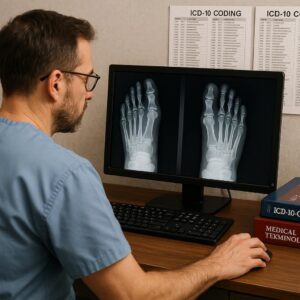
ICD-10 coding for foot radiographs
Table of Contents
ToggleChapter 1: Demystifying the Fundamentals – Why Foot X-Rays are Ordered
Before a single code can be assigned, one must understand the clinical rationale behind the imaging study. A foot X-ray is not ordered at random; it is a targeted investigation prompted by patient history and physical examination findings.
The Clinical Decision Pathway: Mechanism of Injury and Symptomatology
The decision to image the foot follows a logical pathway. For trauma, the mechanism of injury is paramount. A direct blow, a twisting inversion or eversion injury, a fall from height, or a “crush” injury each suggests damage to different anatomical structures. Similarly, the nature of the patient’s symptoms—localized pain, swelling, ecchymosis (bruising), inability to bear weight, deformity, or crepitus (a grating sound or feeling)—guides the clinician’s suspicion.
For non-traumatic conditions, the history focuses on the onset, duration, and character of the pain. Is it worse in the morning (suggesting inflammatory arthritis) or after activity (suggesting a mechanical or degenerative issue)? Are there associated symptoms like numbness, tingling, or skin changes? This clinical context is not just background information; it is the very foundation upon which the radiologic indication and, consequently, the medical code, are built.
Common Indications for Foot Radiography: A Clinical Overview
Foot X-rays, typically consisting of multiple views (e.g., anteroposterior, lateral, and oblique), are requested for a wide array of reasons, including but not limited to:
-
Acute Trauma: To rule out or confirm fractures, dislocations, and subluxations following an injury.
-
Chronic Pain: To evaluate for stress fractures, degenerative joint disease (osteoarthritis), or osteochondral defects.
-
Deformity Assessment: To diagnose and monitor conditions like pes planus (flatfoot), pes cavus (high arch), hallux valgus (bunion), or hammertoes.
-
Infection: To identify osteomyelitis (bone infection) or septic arthritis, often in diabetic patients or those with compromised immunity.
-
Inflammatory Arthritis: To assess for characteristic changes of rheumatoid arthritis, gout, or psoriatic arthritis, such as joint space narrowing, erosions, and tophi.
-
Pre- and Post-Operative Evaluation: To plan for surgical intervention (e.g., bunionectomy, fusion) and to assess alignment, hardware position, and healing post-operatively.
-
Foreign Body Detection: To locate radiopaque objects like glass or metal embedded in the soft tissues.
(Image Suggestion: A clinical flowchart titled “Decision to Order a Foot X-Ray” with decision points like “Trauma? -> Yes -> Unable to Bear Weight? -> Yes -> Order X-ray” and “No Trauma -> Chronic Pain -> Pain Localized to Heel? -> Yes -> Suspect Plantar Fasciitis, consider X-ray to rule out spur.”)
Chapter 2: A Deep Dive into the ICD-10-CM Code Set – Structure and Philosophy
ICD-10-CM is not a simple list of diseases; it is a highly detailed, multi-axial classification system. Understanding its underlying philosophy is key to using it correctly.
Beyond Diagnosis: The Specificity Mandate
The primary driver of ICD-10, compared to its predecessor ICD-9, is specificity. It demands a level of detail that paints a complete clinical picture. For a foot fracture, it’s no longer sufficient to code “fracture of foot.” The coder must identify:
-
The specific bone: Fifth metatarsal, talus, calcaneus, etc.
-
The laterality: Left, right, or bilateral.
-
The type of encounter: Initial, subsequent, or sequela.
-
The fracture type: Displaced, non-displaced, open, closed, etc. (though this is often captured in the CPT code for the radiologist’s report, the diagnosis code may also reflect it).
The Importance of Laterality (Left, Right, Bilateral)
Nearly all ICD-10 codes for musculoskeletal conditions are laterality-specific. Using an unspecified code when the laterality is known is considered inaccurate and can lead to claim denials. For example:
-
S92.311A – Displaced fracture of first metatarsal bone, right foot, initial encounter for closed fracture.
-
S92.312A – Displaced fracture of first metatarsal bone, left foot, initial encounter for closed fracture.
-
S92.319A – Displaced fracture of first metatarsal bone, unspecified foot, initial encounter for closed fracture.
The “unspecified” code should only be used if the documentation is genuinely ambiguous about which foot is affected.
Understanding the 7th Character: The Episode of Care Identifier
For injury codes (Chapter 19, codes starting with S and T), a 7th character extension is required to define the episode of care. This is a critical component that is often missed. The common 7th characters are:
-
A – Initial encounter: Used for active treatment of the injury. This could be in the emergency department, an orthopedic clinic, or even at the initial radiological encounter to diagnose the fracture. It does not mean the patient has never been treated for it before; it means they are receiving active treatment for this specific encounter.
-
D – Subsequent encounter: Used for routine healing and aftercare. This includes encounters for cast change or removal, removal of internal or external fixation device, medication adjustment, and follow-up X-rays to monitor healing.
-
S – Sequela: Used for complications or conditions that arise as a direct consequence of the initial injury. Examples include malunion, nonunion, chronic pain, or joint instability resulting from an old fracture.
Understanding the 7th Character for Injury Codes
| 7th Character | Encounter Type | Clinical Scenario Examples | Appropriate for X-Ray? |
|---|---|---|---|
| A (Initial) | Active Treatment | Patient presents to ED with acute pain after injury. X-ray is performed to diagnose a fracture. Patient sees orthopedist for the first time for a recently diagnosed fracture. | Yes |
| D (Subsequent) | Routine Healing / Aftercare | Patient returns for a follow-up X-ray in 6 weeks to check fracture healing. Patient presents for removal of a surgical pin. | Yes |
| S (Sequela) | Complication / Late Effect | Patient presents months or years later with post-traumatic arthritis in the joint near the old fracture site. X-ray is ordered to assess the arthritic changes. | Yes |
Chapter 3: Coding Traumatic Injuries of the Foot – Fractures, Dislocations, and Sprains
This is one of the most common reasons for foot X-rays and requires meticulous coding.
Fractures of the Ankle and Malleoli (S82.-)
It is crucial to distinguish between an ankle fracture and a foot fracture. The ankle joint technically includes the distal tibia, distal fibula, and the talus. Codes in the S82 category are for fractures of the lower leg, including the ankle, but careful attention must be paid to the specific bone.
-
S82.84- – Fracture of medial malleolus
-
S82.85- – Fracture of lateral malleolus
These are often imaged with the foot, but anatomically, they are considered part of the ankle.
Fractures of the Toe(s) (S92.-)
This category covers fractures of the phalanges (toe bones).
-
S92.1- – Fracture of toe(s): This block is further specified by the toe (e.g., S92.11- for great toe, S92.12- for lesser toes) and the phalanx involved (proximal, distal, etc.).
Other and Unspecified Fractures of the Foot (S92.8-, S92.9-)
This is where the most common foot fractures are found.
-
S92.0- – Fracture of calcaneus: The heel bone. Often from a fall from height.
-
S92.1- – Fracture of talus: A key bone in the ankle joint.
-
S92.2- – Fracture of other tarsal bones: Navicular, cuboid, cuneiforms.
-
S92.3- – Fracture of metatarsal bone(s): This is a frequently used code block. It is essential to specify which metatarsal (e.g., S92.31- for first metatarsal, S92.32- for second, etc.). A very specific and common code is S92.35- – Fracture of fifth metatarsal, which includes the classic Jones fracture (at the metaphyseal-diaphyseal junction).
-
S92.5- – Fracture of foot, unspecified: A code of last resort when the documentation is unclear.
Dislocations, Sprains, and Strains (S93.-)
These codes are for injuries to the joints and ligaments.
-
S93.1- – Dislocation of toe
-
S93.3- – Dislocation of foot: This includes subtalar, midtarsal, and other tarsal joint dislocations.
-
S93.4- – Sprain of ankle: This is a very common code. It requires laterality and a 7th character.
-
S93.6- – Sprain of foot: For sprains of the joints within the foot itself, like the Lisfranc joint complex.
Case Studies: Applying Trauma Codes in Real-World Scenarios
-
Case 1: The Weekend Warrior
-
Scenario: A 45-year-old male twists his right ankle while playing basketball. He presents to Urgent Care with pain and swelling on the outer side of his foot. He is tender over the base of the 5th metatarsal. An X-ray is ordered.
-
Radiologist’s Report: “Non-displaced avulsion fracture of the base of the fifth metatarsal, right foot.”
-
Correct ICD-10 Code: S92.351A (Fracture of fifth metatarsal bone, right foot, initial encounter for closed fracture).
-
-
Case 2: The Post-Treatment Follow-Up
-
Scenario: The same patient returns to the orthopedist 4 weeks later for a follow-up evaluation. A repeat X-ray is ordered to assess callus formation and healing.
-
Correct ICD-10 Code: S92.351D (Fracture of fifth metatarsal bone, right foot, subsequent encounter for fracture with routine healing).
-
-
Case 3: The Crush Injury
-
Scenario: A construction worker drops a heavy object on his left foot. He has significant swelling and pain in the forefoot. An X-ray reveals fractures of the 2nd and 3rd toes.
-
Correct ICD-10 Codes: S92.125A (Fracture of proximal phalanx of lesser toe(s), left foot, initial encounter) and S92.135A (Fracture of distal phalanx of lesser toe(s), left foot, initial encounter). Multiple codes are used to fully describe the injuries.
-
*(Image Suggestion: An annotated foot X-ray pointing to common fracture sites: Calcaneus, Talus, 5th Metatarsal Base (Jones Fracture), Metatarsal Shaft, and Phalanges.)*
Chapter 4: Coding for Degenerative, Inflammatory, and Acquired Conditions
When trauma is not the cause, coding shifts to Chapter 13, Diseases of the Musculoskeletal System and Connective Tissue (M00-M99).
Osteoarthritis and Post-Traumatic Arthropathy (M19.07-, M19.17-, M19.27-)
Osteoarthritis (OA) is a wear-and-tear arthritis. The codes are highly specific.
-
M19.07 – Primary osteoarthritis, ankle and foot: Used for generalized OA affecting the foot.
-
M19.17 – Post-traumatic osteoarthritis, ankle and foot: Used when the arthritis is a direct result of a prior injury (a sequela). This would be linked to the old trauma.
-
M19.27 – Secondary osteoarthritis, ankle and foot: Used when the arthritis is due to another pre-existing condition, such as obesity, congenital deformity, or other diseases.
Acquired Deformities of the Toe and Foot (M20.-, M21.5-, M21.6-)
These codes are for conditions that have developed over time.
-
M20.1- – Hallux valgus (bunion): Requires laterality.
-
M20.3- – Hallux varus
-
M20.4- – Other hammer toe(s): e.g., Mallet toe, claw toe.
-
M20.5- – Other deformities of toe:
-
M21.5- – Pes planus (flat foot): Can be acquired or congenital.
-
M21.6- – Other acquired deformities of foot: Such as pes cavus.
Plantar Fasciitis and Other Enthesopathies (M72.2)
Plantar fasciitis is one of the most common causes of heel pain.
-
M72.2 – Plantar fascial fibromatosis: This is the code for plantar fasciitis. It is not laterality-specific. A single code is used regardless of which foot is affected.
The Diabetic Foot: A Complex Coding Scenario (E11.5-)
Coding for a diabetic foot X-ray is a two-step process that often involves multiple codes. The underlying systemic disease must be coded first, followed by the manifestation.
-
Primary Code: E11.5- – Type 2 diabetes mellitus with circulatory complications. The 5th digit specifies the nature of the complication (e.g., E11.51 for diabetic peripheral angiopathy, E11.52 for diabetic neuropathy).
-
Secondary Code(s): The reason for the X-ray. This could be:
-
M21.6- – Acquired deformity of foot (if Charcot foot is suspected/confirmed).
-
M86.07- – Acute osteomyelitis of ankle and foot (if bone infection is present).
-
L97.5- – Non-pressure chronic ulcer of other part of foot (if an ulcer is present, with codes for severity).
-
S93.6- – Sprain of foot (if there was a minor trauma the patient didn’t feel due to neuropathy).
-
-
Example: A diabetic patient with neuropathy presents for an X-ray due to a red, swollen, deformed foot (suspected Charcot arthropathy).
-
Codes: E11.51 (Type 2 diabetes with diabetic peripheral angiopathy), M21.671 (Other acquired deformities of right foot).
-
Chapter 5: Postprocedural and Follow-Up Imaging – The “Z” Codes and Beyond
After surgery or treatment, the reason for imaging shifts from diagnosis to monitoring. Chapter 21 (Z00-Z99) covers factors influencing health status and contact with health services.
Aftercare Following Surgery (Z47.89, Z48.81-)
These codes are used for encounters specifically for orthopedic aftercare.
-
Z47.89 – Other orthopedic aftercare: This is a broad code for follow-up care after an orthopedic procedure, such as checking healing after a fracture repair. It is often used as the primary code for a follow-up X-ray.
-
Z48.81- – Encounter for surgical aftercare following surgery on the musculoskeletal system: This is more specific to surgical aftercare.
Follow-Up Examination (Z09)
This code is used for a follow-up examination after a condition has been treated and resolved, to ensure it has not recurred. It is less common for routine fracture healing.
Encounter for Radiological Examination (Z01.89)
This code is used when a patient is undergoing a radiological exam in the absence of any signs, symptoms, or known diagnosis. This is rare for a foot X-ray, as there is almost always a clinical indication. It might be used for a pre-employment physical or a research study.
Chapter 6: The Nuances of Signs, Symptoms, and Unspecified Codes
There are times when a definitive diagnosis is not available at the time of the X-ray. In these cases, codes for signs and symptoms from Chapter 18 are appropriate.
When a Definitive Diagnosis is Elusive (R26.-, R29.-, M79.67-)
-
R26.- – Abnormalities of gait and mobility: If the patient’s chief complaint is difficulty walking.
-
R29.3 – Abnormal posture: Could be used if the patient is holding the foot in an abnormal position.
-
R29.898 – Other symptoms and signs involving the musculoskeletal system: A general code for pain or swelling.
-
M79.67- – Pain in foot and toes: This is a more specific code for pain and is laterality-specific. It is often the best code when pain is the only documented reason for the study.
The Responsible Use of “Unspecified” Codes
Unspecified codes (e.g., S92.90- for Unspecified fracture of foot) are valid and necessary. They should be used when:
-
The clinical information in the record is insufficient to support a more specific code.
-
The condition is still “working” and a definitive diagnosis has not been established.
The goal, however, is to minimize their use through clear and complete documentation from the provider.
Chapter 7: A Practical Guide for Coders and Providers – Ensuring Compliance and Reimbursement
Accuracy in medical coding is a shared responsibility between the healthcare provider and the coder.
The Provider’s Role: Documentation is Everything
The radiologist’s and referring clinician’s documentation is the source of truth. It must be clear, consistent, and specific. Key elements include:
-
Laterality: Always state “left” or “right.”
-
Specific Anatomical Site: “Base of the 5th metatarsal,” “neck of the talus,” “proximal phalanx of the great toe.”
-
Definitive Diagnosis: When possible, provide a specific diagnosis (e.g., “Jones fracture,” “moderate hallux valgus,” “Charcot deformity”).
-
Clinical History: The reason for the study must be clear in the report to support medical necessity.
The Coder’s Role: Querying for Clarity
When documentation is ambiguous, the coder’s responsibility is to query the provider. A query is a formal request for clarification. For example: “The report states ‘fracture of the medial foot.’ Can you clarify if this is the navicular bone or the first cuneiform to ensure accurate coding?”
Avoiding Common Denials: A Checklist
-
Is the code to the highest level of specificity?
-
Has laterality been assigned correctly?
-
For injuries, is the correct 7th character (A, D, S) appended?
-
Does the diagnosis code on the claim match the diagnosis in the radiology report?
-
Is there a clear link between the diagnosis code and the medical necessity for the X-ray?
Chapter 8: The Future of Coding – ICD-11 and the Role of AI
The world of medical classification is evolving. The World Health Organization (WHO) has already released ICD-11, which features a more logical, digital-friendly structure. While the US has not yet set a timeline for adoption, it represents the future. It includes more detailed codes for anatomy and etiology, which could further streamline the coding process for radiology.
Furthermore, Artificial Intelligence (AI) and Natural Language Processing (NLP) are beginning to play a role. AI tools can read radiology reports and suggest appropriate ICD-10 codes, reducing manual effort and potential human error. However, these tools are aids, not replacements, for the skilled coder who understands clinical context and coding guidelines.
Conclusion
Mastering ICD-10 coding for foot X-rays is an exercise in precision and clinical understanding. It requires a symbiotic relationship between detailed provider documentation and knowledgeable coder interpretation. By moving beyond memorization to a deeper comprehension of the code set’s structure—embracing specificity, laterality, and the episode of care—healthcare professionals can ensure that every diagnostic image is backed by a code that accurately tells the patient’s story, safeguards revenue, and upholds the highest standards of data integrity.
Frequently Asked Questions (FAQs)
Q1: What is the most important thing to remember when coding for a foot X-ray?
A: The single most important factor is specificity. Always code to the highest level of detail documented in the patient’s record regarding the diagnosis, laterality, and encounter type.
Q2: My provider’s note just says “foot pain” as the reason for the X-ray. What code should I use?
A: In the absence of a more specific diagnosis, you should use a symptom code. The most appropriate is M79.67- (Pain in foot and toes), making sure to assign the correct laterality (e.g., M79.671 for right foot pain).
Q3: What is the difference between the initial (A) and subsequent (D) 7th character? When do I use each?
A: Use ‘A’ for the encounter where the patient is receiving active, initial treatment for the injury (e.g., the first time it’s being diagnosed or treated). Use ‘D’ for all follow-up encounters focused on routine healing and aftercare (e.g., a repeat X-ray to check on healing, cast removal). The ‘A’ is for the active phase; the ‘D’ is for the healing/monitoring phase.
Q4: How do I code for a follow-up X-ray after a bunion surgery?
A: The primary code would typically be a Z code for aftercare. The most appropriate is Z47.89 (Other orthopedic aftercare). You would not use the code for the bunion (M20.1-) again, as the encounter is for monitoring the post-surgical state, not for the disease itself.
Q5: Can I use an “unspecified” code if I’m in a hurry or the documentation is a little unclear?
A: No. Using an unspecified code should be a last resort, not a convenience. If the documentation is unclear, the standard of practice is to query the provider for clarification. Using an unspecified code when a specific one is available or can be obtained can lead to claim denials and audits.
Additional Resources
-
The Official ICD-10-CM Guidelines for Coding and Reporting: Published annually by the CDC and CMS. This is the definitive rulebook.
-
American Health Information Management Association (AHIMA): Offers a wealth of resources, webinars, and practice guidance for medical coders.
-
American Academy of Professional Coders (AAPC): Provides certification, training, and industry updates for coding professionals.
-
American College of Radiology (ACR) Practice Parameters and Technical Standards: Offers clinical guidelines for radiologists, which often include information on appropriate indications for imaging.
-
CDC ICD-10-CM Official Website: https://www.cdc.gov/nchs/icd/icd-10-cm.htm (For the most current code set and files).
Date: November 05, 2025
Author: Medical Coding & Radiology Insights Team
Disclaimer: This article is for informational and educational purposes only and is intended for healthcare professionals. It does not constitute medical, coding, or legal advice. The ultimate responsibility for selecting accurate and appropriate ICD-10-CM codes lies with the healthcare provider, based on a complete and thorough review of the patient’s medical record and official coding guidelines. Always consult the most current, official ICD-10-CM code set and payer-specific policies.