Peripheral neuropathy is a silent epidemic, affecting millions worldwide. It is not a single disease but a manifestation of nerve damage that can arise from a staggering array of causes—from the common, like diabetes and vitamin deficiencies, to the rare, like genetic disorders and autoimmune attacks. Its symptoms are a language of distress from the nervous system: a persistent tingling in the feet, a burning pain that flares in the night, a disturbing numbness that makes walking feel like moving through cotton wool, or a devastating muscle weakness that leads to falls and loss of independence.
In the complex ecosystem of modern healthcare, accurately diagnosing this condition is only the first step. The next, equally critical step is to translate that diagnosis into a precise, universal language that can be understood by insurers, researchers, and public health officials. This is the world of medical coding, and for peripheral neuropathy, the standard lexicon is the International Classification of Diseases, Tenth Revision, Clinical Modification (ICD-10-CM).
This article serves as a definitive guide to mastering the ICD-10 codes for peripheral neuropathy. We will move beyond simple code lists and delve into the why behind the codes, exploring the anatomy and pathology of neuropathy to build a foundational understanding. We will navigate the intricate structure of the ICD-10-CM system, unraveling its logic and highlighting the common pitfalls that can lead to denied claims or inaccurate data. Our journey will be detailed, professional, and designed to equip clinicians, medical coders, students, and healthcare administrators with the knowledge to accurately capture the full clinical picture of this challenging condition. By mastering this “language of codes,” we not only ensure proper reimbursement but also contribute to a clearer, more comprehensive understanding of peripheral neuropathy itself.
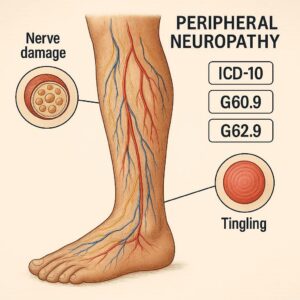
ICD-10 codes for peripheral neuropathy
2. Understanding the Terrain: What is Peripheral Neuropathy?
Before we can assign a code, we must first understand what we are coding. Peripheral neuropathy is a term that describes damage to or disease affecting the peripheral nerves.
The Vast Network of the Peripheral Nervous System
The nervous system is divided into two main parts: the central nervous system (CNS), comprising the brain and spinal cord, and the peripheral nervous system (PNS), which includes all the nerves that lie outside the CNS. Imagine the CNS as the central command headquarters, and the PNS as the vast network of communication cables that connect headquarters to every other part of the body—the limbs, organs, skin, and muscles.
These peripheral nerves are categorized by their function:
-
Sensory Nerves: Carry sensations from the skin and muscles to the brain (e.g., touch, temperature, pain, vibration).
-
Motor Nerves: Carry commands from the brain to the muscles to control movement.
-
Autonomic Nerves: Regulate involuntary body functions like heart rate, blood pressure, digestion, and bladder control.
Damage to any of these types of nerves results in distinct symptom profiles.
Mechanisms of Damage: How Nerves are Injured
Neuropathy can occur through several mechanisms:
-
Axon Degeneration: The most common pattern. The long, thread-like part of the nerve cell (the axon) deteriorates, often starting at the farthest points from the body (hands and feet). This is typical in metabolic neuropathies like diabetes.
-
Demyelination: The protective fatty coating (myelin sheath) around the axon is damaged, severely slowing or blocking the transmission of nerve signals. This is seen in conditions like Guillain-Barré syndrome.
-
Neuronopathy: The nerve cell body itself is damaged or dies.
A Spectrum of Symptoms: From Numbness to Debilitating Pain
The symptoms of peripheral neuropathy are as varied as its causes, but they often follow predictable patterns:
-
Sensory Symptoms: Numbness, tingling (“pins and needles”), burning, stabbing, or electric-shock-like pain. Patients may experience a loss of sensation, making them unaware of injuries, or allodynia, where a light touch is perceived as painful.
-
Motor Symptoms: Muscle weakness, cramps, fasciculations (muscle twitching), and loss of dexterity. In severe cases, this can lead to foot drop (inability to lift the front of the foot) and muscle atrophy.
-
Autonomic Symptoms: These are often overlooked but can be severe. They include dizziness upon standing (orthostatic hypotension), constipation or diarrhea, sweating abnormalities, and sexual dysfunction.
The pattern of nerve involvement is also diagnostically critical:
-
Polyneuropathy: The most common pattern, where multiple nerves are affected symmetrically, typically starting in the feet and hands (a “stocking-and-glove” distribution).
-
Mononeuropathy: A single nerve is affected. Carpal tunnel syndrome (median nerve) is a classic example.
-
Mononeuropathy Multiplex: Two or more individual nerves are affected in different areas.
-
Radiculopathy: Damage to a nerve root as it exits the spinal cord.
3. The Critical Role of ICD-10 Coding in Neuropathy Care
ICD-10 coding is far more than a bureaucratic requirement for billing. It is a critical infrastructure of modern medicine.
Beyond Billing: Coding as a Tool for Public Health and Clinical Insight
Accurate ICD-10 coding for peripheral neuropathy serves several vital functions:
-
Reimbursement and Revenue Cycle: Accurate codes are essential for healthcare providers to receive appropriate payment from insurance companies. Incorrect or nonspecific codes lead to claim denials, delays, and financial losses.
-
Epidemiological Research: Public health officials use aggregated coded data to track the prevalence and incidence of peripheral neuropathy. They can identify trends, such as a rise in neuropathy cases linked to the diabetes epidemic or a cluster of toxic neuropathies.
-
Clinical Trials and Drug Development: Pharmaceutical companies rely on accurate coding to identify potential participants for clinical trials for new neuropathic pain medications or treatments for specific neuropathies.
-
Quality Measurement and Outcomes Tracking: Healthcare systems use coded data to measure the quality of care. For example, they can track how often patients with diabetic polyneuropathy receive recommended foot exams.
-
Population Health Management: By analyzing coded data, health systems can identify patient populations at high risk for complications from neuropathy and target outreach and preventive care programs.
The Financial and Legal Imperative of Accurate Coding
Using an incorrect or unspecified ICD-10 code is not just a minor error. It can have serious consequences:
-
Claim Denials: Insurers may deny claims if the code does not accurately reflect the documented medical necessity for services rendered.
-
Audits and Penalties: Both public (Medicare/Medicaid) and private insurers conduct audits. If a pattern of inaccurate coding is found, providers may face substantial financial penalties, recoupment of payments, and even legal action under fraud and abuse statutes like the False Claims Act.
-
Incomplete Patient Record: An imprecise code in the electronic health record (EHR) creates an inaccurate clinical picture for future providers who care for the patient.
4. Navigating the ICD-10-CM Code Set: A Structured Approach
The ICD-10-CM code set is organized logically, primarily by body system and disease etiology. For peripheral neuropathy, the codes are predominantly found in two chapters:
-
Chapter 6: Diseases of the Nervous System (G00-G99)
-
Chapter 4: Endocrine, Nutritional and Metabolic Diseases (E00-E90)
The key to accurate coding is understanding the relationship between these chapters.
The G Series: The Primary Home for Neuropathic Diagnoses
Most codes for the neuropathic conditions themselves are found in the G60-G64 range. These codes describe the type of neuropathy.
-
G60-G64: These blocks cover hereditary, idiopathic, inflammatory, and other specific types of polyneuropathy.
The E Series: The Crucial Link to Underlying Systemic Diseases
Many peripheral neuropathies are manifestations of an underlying systemic disease. The codes for these underlying conditions are found elsewhere in the ICD-10-CM manual, most notably in the E series for endocrine diseases.
-
E08-E13: Diabetes mellitus codes. The etiology of the neuropathy (e.g., diabetes) is coded from this chapter.
The most critical concept in coding neuropathies with a known cause is the use of the G63 code block.
5. A Deep Dive into Common Peripheral Neuropathy Codes
Let’s explore the specific code categories in detail.
G60.-: Hereditary and Idiopathic Neuropathies
This category is for neuropathies that are inherited or for which no cause can be found (idiopathic).
-
G60.0: Hereditary motor and sensory neuropathy (HMSN): This is the code for Charcot-Marie-Tooth disease, a common inherited neurological disorder.
-
G60.1: Refsum’s disease: A rare genetic disorder that causes neuropathy, among other symptoms.
-
G60.3: Idiopathic progressive neuropathy: Used when a neuropathy is getting worse but no cause is identified.
-
G60.8: Other hereditary and idiopathic neuropathies: Includes Dejerine-Sottas disease and other specified types.
-
G60.9: Hereditary and idiopathic neuropathy, unspecified: A less specific code to be used only if more detailed information is unavailable.
G61.-: Inflammatory Polyneuropathies
These are neuropathies caused by an inflammatory, often autoimmune, process.
-
G61.0: Guillain-Barré syndrome: An acute, rapidly progressing, and potentially life-threatening condition where the body’s immune system attacks the peripheral nerves. It often follows an infection.
-
G61.1: Serum neuropathy: Neuropathy resulting from exposure to foreign serum.
-
G61.81: Chronic inflammatory demyelinating polyneuritis (CIDP): A chronic, acquired autoimmune neuropathy that shares features with Guillain-Barré but has a slower, relapsing course.
-
G61.89: Other inflammatory polyneuropathies
-
G61.9: Inflammatory polyneuropathy, unspecified
G62.-: Other Polyneuropathies
This is a crucial category for neuropathies caused by external agents or specific circumstances.
-
G62.0: Drug-induced polyneuropathy: One of the most important codes in this section. It is used for neuropathy caused by medications. Coding Note: You must also use an additional code from the T36-T50 series (with fifth or sixth character 5) to identify the causative drug. For example, chemotherapy drugs are a common cause.
-
G62.1: Alcoholic polyneuropathy: Used for neuropathy directly attributable to chronic alcohol use.
-
G62.2: Polyneuropathy due to other toxic agents: For exposure to heavy metals (e.g., lead, arsenic) or industrial solvents. Again, an additional code from the T51-T65 series is needed to identify the toxic agent.
-
G62.81: Critical illness polyneuropathy: Often seen in patients in the ICU with sepsis and multiple organ failure.
-
G62.82: Radiation-induced polyneuropathy
-
G62.89: Other specified polyneuropathies
-
G62.9: Polyneuropathy, unspecified: This is a “wastebasket” code to be used as a last resort when the type of polyneuropathy is not documented. Its use is discouraged as it lacks specificity.
G63.-: Polyneuropathy in Diseases Classified Elsewhere
This is arguably the most important code block for clinical coders. G63 is used to indicate that the polyneuropathy is a manifestation of an underlying disease that is coded in another chapter of ICD-10-CM. It is never used alone.
Common G63 Coding Scenarios
| Underlying Disease | Primary Disease Code | Associated Neuropathy Code | Full Code Combination |
|---|---|---|---|
| Diabetes Mellitus | E11.9 (Type 2 DM) | G63.2 (Polyneuropathy in diabetes) | E11.42 (Type 2 DM with polyneuropathy) |
| Hypothyroidism | E03.9 | G63.3 (Polyneuropathy in endocrine diseases) | E03.9 & G63.3 |
| Neoplasm (Cancer) | C25.9 (Pancreatic cancer) | G63.1 (Polyneuropathy in neoplastic disease) | C25.9 & G63.1 |
| Chronic Kidney Disease | N18.9 (CKD) | G63.4 (Polyneuropathy in renal disease) | N18.9 & G63.4 |
| Nutritional Deficiency | E53.9 (B12 deficiency) | G63.5 (Polyneuropathy in nutritional deficiencies) | E53.9 & G63.5 |
| Systemic Lupus | M32.9 (SLE) | G63.6 (Polyneuropathy in connective tissue disorders) | M32.9 & G63.6 |
-
Important Note for Diabetes: For diabetic peripheral neuropathy, the coding has been streamlined. You will typically use a combination code from the E08-E13 series that includes the manifestation. For example, E11.42 means “Type 2 diabetes mellitus with diabetic polyneuropathy.” This single code replaces the need to code E11.9 and G63.2 separately. Always check the Alphabetic Index under “Diabetes, with, polyneuropathy” for the most current combination codes.
G64.-: Other Disorders of Peripheral Nervous System
This is a residual category for peripheral nerve disorders that don’t fit elsewhere.
-
G64.9: Disorder of peripheral nervous system, unspecified
Mononeuropathies: The Focal Point of Injury
Mononeuropathies are coded from the G56-G58 series. These codes are highly specific to the nerve involved and, often, the laterality (left or right).
-
G56.0-: Carpal tunnel syndrome: Requires a 5th digit to specify laterality.
-
G56.01: Right
-
G56.02: Left
-
G56.03: Bilateral
-
-
G56.1-: Other lesions of median nerve
-
G57.5-: Tarsal tunnel syndrome
-
G54.-: Nerve root and plexus disorders: This includes brachial and lumbosacral plexopathies and radiculopathies (e.g., G54.1 for lumbosacral plexopathy).
6. The Art and Science of Specificity: Laterality, Severity, and Manifestations
ICD-10-CM demands a level of detail that was not required in previous coding systems.
The Importance of Laterality (Left, Right, Bilateral)
For mononeuropathies and many other conditions, you must specify which side of the body is affected.
-
If the documentation states “left carpal tunnel syndrome,” you must use G56.02.
-
If the documentation does not specify laterality, the default is the unspecified code (e.g., G56.00 for carpal tunnel syndrome, unspecified side). However, a provider query is always best practice to clarify.
Documenting the Type and Severity of Pain
Neuropathic pain is a common and debilitating symptom. While the primary neuropathy code often implies pain, you can add an additional code to specify the type of pain.
-
G89.0: Central pain syndrome
-
G89.2: Chronic pain
-
G89.4: Chronic pain syndrome
-
G90.5: Complex Regional Pain Syndrome (CRPS) Type I
-
G56.4: Causalgia (CRPS Type II)
The clinician’s documentation of “chronic neuropathic pain” or “causalgia” allows for this greater specificity.
7. Practical Coding Scenarios: From Patient Chart to Accurate Code
Let’s apply this knowledge to real-world examples.
Scenario 1: Diabetic Peripheral Polyneuropathy
-
Clinical Documentation: “Patient with long-standing type 2 diabetes presents for follow-up. Reports worsening bilateral numbness and burning pain in the feet, consistent with his known diabetic peripheral polyneuropathy.”
-
Coding Process:
-
Look up “Diabetes, with, polyneuropathy” in the Alphabetic Index. It directs you to E11.42.
-
Verify in the Tabular List: E11.42 is valid and means “Type 2 diabetes mellitus with diabetic polyneuropathy.”
-
-
Final Code(s): E11.42
Scenario 2: Chemotherapy-Induced Neuropathy
-
Clinical Documentation: “Patient undergoing treatment for ovarian cancer with Paclitaxel presents with new-onset symmetric tingling and numbness in the hands and feet. Diagnosed with chemotherapy-induced peripheral neuropathy.”
-
Coding Process:
-
The neuropathy is drug-induced. Code first G62.0 (Drug-induced polyneuropathy).
-
You must add an external cause code to identify the drug. Paclitaxel is an antineoplastic drug. The code is T45.1X5A (Adverse effect of antineoplastic drugs, initial encounter). The ‘A’ denotes the initial encounter for this condition.
-
You must also code the underlying neoplasm, C56.9 (Malignant neoplasm of ovary).
-
-
Final Code(s): C56.9, G62.0, T45.1X5A
Scenario 3: Carpal Tunnel Syndrome
-
Clinical Documentation: “Patient presents with positive Tinel’s and Phalen’s signs, and EMG confirms moderate right carpal tunnel syndrome.”
-
Coding Process:
-
Look up “Carpal tunnel syndrome” in the Index. It directs you to G56.0-.
-
The documentation specifies “right” and is confirmed. Select G56.01 (Carpal tunnel syndrome, right side).
-
-
Final Code(s): G56.01
Scenario 4: Alcoholic Polyneuropathy
-
Clinical Documentation: “Patient with a history of chronic alcohol use disorder presents with progressive weakness and sensory loss in the lower extremities. Diagnosed with alcoholic polyneuropathy.”
-
Coding Process:
-
The primary neuropathy is G62.1 (Alcoholic polyneuropathy).
-
You must also code the underlying substance use disorder, F10.20 (Alcohol dependence, uncomplicated).
-
-
Final Code(s): F10.20, G62.1
Scenario 5: Idiopathic Sensorimotor Polyneuropathy
-
Clinical Documentation: “Extensive workup for patient’s symmetric sensorimotor polyneuropathy is negative for diabetes, toxins, vitamin deficiencies, and other known causes. Diagnosis is idiopathic sensorimotor polyneuropathy.”
-
Coding Process:
-
The neuropathy is idiopathic and progressive. The best fit is G60.3 (Idiopathic progressive neuropathy).
-
-
Final Code(s): G60.3
8. Common Pitfalls and How to Avoid Them
-
The Perils of “Unspecified” Codes: Overusing codes like G62.9 (Polyneuropathy, unspecified) or G64.9 (Disorder of PNS, unspecified) is a major red flag for auditors. It suggests incomplete clinical documentation or a lack of coding effort. Solution: Always query the provider for more specific details before defaulting to an unspecified code.
-
Misidentifying the Etiology: Coding “diabetic neuropathy” as G62.9 instead of using the correct combination code E11.42 is a common error. Solution: Always check the Alphabetic Index for the underlying disease first.
-
Failure to Code the Underlying Condition: Coding G63.- without the underlying disease code, or coding G62.0 without the T code for the drug, creates an incomplete and invalid claim. Solution: Remember that certain codes are “code first” or “use additional code” situations. Always read the inclusion and exclusion notes in the Tabular List.
9. The Future of Coding: ICD-11 and Beyond
The World Health Organization (WHO) has already released the International Classification of Diseases, Eleventh Revision (ICD-11), which many countries are beginning to adopt. ICD-11 offers a more modern, digital-friendly structure with greater clinical detail.
In ICD-11, peripheral neuropathies are primarily found in Chapter 08: Diseases of the Nervous System. The coding logic remains similar, but the structure is different. For example, a diabetic polyneuropathy might be coded as 8C43.0 (Polyneuropathy) with an etiological code from Chapter 05 (Endocrine diseases) linked via a “post-coordination” mechanism. The transition to ICD-11 will require renewed education but promises even greater specificity for complex conditions like neuropathy.
10. Conclusion: Mastering the Code, Illuminating the Condition
Accurate ICD-10 coding for peripheral neuropathy is a multifaceted skill that blends clinical knowledge with administrative precision. It requires a deep understanding of the condition’s diverse etiologies and manifestations. By moving beyond simple code assignment to comprehend the logical structure of the ICD-10-CM system—particularly the critical relationship between underlying diseases (E codes) and their neurological manifestations (G63 codes)—healthcare professionals can ensure financial integrity, contribute to valuable public health data, and, ultimately, support better patient care. The journey from a patient’s symptoms to a precise alphanumeric code is a fundamental process that, when done correctly, illuminates the true burden and nature of peripheral neuropathy for the entire healthcare ecosystem.
Frequently Asked Questions (FAQs)
Q1: What is the most common mistake when coding for diabetic neuropathy?
A1: The most common mistake is using a generic neuropathy code (like G62.9) along with a diabetes code (like E11.9), instead of using the specific combination code provided for this purpose (E11.42 for Type 2 DM with polyneuropathy). Always check the Alphabetic Index under “Diabetes, with…” for the correct combination code.
Q2: When should I use code G63.2 (Polyneuropathy in diabetes)?
A2: You should use G63.2 only when a combination code is not available. For most cases of diabetic polyneuropathy, a combination code from the E08-E13 series exists and should be used instead. G63.2 might be used in rare instances where the documentation is unclear or for historical data conversion, but for current billing, the combination code is the standard.
Q3: How do I code for “neuropathic pain” in addition to the neuropathy itself?
A3: If the provider specifically documents “chronic neuropathic pain” or a specific pain syndrome like “causalgia,” you can add an additional code from the G89 or G90 series to provide more detail. The primary code is still the neuropathy diagnosis (e.g., G62.1, E11.42), and the pain code is secondary.
Q4: What is the difference between G62.0 (Drug-induced) and G63.1 (Neoplastic disease) for a patient with chemotherapy neuropathy?
A4: You would use both. Code first the neuropathy as drug-induced (G62.0), as the direct cause is the chemotherapeutic agent. Then, you must also code the polyneuropathy as a manifestation of the cancer itself using G63.1. Finally, you must add the codes for the adverse effect of the drug (T45.1X5A) and the cancer (e.g., C56.9). This provides a complete picture.
Q5: My provider’s documentation just says “peripheral neuropathy.” What is the best code to use?
A5: The code G62.9 (Polyneuropathy, unspecified) is technically correct but is non-specific and often leads to audits. The best practice is to query the provider for more detail. Ask for the likely etiology (e.g., diabetic?, idiopathic?) and the type (sensory, motor, sensorimotor?). This simple step can dramatically improve coding accuracy and specificity.
Additional Resources
-
The Official ICD-10-CM Guidelines: Published annually by the CDC and CMS. This is the definitive source for coding rules and conventions.
-
American Academy of Neurology (AAN): Provides clinical practice parameters and resources on diagnosing and managing various peripheral neuropathies, which informs accurate documentation.
-
American Association of Neuromuscular & Electrodiagnostic Medicine (AANEM): Offers educational resources on the role of EDX studies in diagnosing and characterizing neuropathies, which provides the detail needed for specific coding.
-
National Institute of Neurological Disorders and Stroke (NINDS): An excellent source of up-to-date, patient-friendly, and professional information on all neurological conditions, including peripheral neuropathy.
-
The Foundation for Peripheral Neuropathy: A patient-focused organization providing support, education, and information on research.
Date: October 18, 2025
Author: The Health Informatics Team
Disclaimer: The information contained in this article is intended for educational and informational purposes only. It is not a substitute for professional medical advice, diagnosis, or treatment. Always seek the advice of your physician or other qualified health provider with any questions you may have regarding a medical condition. The coding information provided is based on the ICD-10-CM code set as of the date of this article and is subject to change. Always consult the most current, official coding guidelines and resources for accurate billing and reimbursement.