In the modern healthcare ecosystem, a lumbar spine X-ray represents far more than a simple black-and-white image of the lower back. It is a pivotal diagnostic tool, a piece of evidence in a clinical narrative, and, crucially, a transaction that hinges on a complex language of alphanumeric codes. For every patient complaining of low back pain—a condition that will affect an estimated 80% of adults at some point in their lives—a chain of events is set in motion. The physician must accurately diagnose, the radiologist must precisely interpret, and the medical coder must meticulously translate the clinical story into the universal language of the International Classification of Diseases, Tenth Revision, Clinical Modification (ICD-10-CM). The accuracy of this final step is not merely an administrative formality; it is the linchpin of appropriate reimbursement, regulatory compliance, and valuable population health data.
This comprehensive guide is designed to be the definitive resource for medical coders, billers, healthcare administrators, and even clinicians who seek to master the intricate art and science of ICD-10 coding for lumbar spine X-rays. We will journey from the fundamental anatomy of the lumbar spine, through the technical aspects of radiographic imaging, and into the nuanced depths of the ICD-10-CM manual. Our mission is to move beyond simple code lists and foster a deep, practical understanding that empowers you to navigate complex documentation, justify medical necessity, and submit clean, defensible claims. In an era of heightened audits and value-based care, this knowledge is not just power—it is protection.
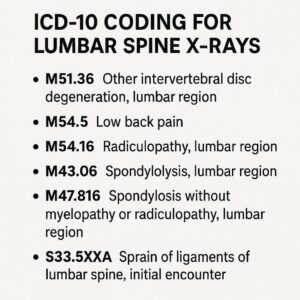
ICD-10 coding for lumbar spine X-rays
Chapter 1: Demystifying the Lumbar Spine – A Primer on Anatomy and Common Pathologies
To code accurately for a lumbar spine X-ray, one must first understand what the physician is looking for. The lumbar spine is a marvel of biomechanical engineering, but it is also a common site for pain and dysfunction.
1.1 Anatomical Overview: Vertebrae, Discs, and Nerves
The lumbar spine typically consists of five large, weight-bearing vertebrae, labeled L1 down to L5. These vertebrae are stacked atop the sacrum (S1). Key anatomical structures include:
-
Vertebral Body: The large, cylindrical anterior part that bears most of the body’s weight.
-
Vertebral Arch: This forms the spinal canal and consists of two pedicles and two laminae.
-
Spinal Canal: The hollow, protected space formed by the vertebral arches, through which the delicate spinal cord and nerve roots (the cauda equina in the lumbar region) pass.
-
Intervertebral Discs: Acting as shock absorbers, these are located between each vertebral body. Each disc has a tough, fibrous outer ring (the annulus fibrosus) and a soft, gel-like center (the nucleus pulposus).
-
Facet Joints: These paired joints at the back of the spine guide and restrict movement, providing stability.
-
Neural Foramina: Small openings on either side of the spine where nerve roots exit the spinal canal to travel to the lower body.
1.2 Common Lumbar Spine Conditions Warranting Imaging
A lumbar X-ray is primarily used to evaluate the bony structures. Common pathologies it can help identify include:
-
Degenerative Disc Disease (DDD): The natural, age-related wear and tear of the intervertebral discs, often seen as a narrowing of the disc space.
-
Spondylosis: Spinal osteoarthritis, characterized by the formation of bone spurs (osteophytes) and joint degeneration.
-
Spondylolisthesis: A condition where one vertebra slips forward over the one below it, often due to a defect (spondylolysis) or degeneration.
-
Spinal Stenosis: A narrowing of the spinal canal, which can compress the nerves.
-
Fractures: Breaks in the vertebrae, which can be traumatic (e.g., from a fall) or pathologic (e.g., due to osteoporosis).
-
Deformities: Abnormal curvatures of the spine, such as scoliosis (lateral curvature) or lordosis (exaggerated inward curve).
-
Infection (Osteomyelitis/Discitis) or Neoplasms (Tumors): Though often better visualized with MRI, X-rays can show suggestive changes like bone destruction.
Chapter 2: The World of Diagnostic Imaging – Understanding the Lumbar Spine X-Ray
2.1 What is a Lumbar Spine X-Ray? (Radiography)
A lumbar spine X-ray is a non-invasive imaging procedure that uses a small amount of ionizing radiation to create pictures of the bones in the lower back. It is often the first imaging test ordered for back pain due to its wide availability, speed, and relatively low cost. It excels at visualizing bony anatomy but is limited in its ability to assess soft tissues like discs, nerves, and ligaments in detail.
2.2 Standard Views: AP, Lateral, Oblique, and Flexion/Extension
A comprehensive lumbar spine series typically includes multiple views to provide a three-dimensional assessment:
-
Anteroposterior (AP) View: The X-ray beam passes from the front to the back of the patient. This view assesses alignment, vertebral body shape, and the overall curvature of the spine.
-
Lateral View: The beam passes from the side. This is the best view for assessing the disc spaces, evaluating for spondylolisthesis (slippage), and checking the alignment of the vertebral bodies in the sagittal plane.
-
Oblique Views (Right and Left): The patient is rotated 45 degrees. These views are particularly useful for visualizing the facet joints and the “scotty dog” appearance of the vertebrae, which allows for clear identification of pars interarticularis defects (spondylolysis).
-
Flexion and Extension Views: These are dynamic views where X-rays are taken while the patient bends forward (flexion) and backward (extension). They are used to assess instability, such as abnormal movement between vertebrae that may not be apparent on static images.
2.3 Clinical Indications: When is a Lumbar X-Ray Ordered?
According to guidelines from the American College of Radiology (ACR) and other bodies, a lumbar X-ray is typically indicated for:
-
Trauma with focal pain or neurological deficit.
-
Evaluation of congenital or developmental deformities (e.g., scoliosis).
-
Suspected spondylolysis or spondylolisthesis in a young athlete.
-
Initial evaluation of chronic low back pain that has not responded to conservative therapy.
-
Assessment for compression fractures in the context of osteoporosis.
-
Pre-surgical planning and post-surgical follow-up (e.g., to assess hardware placement or fusion).
Chapter 3: Introduction to the ICD-10-CM Coding System
3.1 What is ICD-10-CM and Why is it Crucial?
The ICD-10-CM is the U.S. clinical modification of the World Health Organization’s ICD-10, used to classify and code all diagnoses, symptoms, and procedures recorded in conjunction with hospital and outpatient care. Its importance is multifold:
-
Reimbursement: It is the primary language used to justify medical necessity to insurance payers. An incorrect code can lead to claim denial.
-
Epidemiology and Public Health: It provides data for tracking disease incidence and prevalence, which informs public health policy and research.
-
Quality and Analytics: Healthcare organizations use coded data to analyze treatment outcomes, identify areas for quality improvement, and manage population health.
3.2 The Structure of an ICD-10 Code: A Deeper Look
An ICD-10-CM code can be anywhere from 3 to 7 characters long, with each character adding a layer of specificity. The structure is generally as follows:
-
Category (Characters 1-3): The code’s broad family (e.g., M54 for dorsalgia).
-
Etiology, Anatomic Site, Severity, or Other Detail (Characters 4-7): These characters provide critical details.
-
Character 4-6 might specify the anatomic site (e.g., M54.5 for low back pain).
-
Character 7 is often an extension that can indicate:
-
A – Initial encounter
-
B – Subsequent encounter
-
D – Sequela (a condition resulting from the initial disease or injury)
-
-
For example, the code S32.010A breaks down as:
-
S32: Fracture of lumbar vertebra and sacrum
-
.01: Wedge compression fracture of first lumbar vertebra
-
.0: Unspecified type of encounter (this would be further specified, but for illustration)
-
A: Initial encounter
Chapter 4: A Deep Dive into ICD-10 Codes for Lumbar Spine Conditions
This chapter forms the core of our guide, providing a detailed exploration of the most common and relevant ICD-10 codes used to justify a lumbar spine X-ray.
4.1 Low Back Pain (Category M54.5): The Ubiquitous Presentation
Low back pain is one of the most common reasons for a lumbar X-ray. The coding must be as specific as the documentation allows.
-
M54.50 – Low back pain, unspecified: This is a “low-specificity” code. It should be used only when the provider’s documentation does not offer any further detail (e.g., “lumbago,” “low back pain”). While commonly used, it is an audit target.
-
M54.51 – Vertebrogenic low back pain: Used when the pain is specifically attributed to a vertebral source, as confirmed by imaging showing concordant pain from a vertebral source.
-
M54.59 – Other low back pain: This is a catch-all for other specified types of back pain not described by the other codes in this category (e.g., “axial low back pain”).
Coding Tip: Always look for a more specific cause of the pain elsewhere in the documentation. If the X-ray reveals spondylosis and the physician attributes the pain to it, code the spondylosis (M47.16, M47.26, etc.) as the primary diagnosis, not M54.50.
4.2 Lumbar Intervertebral Disc Disorders (Category M51)
This category covers conditions affecting the discs themselves. Laterality (right, left, or unspecified) is a critical component.
-
M51.16 – Intervertebral disc disorders with radiculopathy, lumbar region: This is a highly specific and commonly used code. “Radiculopathy” means a pinched nerve root, often causing pain, numbness, or weakness that radiates down the leg (sciatica).
-
M51.161 – … right side
-
M51.162 – … left side
-
M51.16 – … unspecified side
-
-
M51.17 – Other intervertebral disc displacement, lumbar region: This includes herniations, prolapses, or extrusions without specified radiculopathy.
-
M51.36 – Other intervertebral disc degeneration, lumbar region: This is the code for degenerative disc disease (DDD) specifically located in the lumbar spine.
-
M51.86 – Other intervertebral disc disorders, lumbar region: For other specified disc disorders not covered elsewhere.
4.3 Spondylosis, Spondylolisthesis, and Spondylolysis
-
Spondylosis (M47.-): This is degenerative arthritis of the spine. Codes require specification of the region and whether there is myelopathy (compression of the spinal cord) or radiculopathy.
-
M47.16 – Spondylosis with radiculopathy, lumbar region: (With codes for laterality: M47.161, M47.162, M47.169).
-
M47.26 – Spondylosis with myelopathy, lumbar region: Myelopathy is less common in the lumbar spine but can occur.
-
M47.816 – Spondylosis without myelopathy or radiculopathy, lumbar region.
-
-
Spondylolisthesis (M43.1-): This is the “slippage” of a vertebra.
-
M43.16 – Spondylolisthesis, lumbar region: Requires a 5th digit for the level (e.g., M43.16 for L5-S1).
-
-
Spondylolysis (M43.0-): This is a stress fracture in the pars interarticularis, often the underlying cause of spondylolisthesis in younger patients.
-
M43.06 – Spondylolysis, lumbar region.
-
4.4 Spinal Stenosis of the Lumbar Region (Code M48.06)
Spinal stenosis is a common finding, especially in older adults.
-
M48.06 – Spinal stenosis, lumbar region: This code is used for the narrowing of the spinal canal. It is important to note if it is associated with neurogenic claudication (pain in the legs with walking relieved by sitting forward).
4.5 Postoperative and Postprocedural Codes (Category M96)
If the X-ray is being performed to evaluate the spine after surgery, specific codes from the M96 category may be appropriate.
-
M96.1 – Postlaminectomy syndrome: This refers to a condition of persistent pain after back surgery.
-
M96.81 – Other intraoperative and postprocedural complications and disorders of musculoskeletal system: This can be used for issues like pseudarthrosis (failed fusion).
4.6 Injuries and Trauma: Fractures and Dislocations (Categories S32, S33)
For acute injuries, codes from the Injury chapter (S-section) are used. The 7th character for encounter type (A, D, S) is mandatory.
-
S32.0- – Fracture of lumbar vertebra: This includes various types of fractures (e.g., burst, wedge compression). The 4th and 5th characters specify the type and level.
-
Example: S32.010A – Wedge compression fracture of first lumbar vertebra, initial encounter.
-
-
S33.1 – Subluxation and dislocation of lumbar vertebra.
4.7 Other Relevant Codes: Osteoporosis, Deformities, and Infections
-
Osteoporosis with Fracture (M80.-): If a compression fracture is due to osteoporosis, this code takes precedence.
-
M80.08XA – Age-related osteoporosis with current pathological fracture, vertebra(e), initial encounter.
-
-
Kyphosis and Lordosis (M40.-): For abnormal spinal curvatures.
-
Scoliosis (M41.-): For lateral curvature.
-
Infection: Osteomyelitis (M46.2-) or discitis (M46.4-).
Chapter 5: The Pillars of Compliant Coding: Specificity and Medical Necessity
5.1 The Doctrine of Specificity: Laterality, Acuity, and Manifestation
ICD-10 is built on the principle of specificity. Coders must use the most specific code available based on the provider’s documentation.
-
Laterality: Always code right, left, or bilateral if documented. If not, use “unspecified.”
-
Acuity: Is the condition acute, chronic, or acute on chronic? While not always a direct part of the code, it impacts medical necessity.
-
Manifestation: Code the underlying cause and the manifestation when required. For example, code both the spondylosis (M47.16) and the resulting radiculopathy. Some codes, like M51.16, already bundle the disorder and the radiculopathy.
5.2 Linking Diagnosis to Reason for Service: Establishing Medical Necessity
The diagnosis code on the claim must directly explain why the lumbar spine X-ray was medically necessary. Using a vague code like R10.9 (Unspecified abdominal pain) for a lumbar spine X-ray would likely result in a denial. The code must point to a condition of the lumbar spine. Payers have Local Coverage Determinations (LCDs) that outline which diagnoses support the medical necessity for specific procedures.
5.3 The Role of Clinical Documentation Improvement (CDI)
The coder can only code what is documented. A strong CDI program involves specialists who work with physicians to ensure their notes are clear, complete, and specific. Phrases like “low back pain with radiculopathy down the left leg” are far more codeable and justifiable than simply “back pain.”
Chapter 6: Practical Coding Scenarios – From Patient Chart to Clean Claim
Let’s apply our knowledge to real-world examples.
Scenario 1: The Chronic Back Pain Patient
-
Documentation: “65-year-old male presents for follow-up of chronic mechanical low back pain. Pain is axial, non-radiating. X-ray lumbar spine ordered to evaluate for progression of known DDD.”
-
Coding: The provider has not linked the pain to a specific finding. The safest code is M54.50 (Low back pain, unspecified). If the X-ray report confirms “advanced degenerative disc disease at L4-L5 and L5-S1,” and the physician documents that the pain is from the DDD, you could use M51.36 (Other intervertebral disc degeneration, lumbar region).
Scenario 2: The Acute Injury
-
Documentation: “Patient slipped on ice and fell, presenting with acute, focal pain at the L1 level. Suspected fracture. Ordering X-ray lumbar spine.”
-
Coding: This is an acute injury. You would code from the S32 category. Prior to the X-ray results, you might use a code for back pain (M54.50) or, if the physician is highly specific, S32.009A (Unspecified fracture of lumbar vertebra, initial encounter). After the X-ray confirms a wedge compression fracture of L1, the code would be S32.010A.
Scenario 3: The Patient with Neurological Symptoms
-
Documentation: “Patient has severe pain radiating from the low back down the posterior left leg to the foot, with associated numbness. Suspected L5-S1 disc herniation with radiculopathy.”
-
Coding: This is a classic case for M51.162 (Intervertebral disc disorders with radiculopathy, lumbar region, left side).
Chapter 7: Navigating Common Pitfalls and Audit Triggers
-
Overreliance on “Unspecified” Codes: While sometimes necessary, habitual use of codes like M54.50 or M51.9 (Unspecified disc disorder) is a red flag for auditors. It suggests a lack of clinical diligence or poor coding practices.
-
Mismatched Codes and ABNs: If a test is not medically necessary based on the patient’s diagnosis, but the patient still wants it, an Advance Beneficiary Notice of Noncoverage (ABN) must be signed. Using an incorrect code to force coverage is fraudulent.
-
Insufficient Documentation: The medical record must contain documentation that supports the code selected. If an auditor requests the record and the documentation for M51.16 is not present, the claim will be recouped.
Chapter 8: The Future of Coding and Imaging – A Look Ahead
8.1 The Impending Transition to ICD-11
The WHO has already released ICD-11, which the U.S. will eventually adopt. ICD-11 offers a more flexible, digital-friendly structure with a greater emphasis on clinical detail and combination codes, which could further streamline the coding of complex spinal conditions.
8.2 The Role of Artificial Intelligence (AI) in Coding
AI and Natural Language Processing (NLP) are poised to revolutionize medical coding. These tools can read clinical notes (like radiology reports and clinic notes) and suggest the most appropriate ICD-10 codes, reducing manual effort and potentially increasing accuracy. However, the human coder’s role will evolve to that of a validator, auditor, and expert in complex cases where AI may struggle with nuance.
Chapter 9: Essential Reference Table
Common ICD-10 Codes for Lumbar Spine X-Ray Justification
| ICD-10 Code | Code Description | Clinical Scenario & Notes |
|---|---|---|
| M54.50 | Low back pain, unspecified | Use only when no further specification is documented in the record. A common audit target. |
| M51.16- | Intervertebral disc disorders with radiculopathy, lumbar region | For disc herniations causing sciatica. Requires 6th character for laterality (1-right, 2-left, 9-unspecified). |
| M51.36 | Other intervertebral disc degeneration, lumbar region | The code for Degenerative Disc Disease (DDD) specifically in the lumbar spine. |
| M47.16- | Spondylosis with radiculopathy, lumbar region | For spinal arthritis causing nerve root compression. Requires 6th character for laterality. |
| M47.816 | Spondylosis without myelopathy or radiculopathy, lumbar region | For spinal arthritis that is present but not currently causing nerve issues. |
| M48.06 | Spinal stenosis, lumbar region | For narrowing of the spinal canal. A very common finding in older adults. |
| M43.16 | Spondylolisthesis, lumbar region | For anterior slippage of one vertebra over another. |
| S32.010A | Wedge compression fracture of first lumbar vertebra, initial encounter | Example of a traumatic fracture code. 7th character (A, D, S) is mandatory. |
| M80.08XA | Age-related osteoporosis with current pathological fracture, vertebra(e), initial encounter | Use when a compression fracture is due to osteoporosis, not trauma. |
| M96.1 | Postlaminectomy syndrome | For persistent pain following back surgery. |
Conclusion: Synthesizing Knowledge for Mastery
Mastering ICD-10 coding for lumbar spine X-rays requires a synthesis of anatomical knowledge, an understanding of radiographic purposes, and a meticulous application of coding guidelines. The transition from vague symptoms to precise alphanumeric representations is the core of this critical healthcare function. By prioritizing specificity, relentlessly pursuing accurate documentation, and understanding the direct link between diagnosis and medical necessity, healthcare professionals can ensure compliant reimbursement, contribute to valuable data sets, and ultimately, support high-quality patient care. The future will bring new codes and new technologies, but these foundational principles will remain the bedrock of proficient and ethical medical coding.
Frequently Asked Questions (FAQs)
Q1: What is the most common ICD-10 code used for a lumbar spine X-ray?
A: While it varies by practice, M54.50 (Low back pain, unspecified) is extremely common due to the frequency of this presentation. However, more specific codes like M51.16- (Disc disorder with radiculopathy) or M47.16- (Spondylosis with radiculopathy) are more robust and better justify the medical necessity of the imaging.
Q2: Can I use a code from the symptoms chapter (R00-R99) like R10.9 (Abdominal pain) for a lumbar spine X-ray?
A: Generally, no. Payers expect the diagnosis code to directly relate to the body part being imaged. Using a code for abdominal pain to justify a back X-ray would almost certainly lead to a denial for lack of medical necessity. The code must point to a lumbar spine condition.
Q3: What is the difference between M51.16 and M54.50?
A: M54.50 is a non-specific code for the symptom of pain itself. M51.16 is a definitive diagnosis that describes a specific structural problem (a disc disorder) and its specific consequence (radiculopathy). M51.16 is a much stronger and more appropriate code when supported by documentation.
Q4: How important is the 7th character for injury codes?
A: It is mandatory. Omitting the 7th character (A for initial encounter, D for subsequent encounter, S for sequela) will result in an invalid code and claim rejection. It provides critical information about the phase of treatment.
Q5: What should I do if the physician’s documentation is unclear or lacks specificity?
A: The golden rule is “code what is documented.” If the documentation is insufficient to support a specific code, you must use the corresponding “unspecified” code. However, this is an opportunity for a CDI (Clinical Documentation Improvement) query. A best practice is to have a process in place for coders to ask physicians for clarification to ensure accurate and specific coding.
Additional Resources
-
The Official ICD-10-CM Guidelines for Coding and Reporting: Published annually by the CDC and CMS. This is the definitive source for coding rules.
-
American Medical Association (AMA): Publisher of the CPT codes used for the procedure itself (the X-ray). Their resources are essential for understanding the complete claim picture.
-
American Academy of Professional Coders (AAPC) & American Health Information Management Association (AHIMA): These professional organizations offer certifications, ongoing education, networking, and invaluable coding resources and forums.
-
American College of Radiology (ACR) Appropriateness Criteria: Evidence-based guidelines to help providers order the most appropriate imaging studies, which directly inform medical necessity.
-
CMS.gov (Centers for Medicare & Medicaid Services): For Local Coverage Determinations (LCDs) and National Coverage Determinations (NCDs) that outline what Medicare and other payers consider medically necessary.
Disclaimer: This article is intended for informational and educational purposes only. It is not a substitute for professional medical coding, billing, or legal advice. Medical coders must consult the most current, official ICD-10-CM coding manuals, payer-specific guidelines, and clinical documentation to ensure accurate and compliant coding. The author and publisher disclaim any liability arising directly or indirectly from the use of this information.
Date: November 05, 2025