
In the intricate world of modern healthcare, the seamless integration of clinical practice and administrative precision is paramount. Nowhere is this synergy more critical than in the domain of medical coding, where the complex narrative of a patient’s procedure must be translated into a standardized, alphanumeric language. For the medical coder, this task is a profound responsibility—it is the mechanism that drives reimbursement, fuels health data analytics, and ensures regulatory compliance. Among the myriad of procedures performed daily, cystoscopy stands as one of the most common and vital interventions in urology. It is a window into the hidden passages of the urinary system, allowing for diagnosis, treatment, and management of a vast array of conditions. However, for the coder, a cystoscopy is not a single entity; it is a spectrum of potential procedures, each with its own distinct ICD-10-PCS code. A simple diagnostic look, a biopsy, a stone removal, or a tumor resection—all fall under the umbrella of “cystoscopy,” yet each tells a different story to the payer and the health record.
This comprehensive guide is designed to be your definitive resource for navigating the nuanced landscape of ICD-10-PCS coding for cystoscopic procedures. We will embark on a detailed journey, beginning with the foundational anatomy and technology, then deconstructing the very framework of the ICD-10-PCS system. We will meticulously build codes character by character, applying these principles to real-world clinical scenarios with step-by-step examples. Beyond the mechanics of code assignment, we will delve into the common pitfalls that ensnare even experienced coders, explore the profound impact of accuracy on healthcare finance and quality, and provide you with the tools to achieve mastery. Whether you are a seasoned coding professional seeking a refresher or a newcomer to the field, this article aims to equip you with the depth of knowledge and confidence required to code cystoscopy procedures with unwavering accuracy and insight. Let us begin by understanding the procedure itself.
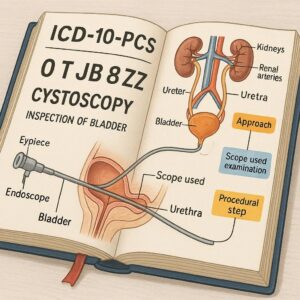
ICD-10-PCS Code for Cystoscopy
Section 1: Understanding the Fundamentals – What is a Cystoscopy?
Before a single code can be assigned, a coder must possess a fundamental understanding of the procedure. Cystoscopy (from the Greek kystis meaning “bladder” and skopein meaning “to look”) is an endoscopic procedure that enables a urologist to visually examine the lining of the urethra and the bladder.
1.1 A Journey Inside: The Anatomy of the Lower Urinary Tract
To appreciate a cystoscopy, one must first be familiar with the anatomy it explores.
-
The Urethra: This is the tube that carries urine from the bladder to the outside of the body. In males, it is longer and passes through the prostate gland and penis. In females, it is significantly shorter.
-
The Bladder: This hollow, muscular organ sits in the pelvis and serves as a reservoir for urine. Its interior lining is a specialized epithelium designed to stretch and be impermeable.
-
The Ureteral Orifices: These are two small openings inside the bladder where the ureters (tubes from the kidneys) empty urine. A crucial part of a cystoscopy is visualizing these openings for efflux of urine, which indicates kidney function.
1.2 The Cystoscope: A Technological Marvel
The cystoscope is the instrument that makes the procedure possible. It is a type of endoscope, a long, thin, flexible or rigid tube equipped with a lens system and a light source.
-
Rigid Cystoscope: A straight, metal instrument that provides a superior optical image and allows for the use of a wider array of surgical instruments. It is often used for more complex therapeutic procedures.
-
Flexible Cystoscope: A bendable fiber-optic instrument that is more comfortable for the patient, typically used for diagnostic procedures, especially in males where navigating the longer urethra is easier with a flexible scope. It can be performed with local anesthetic jelly.
The cystoscope is connected to a camera and a light source, projecting the image onto a video monitor. It also has channels that allow for the instillation of sterile fluid (like saline) to distend the bladder for better visualization and for the passage of miniature instruments.
1.3 Indications for Cystoscopy: From Diagnosis to Treatment
The reasons for performing a cystoscopy are diverse, and the intent directly dictates the ICD-10-PCS code.
-
Diagnostic Indications:
-
Investigation of hematuria (blood in the urine).
-
Recurrent urinary tract infections (UTIs).
-
Persistent irritative voiding symptoms (urgency, frequency, pain).
-
Urinary incontinence or retention.
-
Abnormal cytology or imaging findings.
-
-
Therapeutic/Surgical Indications:
-
Biopsy: Taking a tissue sample from a suspicious area in the bladder or urethra.
-
Resection/Excision: Removing bladder tumors or lesions.
-
Stone Removal: Crushing or extracting bladder stones.
-
Stricture Dilation: Opening a narrowed urethra.
-
Fulgeration: Cauterizing a bleeding vessel or a small lesion.
-
Stent Placement/Removal: Inserting or removing ureteral stents.
-
Injection: For example, injecting Botox into the bladder for overactive bladder or injecting a bulking agent for urinary incontinence.
-
With a solid clinical foundation in place, we can now turn our attention to the language used to describe these procedures: the ICD-10-PCS coding system.
Section 2: Deconstructing the ICD-10-PCS System
ICD-10-PCS (International Classification of Diseases, 10th Revision, Procedure Coding System) is a completely different system from its diagnosis counterpart, ICD-10-CM. It was developed by the Centers for Medicare & Medicaid Services (CMS) for the specific purpose of classifying inpatient procedures.
2.1 The Philosophy of PCS: A Multi-Axial Approach
The core philosophy of PCS is that each code should represent a specific procedure based on its objective (the root operation) and the body part on which it is performed. The system is multi-axial, meaning each character in the code has a specific meaning independent of the others, and the combination of these characters creates a highly specific description.
2.2 The Seven Characters of an ICD-10-PCS Code
Every ICD-10-PCS code is seven characters long, and each character is a letter or a number. The structure is as follows:
-
Character 1: Section – The broadest category (e.g., Medical and Surgical, Obstetrics, Imaging).
-
Character 2: Body System – The general body system (e.g., Urinary, Gastrointestinal, Cardiovascular).
-
Character 3: Root Operation – The objective of the procedure (the what).
-
Character 4: Body Part – The specific part of the body system (the where).
-
Character 5: Approach – The technique used to reach the site (the how).
-
Character 6: Device – Any device that remains after the procedure.
-
Character 7: Qualifier – Additional information about the procedure.
For cystoscopy, the vast majority of procedures will fall within the Medical and Surgical section.
Section 3: The Core Approach – Character by Character for Cystoscopy
Let’s build a cystoscopy code from the ground up, examining the options for each character.
3.1 Character 1: Section – The World of “Medical and Surgical” (0)
Almost all cystoscopic interventions are classified in the Medical and Surgical section. Therefore, the first character of the code will be 0.
3.2 Character 2: Body System – Navigating the Urinary System (T)
The second character defines the body system. For cystoscopy, this is the Urinary System, represented by the character T.
3.3 Character 3: Root Operation – The Heart of the Procedure
This is the most critical character and the one that requires the most careful analysis of the operative report. The root operation defines the goal of the procedure. Here are the most common root operations used in cystoscopy coding:
-
Inspection (J): Visually and/or manually exploring a body part. Used for a purely diagnostic cystoscopy where no other intervention is performed.
-
Excision (B): Cutting out or off a portion of a body part without replacement. Used for biopsies (e.g., biting off a piece of tissue) or removal of small lesions.
-
Resection (T): Cutting out or off all of a body part. This is typically used for the complete removal of a bladder tumor, including its base.
-
Destruction (5): Eradicating a body part without removal. The body part is physically eradicated (e.g., fulgeration, laser ablation) and is not taken out. No specimen is sent to pathology.
-
Extraction (D): Pulling out a foreign body or device. Used for removing a ureteral stent or a bladder stone.
-
Fragmentation (F): Breaking a solid body part into pieces. Used for lithotripsy (laser or mechanical) of a bladder stone. The pieces are often then removed by irrigation.
-
Dilation (7): Expanding an orifice or lumen. Used for dilating a urethral stricture.
-
Insertion (H): Putting in a device. Used for placing a ureteral stent.
-
Control (3): Stopping post-procedural bleeding. Used for cauterizing a bleeding vessel.
3.4 Character 4: Body Part – Precision in Anatomical Location
This character specifies the exact anatomical site. Common body part values for cystoscopy include:
-
Bladder: 5
-
Urethra: 6
-
Bladder Neck: 7
-
Ureter: 0, 1 (right/left)
It is crucial to identify the correct body part from the documentation. A biopsy of the bladder is different from a biopsy of the urethra.
3.5 Character 5: Approach – The Pathway to the Site
The approach describes how the surgeon reached the body part. For cystoscopy, the approaches are:
-
Via Natural or Artificial Opening (8): The cystoscope is passed through the urethra, which is a natural opening. This is the most common approach.
-
Via Natural or Artificial Opening Endoscopic (8): This is the specific approach used for almost all cystoscopies. The key is that an endoscope is used to perform the procedure through a natural opening.
-
Open, Percutaneous, etc.: These are not used for standard cystoscopy.
Important Note: The official ICD-10-PCS guidelines state that if an endoscopic procedure is performed, the approach is “Via Natural or Artificial Opening Endoscopic.” Therefore, for cystoscopy, Character 5 is almost always 8.
3.6 Character 6: Device – The Role of Implants and Materials
This character is used only if a device remains in place after the procedure. For cystoscopy, the most common device is a stent.
-
Device Character for Urinary System: If a ureteral stent is placed and left in, you would use the appropriate device character from the Urinary System table (e.g., Z for Intraluminal Device). If no device remains, this character is Z (No Device).
3.7 Character 7: Qualifier – Adding Specificity
The qualifier provides additional context. Its use varies by root operation.
-
For Excision (B), a qualifier of X is used for Diagnostic.
-
For other operations, it may specify the type of tissue or the purpose. If no qualifier is needed, it is Z.
Section 4: Practical Application – Coding Common Cystoscopy Scenarios
Let’s apply our knowledge to real-world examples.
4.1 The Straightforward Diagnostic Cystoscopy
-
Operative Report: “The patient was prepped and draped in the usual sterile fashion. A flexible cystoscope was introduced per urethra into the bladder under direct vision. The urethra was normal. The bladder was inspected. The mucosa was normal, and both ureteral orifices were seen with clear efflux. The cystoscope was removed.”
-
Code Building:
-
Section: Medical and Surgical (0)
-
Body System: Urinary System (T)
-
Root Operation: What was done? The bladder and urethra were visually examined. This is Inspection (J).
-
Body Part: What was inspected? The Bladder (5). (Note: While the urethra was also inspected, the inspection of the bladder is the primary focus and includes the journey to get there. Separate codes for urethra are generally not warranted).
-
Approach: Via Natural or Artificial Opening Endoscopic (8)
-
Device: No Device (Z)
-
Qualifier: No Qualifier (Z)
-
-
Final Code: 0TJJ8ZZ – Inspection of Bladder, Via Natural or Artificial Opening Endoscopic
4.2 Biopsy During Cystoscopy: The Act of Extraction
-
Operative Report: “Cystoscopy revealed a suspicious 0.5 cm erythematous area on the left lateral bladder wall. Using cold cup biopsy forceps, a biopsy was taken of this area. The specimen was sent to pathology. The area was then cauterized for hemostasis.”
-
Code Building:
-
Section: Medical and Surgical (0)
-
Body System: Urinary System (T)
-
Root Operation: What was the objective of taking the tissue? It was to remove a portion for pathologic analysis. This is Excision (B). (Note: It is not Inspection, because a procedure beyond mere visual examination was performed).
-
Body Part: Bladder (5)
-
Approach: Via Natural or Artificial Opening Endoscopic (8)
-
Device: No Device (Z)
-
Qualifier: The qualifier for Diagnostic Excision is X.
-
-
Final Code: 0TJB8ZX – Excision of Bladder, Via Natural or Artificial Opening Endoscopic, Diagnostic
4.3 Dealing with Stones: Fragmentation and Removal
-
Operative Report: “A 1.5 cm bladder stone was identified. The stone was engaged with the laser fiber and fragmented into small pieces using a holmium laser. The fragments were then irrigated and evacuated from the bladder.”
-
Code Building:
-
Section: Medical and Surgical (0)
-
Body System: Urinary System (T)
-
Root Operation: The primary action was breaking the stone into pieces. This is Fragmentation (F).
-
Body Part: The stone is in the Bladder (5).
-
Approach: Via Natural or Artificial Opening Endoscopic (8)
-
Device: No Device (Z)
-
Qualifier: No Qualifier (Z)
-
-
Final Code: 0TFF8ZZ – Fragmentation in Bladder, Via Natural or Artificial Opening Endoscopic
4.4 Resecting Tumors: The Excision of Bladder Lesions
-
Operative Report: “A 2 cm papillary tumor was seen on the dome of the bladder. Using a resectoscope loop, the tumor was resected in its entirety down to the muscularis layer. The base was fulgerated. All chips were evacuated.”
-
Code Building:
-
Section: Medical and Surgical (0)
-
Body System: Urinary System (T)
-
Root Operation: The tumor was cut out. While “excision” is often used clinically, in PCS, if the entire lesion is cut out (as indicated by “in its entirety”), the root operation is Resection (T). Excision is for a portion.
-
Body Part: Bladder (5)
-
Approach: Via Natural or Artificial Opening Endoscopic (8)
-
Device: No Device (Z)
-
Qualifier: No Qualifier (Z)
-
-
Final Code: 0TTB8ZZ – Resection of Bladder, Via Natural or Artificial Opening Endoscopic
4.5 Addressing Strictures: The Dilation of the Urethra
-
Operative Report: “The cystoscope could not be passed due to a tight bulbar urethral stricture. Under direct vision, a guidewire was passed. Sequential urethral dilators were then passed over the wire to dilate the stricture to 24 French. The cystoscope was then easily passed, and the bladder was inspected and found to be normal.”
-
Code Building:
-
Section: Medical and Surgical (0)
-
Body System: Urinary System (T)
-
Root Operation: The objective was to expand the narrowed lumen. This is Dilation (7).
-
Body Part: Urethra (6)
-
Approach: Via Natural or Artificial Opening Endoscopic (8) – The procedure was performed under endoscopic vision.
-
Device: No Device (Z)
-
Qualifier: No Qualifier (Z)
-
-
Final Code: 0T7D8ZZ – Dilation of Urethra, Via Natural or Artificial Opening Endoscopic
Section 5: Navigating the Nuances and Avoiding Common Pitfalls
5.1 Diagnostic vs. Therapeutic Intent
This is a fundamental concept. If the physician goes in only to look (diagnostic) and does nothing else, the code is Inspection. The moment a biopsy is taken, a stone is fragmented, or a tumor is resected, the procedure becomes therapeutic/surgical, and the root operation changes to Excision, Fragmentation, Resection, etc. You cannot code both an Inspection and a separate root operation for the same anatomical area if the Inspection was part of the approach to the surgical site.
5.2 The “Inspection” Root Operation Controversy
Coders often struggle with when to use Inspection. The key is in the physician’s intent and documentation. If the operative report states the procedure was a “cystoscopy with biopsy,” the biopsy is the definitive procedure. The cystoscopy was the method of access. Therefore, you code only the Excision. The inspection is inherent to performing the excision endoscopically.
5.3 Coding Multiple Procedures in a Single Session
A patient may have a cystoscopy with multiple interventions. For example: “Cystoscopy with biopsy of bladder lesion and fulgeration of a separate small lesion.”
-
Biopsy: 0TJB8ZX (Excision of Bladder, Diagnostic)
-
Fulgeration: 0T5B8ZZ (Destruction of Bladder)
Both codes are assigned because two distinct root operations (Excision and Destruction) were performed on the same body part.
5.4 The Importance of Physician Documentation
Accurate coding is impossible without clear, detailed documentation. Coders must work from the operative report, not the procedure title on the schedule. Key questions to ask:
-
What was the precise objective? (Root Operation)
-
Exactly where was it done? (Body Part)
-
What was the technique? (Approach)
-
Was a device left in place? (Device)
-
Was tissue removed for pathology? (This distinguishes Inspection from Excision)
Section 6: Beyond the Code – The Impact of Accurate Cystoscopy Coding
6.1 Reimbursement and Revenue Cycle Integrity
ICD-10-PCS codes are a primary driver of DRG (Diagnosis-Related Group) assignment for inpatient stays. An inaccurate code can lead to:
-
Under-coding: Assigning a less specific or less complex code, resulting in lower reimbursement and financial loss for the facility.
-
Over-coding: Assigning a more complex code than is supported by documentation, which is considered fraud and abuse and can lead to hefty penalties, recoupments, and legal action.
6.2 Data Analytics and Quality Patient Care
Procedure codes are aggregated into large datasets used for public health monitoring, research, and quality improvement. Accurate coding for cystoscopy allows hospitals and researchers to:
-
Track the prevalence of certain procedures (e.g., tumor resections).
-
Analyze outcomes for different surgical techniques.
-
Identify trends in urological diseases.
6.3 Compliance and Audit Preparedness
With the increased scrutiny from RAC (Recovery Audit Contractors) and other auditors, a well-documented and accurately coded record is the best defense. It demonstrates a commitment to compliance and reduces the risk of adverse audit findings.
Section 7: Visual Aids and Reference Tables
ICD-10-PCS Root Operations Commonly Used in Cystoscopy
| Root Operation | PCS Code | Clinical Objective | Example in Cystoscopy | Key Concept |
|---|---|---|---|---|
| Inspection | J | Visually examine a body part | Looking in the bladder for hematuria source | No intervention is performed. |
| Excision | B | Cut out a portion of a body part | Biopsy of a bladder lesion | Tissue is removed for pathology. |
| Resection | T | Cut out all of a body part | Complete removal of a bladder tumor | The entire lesion is removed. |
| Destruction | 5 | Eradicate a body part without removal | Fulgeration of a small papilloma | No specimen is sent to pathology. |
| Extraction | D | Pull out a foreign body | Removal of a ureteral stent | The object is physically pulled out. |
| Fragmentation | F | Break a solid body part into pieces | Laser lithotripsy of a bladder stone | The object is broken apart. |
| Dilation | 7 | Expand an orifice | Dilating a urethral stricture | The lumen is made wider. |
| Insertion | H | Put in a device | Placing a double-J ureteral stent | A device remains after the procedure. |
| Control | 3 | Stop post-procedural bleeding | Cauterizing a bleeding vessel after biopsy | The objective is purely hemostasis. |
Conclusion
Mastering ICD-10-PCS coding for cystoscopy demands a meticulous, multi-step process grounded in clinical understanding and precise terminology. The journey from a physician’s operative note to a final code requires a disciplined analysis of the root operation, body part, and approach. By moving beyond memorization to a true comprehension of the PCS framework and its application to urological procedures, medical coders can ensure accuracy that upholds revenue integrity, supports quality care data, and maintains strict compliance standards. This mastery is not merely an administrative task but a critical contribution to the healthcare ecosystem.
Frequently Asked Questions (FAQs)
Q1: If a diagnostic cystoscopy is planned but the physician finds and biopsies a lesion, do I code both the Inspection and the Excision?
A: No. According to the ICD-10-PCS guidelines, the Inspection is not coded separately when it is performed to reach the site of the biopsy. The biopsy (Excision) is the definitive procedure, and the approach (Via Natural or Artificial Opening Endoscopic) already implies that the area was visualized. You would code only the Excision.
Q2: What is the difference between Excision and Resection for a bladder tumor?
A: This is a nuanced but critical distinction. Excision (B) is used when only a portion of the body part (e.g., the tumor) is cut out, such as for a biopsy or removal of a small lesion. Resection (T) is used when all of a body part is cut out. For a bladder tumor, if the physician documents “complete resection,” “resected down to muscle,” or “resected in full,” the root operation is typically Resection. Review the documentation carefully for these key terms.
Q3: How do I code a cystoscopy with fulgeration of a bleeding site?
A: It depends on the intent. If the fulgeration is the primary procedure to destroy a lesion (e.g., a small papilloma), use Destruction (5). If the fulgeration is performed only to achieve hemostasis after another procedure like a biopsy (i.e., to control bleeding), use Control (3).
Q4: The physician documents a “cystoscopy with stone manipulation.” What code should I use?
A: “Manipulation” is not a root operation. You must determine what was actually done. If the stone was grasped and pulled out, it’s Extraction (D). If it was broken into pieces with a laser, it’s Fragmentation (F). You may need to query the physician for clarification.
Q5: A ureteral stent is placed cystoscopically. What is the body part?
A: The body part is the Ureter (character 0 for right, 1 for left). The root operation is Insertion (H), the approach is Via Natural or Artificial Opening Endoscopic (8), and the device is an Intraluminal Device (Z). The code would be 0TH98ZZ for a right ureteral stent placement.
Additional Resources
-
The Official ICD-10-PCS Guidelines: The single most important resource, updated annually. [Link to CMS.gov]


