
In the intricate ecosystem of modern healthcare, the flow of information is as vital as the flow of blood. At the heart of this information system lies medical coding, a discipline that translates complex medical diagnoses and procedures into a universal, standardized language. For the patient undergoing an ileostomy reversal—a procedure that signifies a return to normalcy and the closing of a challenging chapter in their lives—the clinical success is paramount. However, for the healthcare system at large, the accuracy with which this procedure is coded carries immense weight, influencing everything from hospital reimbursement and resource allocation to public health data and medical research. An ileostomy reversal, or takedown, is not merely a single code; it is a narrative of restoration, a story told through the precise selection of alphanumeric characters within the ICD-10-PCS system.
This article is designed to be the definitive guide for medical coders, health information management (HIM) professionals, surgeons, and healthcare administrators seeking to master the nuances of ICD-10-PCS coding for ileostomy reversal. We will embark on a detailed journey, beginning with the fundamental anatomy of the digestive system, progressing through the surgical techniques employed, and culminating in the meticulous construction of the correct procedural code. We will dissect the ICD-10-PCS system itself, exploring its logical yet complex structure, and apply its principles to real-world scenarios. With the aid of detailed tables, illustrative explanations, and a focus on common challenges, this guide aims to transform a potentially confusing coding task into a confident and accurate process. In an era of heightened regulatory scrutiny and value-based care, precision in coding is not just an administrative goal—it is a professional and financial imperative.
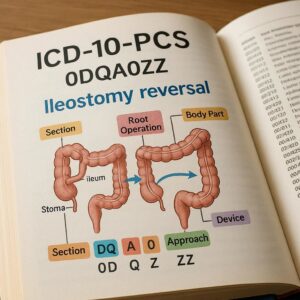
ICD-10-PCS Code for Ileostomy Reversal
2. Understanding the Anatomy and Physiology: The Small Intestine and the Role of an Ileostomy
To accurately code a procedure, one must first understand the anatomy upon which it is performed. The small intestine is a long, coiled tube connecting the stomach to the large intestine (colon). It is divided into three parts: the duodenum, the jejunum, and the ileum. The ileum is the final and longest section, responsible for the absorption of vitamin B12, bile salts, and any remaining nutrients. It terminates at the ileocecal valve, a sphincter muscle that controls the flow of digested material from the ileum into the cecum (the first part of the colon) and prevents backflow.
An ileostomy is a surgically created opening (stoma) that brings the end or a loop of the ileum through the abdominal wall. This diverts the fecal stream away from the colon, rectum, and anus, allowing the distal bowel to rest or heal. Indications for creating an ileostomy are diverse and critical, including:
-
Inflammatory Bowel Disease (IBD): Severe ulcerative colitis or Crohn’s disease that is unresponsive to medical therapy.
-
Colorectal Cancer: To protect a distal anastomosis after tumor resection.
-
Diverticulitis: Complicated cases with perforation or abscess.
-
Trauma: Blunt or penetrating injury to the abdomen damaging the colon.
-
Congenital Conditions: Such as Hirschsprung’s disease or imperforate anus.
There are two primary types of ileostomies, and the original type dictates the complexity of the reversal procedure:
-
Loop Ileostomy: A loop of ileum is brought through the abdominal wall and opened. This is often a temporary measure created to protect a downstream anastomosis. It is generally easier to reverse.
-
End Ileostomy: The end of the ileum is brought out as a stoma, and the downstream colon is either removed or stapled shut (Hartmann’s procedure). This reversal is more complex, as it requires a reconnection (anastomosis) deep within the pelvis.
The existence of the stoma itself represents an interruption of the body’s natural continuity. The reversal procedure, therefore, is fundamentally a mission of restoration—to reestablish the anatomical and functional integrity of the gastrointestinal tract.
3. The Ileostomy Reversal Procedure: A Surgical Overview
The ileostomy reversal, formally known as ileostomy takedown or closure of ileostomy, is the procedure to restore intestinal continuity after the initial reason for diversion has resolved. It is typically performed 8-12 weeks after the initial surgery, allowing time for inflammation to subside and healing to occur, particularly at the site of the distal anastomosis.
The surgical approach can vary, primarily between open and laparoscopic techniques.
Preoperative Preparation: The patient is usually admitted to the hospital. Bowel preparation may be performed, and intravenous antibiotics are administered to reduce the risk of infection. The stoma site is marked and prepared for surgery.
The Surgical Procedure: A Step-by-Step Narrative
-
Incision and Access: The surgeon makes an incision. In an open approach, this is typically an elliptical incision around the stoma, which is then extended to allow adequate access into the peritoneal cavity. In a laparoscopic approach, several small incisions are made: one for the camera (laparoscope) and others for specialized instruments. The stoma site may be used for one of these ports or for extraction of the bowel.
-
Mobilization and Dissection: The surgeon carefully frees the ileum from the layers of the abdominal wall to which it has adhered. This is a delicate process, as the bowel can be fragile. The stoma is dissected free, and the afferent (incoming) and efferent (outgoing) limbs of the ileum are identified. For an end ileostomy, the distal defunctionalized segment (often the colon) must also be mobilized.
-
Preparation for Anastomosis: The surgeon examines the two ends of the bowel to be connected. The old, scarred ends of the ileum (the “stoma buds”) are typically resected (cut away) to ensure that healthy, well-vascularized tissue is used for the new connection. This step is critical for healing and preventing leaks.
-
Creation of the Anastomosis: The two ends of the bowel are reconnected. This can be done in several ways:
-
Hand-Sewn Anastomosis: The surgeon uses sutures to meticulously sew the two ends together in one or two layers.
-
Stapled Anastomosis: A surgical stapling device is used to join the two ends. Common techniques include a functional end-to-end anastomosis or a side-to-side anastomosis.
This reconnection re-establishes the flow of intestinal contents from the small intestine into the large intestine.
-
-
Closure and Completion: The reconnected bowel is returned to the abdominal cavity. The surgeon irrigates the area and checks for hemostasis (bleeding control). The fascia (the strong connective tissue layer of the abdomen) at the stoma site is closed with sutures. The skin incision is then closed, often leaving the old stoma site to heal by secondary intention or with a primary closure, depending on the surgeon’s preference and the degree of contamination.
Understanding these surgical steps is not merely academic for the coder; it is the very source material from which the correct ICD-10-PCS code is derived. The specific actions taken—resecting tissue, reconnecting structures—directly inform the selection of the Root Operation, the most critical component of the code.
4. Deconstructing the ICD-10-PCS Framework: The Building Blocks of a Code
ICD-10-PCS (International Classification of Diseases, Tenth Revision, Procedure Coding System) is a multi-axial system used exclusively in the United States for reporting inpatient procedures. Unlike its diagnosis counterpart or the CPT® system, it is not based on eponyms or common procedure names. Instead, it builds codes from independent values within seven distinct characters. Each character represents an aspect of the procedure.
Let’s break down the structure of a complete ICD-10-PCS code:
-
Character 1: Section – The broadest category (e.g., Medical and Surgical, Obstetrics, Placement).
-
Character 2: Body System – The general physiological system involved (e.g., Gastrointestinal System, Hepatobiliary System).
-
Character 3: Root Operation – The objective or definitive intent of the procedure. This is the core of the code.
-
Character 4: Body Part – The specific anatomical site where the Root Operation was performed.
-
Character 5: Approach – The technique used to reach the site of the procedure.
-
Character 6: Device – Any device that remains after the procedure is complete.
-
Character 7: Qualifier – A further specification of the procedure, often used to add unique detail.
For an ileostomy reversal, we are almost always working within the Medical and Surgical section (0). Our focus will be on meticulously selecting the correct values for Characters 2 through 7 based on the operative report.
5. Navigating the Medical and Surgical Section (Section 0)
For an ileostomy reversal, the first character is always 0, denoting the Medical and Surgical section. The second character, Body System, is almost invariably D, for Gastrointestinal System. This encompasses procedures on the esophagus, stomach, intestines, appendix, liver, pancreas, and gallbladder.
Thus, the foundation for our ileostomy reversal code begins with 0D.
6. The Root Operation Conundrum: Resection, Bypass, or Alteration?
The third character, the Root Operation, is the most pivotal and often the most challenging aspect of coding an ileostomy reversal. The official definition of the Root Operation is crucial. Let’s analyze the most relevant candidates:
-
Resection (Root Operation S): “Cutting out or off, without replacement, a portion of a body part.” The qualifier “without replacement” is key. In an ileostomy reversal, the surgeon often does resect the stoma buds—the scarred ends of the ileum. However, the ultimate goal of the procedure is not merely to remove tissue, but to re-establish continuity. If the only objective action documented is the resection of the stoma buds and re-anastomosis, then Resection is the correct Root Operation. The anastomosis is inherent to the resection in this context.
-
Bypass (Root Operation 1): “Altering the route of passage of the contents of a tubular body part.” This does not fit a standard reversal. Bypass is used when rerouting content around an area, such as creating a new connection between the stomach and jejunum (gastrojejunostomy) to bypass a diseased duodenum. In a reversal, we are restoring the original route, not creating a new one.
-
Alteration (Root Operation 0): “Modifying the natural anatomic structure of a body part without affecting the function of the body part.” The critical phrase here is “without affecting the function.” A reversal dramatically affects function by restoring fecal continuity, so this Root Operation is incorrect.
-
Excision (Root Operation B) vs. Resection (Root Operation S): It is vital to distinguish these. Excision is “cutting out or off a portion of a body part,” while Resection is “cutting out or off without replacement.” The distinction often lies in whether the entire body part is removed. For the ileum, if only a portion (the stoma buds) is removed, and it is not the entire ileum, then Resection is typically the more accurate term, as the excision is part of the reconstructive process.
The Official ICD-10-PCS Guideline and the “Take Down” Instruction:
The coding system provides direct guidance for this exact scenario. The 2025 ICD-10-PCS Guidelines, Section B3.10a, state:
“In the root operations Bypass, Detachment, Excision, Extraction, Reposition, Replacement, Resection, Transfer and Transplantation, the objective of the procedure is to take out or put in/on a device or a body part, and the device or body part is integral to the procedure. If the objective of the procedure is to take out a device, the root operation is Removal. If the objective is to take out a portion of a body part, the root operation is Excision or Resection.
If the sole objective of the procedure is to take down an anastomosis, the root operation is Detachment.
If an anastomosis is taken down and a new anastomosis is created, the root operation is the objective of the procedure performed at the new anastomosis site.”
This is the definitive rule. In a standard ileostomy reversal, the surgeon is not just “taking down” the stoma; they are resecting the old tissue and creating a new anastomosis to restore continuity. Therefore, the root operation is the one performed at the new anastomosis site. Since the new connection is made by joining the ileum to itself or to the colon, and this involves cutting out the old stoma, the most accurate Root Operation is Resection (S).
Conclusion: For the vast majority of ileostomy reversals, where the stoma is resected and a new anastomosis is created to restore continuity, the correct Root Operation is Resection (S). The code for the takedown of the ileostomy is the same as the code for the resection and re-anastomosis.
7. A Deep Dive into the Body Part Character: Ileum and Ileocecal Valve
The fourth character specifies the Body Part. The options relevant to ileostomy reversal are found in the Gastrointestinal System body system (D). The choices are:
-
Ileum: This represents the small intestine body part itself.
-
Ileocecal Valve: This is a specific anatomical structure.
The correct choice depends entirely on the surgeon’s documentation of what was reconnected.
-
Scenario A: Loop Ileostomy Takedown: The ileum was connected to a more distal part of the ileum. The anastomosis is ileum to ileum. Therefore, the body part is Ileum.
-
Scenario B: End Ileostomy Takedown (with reconnection to colon): The ileum was connected to the colon. The specific body part value depends on the precise site of the anastomosis. If it is to the cecum, involving the ileocecal valve, the body part may be Ileocecal Valve. If it is to the ascending colon, the body part would be Ascending Colon (a value under a different part of the D table). The coder must read the operative report carefully to identify the exact anatomical structures involved in the anastomosis.
For the purpose of this foundational guide, we will focus on the ileum-to-ileum reconnection, which is common in loop ileostomy reversals.
8. The Approach Character: From Open to Laparoscopic
The fifth character defines the Approach—how the surgeon reached the procedural site.
-
Open (0): The surgeon makes a large incision to directly visualize the surgical field. For a stoma reversal, this is often an elliptical incision around the stoma.
-
Percutaneous Endoscopic (4): This is the ICD-10-PCS term for a laparoscopic approach. The surgeon uses small incisions, a camera, and long instruments.
-
External (X): Used for procedures performed directly on the skin or mucous membrane. This is not applicable for an ileostomy reversal, as the procedure involves entering the peritoneal cavity.
The coder must review the operative report to confirm the approach. The documentation of “laparoscope,” “trocar,” “ports,” etc., indicates a Percutaneous Endoscopic approach.
9. Device and Qualifier: Their Role in Ileostomy Reversal
The sixth character is Device. In a resection and re-anastomosis, no device remains after the procedure is complete. The sutures or staples used for the anastomosis are considered integral to the procedure and are not coded. Therefore, the Device character is Z (No Device).
The seventh character is the Qualifier. For the Gastrointestinal System and the Root Operation Resection, the Qualifier is almost always Z (No Qualifier). There are no specific qualifiers for a reversal procedure in this context.
10. Constructing the Code: Practical Coding Scenarios and Examples
Let’s now assemble complete ICD-10-PCS codes based on realistic operative reports.
ICD-10-PCS Code Building for Ileostomy Reversal
| Character | Component | Value | Description for Scenario 1 (Open Loop Reversal) | Description for Scenario 2 (Laparoscopic End Reversal to Cecum) | |
|---|---|---|---|---|---|
| 1 | Section | 0 | Medical and Surgical | Medical and Surgical | |
| 2 | Body System | D | Gastrointestinal System | Gastrointestinal System | |
| 3 | Root Operation | S | Resection of the ileum | Resection of the ileocecal valve area | |
| 4 | Body Part | D | Ileum | Ileocecal Valve | |
| 5 | Approach | 0 | Open | 4 (Percutaneous Endoscopic) | |
| 6 | Device | Z | No Device | No Device | |
| 7 | Qualifier | Z | No Qualifier | No Qualifier | |
| Full Code | 0DSD0ZZ | Resection of Ileum, Open Approach | 0DSC4ZZ | Resection of Ileocecal Valve, Percutaneous Endoscopic Approach |
Scenario 1 Narrative:
Operative Report Excerpt: “The patient was taken to the OR. An elliptical incision was made around the ileostomy stoma. The loop of ileum was mobilized from the abdominal wall. The two limbs of the ileum were identified. The stoma buds were sharply resected. A functional end-to-end anastomosis was created between the two ends of the ileum using a linear stapler. The anastomosis was viable and without leak. The bowel was returned to the abdomen. The fascia was closed… The skin was closed.”
-
Coding Analysis:
-
The objective was to restore continuity by resecting the old tissue and creating a new connection.
-
Root Operation: Resection (S)
-
Body Part: The anastomosis was ileum to ileum, so Ileum (D)
-
Approach: A large, elliptical incision was made; this is Open (0)
-
Final Code: 0DSD0ZZ
-
Scenario 2 Narrative:
Operative Report Excerpt: “Under laparoscopic guidance, the abdomen was entered. The end ileostomy was taken down from the abdominal wall. The Hartmann’s pouch in the cecum was identified and mobilized. The stapled end of the ileum and the stapled end of the cecum were resected. An ileocolic anastomosis was created hand-sewn in two layers at the site of the ileocecal valve. The anastomosis was tested and was patent.”
-
Coding Analysis:
-
Root Operation: Resection (S) (of the old ends, to create a new anastomosis)
-
Body Part: The anastomosis was ileum to cecum at the ileocecal valve, so Ileocecal Valve (C)
-
Approach: The procedure was performed laparoscopically, so Percutaneous Endoscopic (4)
-
Final Code: 0DSC4ZZ
-
11. The Crucial Role of Physician Documentation
The coder is entirely dependent on the clarity and specificity of the surgeon’s operative report. Vague documentation like “ileostomy takedown” is insufficient. The coder must be able to answer:
-
What was the exact type of the original stoma (loop vs. end)?
-
What specific anatomical structures were involved in the new anastomosis (ileum, cecum, ascending colon)?
-
What was the surgical approach (open, laparoscopic)?
-
Was any other procedure performed simultaneously (e.g., lysis of adhesions, biopsy)?
HIM professionals should work with physicians to improve documentation through education and the use of structured templates that prompt for these critical details. Queries are essential when documentation is unclear.
12. Common Pitfalls and How to Avoid Them
-
Coding the “Takedown” instead of the “Reconstruction”: The most common error is using a root operation like “Excision” for the stoma or misapplying “Detachment.” Remember, the core objective is to restore continuity, which involves resection and a new anastomosis.
-
Avoidance: Always ask, “What was the ultimate goal? Was a new anastomosis created?” If yes, code the resection and anastomosis.
-
-
Incorrect Body Part Assignment: Assuming the body part is always “Ileum.”
-
Avoidance: Scrutinize the operative report for the exact terms describing the anastomosis (e.g., “ileocolic,” “ileo-ascending,” “ileocecal”).
-
-
Missing the Approach: Overlooking the distinction between open and laparoscopic.
-
Avoidance: Look for keywords: “laparoscope,” “trocar,” “ports” indicate Percutaneous Endoscopic (4). A large, single incision around the stoma typically indicates Open (0).
-
-
Confusing ICD-10-PCS with CPT®: The systems are fundamentally different. CPT® has a specific code for “Closure of ileostomy” (44320). ICD-10-PCS requires building a code based on the specific methodology.
-
Avoidance: Keep the code sets separate in your mind. Use ICD-10-PCS for inpatient billing and focus on its multi-axial structure.
-
13. ICD-10-PCS vs. CPT®: Understanding the Distinction
It is vital to understand that ICD-10-PCS and CPT® (Current Procedural Terminology) are used in different settings. CPT® is primarily used by physicians and for outpatient and ambulatory surgery center billing. ICD-10-PCS is used for reporting inpatient procedures in hospital settings.
-
CPT® Code 44320 – Closure of ileostomy:
-
This is a single, bundled code that describes the entire procedure of takedown and re-anastomosis, regardless of whether it was open or laparoscopic (though laparoscopic may have a different code, e.g., 44227, if performed in conjunction with other laparoscopic procedures).
-
It is simpler but less specific.
-
-
ICD-10-PCS (e.g., 0DSD0ZZ):
-
This code explicitly states that a Resection of the Ileum was performed via an Open approach.
-
It provides a much higher level of clinical detail, which is valuable for data analytics, research, and DRG (Diagnosis-Related Group) assignment.
-
The hospital coder will use ICD-10-PCS, while the surgeon’s professional coder will use CPT®.
14. The Financial and Compliance Implications of Accurate Coding
Accurate coding is not an abstract exercise; it has direct and significant consequences.
-
DRG Assignment: In the inpatient setting, procedures drive the assignment of a DRG, which determines the fixed payment the hospital receives from Medicare and other payers. An incorrectly coded procedure can lead to assignment to a lower-paying DRG, resulting in financial loss. Conversely, upcoding (assigning a more complex code than is justified) is considered fraud.
-
Compliance and Audits: Regulatory bodies like the OIG (Office of Inspector General) and RAC (Recovery Audit Contractors) actively audit medical records. Errors in coding for common procedures like ileostomy reversal can lead to hefty fines, penalties, and reputational damage.
-
Data Integrity: Accurate codes contribute to clean national health data. This data is used for epidemiological studies, tracking surgical outcomes, and making public health policy decisions. An error in your code can ripple through the entire healthcare data ecosystem.
15. Conclusion: The Art and Science of Procedural Coding
Coding an ileostomy reversal in ICD-10-PCS is a process that demands a synthesis of clinical knowledge, analytical skill, and meticulous attention to detail. It requires the coder to move beyond the simple term “takedown” and delve into the surgical narrative to identify the root operation, the precise body parts, and the technical approach. By understanding the underlying anatomy, the surgical goals, and the logical structure of the ICD-10-PCS system, healthcare professionals can ensure that this procedure is coded with the precision it requires. In doing so, they not only ensure appropriate reimbursement but also uphold the integrity of the health data that is essential for the future of medicine. The journey from a patient’s stoma to a fully restored digestive tract is mirrored in the coder’s journey from an operative report to a perfectly constructed, seven-character code.
16. Frequently Asked Questions (FAQs)
Q1: What if the operative report only says “ileostomy takedown” with no other details?
A1: This is insufficient for accurate ICD-10-PCS coding. The coder must query the physician for clarification. The query should ask for the specific type of procedure (e.g., resection with anastomosis), the body parts anastomosed, and the surgical approach.
Q2: How do I code a reversal of a colostomy? Is it the same process?
A2: The process is identical in logic but different in the specific body part values. A colostomy reversal would also typically be coded as a Resection, but the body part character would be from the Lower Intestines table (e.g., Ascending Colon, Transverse Colon, Descending Colon, Sigmoid Colon).
Q3: The surgeon also performed a lysis of adhesions during the reversal. How is that coded?
A3: Lysis of adhesions is a separate procedure. It is coded in addition to the reversal code. The root operation for lysis of adhesions is Release (N) in the Physiological Systems and Anatomical Regions sections. You would assign a separate code, such as 0WNX0ZZ (Release of peritoneal tissue, open approach), if the adhesions were in the peritoneum.
Q4: Why isn’t there a specific root operation for “Reversal” or “Takedown”?
A4: The philosophy of ICD-10-PCS is to code the objective method of the procedure, not its eponymous or common name. This creates a more precise and standardized system. The method for reversing an ileostomy is to resect the non-functioning part and create a new anastomosis, hence the root operation “Resection.”
17. Additional Resources
-
The Official ICD-10-PCS Code Set and Guidelines: Published annually by the Centers for Medicare & Medicaid Services (CMS) and the National Center for Health Statistics (NCHS). This is the ultimate authority.
-
American Health Information Management Association (AHIMA): Offers a wealth of resources, including books, practice exercises, and continuing education on ICD-10-PCS coding.
-
American Academy of Professional Coders (AAPC): Provides certification, training, and networking opportunities for medical coders, with specific materials on ICD-10-PCS.
-
Anatomy Textbooks and Atlases: Resources like Netter’s Atlas of Human Anatomy are invaluable for visualizing the structures involved in complex procedures.


