
In the intricate world of modern healthcare, the language of medicine extends far beyond clinical terminology. It encompasses a complex system of alphanumeric codes that translate medical procedures, diagnoses, devices, and services into a standardized data set. This system is the lifeblood of healthcare administration, driving reimbursement, facilitating public health research, enabling quality tracking, and informing strategic planning. Within this universe of medical coding, the International Classification of Diseases, Tenth Revision, Procedure Coding System (ICD-10-PCS) stands as the definitive framework for reporting inpatient procedures in the United States. For hospital coders, physicians, and healthcare administrators, mastery of ICD-10-PCS is not merely an administrative task; it is a critical competency that ensures accurate communication and financial stability.
This article delves deep into one specific, yet profoundly important, procedure: the placement of an Inferior Vena Cava (IVC) filter. An IVC filter is a small, cage-like device implanted in the inferior vena cava to prevent life-threatening pulmonary emboli (PE) from reaching the lungs. While the clinical decision to place an IVC filter is complex, the coding of this procedure must be precise. A single misstep in selecting one of the seven characters of an ICD-10-PCS code can lead to claim denials, audit findings, and distorted clinical data. This guide is designed to be an exhaustive resource, transforming the complexity of IVC filter coding into a logical, step-by-step process. We will explore the relevant anatomy, dissect the PCS code structure, analyze the nuances of different root operations, and navigate advanced clinical scenarios, all with the goal of empowering you to assign the correct code with confidence and accuracy.
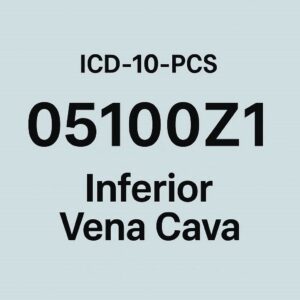
ICD-10-PCS code for Inferior Vena Cava
2. Understanding the Inferior Vena Cava Filter: Anatomy, Function, and Clinical Indications
Before a single code can be assigned, a thorough understanding of the procedure and its purpose is essential.
Anatomy of the Inferior Vena Cava (IVC):
The inferior vena cava is the body’s largest vein. It is a wide-diameter vessel responsible for carrying deoxygenated blood from the lower half of the body—including the legs, pelvis, and abdomen—back to the right atrium of the heart. From there, blood is pumped to the lungs to be oxygenated. The IVC is located to the right of the spine and runs vertically through the abdomen, receiving blood from major veins like the hepatic, renal, and common iliac veins.
What is an IVC Filter?
An IVC filter is a medical device designed to function as a “sieve” or “trap” within the IVC. It is typically constructed from non-ferromagnetic metals like nitinol (a nickel-titanium alloy) or stainless steel. The device is deployed in a collapsed state through a catheter and, once positioned correctly, expands to anchor itself to the walls of the vena cava. Its struts are designed to catch blood clots (thrombi) traveling upward from the deep veins of the legs (a condition known as Deep Vein Thrombosis, or DVT) while allowing normal blood flow to continue.
Clinical Indications for Placement:
The primary indication for an IVC filter is the prevention of pulmonary embolism (PE) in patients who are at high risk and for whom standard anticoagulation therapy (blood thinners) is contraindicated, ineffective, or has failed. Specific scenarios include:
-
Contraindication to Anticoagulation: A patient with an acute DVT or PE who has a high risk of major bleeding (e.g., recent brain hemorrhage, major trauma, active peptic ulcer disease).
-
Failure of Anticoagulation: A patient who develops a new PE or DVT extension despite being on therapeutic doses of anticoagulants.
-
Complication of Anticoagulation: A patient who must discontinue anticoagulation due to a major bleeding event.
-
Prophylaxis in High-Risk Trauma Patients: Patients with significant trauma (especially spinal cord injury, pelvic fractures, multiple long bone fractures) who cannot be anticoagulated immediately.
-
Surgical Prophylaxis: Patients undergoing major surgery (e.g., bariatric, orthopedic) who have a known history of VTE and cannot receive perioperative anticoagulation.
Types of IVC Filters:
Filters are broadly categorized by their intended duration:
-
Permanent Filters: Designed to remain in the IVC indefinitely. These were the first type developed.
-
Retrievable (or Optional) Filters: Designed to be removed after the period of high risk for PE has passed, typically within a few weeks to months. This design aims to reduce the long-term risks associated with permanent filter implantation.
3. Delving into ICD-10-PCS: The Framework of a Seven-Character Code
ICD-10-PCS is a multi-axial coding system where each character in a seven-character code has a specific meaning, independent of the others. This structure allows for precise description of a vast number of procedures. Each character represents an aspect of the procedure:
-
Character 1: Section – The broadest category (e.g., Medical and Surgical, Obstetrics, Placement).
-
Character 2: Body System – The general physiological system involved (e.g., Cardiovascular, Gastrointestinal).
-
Character 3: Root Operation – The objective or definitive intent of the procedure (e.g., Insertion, Restriction, Removal).
-
Character 4: Body Part – The specific anatomical site where the root operation was performed.
-
Character 5: Approach – The technique used to reach the operative site (e.g., Open, Percutaneous, Percutaneous Endoscopic).
-
Character 6: Device – The type of device used, if applicable.
-
Character 7: Qualifier – An additional attribute that provides further specificity about the procedure.
For IVC filter placement, we are almost always working within the Medical and Surgical section (0). The subsequent characters must be carefully selected based on the physician’s documentation.
4. Deconstructing the Medical Root Operation: The “What” of the Procedure
The root operation is the most critical and often the most challenging character to determine. For IVC filter placement, two root operations are potentially relevant: Insertion and Restriction. The choice between them hinges entirely on the procedural intent as documented by the physician.
The Root Operation “Insertion”
-
Official Definition: Putting in a non-biological device that remains in the body after the procedure is completed.
-
Application to IVC Filters: The root operation “Insertion” is used when the primary goal of the procedure is to put the device in. The function of the device, while understood, is not the focus of the root operation’s definition. The action is “inserting” an “intraluminal device” (the filter) into a vessel.
-
PCS Code Character 3: “H”
The Root Operation “Restriction”
-
Official Definition: Partially closing an orifice or the lumen of a tubular body part.
-
Application to IVC Filters: This root operation is used when the primary goal is to narrow the lumen of the IVC to trap clots. The filter is the means used to achieve this restriction. Many coders and clinical professionals consider this the most semantically accurate root operation, as it describes the therapeutic objective—restricting the passage of emboli.
-
PCS Code Character 3: “V”
Which One to Choose?
The official ICD-10-PCS Coding Guidelines do not explicitly mandate one root operation over the other for IVC filter placement. This means that both are technically valid, and the choice may depend on institutional policy or coder interpretation. However, a strong argument can be made for Restriction as it more accurately captures the therapeutic intent of the procedure. The physician is not merely “inserting” a device; they are “restricting” the vena cava to prevent pulmonary embolism. Coders must be consistent and ensure their choice aligns with the physician’s documented intent. For the remainder of this article, we will focus on the Restriction root operation, as it is widely considered the most clinically appropriate.
5. A Step-by-Step Guide to Building the IVC Filter Placement Code
Let us now construct the complete ICD-10-PCS code for a typical IVC filter placement, using the Root Operation “Restriction.”
Scenario: A 65-year-old patient with a recent major hip fracture and acute DVT is scheduled for orthopedic surgery. Due to the high risk of bleeding from the surgical site, anticoagulation is held. The interventional radiologist places a retrievable IVC filter via a percutaneous femoral vein approach.
Character 1: Section – “0” (Medical and Surgical)
The procedure is performed in an operating room or interventional radiology suite and involves cutting, insertion of devices, or other invasive techniques. This squarely places it in the Medical and Surgical section.
Character 2: Body System – “6” (Venous System)
The IVC is a major vein. The procedure is performed on the venous system, not the heart or arteries.
Character 3: Root Operation – “V” (Restriction)
As discussed, the objective is to partially close the lumen of the IVC to trap blood clots.
Character 4: Body Part – “5” (Inferior Vena Cava)
This character specifies the exact anatomical site. The body part value “5” in the Venous System body system corresponds specifically to the “Inferior Vena Cava.”
Character 5: Approach – “3” (Percutaneous)
The physician accessed the IVC by puncturing the skin and entering the femoral vein with a needle, then threading a catheter through that access point. No endoscopic assistance was used. This is a classic percutaneous approach.
(Other possible approaches could be “4” Percutaneous Endoscopic if imaging guidance like fluoroscopy is considered endoscopic, or “0” Open if a surgical cutdown was required for access.)
Character 6: Device – “J” (Intraluminal Device, Filter)
This is the key character that identifies what was left in the body. The IVC filter is an “Intraluminal Device,” and the specific type is a “Filter.”
Character 7: Qualifier – “Z” (No Qualifier)
For this specific combination of values, there is no further qualification needed. The qualifier is “Z” for None.
The Complete Code: 06HV35J – Restriction of Inferior Vena Cava, Percutaneous Approach, Intraluminal Device, Filter
The following table provides a clear breakdown of the coding options for IVC Filter Placement, illustrating how different choices create different codes.
ICD-10-PCS Code Components for IVC Filter Procedures
| PCS Character | Description | Value for “Restriction” | Value for “Insertion” | Value for “Removal” |
|---|---|---|---|---|
| 1. Section | Medical and Surgical | 0 | 0 | 0 |
| 2. Body System | Venous System | 6 | 6 | 6 |
| 3. Root Operation | Core Procedure | V (Restriction) | H (Insertion) | P (Removal) |
| 4. Body Part | Anatomical Site | 5 (Inferior Vena Cava) | 5 (Inferior Vena Cava) | 5 (Inferior Vena Cava) |
| 5. Approach | Access Method | 3 (Percutaneous) | 3 (Percutaneous) | 3 (Percutaneous) |
| 6. Device | Implanted Item | J (Intraluminal Device, Filter) | J (Intraluminal Device, Filter) | Z (No Device) |
| 7. Qualifier | Additional Detail | Z (No Qualifier) | Z (No Qualifier) | Z (No Qualifier) |
| Complete Code Example | 06HV35J | 06H535J | 06P53ZZ |
6. Advanced Scenarios and Complex Cases
Coding is rarely limited to straightforward cases. Here are some advanced scenarios and how to handle them.
Placement of a Temporary/Retrievable Filter
From a coding perspective, the initial placement of a retrievable filter is coded identically to a permanent filter. The device value “J” (Intraluminal Device, Filter) applies to all filters, regardless of their intended duration. The intent for potential future removal is not captured in the PCS code for the placement procedure. It is documented in the clinical notes.
Removal of an IVC Filter
When a retrievable filter is removed, a separate procedure is coded.
-
Root Operation: “P” (Removal) – Taking out or off a device from a body part.
-
Body Part: “5” (Inferior Vena Cava)
-
Approach: Typically Percutaneous (“3”) or Percutaneous Endoscopic (“4”).
-
Device: “Z” (No Device) – Because the device is being taken out, it is not coded in the Device character for a Removal procedure.
-
Qualifier: “Z” (No Qualifier)
-
Complete Removal Code: 06P53ZZ – Removal of Device from Inferior Vena Cava, Percutaneous Approach.
Repositioning of a Dislodged Filter
If a filter migrates or tilts and requires repositioning, the root operation is “Reposition.”
-
Root Operation: “S” (Reposition) – Moving a body part to its normal or other suitable location.
-
Device: The filter is the device being repositioned, so “J” (Intraluminal Device, Filter) is used.
-
Complete Repositioning Code: 06RS3JZ – Reposition of Inferior Vena Cava, Percutaneous Approach, Intraluminal Device, Filter.
Coding for Procedural Failures and Complications
-
Failed Placement: If the physician attempts to place a filter but is unsuccessful (e.g., cannot access the vessel, the filter fails to deploy correctly), the procedure is still coded. The code reflects the procedure that was attempted. The fact that it was unsuccessful is captured by the code itself, which is still reported.
-
Complications: If a complication occurs during the procedure (e.g., perforation of the IVC), this is coded separately. The perforation repair would be coded with a root operation like “Repair” (Q) of the Inferior Vena Cava.
7. The Importance of Physician Documentation
Accurate coding is impossible without clear, complete, and specific physician documentation. The medical coder is bound by what is documented in the procedure report. Key elements the coder looks for include:
-
Precise Procedure Name: “IVC filter placement,” “IVC filter insertion.”
-
Clinical Indication: The reason for the procedure (e.g., “DVT with contraindication to anticoagulation”).
-
Specific Anatomical Site: “Inferior Vena Cava,” and often the precise level (e.g., “infrarenal”).
-
Type of Device: The brand name (e.g., “Günther Tulip,” “Celect,” “OPT-E”) can often be cross-referenced to determine if it is a permanent or retrievable filter, though the device character remains “J”.
-
Technical Approach: “Percutaneous access via the right common femoral vein,” “using Seldinger technique.”
-
Use of Imaging Guidance: “Under fluoroscopic guidance.”
-
Completion Statement: “The filter was successfully deployed in the infrarenal IVC.”
Coders should not assume the device type or the approach. If the documentation is ambiguous, a query to the physician is a necessary and professional step to ensure coding integrity.
8. Conclusion
Accurately coding an IVC filter placement in ICD-10-PCS requires a methodical understanding of both clinical practice and the PCS structure. By carefully analyzing the physician’s intent to determine the correct root operation—most accurately “Restriction”—and meticulously selecting each character based on detailed documentation, coders can ensure precise data capture and appropriate reimbursement. Mastery of these principles is essential for navigating the complexities of inpatient procedural coding.
9. Frequently Asked Questions (FAQs)
Q1: Is there a single “correct” root operation for IVC filter placement, or is it up to the coder’s discretion?
A1: The ICD-10-PCS guidelines do not mandate one specific root operation. Both “Insertion” and “Restriction” are technically valid. However, “Restriction” (06HV35J) is widely considered the most clinically accurate as it describes the therapeutic goal of narrowing the lumen to trap clots. The most important factor is consistency within your healthcare facility. Adhere to your facility’s coding policy regarding which root operation to use.
Q2: How do I code the placement of a “retrievable” or “optional” filter? Is it different from a permanent filter?
A2: No, the initial placement code is the same. The PCS system does not differentiate between permanent and retrievable filters at the time of placement. Both are coded with the Device value “J” (Intraluminal Device, Filter). The retrievable nature of the device is captured in the clinical documentation, not the PCS code for the insertion/restriction procedure.
Q3: What if the physician’s documentation only says “IVC filter inserted” and does not specify the approach?
A3: In ICD-10-PCS, the approach must be specified. If the documentation is incomplete, the coder cannot assume a percutaneous approach. This situation requires a physician query to clarify how the procedure was performed (e.g., percutaneous, open via cutdown, etc.). Coding based on assumption is not compliant.
Q4: How is the removal of a retrievable IVC filter coded?
A4: The removal is coded separately using the Root Operation “Removal” (P). The code is built from the Medical and Surgical Section (0), Venous System (6), Root Operation Removal (P), Body Part Inferior Vena Cava (5), with the appropriate Approach (usually 3 for Percutaneous). Since the device is being taken out, the Device character is “Z” (No Device). A typical code is 06P53ZZ.
Q5: What body part value do I use if the filter is placed in the Superior Vena Cava (SVC)?
A5: While rare, SVC filters are placed in some unique clinical situations. The body part value would change. In the Venous System (6) body system, the body part value for the Superior Vena Cava is “4”. The code for a percutaneous SVC filter placement via Restriction would be 06HV34J.
Date: November 28, 2025
Author: Healthcare Coding Insights
Disclaimer: This article is intended for educational purposes and to illustrate professional coding principles. It is not a substitute for the official ICD-10-PC
S guidelines, Coding Clinic advice, or a coder’s clinical judgment. Medical coders must use the most current official resources and physician documentation to assign codes.


