
In the intricate world of medical coding, precision is not merely a goal—it is an absolute necessity. The accurate translation of a complex surgical procedure into a standardized, alphanumeric code directly impacts patient care, provider reimbursement, and institutional compliance. Few procedures exemplify this challenge more than kyphoplasty, a minimally invasive spinal surgery that offers profound relief to patients suffering from debilitating vertebral compression fractures. For the medical coder, kyphoplasty represents a intricate puzzle, requiring a deep understanding of both the clinical technique and the nuanced logic of the ICD-10-PCS system. A single misstep in character selection, particularly in identifying the correct root operation, can lead to claim denials, audits, and significant financial repercussions. This article is designed to be your definitive guide, dissecting the ICD-10-PCS coding for kyphoplasty with unparalleled detail. We will move beyond simplistic code lookup and delve into the “why” behind the code, empowering you with the knowledge to code with confidence, accuracy, and expertise. From foundational anatomy to advanced multi-level coding scenarios, we will leave no stone unturned in our quest for coding mastery.
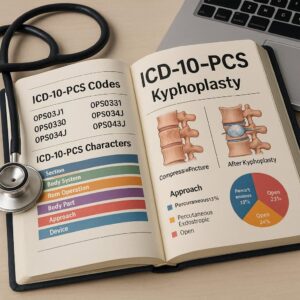
ICD-10-PCS Code for Kyphoplasty
2. Understanding the Clinical Procedure: Kyphoplasty vs. Vertebroplasty
To code a procedure correctly, one must first understand what the procedure entails. Confusion often arises between kyphoplasty and its cousin, vertebroplasty. While both address the same problem, their methodologies are distinct, and ICD-10-PCS captures this distinction with different root operations.
What is a Vertebral Compression Fracture (VCF)?
A Vertebral Compression Fracture is a collapse of one or more vertebrae, the bones that make up the spinal column. This collapse is often described as a “wedging” of the bone, as the front (anterior) part of the vertebra crumples more than the back. VCFs are most commonly caused by osteoporosis, which weakens the bone until it can no longer support normal stress. They can also result from trauma or malignancies (e.g., metastatic cancer). Symptoms include severe back pain, height loss, and a stooped-forward posture (kyphosis).
Vertebroplasty: The Predecessor
Vertebroplasty, developed first, is a relatively straightforward procedure. Under fluoroscopic guidance, a physician percutaneously inserts a needle directly into the fractured vertebra. Once the needle tip is correctly positioned, medical-grade bone cement (polymethylmethacrylate, or PMMA) is injected under high pressure directly into the collapsed vertebral body. The cement hardens quickly, stabilizing the fracture and providing pain relief by immobilizing the bone fragments.
Kyphoplasty: The Evolution with Balloon Tamp
Kyphoplasty is an evolution of vertebroplasty that involves an additional, critical step. The procedure begins similarly, with a percutaneous approach to the fractured vertebra. However, before injecting the cement, the physician inserts a specialized balloon tamp through the cannula. This balloon is carefully inflated within the vertebral body. This inflation serves two primary purposes:
-
It pushes the collapsed bone back toward its original height, repositioning the fracture fragments.
-
It creates a low-pressure cavity within the bone.
Once the cavity is created, the balloon is deflated and removed. The newly created space is then filled with a more controlled, viscous application of bone cement. Because the cement is not being injected under high pressure into a compact space, the risk of cement leakage—a known complication of vertebroplasty—is significantly reduced.
Key Clinical Differences and Implications
The core difference lies in the mechanical action. Vertebroplasty is primarily about filling and supplementing the fractured bone with cement. Kyphoplasty, by contrast, involves a deliberate mechanical maneuver to restore the bone’s position and shape before stabilization. This fundamental clinical difference is the cornerstone upon which correct ICD-10-PCS coding is built.
3. Navigating the ICD-10-PCS Universe: Foundational Concepts
ICD-10-PCS (Procedure Coding System) is a multi-axial system where each code is composed of seven characters. Each character represents a specific aspect of the procedure, and each has its own table of values. Unlike ICD-10-CM, there is no room for interpretation based on verbiage; the coder must map the documented procedure to the precise definitions within PCS.
-
Character 1: Section – The broadest category (e.g., Medical and Surgical, Obstetrics, Placement).
-
Character 2: Body System – The general physiological system or anatomical region involved.
-
Character 3: Root Operation – The objective of the procedure; this is the most critical conceptual component.
-
Character 4: Body Part/Region – The specific anatomical site where the root operation was performed.
-
Character 5: Approach – The technique used to reach the operative site.
-
Character 6: Device – The type of device used and, if applicable, whether it remains in the body.
-
Character 7: Qualifier – Provides additional information about the procedure (e.g., diagnostic, type of tissue).
For kyphoplasty, we will be working exclusively within the Medical and Surgical Section (0).
4. Deconstructing the Kyphoplasty Code: A Step-by-Step Build
Let us now construct a complete ICD-10-PCS code for a percutaneous kyphoplasty of the L1 vertebra.
Character 1: Section – 0
This is straightforward. Kyphoplasty is a surgical procedure, so it falls under the Medical and Surgical section.
Character 2: Body System – W (Anatomical Regions, General)
This is a crucial decision point. Why not the “Lower Bones” system? The PCS guidelines direct us that procedures performed on a specific body part are found in the relevant body system. However, procedures performed on the “general” anatomical region are found in the “Anatomical Regions, General” body system. The vertebrae are considered part of the general anatomical region of the spine. Therefore, for procedures like kyphoplasty that target the vertebral body itself for stabilization, the correct body system is W – Anatomical Regions, General.
Character 3: Root Operation – Reposition
This is the single most important character and the source of most coding errors for this procedure. Let’s examine the official PCS definition:
-
Reposition: “Moving to its normal location, or other suitable location, all or a portion of a body part.” The official definition further clarifies that the purpose of repositioning is to “normalize the alignment of a body part.”
Now, let’s compare this to the kyphoplasty procedure. The inflation of the balloon tamp is a deliberate act to move the compressed bone fragments back toward their normal anatomical position. The objective is to restore height and alignment. This action fits the definition of “Reposition” perfectly.
Let’s contrast this with other commonly considered, but incorrect, root operations:
-
Insertion: “Putting in a non-biological device that monitors, assists, performs, or prevents a physiological function but does not physically take the place of a body part.” The cement and the device are not “monitoring, assisting, performing, or preventing” a function in this context; they are stabilizing a structure.
-
Supplement: “Putting in or on a biological or non-biological material that physically reinforces and/or augments the function of a portion of a body part.” This is the correct root operation for Vertebroplasty, where the cement is used to augment and reinforce the fractured bone without a prior repositioning step. Kyphoplasty involves both repositioning and then supplementation, but the defining, distinct action is the repositioning.
-
Restriction: “Partially closing an orifice or the lumen of a tubular body part.” This does not apply to the vertebral body.
Therefore, the correct root operation for Kyphoplasty is Reposition.
Character 4: Body Part/Region – Lumbar Vertebra L1
Within the “Anatomical Regions, General” body system and the “Reposition” root operation table, we find the body part values. It is vital to select the precise vertebral level documented.
-
Upper Vertebral Regions:
-
W - Head and Neck Region(for C1-C2, though kyphoplasty here is rare) -
P - Upper Vertebral Region(for C3-C7)
-
-
Lower Vertebral Regions:
-
N - Lower Vertebral Region(for L1-L5) -
M - Lumbosacral Region(for L5-S1, sacrum) -
Specific codes exist for
Lumbar Vertebra L1,Lumbar Vertebra L2, etc., which are the most precise and should be used.
-
For our example, the body part is Lumbar Vertebra L1.
Character 5: Approach – Percutaneous
Kyphoplasty is, by design, a minimally invasive procedure. The physician accesses the vertebra through a small skin puncture, without a significant incision.
-
Percutaneous: “Entry, by puncture or minor incision, of instrumentation through the skin or mucous membrane and any other body layers necessary to reach the site of the procedure.” This is the standard and correct approach for kyphoplasty.
-
Open: “Cutting through the skin or mucous membrane and any other body layers necessary to expose the site of the procedure.” This would be used only in extremely rare, converted, or complex open surgical cases involving kyphoplasty.
-
Percutaneous Endoscopic: “Entry, by puncture or minor incision, of instrumentation through the skin or mucous membrane and any other body layers necessary to reach and visualize the site of the procedure.” While a scope may be used for visualization, the standard fluoroscopic guidance does not typically constitute an “endoscopic” approach in the PCS sense. “Percutaneous” is the default unless the documentation specifies an endoscopic technique.
For our example, the approach is Percutaneous.
Character 6: Device – Internal Fixation Device, Other
After the repositioning is complete, a device is used to maintain the new position. The balloon is temporary and is removed; it is not the device that remains. The bone cement is the permanent element that stabilizes the fracture. In PCS, the cement is classified under the device category.
-
Internal Fixation Device, Other: This is the catch-all term for an internal fixation device that does not have a more specific value (like a rod, plate, or screw). Since the bone cement acts as an internal splint to fixate the bone fragments in their new position, this is the appropriate device value.
It is critical to note that the device character is required for this root operation when a device is used to maintain the repositioning.
Character 7: Qualifier – Z (No Qualifier)
For this specific combination, there is no applicable qualifier. The value is Z.
Putting It All Together:
Our complete ICD-10-PCS code for a percutaneous kyphoplasty of the L1 vertebra is:
0WNG3ZZ
Let’s break it down visually:
-
0 – Medical and Surgical
-
W – Anatomical Regions, General
-
N – Reposition
-
G – Lumbar Vertebra L1
-
3 – Percutaneous
-
Z – Internal Fixation Device, Other
-
Z – No Qualifier
5. Advanced Coding Scenarios and Complex Cases
Coding becomes truly challenging with complex procedures. Here are some advanced scenarios.
Coding Multiple Vertebral Levels in a Single Session
If a physician performs a kyphoplasty on three separate vertebrae (e.g., T11, T12, L1) during the same operative session, you must assign three separate ICD-10-PCS codes. Each vertebral level is a distinct body part and requires its own code.
-
Code 1: 0WNG3ZZ (Reposition Lumbar Vertebra L1)
-
Code 2: 0WNF3ZZ (Reposition Lumbar Vertebra L2… Note: This is an example; you would use the specific thoracic codes for T11 and T12)
-
Code 3: [Code for the specific thoracic vertebra]
When Kyphoplasty is Combined with Other Procedures
A patient may require a spinal fusion for instability at one level and a kyphoplasty for a VCF at an adjacent level. These are separate and distinct procedures.
-
Spinal Fusion: Coded from the “Fusion” root operation table in the “Lower Bones” body system (for lumbar fusions). The root operation is “Fusion” (character E), and the device would often be an “Interbody Fusion Device.”
-
Kyphoplasty: Coded separately as described above.
You would report both codes, ensuring the body part and device characters are accurate for each.
Coding for Bone Biopsy During the Same Procedure
It is common to perform a biopsy of the vertebral body during a kyphoplasty to determine if the fracture is due to osteoporosis or malignancy.
-
Kyphoplasty: Code as 0WNG3ZZ.
-
Biopsy: This is a separate procedure. You would assign a second code from the “Medical and Surgical” section, root operation “Excision” (cutting out) or “Extraction” (pulling out), with the qualifier “X” for Diagnostic. The body part would be the same vertebra (e.g., Lumbar Vertebra L1). The code would be something like 0WNGXZZ (if using Extraction for a biopsy).
6. The Pervasive Challenge: Kyphoplasty vs. Vertebroplasty in ICD-10-PCS
As we have alluded to, the coding distinction is absolute and based on the root operation. The following table provides a clear, side-by-side comparison.
ICD-10-PCS Coding: Kyphoplasty vs. Vertebroplasty
| Feature | Kyphoplasty | Vertebroplasty |
|---|---|---|
| Clinical Goal | Restore vertebral height and stabilize fracture. | Stabilize fracture without height restoration. |
| Key Step | Inflation of a balloon tamp to create a cavity. | Direct injection of bone cement under pressure. |
| ICD-10-PCS Root Operation | Reposition (moving to normal location) | Supplement (putting in material to reinforce) |
| ICD-10-PCS Body System | Anatomical Regions, General (W) | Anatomical Regions, General (W) |
| Example Code (L1, Percutaneous) | 0WNG3ZZ | 0WNG32Z (Note the different 3rd and 6th characters) |
| Device Character | Internal Fixation Device, Other (Z) | Synthetic Substitute, Other (2) or Bone Void Filler (J) [See note below] |
| Clinical Documentation Key Words | “Balloon inflation,” “cavity creation,” “height restoration,” “tamp,” “reposition.” | “Cement injection,” “fill,” “stabilize,” “no balloon used.” |
Note on Vertebroplasty Device: The device for vertebroplasty has been a topic of discussion. The 2024 ICD-10-PCS update introduced a new device value J – Bone Void Filler, which is an appropriate and specific choice for the cement used in vertebroplasty. Prior to this, 2 – Synthetic Substitute was commonly used. Always consult the most current year’s code set.
7. Common Pitfalls and How to Avoid Them: Ensuring Compliance
-
Pitfall #1: Misidentifying the Root Operation. This is the most common and costly error. Coders sometimes see “cement” and default to “Supplement.” Solution: Interrogate the operative report. If a balloon was inflated to restore height, it is “Reposition.”
-
Pitfall #2: Incorrect Body Part/Region. Coding a lumbar vertebra as thoracic. Solution: Carefully review the preoperative imaging report and the operative note to confirm the exact vertebral level(s) treated.
-
Pitfall #3: Omitting the Device Character. Forgetting that the cement is coded as a device in the “Reposition” table. Solution: Remember that the 6th character is mandatory. After repositioning, a device is used to maintain the new position.
-
Pitfall #4: Confusing Approach Terms. Using “Percutaneous Endoscopic” without clear documentation of endoscopic visualization. Solution: Default to “Percutaneous” unless the physician explicitly documents the use of an endoscope.
8. Conclusion: Synthesizing Knowledge for Coding Excellence
Accurate ICD-10-PCS coding for kyphoplasty hinges on understanding the procedure’s core mechanical action: the repositioning of bone fragments. By meticulously building the code from the root operation outward and paying close attention to vertebral level, approach, and device, coders can achieve precision and ensure compliance. Always remember the critical distinction between kyphoplasty’s “Reposition” and vertebroplasty’s “Supplement,” and let the physician’s detailed operative report be your ultimate guide.
9. Frequently Asked Questions (FAQs)
Q1: What is the ICD-10-PCS code for a kyphoplasty at the T8 level?
A: The code would be 0WPF3ZZ. This breaks down as: Section 0, Body System W (Anatomical Regions), Root Operation P (Reposition), Body Part F (Thoracic Vertebra T8), Approach 3 (Percutaneous), Device Z (Internal Fixation Device, Other), Qualifier Z (None).
Q2: How do I code a kyphoplasty if the balloon tamp is used but no cement is injected (e.g., due to a complication)?
A: This is a complex scenario. If the repositioning with the balloon was successfully performed but the cement was not placed, you would still code the Reposition root operation. However, you would need to check the PCS table for the device character when no device remains. There may be an option for “No Device” or “Traction Device” (since the balloon was temporary). The exact code would depend on the available values in the current year’s PCS table, and the coder may need to consult the AHA Coding Clinic for guidance. The key is that the root operation (Reposition) was completed.
Q3: Our surgeon documents a “kyphoplasty” but does not mention a balloon. Should I code it as Reposition or Supplement?
A: This is a documentation clarification scenario. You cannot assume the use of a balloon. If the documentation only describes the injection of cement, it must be coded as a vertebroplasty (Root Operation: Supplement). It is crucial to query the physician for clarification to ensure accurate coding. The clinical distinction must be reflected in the documentation.
Q4: Can kyphoplasty be coded from the “Lower Bones” body system?
A: No. The ICD-10-PCS Official Guidelines for Coding and Reporting specify that procedures performed on the spine are coded in the “Anatomical Regions, General” body system (W), not the “Lower Bones” system. The “Lower Bones” system is for procedures on specific bones like the femur or tibia.
Date: November 29, 2025
Author: The Medical Coding Specialist Team
Disclaimer: *This article is intended for educational and informational purposes only. It is not a substitute for professional medical coding advice, official coding guidelines, or payer-specific policies. Medical coders must consult the current year’s official ICD-10-PCS code set, the AHA Coding Clinic, and individual payer guidelines for accurate and compliant coding. The authors and publishers are not responsible for any coding errors or compliance issues resulting from the use of this information.*
Meta Description: A definitive guide to ICD-10-PCS coding for Kyphoplasty and Vertebroplasty. Master root operations, anatomical approach, device coding, and common pitfalls with detailed examples, tables, and FAQs for complete coding confidence.


