
In the intricate world of modern healthcare, two parallel forms of precision dictate success: the surgeon’s skilled hands navigating the delicate structures of the human body, and the coder’s meticulous translation of that procedure into a universal, alphanumeric language. Nowhere is this duality more critical than in spinal surgery, where a millimeter’s deviation can have profound consequences, and a single character’s error in a code can lead to significant financial and administrative repercussions. This article focuses on a common, yet highly specific, spinal procedure: the laminectomy of the eighth thoracic vertebra (T8). Our journey will be to deconstruct this operation, not with a scalpel, but with the rigorous logic of the International Classification of Diseases, Tenth Revision, Procedure Coding System (ICD-10-PCS). We will embark on a deep dive into spinal anatomy, surgical technique, and the granular structure of ICD-10-PCS to arrive at the one correct code that encapsulates the entire event. This is more than an academic exercise; it is an essential exploration for medical coders, billers, surgeons, and healthcare administrators who understand that in today’s ecosystem, clinical excellence and coding accuracy are inextricably linked.
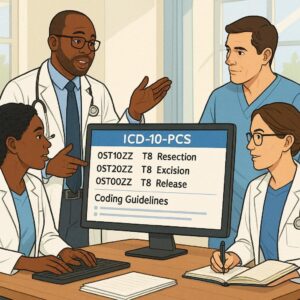
ICD-10-PCS Code for Laminectomy of T8
2. Understanding the Foundation: Spinal Anatomy and the Crucial Role of T8
To accurately code a procedure, one must first understand the landscape in which it occurs. The human spine is a marvel of bioengineering—a flexible yet sturdy column that provides structural support, allows for movement, and protects the most vital neural pathway: the spinal cord.
The spine is divided into five regions: cervical (neck), thoracic (mid-back), lumbar (lower back), sacral, and coccygeal (tailbone). The thoracic spine consists of 12 vertebrae, labeled T1 through T12. These vertebrae are unique because they articulate with the ribs, forming the thoracic cage that protects the heart and lungs.
The T8 vertebra sits in the lower third of the thoracic spine. A typical vertebra consists of a anterior vertebral body and a posterior vertebral arch. The vertebral arch is formed by two pedicles (short, thick processes that project backward) and two laminae (broad, flat plates that fuse in the midline to complete the arch). The space between the vertebral body and the vertebral arch is the vertebral foramen, and when stacked, these foramina create the spinal canal, which houses and protects the spinal cord.
[Image: A detailed anatomical diagram of the spine, highlighting the thoracic region and providing a close-up, labeled view of a typical thoracic vertebra, pointing out the Lamina, Spinous Process, Pedicle, and Vertebral Body.]
The lamina is the specific bony structure that is the target of a laminectomy. It acts as a protective roof over the spinal cord. At the T8 level, the spinal cord contains nerve tracts that relay motor and sensory information to and from the abdomen and lower trunk. Pathologies that compromise the space within the spinal canal at T8 can therefore lead to pain, weakness, or sensory changes in these areas.
3. What is a Laminectomy? Beyond the Basic Definition
A laminectomy is a surgical procedure that involves the removal of the lamina, the bony roof of the spinal canal. The term is often colloquially referred to as “decompression surgery.” Its primary goal is to alleviate pressure on the spinal cord or the nerve roots that branch off from it.
3.1. Indications for a T8 Laminectomy
A surgeon does not decide to remove the lamina of T8 arbitrarily. The decision is based on clear pathological indications, including:
-
Spinal Stenosis: A narrowing of the spinal canal, which can be congenital or, more commonly, acquired due to degenerative changes like arthritic spurring and thickening of the ligaments.
-
Herniated Disc: While less common in the rigid thoracic spine than in the cervical or lumbar regions, a disc herniation at T8 can protrude into the canal and compress the cord.
-
Spinal Tumors: Both benign and malignant tumors can grow within the spinal canal (intradural or extradural), requiring removal of the lamina for access and decompression.
-
Trauma: A traumatic fracture of the T8 vertebra can cause bone fragments to intrude into the spinal canal, necessitating decompression.
-
Infection: An epidural abscess or other severe infection can cause compression and require surgical drainage and decompression.
3.2. The Surgical Procedure: A Step-by-Step Walkthrough
Understanding the surgical steps is paramount to accurate coding. A standard open laminectomy of T8 typically proceeds as follows:
-
Anesthesia and Positioning: The patient is placed under general anesthesia and positioned prone (face down) on the operating table, with care taken to pad all pressure points.
-
Incision and Approach: The surgeon makes a midline vertical incision over the T8 spinous process. The subcutaneous tissues and muscles (the paraspinal muscles) are dissected and retracted laterally to expose the bony elements of the posterior spine—the spinous processes and laminae.
-
Identification of Anatomy: The T8 vertebra is precisely identified, often using intraoperative X-ray (fluoroscopy) to count up from the sacrum or down from the lower cervical vertebrae.
-
The Laminectomy Proper: Using specialized instruments like a high-speed burr, Kerrison rongeurs, and pituitary rongeurs, the surgeon carefully removes the spinous process of T8 and then the entire lamina on both sides. This “unroofing” of the spinal canal exposes the protective dura mater covering the spinal cord.
-
Decompression and Additional Work: With the spinal cord now visible, the surgeon can address the underlying pathology—removing a herniated disc fragment, debulking a tumor, or undercutting hypertrophic facet joints to further widen the canal.
-
Closure: The wound is irrigated with saline, hemostasis (control of bleeding) is achieved, and the muscle layers, subcutaneous tissues, and skin are sutured closed.
4. The ICD-10-PCS System: A Language of Medical Procedural Precision
ICD-10-PCS is not a mere update to its predecessor; it is a fundamentally different system. Developed by the Centers for Medicare & Medicaid Services (CMS) in the U.S., its primary purpose is to provide a detailed and precise procedure classification system for inpatient hospital settings.
4.1. The Philosophy Behind the Code: Why Seven Characters?
Unlike ICD-9-CM, which had a variable number of digits, every ICD-10-PCS code is exactly seven characters long. Each character represents a specific aspect of the procedure, chosen from a predefined table. This structure allows for immense specificity and a logical, building-block approach to code construction. The seven axes are:
-
Section: The general type of procedure (e.g., Medical and Surgical).
-
Body System: The physiological system involved (e.g., Central Nervous System).
-
Root Operation: The objective or definitive intent of the procedure (e.g., Excision).
-
Body Part: The specific anatomical site (e.g., Thoracic Vertebra, 8th).
-
Approach: The technique used to reach the operative site (e.g., Open).
-
Device: Any device that remains after the procedure (e.g., None).
-
Qualifier: An additional attribute that specifies a unique circumstance (e.g., Diagnostic).
5. Building the Code for T8 Laminectomy: A Character-by-Character Deconstruction
Now, we apply the ICD-10-PCS framework to build the code for a laminectomy of T8.
5.1. Section 0: Medical and Surgical
The first character is always 0. This section encompasses all procedures performed in an operating room that are invasive in nature.
5.2. Body System: Central Nervous System and Cranial Nerves
The laminectomy is performed to decompress the spinal cord, which is part of the central nervous system (CNS). The second character is 0, representing the “Central Nervous System and Cranial Nerves” body system.
5.3. Root Operation: The Core of the Procedure
This is the most critical and often the most challenging character to determine. The root operation describes the goal of the procedure.
-
Excision vs. Resection: A Critical Distinction
-
Excision (Root Operation B): “Cutting out or off, without replacement, a portion of a body part.” The qualifier portion is key. In a laminectomy, the surgeon is cutting out the lamina, which is a portion of the entire T8 vertebra. The body part (the vertebra) is not completely removed. Therefore, for a standard laminectomy, the correct root operation is Excision (B).
-
Resection (Root Operation T): “Cutting out or off, without replacement, all of a body part.” This would be used if the entire T8 vertebra were removed (e.g., in a corpectomy), which is a different and far more extensive procedure.
-
-
Other Potential Root Operations (Release, Division, etc.)
It is crucial to note that if the primary objective of the procedure is to free a body part from constraint (e.g., cutting ligamentous bands compressing a nerve root), the root operation Release (N) might be considered. However, when the release is accomplished by cutting and removing a bony structure (the lamina), the root operation of cutting out that bony structure (Excision) takes precedence. The decompression (release) is the outcome of the excision.
5.4. Body Part: Zeroing in on the 8th Thoracic Vertebra
The fourth character specifies the body part. In the “Central Nervous System” body system table, the body part values for vertebrae are found under the general category of “Spinal Cord” and “Spinal Meninges.” The specific body part value for the 8th Thoracic Vertebra is P. It is essential to use the official PCS tables to verify this, as the alphanumeric values are not intuitive.
5.5. Approach: How the Surgeon Accesses the Spine
The fifth character describes the surgical approach. For our described standard procedure, the surgeon cuts through the skin and soft tissues to directly visualize the spine. This is an Open (0) approach. Other approaches like Percutaneous (3) or Percutaneous Endoscopic (4) are possible for certain spinal procedures but are not typical for a standard laminectomy.
5.6. Device: The “Z” Character and Its Significance
The sixth character identifies a device that remains in the body after the procedure. In a simple laminectomy, no device is implanted. The character for “No Device” is Z.
5.7. Qualifier: The Final Piece of the Puzzle
The seventh character is a qualifier that provides additional information. In the context of an excision from the Central Nervous System, the qualifier can specify the purpose. For a therapeutic laminectomy performed to treat a known condition like stenosis, the qualifier is X, meaning Diagnostic. This can be confusing, as “Diagnostic” in PCS often refers to procedures that are performed for the purpose of obtaining a specimen for pathology, which is a routine part of any excision. The official guidelines state that if a procedure is both diagnostic and therapeutic, the qualifier “Diagnostic” is used. The alternative, No Qualifier (Z), is used only when the procedure is solely therapeutic and no specimen is taken. Since a lamina specimen is almost always sent to pathology, X (Diagnostic) is the appropriate qualifier.
6. The Final Code and Common Scenarios: Putting It All Together
Assembling all seven characters, we arrive at the complete ICD-10-PCS code for a standard open laminectomy of the T8 vertebra.
ICD-10-PCS Code Components for a Standard Open Laminectomy of T8
| Character Position | Axis Description | Value | Meaning |
|---|---|---|---|
| 1 | Section | 0 | Medical and Surgical |
| 2 | Body System | 0 | Central Nervous System |
| 3 | Root Operation | B | Excision |
| 4 | Body Part | P | Thoracic Vertebra, 8th |
| 5 | Approach | 0 | Open |
| 6 | Device | Z | No Device |
| 7 | Qualifier | X | Diagnostic |
| FULL CODE | 00BP0ZX | Excision of 8th Thoracic Vertebra, Open Approach, Diagnostic |
This code, 00BP0ZX, is a complete and precise representation of the procedure.
7. Navigating Complexities: Associated Procedures and Combined Codes
A T8 laminectomy is rarely performed in isolation. Coders must be vigilant to code all procedures performed during the same operative session.
-
Laminectomy with Discectomy: If the surgeon also removes a herniated disc at the T8-T9 level, this is a separate procedure. It would be coded with a root operation of Excision (B) from the same body system, but the body part would be the Thoracic Intervertebral Disc, T8-T9, resulting in a separate code (e.g., 00BP0ZX for the laminectomy and 00RQ0ZZ for the discectomy).
-
Laminectomy with Spinal Fusion: This is a very common combination. The laminectomy provides decompression, and the fusion provides stabilization. Fusion is coded separately with a root operation of Fusion (G) in the Musculoskeletal System body system (Section 0, Body System N). The fusion would have its own set of codes describing the body part(s) fused, the approach, and the device used (e.g., interbody cage, rods, screws). This is a complex coding scenario that requires careful review of the operative report.
-
Laminectomy for Tumor Excision: If the laminectomy is performed primarily to access and remove a spinal cord tumor, the root operation for the tumor removal itself would be Excision (B) or Resection (T) of the tumor from the Central Nervous System body part. The laminectomy is then the approach for that more definitive procedure and may not be coded separately if it is considered integral to the tumor removal. This requires careful application of the ICD-10-PCS coding guidelines regarding the “procedure which most closely satisfies the objective of the procedure.”
8. The Critical Link: Accurate Coding’s Impact on Reimbursement and Healthcare Data
The consequences of inaccurate coding extend far beyond a simple clerical error. The code 00BP0ZX is used for:
-
DRG Assignment: Inpatient payments are often determined by Diagnosis-Related Groups (DRGs). The procedures performed are a major factor in DRG assignment. An incorrect code could place the patient stay in a lower-paying DRG, resulting in significant financial loss for the hospital.
-
Healthcare Analytics and Research: Accurate procedural data is the bedrock of public health research, tracking surgical outcomes, and understanding the epidemiology of surgical care. Miscoded data leads to flawed conclusions.
-
Regulatory Compliance: Incorrect coding can be construed as fraud or abuse, leading to audits, hefty fines, and legal penalties.
9. Conclusion: The Art and Science of Procedural Coding
Coding a T8 laminectomy is a process that demands a synthesis of anatomical knowledge, surgical understanding, and meticulous attention to the rules of ICD-10-PCS. The journey from the surgeon’s incision to the final code 00BP0ZX is a testament to the critical role of the medical coder as a translator and data scientist in the healthcare continuum. By building the code character-by-character, grounded in the official documentation of the operative report, coding professionals ensure financial integrity, contribute to valuable health data, and ultimately support the delivery of high-quality patient care.
10. Frequently Asked Questions (FAQs)
Q1: What is the ICD-10-PCS code for a minimally invasive laminectomy of T8?
A1: The code would change based on the approach. If it’s a percutaneous endoscopic procedure, the approach character (the 5th character) would change from Open (0) to Percutaneous Endoscopic (4). The code would be 00BP4ZX. The specific approach must be clearly documented in the operative report.
Q2: How do I code a laminectomy if multiple thoracic levels are done, for example, T7, T8, and T9?
A2: ICD-10-PCS requires a separate code for each distinct body part. You would report three codes: one for excision of the 7th thoracic vertebra (00BN0ZX), one for the 8th (00BP0ZX), and one for the 9th (00BR0ZX).
Q3: The surgeon’s report says “L5 laminectomy,” but the coder used the Musculoskeletal system. For T8, you used the Central Nervous system. Why the difference?
A3: This is an excellent and crucial question. The ICD-10-PCS tables provide different options. Procedures on vertebrae that are performed for disorders of the spinal cord (like stenosis compressing the cord) are typically found in the Central Nervous System body system (0). Procedures on vertebrae that are performed for disorders of the bone itself (e.g., a fracture or infection) or for conditions primarily affecting the nerve roots in the lower spine (like a lumbar discectomy for radiculopathy) are often found in the Musculoskeletal System body system (N). The coder must use the principal diagnosis and the surgeon’s stated objective to determine the correct body system table. For a T8 laminectomy due to spinal cord compression, the Central Nervous System table is appropriate.
Q4: What if the laminectomy is performed as part of a trauma case where the lamina is fractured? Is the root operation still “Excision”?
A4: In a trauma case, the root operation could be Excision (B) if a portion of the fractured bone is cut out. However, if the procedure involves putting the fracture fragments back together, the root operation might be Reposition (S). The operative report’s description of the surgeon’s actions is paramount.
Date: November 17, 2025
Author: The Medical Coding Specialist
Disclaimer: This article is intended for educational and informational purposes only and is designed to be a unique, original work. It is not a substitute for professional medical coding advice, official coding guidelines, or the current ICD-10-PMS manual. Always consult the most recent official resources and payer-specific policies for definitive coding guidance.


