
Imagine a busy emergency department. A patient arrives with a significant scalp laceration, the result of a fall. Blood mats their hair, and beneath the surface, layers of tissue are disrupted. The physician’s focus is clinical: assess, anesthetize, irrigate, and repair. Their documentation tells the story of the injury and the intervention. But this story has a second, equally critical audience: the medical coder. For the coder, this narrative must be translated into a precise, alphanumeric language—the International Classification of Diseases, Tenth Revision, Procedure Coding System (ICD-10-PCS). This translation is not a mere administrative task; it is the linchpin that connects patient care to data analytics, reimbursement, and the very integrity of the healthcare record. A single misstep in code selection can distort the severity of the case, lead to claim denials, and obscure vital public health data.
This article is designed to be the definitive guide for navigating the nuanced world of ICD-10-PCS coding for one of the most common yet deceptively complex procedures: the repair of a scalp laceration. We will move beyond simple code look-ups and delve into the “why” behind the “what.” We will dissect the anatomy of the scalp, explore the foundational principles of the PCS system, and master the art of selecting the correct root operation. Through detailed clinical scenarios, a comprehensive reference table, and a discussion of common pitfalls, this guide will empower medical coders, billing specialists, students, and even clinicians to achieve a level of precision that ensures clinical documentation is accurately reflected in the coded data. Our journey is not just about finding a code; it’s about understanding the procedural landscape of scalp repair from the skin surface down to the galea aponeurotica and beyond.
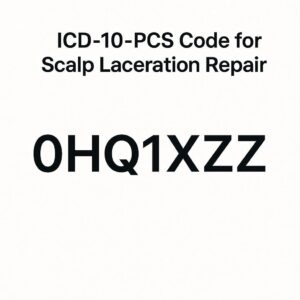
ICD-10-PCS Code for Scalp Laceration Repair
2. Deconstructing the Scalp: A Primer on Anatomical Layers for the Coder
To code a repair procedure accurately, one must first understand what is being repaired. The scalp is not a single layer of skin; it is a complex, multi-layered structure, each layer with specific clinical and coding implications. The familiar acronym “SCALP” serves as a perfect mnemonic for its five distinct layers:
-
S: Skin – This is the outermost layer, thick and hair-bearing, rich with sebaceous glands and hair follicles. A laceration confined to this layer is typically superficial.
-
C: Connective Tissue – A dense, fibrous and fatty subcutaneous layer. This is where the neurovascular structures (nerves and blood vessels) reside. This layer is highly vascular, which is why scalp lacerations can bleed so profusely.
-
A: Aponeurosis (Galea Aponeurotica) – This is a critical layer from a coding perspective. The galea is a tough, tendon-like sheet of fibrous tissue that connects the frontalis muscle (forehead) to the occipitalis muscle (back of the head). It provides structural integrity to the scalp.
-
L: Loose Areolar Connective Tissue – This is a potential space beneath the galea. It is a plane of loose connective tissue that allows the overlying layers to move freely over the skull. Infections can spread easily through this layer.
-
P: Pericranium – The periosteum of the skull bones. It is the deepest layer, a dense membrane that supplies blood to the bone.
Why does this anatomy matter to a coder? The depth of the laceration, as documented by the provider, directly dictates the correct Body Part character in the ICD-10-PCS code. A repair involving only the skin and superficial connective tissue will map to a different body part value than a repair that involves the galea aponeurotica. The coder must be a detective, scrutinizing the operative report or procedure note for keywords that indicate depth: “superficial,” “full-thickness,” “involving the galea,” “subcutaneous layer,” etc. This anatomical knowledge is the first and most crucial step in accurate code assignment.
(Image: A detailed anatomical diagram of the scalp, clearly labeling all five layers (SCALP) and showing how a laceration might extend through each one.)
3. The Foundation of ICD-10-PCS: Understanding the Medical and Surgical Section
The ICD-10-PCS system is built on a logical, multi-axial structure. Each code is composed of seven alphanumeric characters, each representing a specific aspect of the procedure. For procedures in the Medical and Surgical section (the first character “0”), the meaning of each character position is as follows:
-
Character 1: Section – Identifies the broad section of the procedure. For our purposes, this is always 0 (Medical and Surgical).
-
Character 2: Body System – Identifies the general body system. For scalp laceration repairs, this is almost always 0 (Skin and Subcutaneous Tissue) or, in the case of reattachment, M (Musculoskeletal System).
-
Character 3: Root Operation – This is the cornerstone of the code. It defines the objective of the procedure. For scalp laceration repair, the two primary root operations are Repair and Reattachment. We will explore these in profound detail in the next section.
-
Character 4: Body Part – Specifies the specific anatomical site. This is where our knowledge of scalp anatomy is applied (e.g., Scalp, Skin of Scalp, Subcutaneous Tissue of Scalp).
-
Character 5: Approach – Describes the technique used to reach the procedure site (e.g., Open, Percutaneous, External).
-
Character 6: Device – Identifies any device that remains after the procedure is completed (e.g., Sutures, Tissue Adhesive).
-
Character 7: Qualifier – Provides additional information about the procedure. For many repair procedures, this is a Z (No Qualifier).
This structured approach means that every code tells a complete story: What was done (Root Operation), Where was it done (Body Part), How did they get there (Approach), and What was left behind (Device)?
4. The Heart of the Matter: Selecting the Correct Root Operation
The selection of the Root Operation (Character 3) is the single most critical decision in building an accurate ICD-10-PCS code. For scalp lacerations, the coder is typically choosing between two options.
4.1. Root Operation “Repair”: Closing the Defect
The official definition of the root operation Repair is: Restoring, to the extent possible, a body part to its normal anatomic structure and function.
The Key Point: Repair is used when the procedure is performed on a body part that is functionally intact, but its structure has been compromised. A laceration, a tear, or a rupture qualifies. The body part is still there; it’s just broken and needs to be fixed.
Coding for Repair:
-
Body System: 0 (Skin and Subcutaneous Tissue)
-
Root Operation: Q (Repair)
-
Body Part: This varies based on depth.
-
Skin of Scalp: Used for repairs confined to the epidermal and dermal layers.
-
Subcutaneous Tissue of Scalp: Used for repairs involving the deeper connective tissue but not involving the galea aponeurotica.
-
Scalp: This is a crucial distinction. The body part “Scalp” is used when the repair involves the muscle or fascia of the scalp—which, anatomically, refers to the galea aponeurotica.
-
4.2. Root Operation “Reattachment”: The Critical Time-Sensitive Procedure
The official definition of the root operation Reattachment is: Putting back in or on all or a portion of a separated body part to its normal location or other suitable location.
The Key Point: Reattachment is used when a body part has been completely severed (amputated, avulsed) and is being physically reconnected. This is a far more complex procedure than a simple repair, involving microsurgical techniques to reconnect blood vessels and nerves.
Coding for Reattachment:
-
Body System: M (Musculoskeletal System)
-
Root Operation: M (Reattachment)
-
Body Part: The body part values here are broader, such as “Scalp.” The focus is on the reattachment of the entire avulsed segment.
The Coder’s Dilemma: The distinction is clear in theory but can be blurry in documentation. A “scalp avulsion” might refer to a severe tearing injury where the scalp is hanging by a flap but not completely detached. If it is not completely detached, it is not a reattachment. The coder must look for explicit terms like “complete amputation,” “complete avulsion,” “severed,” or documentation of microvascular anastomosis to assign Reattachment correctly. In the absence of such documentation, Repair is the default.
5. The Seventh Character Symphony: Building the Complete ICD-10-PCS Code
With the Root Operation and Body System determined, we now build the rest of the code by selecting the appropriate characters for Body Part, Approach, and Device.
5.1. The Body Part Key: Scalp, Skin, and Subcutaneous Tissue
As introduced earlier, the Body Part character is driven by depth. The coder must be a meticulous reader of the procedure note.
-
“Superficial laceration, closed with sutures” -> Points to Skin of Scalp.
-
“Laceration extended into the subcutaneous tissue, closed in layers” -> If the galea is not mentioned, this points to Subcutaneous Tissue of Scalp.
-
“Deep laceration with disruption of the galea aponeurotica. The galea was re-approximated with interrupted sutures” -> This explicitly points to Scalp (as the body part value “Scalp” includes its muscle/fascia layer).
5.2. The Approach Character: From External to Open
The Approach describes how the surgeon reached the site of the procedure.
-
External (X): No incision is made. The procedure is performed directly on the skin surface. The application of tissue adhesive (skin glue) or Steri-Strips™ to a superficial laceration is coded with an External approach.
-
Percutaneous (3): The procedure is performed via a puncture or stick through the skin, without direct visualization. This is uncommon for standard scalp laceration repair but could be used for some deep suture techniques.
-
Open (0): The procedure involves cutting through the skin or mucous membrane and any other body layers necessary to expose the site of the procedure. A layered closure, where the surgeon dissects down to the galea to place deep sutures, is an Open approach.
5.3. The Device Character: The Nuances of Sutures and Tissue Adhesive
The Device character identifies a device that remains after the procedure is complete.
-
Synthetic Substitute (J): This is the value used for sutures (both absorbable and non-absorbable) in the context of a Repair procedure. The suture material is considered a synthetic device left in place.
-
Tissue Adhesive (C): This is the value used for skin glue (e.g., Dermabond®).
-
No Device (Z): Used when no device is left, such as when a laceration is repaired with Steri-Strips™ alone.
6. Clinical Scenarios Decoded: From Simple to Complex
Let’s apply our knowledge to real-world documentation.
6.1. Scenario 1: The Simple Superficial Laceration
Procedure Note: “The patient sustained a 3 cm superficial laceration to the right parietal scalp. The wound was irrigated and prepped. It was closed with simple interrupted 4-0 nylon sutures.”
-
Analysis: The laceration is superficial (Skin). The procedure is Repair. Sutures were used.
-
ICD-10-PCS Code: 0HQ0XZZ
-
0: Medical and Surgical
-
H: Skin and Subcutaneous Tissue
-
Q: Repair
-
0: Skin of Scalp
-
X: External
-
Z: No Device (Note: While sutures are used, for an External approach repair of the skin, the sutures are not specified with a device character. The device character is only used for Open and Percutaneous approaches in the Skin and Subcutaneous Tissue body system for Repair.)
-
Z: No Qualifier
-
6.2. Scenario 2: The Deep, Complex Layered Repair
Procedure Note: “A 5 cm stellate laceration to the vertex of the scalp was explored. The wound extended through the skin and subcutaneous tissue, with a 2 cm tear in the galea aponeurotica. The wound was copiously irrigated. The galea was re-approximated with interrupted 3-0 Vicryl sutures. The subcutaneous tissue was closed with 4-0 Vicryl, and the skin was closed with staples.”
-
Analysis: The key phrase is “tear in the galea aponeurotica.” This elevates the body part to “Scalp” (muscle/fascia). It is a Repair. The approach is Open, as the surgeon had to expose the galea. Sutures (synthetic substitute) were used.
-
ICD-10-PCS Code: 0HQ90JZ
-
0: Medical and Surgical
-
H: Skin and Subcutaneous Tissue
-
Q: Repair
-
9: Scalp
-
0: Open
-
J: Synthetic Substitute (for the sutures re-approximating the galea)
-
Z: No Qualifier
-
6.3. Scenario 3: The Traumatic Avulsion and Reattachment
Procedure Note: “The patient suffered a complete avulsion of a 4×5 cm segment of the left temporal scalp from a machinery accident. The avulsed segment was brought in on ice. Under microscopic visualization, the arterial and venous supply was identified and anastomosed. The galea and skin were then closed in layers.”
-
Analysis: The term “complete avulsion” is the key. This is not a repair; it is a Reattachment. The body system changes to Musculoskeletal.
-
ICD-10-PCS Code: 0MM00ZZ
-
0: Medical and Surgical
-
M: Musculoskeletal System
-
M: Reattachment
-
0: Scalp
-
0: Open
-
Z: No Device
-
Z: No Qualifier
-
7. Navigating Common Pitfalls and Documentation Challenges
Even experienced coders can stumble. Here are common pitfalls:
-
Assuming All Sutures Mean the Same Thing: The depth of the sutures matters. Superficial skin sutures are part of an External approach repair of the Skin. Deep sutures to the galea constitute an Open approach repair of the Scalp.
-
Confusing Debridement with Repair: If the provider extensively debrides devitalized tissue from the wound edges before repair, this may be coded separately. However, simple wound irrigation and minimal trimming of ragged edges are considered part of the repair procedure and are not coded separately.
-
Overlooking the Galea: The most common source of error is missing the documentation about the galea. Coders must be trained to recognize “galea,” “frontalis muscle,” “occipitalis muscle,” and “fascia of the scalp” as triggers for the body part “Scalp.”
-
Miscoding Tissue Adhesive: Using tissue adhesive on a superficial skin laceration is correctly coded as Repair of Skin of Scalp, External Approach, with Device of Tissue Adhesive: 0HQ0XCZ.
8. The Importance of Continuous Education and Auditing
The world of medical coding is dynamic. Official Coding Guidelines are updated annually, and payer policies evolve. Continuous education through webinars, workshops, and professional forums (like those offered by AHIMA and AAPC) is not a luxury but a necessity. Furthermore, internal and external audits are vital for maintaining coding integrity. They serve as a quality check, identifying areas for improvement for individual coders and the practice as a whole, ensuring compliance and maximizing accurate reimbursement.
9. Conclusion
Accurate ICD-10-PCS coding for scalp laceration repair hinges on a deep understanding of scalp anatomy and the precise definitions within the PCS framework. The coder’s role is to meticulously translate clinical documentation—specifically the depth of injury and the repair technique—into the correct seven-character code. By mastering the distinction between Root Operations Repair and Reattachment, correctly identifying the body part based on layered anatomy, and appropriately specifying the approach and device, healthcare organizations can ensure data integrity, support appropriate reimbursement, and contribute to valuable health outcomes research.
10. Frequently Asked Questions (FAQs)
Q1: How do I code a scalp laceration repaired with Steri-Strips™ only?
A1: This would be coded to the Root Operation Repair, Body Part Skin of Scalp, Approach External, with No Device. The complete code would be 0HQ0XZZ.
Q2: The provider documented a “through-and-through” laceration involving the galea. Is this Reattachment?
A2: No. “Through-and-through” indicates the laceration goes through all layers, but the scalp is not completely severed from the body. This is a Repair of the body part Scalp (0HQ90JZ), as it involves the muscle/fascia.
Q3: A complex laceration was repaired, and a drain was placed in the wound. How is this coded?
A3: The laceration repair is coded as described in this article. The placement of the drain is a separate procedure. You would assign an additional code for the drainage procedure, typically using the Root Operation Drainage from the Medical and Surgical section, with the appropriate body part and approach.
Q4: What if the documentation is unclear about whether the galea was involved?
A4: In coding, if it is not documented, it was not done. You should not assume the galea was involved. If the documentation only states “deep laceration” without specifying the galea, you should query the provider for clarification. In the absence of a query response, code to the deepest documented layer (e.g., Subcutaneous Tissue).
Date: November 29, 2025
Author: Medical Coding Insights Institute
Disclaimer: The information contained in this article is for educational and informational purposes only and is not a substitute for professional medical coding advice, official coding guidelines, or the current, complete ICD-10-PCS code set. Coders must rely on their own clinical knowledge, provider documentation, and the most current official coding resources and guidelines to ensure accurate code assignment. The authors and publishers are not responsible for any errors, omissions, or any consequences resulting from the use of this information.


