
In the vast and intricate ecosystem of modern healthcare, data is the lifeblood. While diagnoses tell us what is wrong with a patient, procedures tell us what was done about it. This distinction is not merely academic; it is fundamental to billing, reimbursement, surgical outcome analysis, healthcare economics, and advanced medical research. Enter the International Classification of Diseases, 10th Revision, Procedure Coding System (ICD-10-PCS), a monumental, purpose-built framework for cataloging every medical, surgical, and diagnostic intervention performed in a hospital inpatient setting in the United States.
Imagine a language so precise that it can distinguish between trimming the edge of a meniscus and removing the entire structure, between placing a stent to open a vessel and plugging it shut permanently. This is the power of ICD-10-PCS. It is not an update to its predecessor, ICD-9-CM Volume 3, but a complete reinvention—a shift from a limited, numeric classification to a rich, multi-axial alphanumeric architecture. With over 87,000 available codes (compared to approximately 4,000 in ICD-9-CM), it offers an unprecedented capacity for specificity. This article is your deep dive into this architectural marvel. We will move beyond memorization to cultivate understanding, exploring the logic, structure, and application of ICD-10-PCS to empower you to code with confidence and insight.
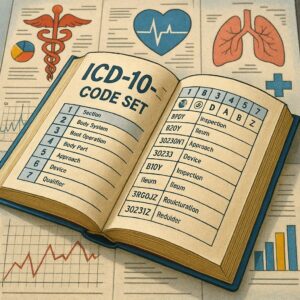
ICD-10-PCS Code Set
2. The Genesis and Philosophy of ICD-10-PCS: A Break from the Past
The development of ICD-10-PCS, led by the Centers for Medicare & Medicaid Services (CMS), was driven by the critical limitations of ICD-9-CM. The old system was running out of numbers, was often non-intuitive, and lacked the granularity needed for contemporary medicine, especially with the rapid advent of new technologies like robotic-assisted surgery and percutaneous interventions.
The core philosophy of ICD-10-PCS is built on several foundational principles:
-
Complete Specificity: Each code must describe a procedure as uniquely as possible within its defined axes.
-
Standardized Terminology: Each term has one precise meaning, eliminating clinical jargon and ambiguity.
-
Multi-Axial Structure: Each character in the 7-character code represents a distinct aspect (axis) of the procedure, such as the what (root operation), where (body part), and how (approach).
-
Expandability: The alphanumeric structure allows for the seamless addition of new codes without disrupting the existing framework.
This philosophical shift transforms coding from a lookup task to a logical, building-block process.
3. The Architectural Blueprint: Deconstructing the 7-Character Alphanumeric Code
Every ICD-10-PCS code is a 7-character string, where each character occupies a specific position and has a defined set of possible values (numbers 0-9 or letters A-H, J-N, P-Z, excluding O and I to avoid confusion with 0 and 1).
The 7-Character Structure:
-
Character 1: Section. This is the highest level of classification, identifying the broad procedure type (e.g., Medical and Surgical, Obstetrics, Imaging).
-
Character 2: Body System. Refines the section, specifying the general physiological system (e.g., Central Nervous, Cardiovascular, Gastrointestinal).
-
Character 3: Root Operation. The cornerstone of the code. It defines the objective of the procedure—what the provider accomplished. This is the most critical conceptual element.
-
Character 4: Body Part. Identifies the specific anatomical site where the root operation was performed.
-
Character 5: Approach. Describes the technique used to reach the site (e.g., Open, Percutaneous, Via Natural or Artificial Opening).
-
Character 6: Device. Specifies any device that remains in or on the body part after the procedure is completed (e.g., synthetic substitute, stent, infusion device).
-
Character 7: Qualifier. Provides additional contextual information that does not fit elsewhere (e.g., diagnostic vs. therapeutic, a qualifier for a specific type of graft).
This structure is consistent across the system, making it predictable and logical.
4. The 31 Medical and Surgical Sections: A World of Possibilities
4.1. The Foundation: The Medical/Surgical Section (0) and its 31 Root Operations
The Medical and Surgical section (Section 0) is the largest and most complex. Its mastery begins with the 31 Root Operations. These are grouped conceptually:
-
Taking Out Some/All of a Body Part: Excision, Resection, Destruction, Extraction.
-
Taking Out Solids/Fluids/Gases from a Body Part: Drainage, Extirpation, Fragmentation.
-
Putting In/Putting Back or Moving Some/All of a Body Part: Insertion, Replacement, Supplement, Transplantation, Reposition, Transfer.
-
Altering the Diameter/Route of a Tubular Body Part: Dilation, Occlusion, Restriction, Bypass.
-
Other Objectives: Inspection, Map, Control, Repair, Fusion, Creation.
Each root operation has a precise, standardized definition. For example:
-
Excision: Cutting out or off, without replacement, a portion of a body part.
-
Resection: Cutting out or off, without replacement, all of a body part.
-
Destruction: Physical eradication of a body part in situ (e.g., ablation, fulguration).
4.2. Navigating the Axes: Body System, Approach, Device, and Qualifier
Once the root operation is identified, the other axes provide context. The Body Part character (4) requires precise anatomical knowledge. The Approach character (5) is vital; for instance, a laparoscopic (percutaneous endoscopic) appendectomy is fundamentally different in terms of recovery and risk than an open one. The Device character (6) is used only if a device remains post-procedure. The Qualifier (7) often distinguishes between autologous versus synthetic materials or diagnostic versus therapeutic intent.
5. Beyond the Operating Room: Exploring Other Sections (1-9, B-D, F-H)
ICD-10-PCS comprehensively covers the entire inpatient experience:
-
Sections 1-9, B-D: These cover Obstetrics, Placement, Administration, Measurement and Monitoring, Extracorporeal Assistance and Performance, Extracorporeal Therapies, Osteopathic, Other Procedures, and Chiropractic.
-
Sections F-H: Imaging (Diagnostic and Therapeutic), Nuclear Medicine, and Radiation Therapy.
For example, administering intravenous insulin is coded in the Administration section (3E0), not Medical/Surgical. A chest X-ray is found in the Imaging section (BW).
6. The Logic Engine: A Step-by-Step Guide to Building a Code
Let’s apply the logic. Consider: “Laparoscopic cholecystectomy.”
-
Identify the Root Operation: The gallbladder is being taken out. Is it Excision or Resection? The definition of Resection is cutting out or off all of a body part. A cholecystectomy removes the entire gallbladder. Root Operation = Resection (T).
-
Identify the Section & Body System: It’s a surgical procedure on the hepatobiliary system. Section = Medical and Surgical (0). Body System = Hepatobiliary System and Pancreas (F).
-
Identify the Body Part: Gallbladder. In the PCS table, the specific value is Gallbladder (3).
-
Identify the Approach: Laparoscopic. In PCS, this is Percutaneous Endoscopic (4).
-
Device: No device remains. Device = No Device (Z).
-
Qualifier: None needed for this procedure. Qualifier = No Qualifier (Z).
Final Code: 0FT44ZZ – Resection of Gallbladder, Percutaneous Endoscopic Approach.
7. The Art of the Index and Tables: Your Roadmap to Accuracy
While understanding logic is key, the official ICD-10-PCS Index and Tables are your essential tools. You always start in the Index, but you must verify the code in the corresponding Table. The Table is a grid that displays all possible combinations for a given Section, Body System, and Root Operation, allowing you to select the correct characters for Body Part, Approach, Device, and Qualifier.
8. Clinical Concepts in Code: A Deep Dive into Complex Root Operations
8.1. Excision vs. Resection vs. Destruction
-
Excision (B): Partial removal. Example: Biopsy of a liver lesion (removing a piece for pathology).
-
Resection (T): Total removal. Example: Lobectomy of the liver (removing an entire lobe).
-
Destruction (5): Eradication without removal. Example: Cryoablation of a liver tumor.
8.2. The Nuances of Repair, Supplement, and Restriction
-
Repair (Q): Fixing a malfunctioning or ruptured body part (e.g., suturing a laceration).
-
Supplement (U): Using material to physically reinforce or augment a body part (e.g., adding a mesh for a hernia repair).
-
Restriction (V): Making an orifice or lumen smaller (e.g., placing a gastric band).
8.3. Transplantation vs. Administration vs. Fusion
Understanding these distinctions is critical for accurate coding in complex cases.
9. Case Studies: From Operative Report to Final Code
Case Study 1: Robotic-Assisted Prostatectomy with Nerve-Sparing
We would walk through identifying the root operation (Resection), body system (Male Reproductive System), body part (Prostate), approach (Open, with the qualifier for robotic assistance), and any devices.
Case Study 2: Percutaneous Coronary Intervention with Drug-Eluting Stent
This involves two procedures: Dilation of the coronary artery and Insertion of a stent. Two codes are required.
10. The Critical Role of Devices: New Technology, Materials, and Challenges
The Device axis (Character 6) is where technological innovation is captured. The distinction between a “drug-eluting intraluminal device” and a “non-drug-eluting intraluminal device” is a prime example, impacting reimbursement and outcomes tracking. Coders must stay abreast of new devices approved for use.
11. ICD-10-PCS in Action: Impact on Reimbursement, Analytics, and Public Health
ICD-10-PCS codes feed into MS-DRGs (Medicare Severity-Diagnosis Related Groups), which determine hospital payment. Greater specificity improves the accuracy of DRG assignment. Beyond billing, this granular data enables:
-
Advanced Outcomes Research: Comparing effectiveness of different surgical approaches.
-
Quality Measurement: Tracking rates of specific complications related to devices or techniques.
-
Public Health Surveillance: Monitoring the volume and types of procedures performed nationally.
12. Common Pitfalls and Pro-Tips for Expert-Level Coding
-
Pitfall: Confusing root operations (e.g., using Excision for a total removal).
-
Pro-Tip: Always return to the formal PCS definitions.
-
Pitfall: Missing the need for multiple codes (e.g., a procedure that involves both taking something out and putting something in).
-
Pro-Tip: Code each distinct objective separately.
-
Pitfall: Ignoring the Device character when a device is left in place.
-
Pro-Tip: Scrutinize the operative report’s “procedure in detail” and “implants” sections.
13. The Future Horizon: ICD-11-PCS and Beyond
The World Health Organization (WHO) has released ICD-11, which includes a procedural code set. While the US has not set a timeline for transitioning from ICD-10 to ICD-11 for mortality or morbidity (let alone procedures), awareness is key. ICD-11-PCS is even more detailed and has a different structure, potentially allowing for greater clinical detail and digital interoperability.
14. Conclusion
The ICD-10-PCS code set is far more than a billing requirement; it is a sophisticated language of modern medicine. Its logical, multi-axial architecture provides the granularity needed to precisely document the full scope of inpatient procedural care. Mastering its principles—the 31 root operations, the consistent character meanings, and the imperative to code to the greatest specificity—empowers Health Information Management (HIM) professionals to ensure accurate reimbursement, contribute to vital health data analytics, and ultimately, support the delivery of higher-quality patient care. As medicine evolves, so too will this foundational system, demanding continual learning and engagement from every coding professional.
15. Frequently Asked Questions (FAQs)
Q1: Is ICD-10-PCS used for physician office visits?
A: No. ICD-10-PCS is used only for reporting procedures performed in hospital inpatient settings. Physician services, including surgeries performed in outpatient hospital departments or ambulatory surgical centers, are coded using the Current Procedural Terminology (CPT®) or Healthcare Common Procedure Coding System (HCPCS) code sets.
Q2: How many codes can I assign for a single operative session?
A: There is no arbitrary limit. You must assign as many codes as necessary to fully describe all procedures performed. Each distinct procedural objective, defined by a unique root operation on a distinct body part, requires its own code.
Q3: What is the single most important skill for an ICD-10-PCS coder?
A: The ability to read and comprehend an operative report and translate the surgeon’s narrative into the standardized, precise terminology of PCS definitions. Critical thinking and analytical reasoning are more valuable than rote memorization.
Q4: Where can I find the official ICD-10-PCS guidelines and updates?
A: The official guidelines, files, and tables are published and maintained by the Centers for Medicare & Medicaid Services (CMS) and the National Center for Health Statistics (NCHS) on the CMS ICD-10 website and the CDC NCHS ICD-10-CM/PCS page.


