
Open Reduction and Internal Fixation (ORIF) is one of the most common and critical surgical procedures in orthopedic medicine. It is the gold standard for treating many severe or displaced fractures, offering the patient the best chance for anatomical alignment and early mobilization. From a procedural coding perspective, however, ORIF represents a significant challenge. The complexity stems from the procedure’s dual nature: it involves both realignment (reduction) and stabilization (fixation), which often translates into two distinct components within the ICD-10-PCS framework.
Accurate coding is not merely an administrative exercise; it is the fundamental mechanism for clinical documentation integrity, reimbursement, and data analysis. In the ICD-10-PCS system, the structure of the code is paramount, as a single incorrect character can drastically misrepresent the procedure performed, leading to claim denials, compliance risks, and inaccurate data used for public health statistics and research. This article serves as a professional, methodological guide to navigating the often-confusing landscape of coding for ORIF, ensuring coders and clinicians can confidently translate the operative report into the correct ICD-10-PCS code sequence.
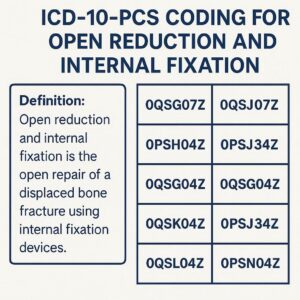
ICD-10-PCS Coding for Open Reduction and Internal Fixation
2. Understanding ORIF: Clinical Context
To code ORIF correctly, one must first grasp its surgical goals. ORIF involves a surgical incision (Open) to expose the fracture site. The surgeon then manually reduces (or restores) the fractured bone fragments back into their anatomical position. Finally, Internal Fixation is achieved by implanting a device—such as plates, screws, rods, or pins—to hold the fragments securely while they heal.
The key clinical components that drive coding decisions are:
-
Fracture Site: The specific bone and location (e.g., shaft of the femur, distal radius).
-
Technique: The use of an Open approach (a critical character in PCS).
-
Implants: The type of internal fixation device used (a defining characteristic of the procedure).
3. The Anatomy of an ICD-10-PCS Code
The ICD-10-PCS (Procedure Coding System) utilizes a structured, seven-character alphanumeric system. For surgical procedures like ORIF, which fall under the Medical and Surgical Section (Character 1: 0), the code is meticulously built by selecting one character for each of the seven defined axes.
3.1. The Seven Characters
Each character of the code describes a specific aspect of the procedure.
| Character | Description | ORIF Relevance |
| 1 | Section | Always 0 for Medical and Surgical |
| 2 | Body System | Q (Lower Joints), P (Upper Joints), S (Bones), etc. |
| 3 | Root Operation | S (Reposition) or Q (Reduction) |
| 4 | Body Part | The specific bone or joint treated (e.g., T for Femoral Shaft) |
| 5 | Approach | Always 0 (Open) for traditional ORIF |
| 6 | Device | D (Internal Fixation Device) or Z (No Device) |
| 7 | Qualifier | Varies by procedure; often Z (No Qualifier) or specific joint function. |
3.2. Key Root Operations for ORIF
The single most critical step in coding ORIF is accurately identifying the correct Root Operation (Character 3). The choice hinges on the PCS definition of the fracture management.
A. Reduction (Root Operation Q)
PCS Definition: Putting back or bringing together separated components of a body part.
-
Use: This is used when the surgeon reduces a fracture using manual force or traction without involving a joint alignment. This applies primarily to simple or non-articular fractures (fractures not extending into a joint). Note: The ICD-10-PCS Index may map fracture treatment to Reduction or Reposition depending on the Body System/Body Part.
B. Reposition (Root Operation S)
PCS Definition: Moving to its normal location or other suitable location all or a portion of a body part.
-
Use: This is the correct operation for aligning joint structures or articular fractures (fractures that involve a joint surface). The Reposition table is also the primary table for many orthopedic procedures that restore a body part to its normal anatomic position.
Critical Coding Tip: While Reduction might seem more intuitive, many common ORIF procedures, especially those involving long bones or joints, are coded to the Reposition (S) root operation when the body part is a Bone (Body System S) or Joint (Body System Q or P). Always follow the Index and the corresponding table instructions. For example, a Reposition of a bone fragment aligns it to its normal location, which perfectly describes the goal of Reduction in ORIF.
4. Methodological Deep Dive: Step-by-Step Code Selection
The most reliable way to code ORIF is through a systematic approach that separates the two actions (reduction and fixation) into the seven characters.
4.1. Step 1: Determining the Root Operation (Reduction vs. Reposition)
As discussed, this is the pivotal decision. The coder must consult the ICD-10-PCS Index by looking up the main term “Reposition” or “Reduction” and the bone/joint involved.
Example: ORIF of a Femoral Shaft Fracture.
-
Look up: Reposition, Bone, Femur, Shaft.
-
This points to the Medical and Surgical section, Bone Body System, and Reposition Root Operation (0S_).
Example: ORIF of a Tibia-Fibula Joint.
-
Look up: Reposition, Joint, Lower Extremity, Tibia/Fibula.
-
This points to the Medical and Surgical section, Lower Joints Body System, and Reposition Root Operation (0Q_).
Crucial Guideline: If an Implantation of an Internal Fixation Device is performed, the Root Operation chosen for the initial realignment must be one that allows for the Device value in Character 6. Both Reposition (S) and Reduction (Q) tables include options for Device: Internal Fixation Device (D).
4.2. Step 2: Pinpointing the Body Part and Body System
The Body System (Character 2) and Body Part (Character 4) must align with the specific site of the fracture.
| Procedure Site | Body System (Char 2) | Body Part Examples (Char 4) |
| Femoral Shaft | S (Bones) | T (Shaft, Femur) |
| Distal Radius | S (Bones) | 6 (Distal, Radius) |
| Ankle Joint | Q (Lower Joints) | 7 (Ankle Joint, Right) |
| Humerus | S (Bones) | 4 (Shaft, Humerus) |
The level of detail required by PCS is far greater than ICD-9-CM. Coders must specify which bone (e.g., radius vs. ulna) and which segment (e.g., proximal, shaft, distal).
4.3. Step 3: Clarifying the Approach (Open)
For a true ORIF, the Approach (Character 5) must be 0 (Open).
Open (0): Cutting through the skin or mucous membrane and any other body layers necessary to expose the site of the procedure. This character is non-negotiable for a coded ORIF procedure.
-
Compare to: Percutaneous (3), Percutaneous Endoscopic (4), or External (X) for other fracture management methods.
4.4. Step 4: Identifying the Device (Internal Fixation)
Internal fixation is the defining feature of ORIF that distinguishes it from an open reduction without fixation.
The Device (Character 6) for ORIF is almost always D (Internal Fixation Device). This value covers all standard hardware used to stabilize the bone fragments:
-
Plates and Screws
-
Intramedullary Rods (Nails)
-
Pins and Wires (K-wires)
-
Tension Band Wiring
If the surgeon performs an Open Reduction but chooses not to use permanent internal fixation (e.g., simply closing the wound after reduction or applying an external cast), the Device character would be Z (No Device).
4.5. Step 5: Assigning the Qualifier
The Qualifier (Character 7) often represents a specific detail that differentiates the procedure from others in the same table. For many ORIF procedures in the Bones (S) system, the qualifier is simply Z (No Qualifier).
However, in the Joints (Q/P) system, the qualifier may specify the type of fixation or other structural detail:
| Body System | Qualifier Value | Example Use |
| S (Bones) | Z (No Qualifier) | Most long bone shaft ORIFs. |
| P/Q (Joints) | 7 (Acetabulum and Joint, Left) | Repositioning of Hip Joint with Internal Fixation. |
| P/Q (Joints) | 9 (Arthrodesis) | If the ORIF is performed in conjunction with a fusion (a common scenario for certain unstable joints). |
5. Case Study Analysis: Coding for a Femoral ORIF
Operative Report Summary:
-
Procedure: Open Reduction and Internal Fixation (ORIF) of a displaced mid-shaft fracture of the left femur.
-
Technique: A lateral incision was made. The fracture fragments were identified and anatomically realigned. An intramedullary rod (nail) was inserted and secured with locking screws to provide rigid internal fixation.
| PCS Character | Value | Description | Rationale |
| 1 | 0 | Section | Medical and Surgical |
| 2 | S | Body System | Bones (Femur is a bone) |
| 3 | S | Root Operation | Reposition (Per PCS Index for bone reduction/realignment) |
| 4 | T | Body Part | Shaft, Femur, Left (Specific site) |
| 5 | 0 | Approach | Open (Procedure name specifies Open) |
| 6 | D | Device | Internal Fixation Device (Intramedullary Rod/Nail) |
| 7 | Z | Qualifier | No Qualifier (Standard for this specific bone section) |
| Final Code | 0STT0DZ | Reposition of Shaft, Femur, Left with Internal Fixation Device, Open Approach |
6. Addressing Common Coding Challenges and Traps
6.1. The “Open Reduction without Internal Fixation” Trap
A surgeon might dictate “Open Reduction” but use only External Fixation (e.g., a simple cast) or temporary K-wires that are removed before discharge. If no permanent internal device is left in the body, the Device character is Z (No Device). This is not an ORIF for coding purposes, even if the approach was Open (0).
6.2. Coding for Removal of Internal Fixation (Hardware Removal)
When hardware is removed, it is a separate procedure and must be coded separately using the Removal (P) Root Operation. The approach for removal is also typically Open (0).
-
Example Code Structure for Removal: 0SP_0_Z (Removal of Internal Fixation Device from Bone, Open Approach). PCS Guidelines mandate that Insertion and Removal are separate codes.
6.3. Simultaneous ORIF on Multiple Body Parts
If a patient has a fracture of the distal radius and a fracture of the ulna, and both undergo ORIF during the same operative session, two separate PCS codes must be assigned—one for the radius and one for the ulna. Each code must reflect the specific Body Part (Character 4) and Body System (Character 2). PCS does not allow for a single code to cover multiple, non-contiguous body parts.
6.4. ORIF Combined with Arthroplasty (Joint Replacement)
In complex scenarios, a fracture may be treated with a hemiarthroplasty or total joint arthroplasty (TJA) instead of an ORIF. The principal procedure becomes Replacement (R), not Reposition (S). For example, a displaced femoral neck fracture in an elderly patient may be treated with a total hip replacement. The procedure is coded as a Replacement (0SR_ or 0ST_). The ICD-10-PCS takes the most definitive procedure performed.
7. Conclusion
Mastering ICD-10-PCS coding for Open Reduction and Internal Fixation requires more than simple keyword matching. It demands a deep, methodological understanding of the seven-character structure, particularly the distinction between the Reposition and Reduction root operations. By meticulously separating the procedure into its component parts—the bone/joint, the Open approach, and the Internal Fixation Device—the coder can navigate the complexity of the PCS tables to achieve unassailable coding accuracy. Consistent application of the official guidelines and careful reading of the operative note remain the gold standard for compliance and proper reimbursement in orthopedic services.
8. Frequently Asked Questions (FAQs)
Q1: Can an ORIF ever be coded as a single PCS code?
A: Yes, the single PCS code for ORIF inherently includes both the reduction/reposition and the placement of the internal fixation device. The Reposition (S) or Reduction (Q) root operation is used, and the Device (Character 6) is assigned the value D (Internal Fixation Device). You do not code two separate procedures for the reduction and the fixation.
Q2: If the surgeon uses K-wires for temporary fixation during an ORIF, is the Device character still ‘D’?
A: If the K-wires (pins) are meant to be permanent internal fixation (i.e., they are left in place to hold the fracture during healing), then the Device is D (Internal Fixation Device). If the K-wires are removed before the patient leaves the operating room or are considered temporary supports that are not meant to provide long-term internal fixation, the Device is typically Z (No Device). Always check the operative report for the device’s intent and final disposition.
Q3: What is the difference between a fracture reduction coded to Root Operation ‘S’ (Reposition) and ‘Q’ (Reduction)?
A: Reposition (S) is generally used for alignment procedures involving joints or bones (Body System S) where the goal is to move the body part back to its normal anatomical location. Reduction (Q) is used for bringing separated components together. For fracture management, the PCS Index is the definitive guide; for nearly all common long bone and articular fractures, the Index directs the coder to the Reposition (S) table in the Bones (0S) or Joints (0Q/0P) Body System.
Q4: How do I code a revision of internal fixation hardware?
A: A revision usually involves Removal of the old device and Insertion of a new device. This requires two separate codes:
-
Removal (P) of the old device (e.g., 0SP_0ZZ).
- Insertion (H) of the new device (e.g., 0SH_0_D).If the surgeon only exchanges the device without removal and insertion, the Root Operation Revision (W) might be applicable, but this is less common for ORIF hardware.
Q5: Where do I find the specific Body Part character for the procedure?
A: The Body Part (Character 4) is determined by consulting the specific PCS Table identified by the first three characters (Section, Body System, Root Operation). For instance, if you are in the 0SS table (Medical and Surgical, Bones, Reposition), the available Body Part characters in column 4 will correspond to specific segments of the bones, such as ‘3’ for Proximal, Radius, Left, or ‘T’ for Shaft, Femur, Left.
Date: December 04, 2025
Disclaimer: This article provides educational information on the principles of ICD-10-PCS coding for Open Reduction and Internal Fixation (ORIF) procedures. It is not a substitute for the official ICD-10-PCS manuals, CPT guidelines, or payer-specific coding policies. Always consult the current, official resources for professional claim submission.


