
In the intricate world of procedural coding, few assignments carry the weight—and potential for nuance—of the carotid endarterectomy. This surgical intervention, a cornerstone in the prevention of catastrophic stroke, represents a triumph of modern vascular surgery. For the medical coder, however, it represents a formidable challenge where anatomical precision, procedural understanding, and coding acumen must converge flawlessly. A single misstep in character selection can distort clinical data, trigger audit flags, and impact reimbursement. The code for a right carotid endarterectomy is not merely a bureaucratic cipher; it is a precise digital narrative of a life-saving procedure.
This article is designed to be the ultimate resource for the advanced coder, the curious clinician, and the healthcare administrator seeking mastery over this specific ICD-10-PCS code. We will move beyond basic code lookup tables and delve into the why behind the what. Through a detailed exploration of surgical anatomy, procedural technique, and the philosophical framework of ICD-10-PCS, we will build the code 03CH0** from the ground up. We will navigate the common pitfalls, analyze complex scenarios involving concomitant procedures, and place this code within the larger context of healthcare compliance. By the end of this comprehensive guide, you will not just know the code; you will understand the story it tells.
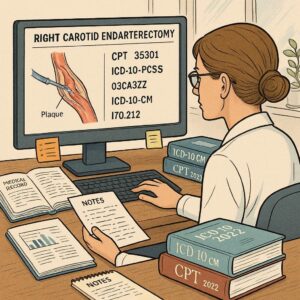
ICD-10-PCS coding for Right Carotid Endarterectomy
2. Anatomy Refresher: The Carotid Artery System and the Site of Stenosis
Precision in coding begins with precision in anatomy. The carotid arteries are the principal conduits of oxygenated blood to the head and brain. Arising from the aortic arch, they ascend through the neck within the carotid sheath.
-
Common Carotid Artery: On the right side, it originates from the brachiocephalic trunk; on the left, directly from the aortic arch. It bifurcates (divides) at the level of the upper border of the thyroid cartilage (approximately C4 vertebra) into:
-
External Carotid Artery: Supplies blood to the face, scalp, and neck muscles.
-
Internal Carotid Artery: The critical vessel for coding. It has no branches in the neck and enters the skull to form part of the Circle of Willis, supplying the anterior parts of the brain (frontal, parietal, and temporal lobes).
The carotid bulb is a slight dilation at the bifurcation and the origin of the internal carotid artery. This area is particularly susceptible to atherosclerosis. Plaque buildup here—carotid stenosis—is dangerously proximal to the brain, as emboli can easily break off and travel intracranially, causing an ischemic stroke.
Why Laterality is Non-Negotiable: ICD-10-PCs requires explicit laterality. The circulatory system body part values are distinct:
-
031: Left Internal Carotid Artery
-
041: Right Internal Carotid Artery
-
03J: Left Common Carotid Artery
-
04J: Right Common Carotid Artery
The procedure is almost always performed on the internal carotid artery, extending down into the common carotid. The primary target is the plaque at the bifurcation and extending into the internal carotid. Accurate coding hinges on the operative report specifying which vessel(s) were involved.
3. The Procedure Deconstructed: Surgical Steps of a Carotid Endarterectomy
Understanding the surgeon’s actions is paramount to selecting the correct root operation. A standard carotid endarterectomy follows a meticulous sequence:
-
Positioning and Incision: The patient is supine with the neck extended and head turned away. An oblique incision is made along the anterior border of the sternocleidomastoid muscle.
-
Exposure and Vascular Control: The dissection proceeds to isolate the common carotid, external carotid, and internal carotid arteries. Vessel loops or clamps are placed for proximal and distal control.
-
Heparinization: Systemic heparin is administered to prevent clotting during the period of clamped flow.
-
Arteriotomy: The surgeon makes a longitudinal incision in the arterial wall, typically starting in the common carotid and extending through the bifurcation into the internal carotid artery, past the distal end of the plaque.
-
The Core Event: Endarterectomy: A plane is developed between the atheromatous plaque (the diseased inner layer of the artery – the tunica intima and part of the media) and the outer arterial wall. The plaque is circumferentially freed and removed in one piece. This is the critical action that defines the root operation.
-
Closure – With or Without Patch: The arteriotomy is closed. Due to the risk of restenosis, a patch angioplasty is frequently performed.
-
Primary Closure: The arteriotomy is sutured directly closed.
-
Patch Angioplasty: A patch of material (autologous vein, bovine pericardium, synthetic polymer like Dacron or PTFE) is sewn into the opening to widen the lumen.
-
-
Re-establishing Flow: Clamps are removed in a specific sequence to prevent embolization. Flow is restored.
-
Completion Assessment: Surgeons may use Doppler ultrasound or angiography to confirm a technically successful result with no flaps or significant residual stenosis.
This step-by-step understanding clarifies that the essence of the procedure is the removal of the plaque from the vessel, not the cutting out of the vessel wall itself.
4. ICD-10-PCS Fundamentals: Understanding the Building Blocks
Before we build our code, a review of the ICD-10-PCS structure for the Medical and Surgical section (first character 0) is essential. The code is composed of seven alphanumeric characters, each representing a specific aspect of the procedure.
-
1st Character: Section (0) – Medical and Surgical
-
2nd Character: Body System (3) – Upper Arteries
-
3rd Character: Root Operation – The objective of the procedure (e.g., excision, extraction). This is the most critical and often debated component.
-
4th Character: Body Part – The specific site (e.g., right internal carotid artery).
-
5th Character: Approach – How the site was reached (e.g., open).
-
6th Character: Device – Any device remaining after the procedure (e.g., a patch).
-
7th Character: Qualifier – Provides additional information; often “Z” (no qualifier) for this procedure.
5. Root Operation Conundrum: Excision vs. Extirpation vs. Endarterectomy
This is the heart of the coding challenge. Let’s define the contenders:
-
Excision (B): Cutting out or off, without replacement, a portion of a body part. The body part is removed, and nothing is put in its place. (e.g., appendectomy, breast lumpectomy).
-
Extirpation (C): Taking or cutting out solid matter from a body part. The solid matter (like a plaque, thrombus, or foreign body) is removed from the body part, and the body part remains. (e.g., thrombectomy, removal of kidney stone).
-
Endarterectomy (L): A specific type of extirpation limited to the stripping of the inner lining of an artery.
The official ICD-10-PCS guideline B3.10 is decisive: “Endarterectomy (character value L) includes patch angioplasty of the same vessel. When an endarterectomy (L) is performed on a vessel, it is coded to the root operation Endarterectomy regardless of whether a patch angioplasty is also performed.”
Analysis: In a carotid endarterectomy, the plaque (solid matter) is removed from the artery (body part). The artery is not cut out; it is cleaned out. Therefore, Extirpation (C) conceptually fits. However, ICD-10-PCS provides the more specific root operation Endarterectomy (L), which takes precedence.
Conclusion: The correct root operation for a carotid endarterectomy is Endarterectomy (L).
6. Building the Code: A Step-by-Step Approach to 03CH0**
Now we assemble our code using the operative narrative: “Open right carotid endarterectomy with patch angioplasty using bovine pericardium.“
-
Section: 0 – Medical and Surgical
-
Body System: 3 – Upper Arteries
-
Root Operation: C – Wait, didn’t we just say L? This is a crucial nuance. In the Upper Arteries body system (character 2 value ‘3’), the root operation Endarterectomy is represented by the character C. This is a unique mapping within PCS. Root operation C in the Upper Arteries system means Endarterectomy. (Refer to the ICD-10-PCS Table 03C).
-
Body Part: H – We must consult the 04* table. Character 4 value H corresponds to the Right Internal Carotid Artery.
-
Approach: 0 – Open. The procedure is performed via a surgical incision directly over the site.
-
Device: K – This character identifies the device that remains after the procedure is complete. For a patch angioplasty, we must select the correct device value. In Table 03C, device character ‘K’ represents Autologous Tissue Substitute (e.g., a saphenous vein patch) or Nonautologous Tissue Substitute (e.g., bovine pericardium).
-
Qualifier: Z – No Qualifier. There is no additional information needed for this base procedure.
Therefore, the complete code is: 03CH0KZ
What if it’s a primary closure? If the operative report states the arteriotomy was closed primarily without a patch, the 6th character (Device) would be Z (No Device). The code would be: 03CH0ZZ.
* ICD-10-PCS Code Build for Right Carotid Endarterectomy)*
| PCS Character | Position Meaning | Character Value | Code Value Explanation |
|---|---|---|---|
| 1st | Section | 0 | Medical and Surgical |
| 2nd | Body System | 3 | Upper Arteries |
| 3rd | Root Operation | C | Endarterectomy (specific to this body system) |
| 4th | Body Part | H | Right Internal Carotid Artery |
| 5th | Approach | 0 | Open |
| 6th | Device | K or Z | K= Tissue Substitute Patch, Z= No Device |
| 7th | Qualifier | Z | No Qualifier |
| Final Code | 03CH0KZ | Open Endarterectomy of Right Internal Carotid Artery with Patch |
7. The Patch Question: Device Character (7th Character) Deep Dive
The device character requires careful attention to documentation.
-
03CH0KZ – Tissue Substitute Patch: This is the most common scenario. “Tissue Substitute” encompasses both autologous vein and nonautologous biological materials (bovine pericardium, porcine). The documentation must specify the patch material. “Patch angioplasty” alone may require querying for specificity, though many facilities have a standard.
-
03CH0JZ – Synthetic Substitute Patch: Used if the patch material is a synthetic polymer, such as Dacron or PTFE (e.g., “Dacron patch angioplasty”).
-
03CH0ZZ – No Device: Used for primary closure.
Critical Note: Per guideline B3.10, the root operation remains Endarterectomy (C) whether a patch is used or not. The patch only affects the 6th character.
8. Coding Complexities and Clinical Scenarios
Scenario 1: Bilateral Procedure
If a staged bilateral procedure is performed during different operative episodes, you would code each separately: 03CH0KZ (Right) and 03CL0KZ (Left Internal Carotid). If, in an extremely rare single episode, both are done, both codes would be reported.
Scenario 2: Endarterectomy of the Common Carotid Only
If the report clearly indicates the plaque was limited to the common carotid artery and the endarterectomy did not extend into the internal carotid, the body part changes. For the Right Common Carotid Artery, the 4th character is J. The code would be 03CJ0KZ.
Scenario 3: Concomitant Procedures – Carotid Stenting
This is a separate procedure. If a patient has a hybrid procedure with an endarterectomy and stenting of a distal lesion, the stenting is coded separately from the Lower Arteries body system (value 4) using root operation Dilation with an intraluminal device.
Scenario 4: Eversion Endarterectomy
In this technique, the internal carotid artery is transected, everted, the plaque stripped, and then re-anastomosed. The root operation remains Endarterectomy (C). The approach is still open. The key is whether a patch is used; often in eversion, it is not (03CH0ZZ).
Scenario 5: Inadequate Documentation
“Carotid endarterectomy” is insufficient. The coder must identify:
-
Laterality (Right/Left)
-
Specific vessel (Internal/Common Carotid)
-
Use and type of patch.
A physician query is necessary if any element is missing.
9. The Compliance Landscape: Audits, Documentation, and Common Errors
This code is frequently audited by both internal compliance teams and external agencies like the RACs.
Common Errors:
-
Using the Wrong Root Operation: Coding to Excision (B) instead of Endarterectomy (C).
-
Incorrect Laterality: Miscoding left for right.
-
Misidentifying the Body Part: Confusing internal carotid (H/L) with common carotid (J/3).
-
Omitting or Mis-specifying the Device: Using “Z” when a patch was documented, or using “K” for a synthetic patch instead of “J”.
-
Combining with Unrelated Codes: Incorrectly bundling the code with an unrelated diagnostic angiography performed during the same stay.
Best Practices:
-
Audit the Operative Report: The report is the source of truth. Look for the keywords: “arteriotomy,” “plaque removed,” “patch angioplasty using…”, “closed primarily.”
-
Understand Surgical Intent: Focus on the objective—removing plaque to restore lumen diameter.
-
Consult Coding Clinic: Reference official AHA Coding Clinic advice for nuanced scenarios.
-
Continuing Education: Stay updated on guideline changes and payer-specific policies.
10. Conclusion
Mastering ICD-10-PCS code 03CH0KZ for a right carotid endarterectomy demands more than memorization; it requires a synthesis of anatomical knowledge, surgical understanding, and meticulous attention to documentation detail. By anchoring the code in the specific root operation of Endarterectomy, accurately identifying the laterality and vessel, and precisely classifying the closure method, coders ensure data integrity, support appropriate reimbursement, and contribute to the accurate historical record of a pivotal stroke-prevention procedure. In the complex ecosystem of healthcare data, such precision is not just technical—it is fundamental.
11. Frequently Asked Questions (FAQs)
Q1: Why is the root operation for endarterectomy ‘C’ and not under a separate value like ‘L’?
A: In the Medical and Surgical section, the meaning of a root operation character is dependent on the body system. In the Upper Arteries system (0-3-?), the character ‘C’ is defined as “Endarterectomy.” In other systems, ‘C’ means something else (e.g., in the Central Nervous system, ‘C’ is Extirpation). Always work from the correct table.
Q2: How do I code a carotid endarterectomy with a shunt?
A: The use of a shunt (a temporary tube to maintain blood flow during plaque removal) is considered an integral part of the procedure and is not coded separately. It does not alter the root operation or device characters.
Q3: The surgeon documented “endarterectomy of the right carotid bifurcation.” What body part do I use?
A: The “carotid bifurcation” is not a specific body part value in PCS. You must determine from the report which vessel(s) were involved. If the procedure extended into the internal carotid (which it almost always does), code the internal carotid artery (H). If it was truly limited to the bifurcation area itself, a query may be needed, but the common carotid (J) is often used as the proximal vessel.
Q4: What if the procedure was performed percutaneous?
A: A true percutaneous carotid endarterectomy does not exist. The procedure requires an open arteriotomy. Percutaneous carotid interventions are stenting procedures, which are coded to the Dilation root operation in the Lower Arteries body system with an intraluminal device.
12. Additional Resources
-
Official: ICD-10-PCS Code Tables and Index, FY 2025. Centers for Medicare & Medicaid Services (CMS).
-
Official: ICD-10-PCS Official Guidelines for Coding and Reporting, FY 2025. AHA, CMS, NCHS.
-
Authoritative: AHA Coding Clinic for ICD-10-CM/PCS. American Hospital Association. (Search historical issues for “endarterectomy”).
-
Clinical: Rutherford’s Vascular Surgery and Endovascular Therapy. Elsevier.
-
Professional: American Health Information Management Association (AHIMA) – www.ahima.org
-
Professional: American Academy of Professional Coders (AAPC) – www.aapc.com
Disclaimer: This article is for informational purposes only and is intended for healthcare professionals. It is not a substitute for clinical judgment, official coding guidelines, or physician documentation. Always consult the most current ICD-10-PCS manuals, Coding Clinic advice, and facility-specific policies for definitive coding.
Date: December 08, 2025
Author: The Coding Specialist


