
In the meticulously structured world of modern healthcare, where clinical care converges with administrative rigor, few tasks are as pivotal—and as challenging—as procedural coding. Each alphanumeric character assigned to a patient’s procedure carries immense weight, influencing hospital reimbursement, shaping health statistics, driving quality metrics, and ensuring regulatory compliance. Nowhere is this precision more critical than in surgical specialties, where a single-digit error can cascade into significant financial and legal repercussions. This article embarks on a comprehensive exploration of one such precise code: the ICD-10-PCS (International Classification of Diseases, Tenth Revision, Procedure Coding System) code for a right orchidopexy.
While a surgeon focuses on the delicate task of mobilizing and securing an undescended testicle within the scrotum, a medical coder must translate that complex action into a flawless, seven-character code. This is not a mere clerical task; it is an act of clinical translation. Our journey will go far beyond simply presenting the correct code. We will dissect the very philosophy of the ICD-10-PCS system, explore the varied clinical indications for orchidopexy—from congenital cryptorchidism in infants to traumatic torsion in adults—and meticulously build the code from the ground up, character by character. We will navigate the nuances of surgical approach, device usage, and the profound importance of clinical documentation. Whether you are a seasoned medical coder, a billing specialist, a healthcare administration student, or a clinical professional seeking to understand the administrative lens, this deep dive into the right orchidopexy code serves as a masterclass in the intricate dance between medicine and data. Prepare to delve into a narrative where anatomy meets analytics, and where the future of healthcare data begins with a single, correctly assigned character.
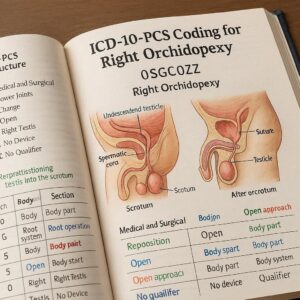
ICD-10-PCS Coding for Right Orchidopexy
2. Understanding Orchidopexy: More Than Just a Surgical Fix
To code a procedure accurately, one must first understand its medical purpose, anatomy, and clinical context. Orchidopexy (orchiopexy) is derived from the Greek words orchis (testicle) and pexis (fixation). It is a surgical procedure designed to permanently fix a testicle within the scrotum.
Primary Indication: Cryptorchidism
The most common reason for orchidopexy is cryptorchidism, or undescended testis. This is a congenital condition where one or both testicles fail to descend from the abdomen into the scrotum during fetal development. It is the most common endocrine disorder in male newborns, affecting approximately 1-3% of full-term and up to 30% of preterm infant boys. The right testicle is slightly more commonly undescended than the left. The reasons for performing orchidopexy in these cases are multifactorial:
-
Fertility Preservation: The scrotum provides a temperature 2-3°C cooler than core body temperature, which is essential for normal spermatogenesis. An undescended testis has impaired development and can lead to reduced sperm count and infertility.
-
Cancer Risk Reduction: Cryptorchidism increases the risk of testicular germ cell cancer later in life (approximately 4-6 times higher risk). Placement in the scrotum allows for routine and easy self-examination and clinical palpation.
-
Hernia Repair: A patent processus vaginalis (an inguinal hernia) accompanies an undescended testis in nearly 90% of cases. Orchidopexy often involves ligation of this hernia sac.
-
Psychological and Cosmetic Considerations: The absence of a testicle in the scrotum can affect body image and psychological well-being.
Other Indications:
-
Testicular Torsion (Emergent): While orchiectomy (removal) is often necessary after prolonged torsion, salvageable cases may undergo detorsion and orchidopexy to fix both the affected and the contralateral testicle to prevent future torsion.
-
Iatrogenic or Traumatic Displacement: Rarely, a testicle may be displaced due to prior surgery or trauma, requiring surgical fixation.
The typical age for elective orchidopexy for cryptorchidism is between 6 and 18 months, as recommended by pediatric urology guidelines, to maximize the potential for testicular development.
Anatomy Involved: The procedure involves a deep understanding of the inguinal canal, the spermatic cord (containing the vas deferens, testicular artery, and pampiniform plexus), the processus vaginalis, and the scrotal structures like the dartos pouch.
3. The Foundation: Navigating the ICD-10-PCS Universe
Before we construct our code, we must understand the coding system’s architecture. ICD-10-PCS is a completely different system from its diagnosis counterpart, ICD-10-CM. Introduced in 2015, it is used exclusively in inpatient hospital settings in the United States.
Key Principles of ICD-10-PCS:
-
Multi-axial Structure: Each of the seven characters has a specific meaning and comes from a predefined table. The character’s position (1st, 2nd, 3rd, etc.) is fixed.
-
Standardized Terminology: PCS uses specific, consistent terms that may differ from clinical jargon (e.g., “open” vs. “laparoscopic” has specific definitions).
-
Completeness: A valid code must have all seven characters specified.
-
No Diagnostic Information: PCS codes only what was done procedurally, not why it was done (the diagnosis).
The Seven Characters of an ICD-10-PCS Code:
-
1st Character: Section – Broadest category (e.g., Medical and Surgical, Obstetrics, Placement).
-
2nd Character: Body System – The general physiological system (e.g., Male Reproductive System).
-
3rd Character: Root Operation – The objective of the procedure (the single most critical conceptual step). There are 31 root operations.
-
4th Character: Body Part – The specific anatomical site.
-
5th Character: Approach – How the procedure site was reached (e.g., Open, Percutaneous).
-
6th Character: Device – Any device that remains after the procedure.
-
7th Character: Qualifier – An additional attribute for further specification.
For our task—coding a right orchidopexy—we are operating in the Medical and Surgical section on the Male Reproductive System, performing a specific Root Operation.
4. Deconstructing the Code: A Seven-Character Deep Dive for Right Orchidopexy
Let us now build the definitive ICD-10-PCS code for a right orchidopexy, step by step.
Character 1: Section = 0 (Medical and Surgical)
This is straightforward. Orchidopexy is a surgical procedure, so it falls under this section.
Character 2: Body System = V (Male Reproductive System)
The testis is an organ of the male reproductive system.
Character 3: Root Operation = S (Reposition)
This is the most crucial and often debated step. The ICD-10-PCS defines Reposition as: “Moving to its normal location or other suitable location all or a portion of a body part. The body part is moved to a new location from an abnormal location, or from a normal location where it is not functioning correctly. A reposition is not assigned for the incidental correction of a malpositioned body part during a procedure performed for a different objective.”
-
Why Reposition? In cryptorchidism, the testicle is in an abnormal location (abdomen, inguinal canal). The surgeon’s objective is to move it to its normal, functional location—the scrotum. This is the very definition of “reposition.”
-
Common Misconception: Some may consider “Release” or “Excision.” Release (freeing a body part) is part of the procedure but not the objective. Excision (cutting out) is not performed. “Reposition” accurately captures the primary goal.
Character 4: Body Part = 4 (Testis, Right)
This character specifies the exact anatomical part being repositioned. For a right orchidopexy, it is the right testis. The PCS system differentiates between left and right for paired organs.
Character 5: Approach = 0 (Open)
The approach defines how the surgeon reaches the operative site. “Open” is defined as cutting through the skin or mucous membrane and any other body layers necessary to expose the site. A standard inguinal orchidopexy involves an open incision in the inguinal region. Note: Laparoscopic approaches (which would be 8 = Percutaneous Endoscopic) are used for abdominal testes and would change this character.
Character 6: Device = Z (No Device)
In a standard orchidopexy, no device is left in place. The testis is typically fixed using sutures between the tunica vaginalis and the scrotal tissue (dartos pouch). Sutures are considered materials, not devices, in PCS terminology. A device is something like a stent, graft, or prosthetic that takes the place of a body part or remains after the procedure. Therefore, we use “Z” for No Device.
Character 7: Qualifier = Z (No Qualifier)
For the root operation Reposition in the Male Reproductive System, there are no applicable qualifiers in the PCS tables. Thus, it is “Z.”
The Complete ICD-10-PCS Code for an Open Right Orchidopexy: 0VS40ZZ
ICD-10-PCS Code Breakdown for Open Right Orchidopexy
| Character Position | Meaning | Character Used | Definition/Note |
|---|---|---|---|
| 1st | Section | 0 | Medical and Surgical |
| 2nd | Body System | V | Male Reproductive System |
| 3rd | Root Operation | S | Reposition: Moving the testis to its normal location. |
| 4th | Body Part | 4 | Testis, Right |
| 5th | Approach | 0 | Open (via inguinal incision) |
| 6th | Device | Z | No Device (sutures are material, not a device) |
| 7th | Qualifier | Z | No Qualifier |
| Final Code | 0VS40ZZ | Reposition of Right Testis, Open Approach |
5. Surgical Approaches in Orchidopexy and Their PCS Equivalents
Not all orchidopexies are performed via a single open inguinal incision. The approach is dictated by the preoperative location (palpable vs. non-palpable) of the testis.
1. Open Inguinal Orchidopexy (0VS40ZZ)
-
Clinical Context: For palpable testes located in the inguinal canal or just outside the external ring.
-
Procedure: A transverse incision in the inguinal crease. The spermatic cord is mobilized, the hernia sac is ligated, and adequate cord length is achieved. The testis is then placed in a subdartos pouch in the scrotum and secured.
-
PCS Approach: 0 (Open)
2. Laparoscopic Orchidopexy (0VS48ZZ)
-
Clinical Context: For non-palpable testes, most commonly located intra-abdominally.
-
Procedure: A telescope and instruments are inserted via small abdominal ports. The testicular vessels are identified. A two-stage Fowler-Stephens technique may be used if vessel length is insufficient, involving clipping of the vessels followed by orchidopexy months later.
-
PCS Nuance: Laparoscopy falls under the approach 8 = Percutaneous Endoscopic. The code for a laparoscopic reposition of a right abdominal testis would be 0VS48ZZ.
3. Single-Incision Scrotal Orchidopexy
-
Clinical Context: For testes that are “peeping” or very low in the inguinal canal (the “low palpable” testis).
-
Procedure: A single incision at the top of the scrotum is used to access, mobilize, and fix the testis.
-
PCS Approach: This is still considered an Open (0) approach, as it involves a direct incision to expose the site, even though it’s scrotal. The code remains 0VS40ZZ.
4. Two-Stage Fowler-Stephens Orchidopexy
-
Clinical Context: For high intra-abdominal testes with short vessels.
-
Procedure:
-
Stage 1 (0VT08ZZ): Laparoscopic Occlusion (root operation) of the right testicular artery/vein. This is coded separately: 0VT08ZZ – Occlusion of Right Testicular Artery, Percutaneous Endoscopic Approach, No Device.
-
Stage 2 (0VS44ZZ or 0VS48ZZ): Performed 6-12 months later. The testis, now relying on collateral blood supply, is repositioned. This could be open or laparoscopic, leading to codes like 0VS44ZZ (Open) or 0VS48ZZ (Percutaneous Endoscopic).
-
The coder must read the operative report meticulously to identify the correct approach, as it directly changes the 5th character of the code.
6. Clinical Scenarios and Coding Nuances: From Pediatrics to Trauma
Coding is not performed in a vacuum. The clinical scenario and associated procedures are vital.
Scenario 1: Simple Right Inguinal Orchidopexy with Hernia Repair
-
Procedure: Open right orchidopexy + high ligation of a patent processus vaginalis (indirect inguinal hernia repair).
-
Coding:
-
0VS40ZZ – Reposition Right Testis, Open Approach.
-
0YQ50ZZ – Repair of Right Inguinal Region, Open Approach. (Root Operation = Repair: Restoring, to the extent possible, a body part to its normal anatomic structure and function).
-
-
Note: Both procedures are coded. The hernia repair is a distinct objective (Repair vs. Reposition).
Scenario 2: Bilateral Orchidopexy
-
Procedure: Open orchidopexy on both the right and left sides.
-
Coding:
-
0VS40ZZ – Reposition Right Testis, Open Approach.
-
0VS80ZZ – Reposition Left Testis, Open Approach. (Note the 4th character changes to 8 for “Testis, Left”).
-
-
Rule: PCS requires separate codes for each distinct body part (laterality) when procedures are performed.
Scenario 3: Orchidopexy for Acute Testicular Torsion (Salvage)
-
Procedure: Emergent exploration, detorsion of the right spermatic cord, and fixation of both testes (right orchidopexy and left prophylactic orchidopexy).
-
Coding:
-
0VS40ZZ – Reposition Right Testis, Open Approach (after detorsion).
-
0VS80ZZ – Reposition Left Testis, Open Approach (prophylactic).
-
(Detorsion itself, as a manual maneuver, does not have a specific PCS code; the objective is Reposition).
-
Scenario 4: Aborted Orchidopexy with Orchiectomy
-
Finding: During exploration for a presumed undescended testis, an atrophic nubbin is found.
-
Procedure: Excision of the testicular remnant.
-
Coding: 0VT40ZZ – Excision of Right Testis, Open Approach. The root operation changes from Reposition to Excision because the objective became removal.
7. The Critical Role of Documentation in Accurate Coding
The operative report is the coder’s bible. Ambiguous documentation leads to inaccurate coding, which impacts DRG assignment and reimbursement. Key elements the surgeon must document for precise coding of an orchidopexy include:
-
Precise Preoperative Diagnosis: “Right cryptorchidism” or “Right non-palpable testis.”
-
Detailed Operative Findings: “Right testis located at the internal inguinal ring.”
-
Clear Description of the Procedure: “The spermatic cord was mobilized. The hernia sac was dissected free, ligated, and transected.”
-
Explicit Statement of the Action: “The right testis was then repositioned into a subdartos pouch in the right scrotum and secured with 3-0 vicryl sutures.”
-
Specific Approach: “A standard right inguinal incision was made” vs. “Three laparoscopic ports were placed.”
-
Any Additional Procedures: “A concomitant right inguinal hernia repair was performed.”
A query may be necessary if the documentation states “orchidopexy performed” but does not specify the approach or laterality.
8. Compliance, Audits, and Avoiding Common Pitfalls
Incorrect coding for a procedure like orchidopexy can lead to claim denials, underpayment, or allegations of fraud. Common pitfalls include:
-
Incorrect Root Operation: Using “Excision” or “Release” instead of “Reposition.”
-
Missing Laterality: Coding for an unspecified testis when the record clearly indicates “right.”
-
Incorrect Approach: Assuming all orchidopexies are “Open” when some are laparoscopic.
-
Failing to Code All Procedures: Not reporting a concurrent hernia repair.
-
Miscoding the Fowler-Stephens: Not recognizing the first stage as an Occlusion procedure.
Regular internal audits and coder education are essential. The coder must apply the ICD-10-PCS Official Guidelines for Coding and Reporting, which provide specific instructions on selection of principal procedure, laterality, and combined procedures.
9. The Future of Procedural Coding: Implications for Healthcare
The granularity of ICD-10-PCS, as exemplified by our orchidopexy code, feeds into larger healthcare trends:
-
Value-Based Reimbursement: Precise codes allow for better risk-adjustment and outcome measurement. Does a laparoscopic approach have different outcomes or costs than an open one for abdominal testes? The data can tell.
-
Advanced Analytics and AI: Clean, specific procedural data is fuel for machine learning models that can predict surgical complications, optimize operating room schedules, and identify best practices.
-
Enhanced Research: Epidemiological studies on surgical trends and effectiveness rely on accurate procedural data.
-
The Horizon of ICD-11: The World Health Organization’s ICD-11 includes an expanded procedural classification. While not yet adopted in the US, it signals a continued global move towards greater specificity.
The humble code 0VS40ZZ is a tiny but perfect data point in this vast, data-driven future of healthcare.
10. Conclusion
Accurate ICD-10-PCS coding for a right orchidopexy, culminating in the precise code 0VS40ZZ for the open approach, is a meticulous process that demands a fusion of clinical knowledge and coding expertise. It requires understanding the surgical objective as Reposition, correctly identifying anatomical laterality and surgical approach, and recognizing when concurrent procedures must be separately reported. In an era where data integrity directly impacts patient care analytics and financial sustainability, mastering such granular coding is not an administrative triviality—it is a fundamental pillar of modern, accountable healthcare delivery.
11. Frequently Asked Questions (FAQs)
Q1: What is the ICD-10-PCS code for a laparoscopic right orchidopexy?
A1: The code is 0VS48ZZ. The only difference from the open approach code is the 5th character: ‘8’ for Percutaneous Endoscopic (which encompasses laparoscopic) instead of ‘0’ for Open.
Q2: If a surgeon performs a left hernia repair during a right orchidopexy, do I code both?
A2: Yes. You would code:
-
0VS40ZZ for the right orchidopexy (Reposition).
-
0YQ50ZZ for the repair of the right inguinal region (if on the same side).
-
If the hernia repair was on the left side, you would use 0YQ80ZZ (Repair Left Inguinal Region).
Q3: How do I code an orchidopexy for testicular torsion?
A3: The root operation remains Reposition, as the surgeon is moving a torsed (mispositioned) testicle back to its correct orientation and fixing it. The code would be 0VS40ZZ for an open approach on the right side. Prophylactic fixation of the contralateral testis is coded separately (0VS80ZZ).
Q4: What is the root operation for a Fowler-Stephens first stage?
A4: The first stage, where the testicular vessels are clipped or ligated, is coded as Occlusion (root operation L). The objective is to close off the vessel. A laparoscopic approach would be 0VT08ZZ – Occlusion of Right Testicular Artery, Percutaneous Endoscopic Approach.
Q5: Why are sutures not considered a device in PCS?
A5: ICD-10-PCS defines a device as “an object that remains after the procedure is complete and whose function is intended to remain.” Sutures are considered materials used in the procedure to facilitate healing; they are absorbed or incorporated into tissue and do not have a lasting mechanical function like a stent or artificial joint.


