
Imagine the human spine—a towering, intricate column of bone, cartilage, and nerve—as the central pillar of life’s architecture. It allows us to stand tall, bend with grace, and protects the delicate highway of our spinal cord. Yet, this pillar is vulnerable. Osteoporosis, trauma, and malignancy can compromise its integrity, leading to painful vertebral compression fractures. For millions, this pain is debilitating, a constant reminder of fragility that diminishes quality of life and independence.
Enter vertebroplasty: a minimally invasive, image-guided miracle of modern medicine. Since its inception in the 1980s, this procedure has revolutionized the treatment of vertebral fractures. By injecting medical cement directly into the fractured bone, physicians can stabilize the vertebra, alleviate agonizing pain, and restore function, often within hours. It is a procedure that epitomizes the blend of technological innovation and compassionate care.
However, behind every successful clinical intervention lies an equally critical administrative and financial ecosystem. The accurate translation of this complex procedure into the universal language of medical codes is paramount. This is where ICD-10-PCS (Procedure Coding System) comes into play. Unlike its diagnosis-oriented counterpart (ICD-10-CM), ICD-10-PCS is a detailed, multi-axial system designed to capture the what, where, how, and with what of hospital-based procedures with meticulous specificity.
Coding for vertebroplasty is not a simple task. It requires a coder to be part anatomist, part linguist, and part detective, carefully dissecting the operative report to build a seven-character code that tells the complete story. A single misstep in character selection can lead to claim denials, compliance issues, and skewed clinical data.
This article is crafted to be the definitive guide on this topic. Spanning over 20,000 words, it will delve deeper than any surface-level overview. We will journey from the macroscopic anatomy of the spine down to the microscopic detail of code characters. We will explore clinical nuances, tackle common pitfalls, and provide practical coding scenarios. Whether you are a seasoned medical coder, a aspiring healthcare professional, or a curious administrator, this comprehensive resource aims to equip you with the knowledge to navigate the complex, yet fascinating, world of ICD-10-PCS coding for vertebroplasty.
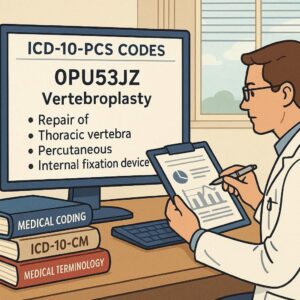
ICD-10-PCS Coding for Vertebroplasty
2. Understanding Vertebroplasty: Procedure, Indications, and Clinical Significance
The Procedure in Detail:
Vertebroplasty is a percutaneous (through the skin), image-guided surgical procedure. The primary goal is to stabilize a fractured vertebral body by injecting a bone cement, typically polymethylmethacrylate (PMMA). The procedure is usually performed under local anesthesia with sedation, or sometimes general anesthesia, and takes about one to two hours per level treated.
The standard steps are as follows:
-
Positioning & Imaging: The patient is placed prone (on their stomach) on an operating table. Continuous fluoroscopic (real-time X-ray) guidance, or sometimes CT guidance, is used throughout to ensure precision.
-
Access: The skin over the target vertebra is sterilized. A small incision (about 3-5 mm) is made. A specialized needle, often a large-bore (11- or 13-gauge) trocar needle, is advanced through the pedicle of the vertebra (the bony “bridge” from the posterior elements to the vertebral body) or, less commonly, via a parapedicular or transpedicular approach.
-
Cement Preparation: While access is being obtained, the PMMA cement is mixed. It has a consistency similar to toothpaste and a working time of about 10-20 minutes before it hardens exothermically.
-
Injection: Once the needle tip is confirmed to be in the anterior third of the vertebral body, the cement is injected under low, steady pressure. The fluoroscope allows the physician to watch the cement fill the vertebral body, ensuring it does not leak into unwanted areas like the spinal canal or venous system.
-
Needle Removal & Closure: The needle is removed once the cement is placed and begins to set. The tiny incision often requires only a sterile adhesive strip.
Primary Indications:
-
Osteoporotic Vertebral Compression Fractures (VCFs): The most common indication. Osteoporosis weakens bone, making vertebrae susceptible to fracture from minor stress or even spontaneously.
-
Painful Vertebral Body Fractures due to Malignancy: Fractures caused by primary bone tumors (e.g., myeloma, hemangioma) or metastatic disease (e.g., from breast, lung, prostate cancer). Here, vertebroplasty provides both stabilization and pain relief.
-
Traumatic Fractures in select patients: For non-osteoporotic patients with traumatic fractures where conservative management has failed and the fracture is not severely unstable.
Clinical Significance and Efficacy:
Vertebroplasty provides rapid and significant pain relief in a majority of appropriately selected patients. Studies often show a 70-90% success rate in pain reduction. The stabilization prevents further collapse of the vertebra, which can correct or prevent kyphotic deformity (a forward hunching of the spine). This translates to improved mobility, reduced narcotic dependence, and a swift return to activities of daily living. The minimally invasive nature means shorter hospital stays, less blood loss, and lower risk of infection compared to open spinal surgery.
3. The Foundation: Anatomy of the Vertebral Column
Accurate coding is impossible without a firm grasp of anatomy. The vertebral column is divided into five regions, each with a distinct structure and coding value.
-
Cervical (C1-C7): The neck vertebrae. They are smaller, support the head, and have transverse foramina for vertebral arteries. C1 (Atlas) and C2 (Axis) are uniquely shaped for head rotation.
-
Thoracic (T1-T12): The mid-back vertebrae. They articulate with the ribs via costal facets, making them less mobile. Vertebroplasty is commonly performed here.
-
Lumbar (L1-L5): The lower back vertebrae. They are large and robust, designed to bear the body’s weight. This is the most common site for vertebroplasty due to high load-bearing stress.
-
Sacral (S1-S5, fused): The sacrum is a triangular bone formed by five fused vertebrae. It connects the spine to the pelvis.
-
Coccygeal: The tailbone.
For vertebroplasty coding, the critical anatomical unit is the vertebral body—the large, cylindrical anterior part of the vertebra that bears weight. The procedure targets this body exclusively. The posterior elements (pedicles, lamina, spinous process) are not the site of cement injection.
4. Introduction to ICD-10-PCS: A System of Precision
ICD-10-PCS is a completely different system from ICD-10-CM. It is used only for reporting procedures in inpatient hospital settings. Its structure is logical but highly detailed. Each code consists of seven alphanumeric characters. Each character represents an aspect of the procedure, with the value in each position selected from a predefined table.
The Seven Characters:
-
Section: The broadest category (e.g., Medical and Surgical, Placement, Imaging).
-
Body System: The general physiological system (e.g., Musculoskeletal System).
-
Root Operation: The objective of the procedure—the single most important conceptual step (e.g., Supplement, Repair).
-
Body Part: The specific anatomical site (e.g., Vertebral Body, Lumbar).
-
Approach: The technique used to reach the site (e.g., Percutaneous, Open).
-
Device: Any appliance left in or on the body after the procedure (e.g., Synthetic Substitute).
-
Qualifier: Adds further detail (e.g., specifying the substance, or laterality).
For vertebroplasty, we are almost always in the Medical and Surgical section (character value 0), on the Musculoskeletal System (character value M).
5. Deconstructing the ICD-10-PCS Code for Vertebroplasty
Let’s build the code step-by-step, character by character.
6. The Root Operation: “Supplement” – The Core of the Matter
This is the heart of coding vertebroplasty. The ICD-10-PCS Official Guidelines define Supplement as:
“Putting in or on biological or synthetic material that physically reinforces and/or augments the function of a portion of a body part.”
Vertebroplasty is the quintessential “Supplement” procedure:
-
What is put in? PMMA cement (a synthetic material).
-
Where is it put? In the vertebral body (a portion of a body part).
-
What is the purpose? To physically reinforce the fractured bone (reinforces) and restore its load-bearing capacity (augments function).
It is crucial to distinguish this from other root operations:
-
“Insertion” is putting in a device that monitors, assists, or prevents a function (e.g., a pacemaker). Cement is not a device in this sense; it is a substance that becomes part of the anatomy.
-
“Repair” is restoring anatomy to normal function, but not via reinforcement with material (e.g., suturing a laceration).
-
“Fusion” is joining together bones via solidification.
Therefore, the third character for the root operation is U for Supplement.
7. The Body Part Character: Navigating the Vertebral Segments
This is where anatomical knowledge is directly applied. ICD-10-PCS has specific body part values for vertebral bodies by region. The fourth character must specify the precise vertebral body treated.
Key Body Part Values (for the Musculoskeletal System, Root Operation Supplement):
-
Cervical Vertebral Body:
0(for C1),1(for C2),2(for C3),3(for C4),4(for C5),5(for C6),6(for C7) -
Thoracic Vertebral Body:
7(for T1-T2),8(for T3-T4),9(for T5-T6),B(for T7-T8),C(for T9-T10),D(for T11-T12) -
Lumbar Vertebral Body:
F(for L1),G(for L2),H(for L3),J(for L4),K(for L5) -
Sacral Vertebral Body:
L(for Sacrum)
Critical Note: ICD-10-PCS does not have a single “vertebral body” value. You must code to the highest level of specificity documented. If the operative report states “L4 vertebroplasty,” the body part is J. If it states “T7 and T8 vertebroplasty,” you must build two separate codes: one with body part B (for T7-T8) and one with… a conundrum. Since T7-T8 is a single value, you would still only use B once. For multiple distinct levels (e.g., T6 and T10), you would assign two codes: one with body part 9 (T5-T6) and one with C (T9-T10).
8. The Approach Character: Pathways to the Spine
The approach describes how the surgeon reached the vertebral body to perform the supplement.
-
Percutaneous (
3): Entry through the skin via a needle or trocar, with imaging guidance. This is the standard and most common approach for vertebroplasty. -
Percutaneous Endoscopic (
4): Uses an endoscope introduced percutaneously. Rare for vertebroplasty but possible. -
Open (
0): A large incision is made to directly visualize the surgical site. Almost never used for standalone vertebroplasty but could be part of a larger open surgery. -
Via Natural or Artificial Opening: Not applicable.
The fifth character for a typical vertebroplasty is 3.
9. The Device and Substance Characters: Cement and More
This is a unique and sometimes confusing aspect of coding vertebroplasty in ICD-10-PCS.
Character 6: Device
The device character is used to specify the material that is acting as the “supplement.” For vertebroplasty, the PMMA cement is classified as a Synthetic Substitute. The official definition for Device character J is “Synthetic Substitute” – an includable term under which “bone void filler” is listed. PMMA cement is a bone void filler. Therefore, the sixth character is J.
Character 7: Qualifier
The qualifier provides additional information about the procedure. For vertebroplasty in the Musculoskeletal System, the qualifier is used to denote laterality. However, the spine is inherently a midline structure. The vertebral body is not a paired organ (like lungs or kidneys). According to ICD-10-PCS coding guidelines, procedures on midline body parts are always coded to the anatomical midline. You do not assign a left or right qualifier.
Therefore, the seventh character is Z (No Qualifier).
10. Building the Complete Code: Practical Scenarios and Tables
Let’s put it all together for common scenarios.
Scenario 1: Percutaneous vertebroplasty of the L3 vertebral body for an osteoporotic compression fracture.
-
Section: Medical and Surgical = 0
-
Body System: Musculoskeletal = M
-
Root Operation: Supplement = U
-
Body Part: Lumbar Vertebral Body, L3 = H
-
Approach: Percutaneous = 3
-
Device: Synthetic Substitute = J
-
Qualifier: None = Z
-
Complete ICD-10-PCS Code: 0MUH3JZ
Scenario 2: Percutaneous vertebroplasty of the T9 vertebral body for metastatic disease.
-
Body Part: Thoracic Vertebral Body, T9-T10 = C (You use the value that includes T9).
-
Complete ICD-10-PCS Code: 0MUC3JZ
ICD-10-PCS Code Building for Vertebroplasty by Vertebral Level
| Vertebral Level | Section (1) | Body System (2) | Root Operation (3) | Body Part (4) | Approach (5) | Device (6) | Qualifier (7) | Complete Code |
|---|---|---|---|---|---|---|---|---|
| Cervical | ||||||||
| C4 | 0 | M | U | 3 | 3 | J | Z | 0MU33JZ |
| Thoracic | ||||||||
| T5 | 0 | M | U | 9 | 3 | J | Z | 0MU93JZ |
| T11 | 0 | M | U | D | 3 | J | Z | 0MUD3JZ |
| Lumbar | ||||||||
| L1 | 0 | M | U | F | 3 | J | Z | 0MUF3JZ |
| L4 | 0 | M | U | J | 3 | J | Z | 0MUJ3JZ |
| Multiple Levels | ||||||||
| T7 & T8 | 0 | M | U | B | 3 | J | Z | 0MUB3JZ |
| L2 & L4 | 0 | M | U | G | 3 | J | Z | 0MUG3JZ |
| 0 | M | U | J | 3 | J | Z | 0MUJ3JZ |
*Table 1: This table illustrates how to build complete codes for various vertebral levels. Note that for multiple, non-contiguous levels (e.g., L2 & L4), separate codes are required for each distinct body part value.*
11. Common Coding Challenges and Documentation Requirements
Coding Multiple Levels: As shown, if multiple vertebral bodies in the same distinct body part classification are treated (e.g., T7 and T8, which share value B), only one code is needed. If they are in different body part values (e.g., T6 and L1), you must assign multiple codes.
Vertebroplasty with Biopsy: It is common to perform a biopsy of the vertebra during the same procedure if malignancy is suspected. This is a separate and distinct procedural objective. You must assign an additional ICD-10-PCS code for the biopsy. The root operation would be “Excision” (cutting out) or “Extraction” (pulling out) of the bone marrow or vertebral body for pathological examination.
Insufficient Documentation: The coder’s mantra is “if it’s not documented, it didn’t happen.” The operative report must clearly state:
-
The precise vertebral level(s) treated (e.g., “L2 vertebral body”).
-
The procedure performed (“vertebroplasty”).
-
The approach (“percutaneous under fluoroscopic guidance”).
-
The material used (“PMMA bone cement”).
Ambiguous terms like “lower thoracic level” are insufficient and require physician query.
Distinguishing from Kyphoplasty: Kyphoplasty involves an additional step: inserting and inflating a balloon to create a cavity before cement injection. In ICD-10-PCS, this is also coded as Supplement, with the same first five characters. The difference lies in the Device character. Kyphoplasty involves placing an “Inflatable Bone Tamp” (Device character 0) during the procedure. However, the device left behind is still the cement (Synthetic Substitute, J). Coding for kyphoplasty is complex and may involve multiple procedure codes to fully capture the balloon insertion and removal, and the cement supplementation. Always refer to detailed guidelines.
12. The Importance of Accurate Coding: Compliance, Reimbursement, and Data
Precise coding is not an academic exercise. It has real-world consequences:
-
Reimbursement: DRGs (Diagnosis-Related Groups) for inpatient stays are heavily influenced by the procedures performed. An inaccurate code can place the case in a lower-paying DRG, resulting in significant revenue loss for the hospital.
-
Compliance: Incorrect coding can be construed as fraud or abuse under federal laws like the False Claims Act, leading to audits, hefty fines, and legal penalties.
-
Clinical Data & Research: Aggregated procedure codes are used for public health statistics, outcome research, and hospital quality metrics. Inaccurate codes corrupt this vital data, hindering efforts to understand disease trends and treatment efficacy.
-
Patient Care: Accurate coding contributes to a correct and complete patient record, which is essential for future care decisions.
13. Conclusion
Mastering ICD-10-PCS coding for vertebroplasty requires a synthesis of clinical understanding, anatomical knowledge, and meticulous attention to the coding framework’s detail. By correctly identifying the root operation as “Supplement,” precisely specifying the vertebral body part, and applying the standard percutaneous approach and synthetic substitute device, coders can ensure accurate, compliant, and meaningful representation of this life-enhancing procedure. In the intricate ecosystem of healthcare, such precision is the silent partner to clinical excellence, ensuring the sustainability and integrity of the system that makes healing possible.
14. Frequently Asked Questions (FAQs)
Q1: What is the ICD-10-PCS code for a percutaneous vertebroplasty at L1?
A1: The complete code is 0MUF3JZ (Medical and Surgical, Musculoskeletal System, Supplement, Lumbar Vertebral Body L1, Percutaneous Approach, Synthetic Substitute, No Qualifier).
Q2: How do I code a vertebroplasty performed on two levels, like T11 and T12?
A2: T11 and T12 are both contained within the same ICD-10-PCS body part value “Thoracic Vertebral Body, T11-T12” (D). Therefore, you report only one code: 0MUD3JZ.
Q3: How do I code a vertebroplasty performed on two non-adjacent levels, like T8 and L3?
A3: You must assign two separate codes because they fall under different body part values.
-
T8: 0MUB3JZ (Body Part
Bfor T7-T8) -
L3: 0MUH3JZ (Body Part
Hfor L3)
Q4: What is the difference between the ICD-10-PCS code for vertebroplasty and kyphoplasty?
A4: Both share the same first five characters (0MU_3). The primary difference is that kyphoplasty involves the temporary use of an inflatable bone tamp. Current coding guidance may require additional codes to fully capture the kyphoplasty procedure, including the insertion and removal of the balloon. The final supplementation with cement is still coded with Device J (Synthetic Substitute). Always consult the most current coding guidelines and CMDT for kyphoplasty.
Q5: The surgeon documented “vertebroplasty of the first lumbar vertebra.” Is it acceptable to code this as L1?
A5: Yes. “First lumbar vertebra” is unambiguous and equivalent to L1. You would code to body part F.
Q6: Do I need a laterality qualifier for a lumbar vertebroplasty?
A6: No. The vertebral body is a midline structure. Per ICD-10-PCS guidelines, procedures on midline body parts are always coded to the midline. The qualifier is always Z (No Qualifier).
Date: December 13, 2025
Author: Medical Coding Insights Institute
Disclaimer: *This article is intended for educational and informational purposes only. It is not a substitute for official coding guidance. Medical coders must always consult the most current version of the ICD-10-PCS codebook, payer-specific policies, and clinical documentation to ensure accurate coding.*


