If you’ve ever dealt with medical billing, insurance forms, or your own health records, you’ve likely encountered a string of numbers known as an ICD code. These codes are the universal language of diagnoses, and for millions experiencing the burning sensation of acid reflux, a specific ICD-9 code told their story to doctors and insurers for decades. While the healthcare world has moved to a newer coding system, understanding the ICD 9 code for acid reflux remains crucial for historical records, certain legacy systems, and grasping the evolution of medical classification.
This article is your definitive, reader-friendly resource. We’ll demystify the exact code, explain what it meant, explore its place in the broader landscape of digestive disorders, and guide you through its modern counterpart. Our goal is to transform complex medical jargon into clear, actionable knowledge, whether you’re a patient reviewing an old bill, a medical student, or a coding professional brushing up on fundamentals.
We’ll navigate this topic with simple, clear language, breaking down everything into digestible sections. You’ll find helpful comparisons, key notes, and answers to the most common questions. By the end, you’ll have a thorough and reliable understanding that goes far beyond a simple number.
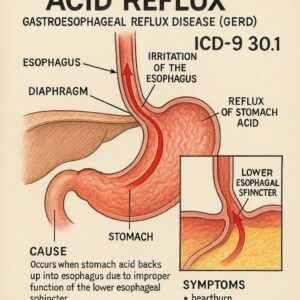
ICD-9 Code for Acid Reflux
Understanding the Basics: What is an ICD-9 Code?
Before we pinpoint the specific code for acid reflux, let’s build a solid foundation. ICD stands for the International Classification of Diseases. It’s a system created and maintained by the World Health Organization (WHO) to standardize how diseases, symptoms, and health problems are recorded globally.
The “9” in ICD-9 signifies the ninth revision of this system. ICD-9-CM (Clinical Modification) was used in the United States for diagnosis coding from 1979 until September 30, 2015. Think of it as a massive, detailed dictionary where every possible health condition has a unique numeric “word” or code. These codes are essential for:
-
Medical Billing and Reimbursement: Insurance companies require precise ICD codes to process claims and determine payment.
-
Tracking Public Health: Aggregating ICD code data helps governments and health organizations track disease outbreaks, monitor chronic conditions like acid reflux, and allocate resources.
-
Clinical Research: Researchers use these codes to identify patient populations for studies on treatment efficacy and disease patterns.
-
Maintaining Patient Records: Codes provide a concise, standardized summary of a patient’s health history.
As of October 1, 2015, the U.S. healthcare system officially transitioned to ICD-10-CM, a much more detailed and modern system. However, understanding ICD-9 is still relevant for dealing with older medical records or understanding the historical context of a diagnosis.
Key Takeaway: “ICD-9 was the foundational coding language for diagnoses in the U.S. for over 35 years. It connected a patient’s symptoms to the administrative and analytical engines of healthcare.”
The Specific ICD-9 Code for Acid Reflux
After that necessary context, let’s answer the core question. The direct ICD 9 code for acid reflux is:
530.81
This code is not a random number. It has a specific structure and meaning within the ICD-9 hierarchy:
-
530: This is the parent category. In ICD-9, codes starting with 530 represent “Diseases of esophagus.”
-
.81: This fourth and fifth digit provides the specificity. The extension “.81” was designated for “Esophageal reflux.”
Therefore, 530.81 explicitly translates to “Esophageal reflux disease.” It was the catch-all code for the condition commonly known as acid reflux, gastroesophageal reflux (GER), or when chronic and symptomatic, gastroesophageal reflux disease (GERD).
Important Clinical Note: In the ICD-9 framework, 530.81 was used to document the presence of reflux. The severity, frequency, or the presence of complications (like esophagitis or Barrett’s esophagus) were typically not detailed by this code alone. Additional codes or clinical documentation were needed to paint the full picture.
How 530.81 Fit into the ICD-9 Landscape (A Comparative Table)
To understand 530.81’s role, it’s helpful to see it alongside other related codes in the ICD-9 chapter for Digestive System Diseases (520-579).
| ICD-9 Code | Code Description | Clinical Relationship to Acid Reflux |
|---|---|---|
| 530.81 | Esophageal reflux | The primary code for uncomplicated acid reflux/GERD. |
| 530.11 | Reflux esophagitis | Used when reflux has caused visible inflammation of the esophageal lining. A more specific complication of 530.81. |
| 530.10 | Esophagitis, unspecified | General inflammation of the esophagus, which may or may not be caused by reflux. |
| 530.85 | Barrett’s esophagus | A serious complication of long-term GERD where the esophageal lining changes, increasing cancer risk. |
| 787.1 | Heartburn | A symptom code, used for the sensation of burning pain itself, not the disease causing it. |
| 536.8 | Dyspepsia and other specified disorders of function of stomach | Used for vague upper abdominal discomfort or indigestion, which can overlap with reflux symptoms. |
This table highlights a key limitation of ICD-9: its lack of granularity. Notice that 530.81 covered a wide range of presentations, from occasional reflux to severe GERD. Distinguishing between them relied on the physician’s written notes, not the code itself.
Beyond the Code: What is Acid Reflux (GERD)?
Knowing the code is one thing; understanding the condition it represents is another. Let’s briefly define acid reflux from a medical perspective, using clear, patient-friendly language.
Acid reflux occurs when the lower esophageal sphincter (LES)—a muscular valve at the junction of your esophagus and stomach—becomes weak or relaxes inappropriately. This allows stomach acid, and sometimes bile or food particles, to flow backward (reflux) into the esophagus.
The esophagus lining isn’t designed to handle this corrosive mix, leading to the familiar burning sensation known as heartburn. When this happens more than twice a week or causes significant inflammation, it’s typically diagnosed as Gastroesophageal Reflux Disease (GERD).
Common symptoms include:
-
A burning sensation in the chest (heartburn), often after eating or at night.
-
Regurgitation of sour liquid or food.
-
Difficulty swallowing (dysphagia).
-
The sensation of a lump in the throat (globus sensation).
-
Chronic cough, laryngitis, or new or worsening asthma.
Common triggers and risk factors:
-
Certain foods (spicy, fatty, acidic, chocolate, mint).
-
Beverages (alcohol, coffee, carbonated drinks).
-
Smoking.
-
Obesity.
-
Pregnancy.
-
Hiatal hernia.
-
Certain medications (e.g., some asthma drugs, calcium channel blockers).
Reader-Focused Note: If you’re experiencing frequent heartburn, it’s important to consult a healthcare provider. While the ICD-9 code is a historical artifact, getting an accurate modern diagnosis (and ICD-10 code) is the first step to effective management, which can include lifestyle changes, over-the-counter medications, or prescription treatments.
The Transition from ICD-9 to ICD-10: A Major Shift in Specificity
The transition from ICD-9 to ICD-10-CM on October 1, 2015, was not just an update; it was a revolution in medical coding. ICD-10 offers exponentially more detail, which allows for much more precise tracking of diagnoses, treatments, and outcomes.
What Happened to Code 530.81?
The ICD-9 code 530.81 (Esophageal reflux) did not have a single, direct crosswalk to ICD-10. Instead, it mapped to a range of far more specific codes under the new system. This reflects modern medicine’s need for greater clinical detail.
The primary ICD-10-CM category for reflux is K21, which stands for “Gastro-esophageal reflux disease.”
Mapping ICD-9 530.81 to ICD-10 Codes (Comparative Table)
The table below shows how the broad ICD-9 code fragmented into multiple, precise ICD-10 options.
| ICD-9 Code & Description | Corresponding ICD-10-CM Code(s) & Description | Key Difference & Advancement |
|---|---|---|
| 530.81 – Esophageal reflux | K21.9 – Gastro-esophageal reflux disease without esophagitis | The default code for GERD without noted inflammation. Replaces the vague 530.81. |
| K21.0 – Gastro-esophageal reflux disease with esophagitis | Specifies that reflux has caused inflammation, adding a layer of clinical severity. | |
| Additional 5th and 6th digits can specify the type of esophagitis (e.g., due to reflux, drug-induced, infectious). | Unprecedented specificity. Allows coding of the exact nature of the complication. |
This shift highlights a critical point: ICD-10 forces a clearer clinical distinction. The provider must now document whether esophagitis is present or not, leading to more accurate records and tailored treatment plans.
Why Knowing the Right Code Matters: Practical Implications
You might wonder why all this coding detail matters to anyone outside of a medical billing office. The reality is that accurate coding touches many aspects of healthcare.
-
For Patients: An incorrect or outdated code on your insurance claim can lead to delays, denials, or out-of-pocket expenses. Understanding that your diagnosis has a specific “label” helps you navigate your medical records and communicate effectively with your insurer if issues arise.
-
For Healthcare Providers: Precise coding is a legal and financial necessity. It ensures they are reimbursed correctly for their services and creates an accurate legal record of the care provided. The move to ICD-10’s specificity reduces ambiguity.
-
For Researchers and Public Health Officials: Detailed codes like those in ICD-10 allow for better tracking of how many people have GERD with complications versus without. This data can influence public health initiatives, funding for research, and guidelines for screening and treatment.
A Helpful List: What Information a Coder Needs for an Accurate GERD Code Today (in ICD-10):
-
Confirmed Diagnosis: Is it GERD or another condition?
-
Presence of Esophagitis: Has an endoscopy or other test confirmed inflammation?
-
Type of Esophagitis: If present, what is the cause (reflux, eosinophilic, etc.)?
-
Associated Conditions: Is there a hiatal hernia (coded separately)? Is reflux manifesting as cough or laryngitis?
-
Severity and Frequency: While less often captured directly in the code, this is crucial in the clinical notes for justifying treatment.
Navigating Medical Records and Bills
If you are reviewing an old medical bill or record from before October 2015 and see 530.81, you now know it represents a diagnosis of acid reflux or GERD. If you see a bill with an ICD-9 code after 2015, it is likely an error, as the system had officially changed.
For current records, look for codes starting with K21. If you have questions about a code on your bill, the best course of action is to contact your healthcare provider’s billing department. They can clarify the diagnosis code used and why it was selected.
Important Disclaimer for Readers: This article is for informational and educational purposes only. It is not a substitute for professional medical advice, diagnosis, or treatment. Always seek the advice of your physician or other qualified health provider with any questions you may have regarding a medical condition or coding inquiry. Never disregard professional medical advice or delay seeking it because of something you have read here.
Conclusion
The journey to understand the ICD 9 code for acid reflux, 530.81, reveals much more than a retired number. It opens a window into how we systematically classify disease, a process that evolved from the broad category of “esophageal reflux” to the precise descriptions of ICD-10. This transition underscores modern healthcare’s drive for specificity, improving everything from individual patient care to global health tracking. While 530.81 belongs to medical history, grasping its meaning empowers you to better understand your health journey and the intricate language that documents it.
Frequently Asked Questions (FAQ)
Q1: I have an old medical bill with code 530.81. What does that mean?
A1: It means you were diagnosed with and likely treated for acid reflux or gastroesophageal reflux disease (GERD) during that encounter before October 2015.
Q2: What is the current ICD code for acid reflux?
A2: The current codes are in the ICD-10 system, primarily within the K21 category. The most common is K21.9 for GERD without esophagitis. A more specific code like K21.0 is used if inflammation (esophagitis) is present.
Q3: Why are there so many more codes in ICD-10 than ICD-9?
A3: ICD-10 was designed to capture vastly more clinical detail, including laterality (which side), severity, etiology (cause), and specific anatomic details. This improves care quality, research, and health statistics.
Q4: Can a billing office still use ICD-9 codes today?
A4: For services provided on or after October 1, 2015, the use of ICD-9 codes is generally not permitted for claims submission to U.S. health insurers. Using them would result in claim rejection.
Q5: Where can I find official, up-to-date coding information?
A5: The Centers for Medicare & Medicaid Services (CMS) and the National Center for Health Statistics (NCHS) are the official U.S. government sources for ICD-10-CM guidelines and code sets.
Additional Resources
For further reading on GERD, its symptoms, and modern treatment options, we recommend visiting the reliable patient education resources provided by the American College of Gastroenterology at their official website: https://gi.org/
Date: January 07, 2026
Author: The Web Health Writer Team
Disclaimer: The information contained in this article is intended for general knowledge and educational purposes only. While we strive for accuracy, medical coding guidelines can be complex and are subject to change. Always consult with a qualified healthcare professional for medical advice and a certified medical coder or your healthcare provider’s billing specialist for coding-related questions pertaining to your specific situation.