Navigating the world of medical diagnosis and billing codes can feel like learning a foreign language. If you’re looking at an older medical record, a historical bill, or simply trying to understand a past diagnosis, you might have encountered the term “ICD-9 code for Adjustment Disorder.” While this coding system is no longer in active use in the United States, understanding it remains crucial for interpreting past healthcare information.
This guide will serve as your definitive resource. We’ll explore the now-replaced ICD-9 system, break down the specific codes for Adjustment Disorder, and explain why this knowledge is still relevant today. We aim to provide clarity and context, transforming complex coding jargon into accessible information.
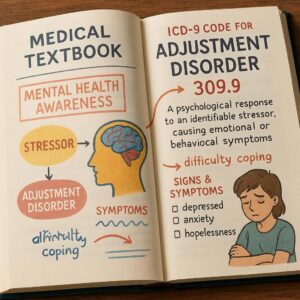
ICD-9 Code for Adjustment Disorder
What Was the ICD-9 Coding System?
Before we dive into the specific code, let’s set the stage. The International Classification of Diseases, 9th Revision, Clinical Modification (ICD-9-CM) was the standard system used in the United States to classify and code all diagnoses, symptoms, and procedures for medical billing and record-keeping from 1979 until September 30, 2015.
Think of it as a vast, intricate dictionary where every conceivable health condition has a unique numeric “address.” This address allowed healthcare providers, insurers, and researchers to speak a common, precise language. The system ensured that a diagnosis like Adjustment Disorder was communicated consistently across different doctors’ offices, hospitals, and insurance companies.
Note: As of October 1, 2015, the U.S. healthcare system officially transitioned to ICD-10-CM, a much more detailed and modern system. ICD-9 codes are considered legacy codes. You will primarily encounter them when dealing with medical records or billing documents dated before October 2015.
The Specific ICD-9 Code for Adjustment Disorder
In the ICD-9-CM system, Adjustment Disorder was categorized under “Neurotic Disorders, Personality Disorders, and other Nonpsychotic Mental Disorders.” The general code for any Adjustment Disorder was:
309
However, this code required a fourth digit to specify the predominant feature or subtype. This fourth digit provided crucial context about the patient’s experience. Here is the complete breakdown:
Breakdown of ICD-9 Codes for Adjustment Disorder Subtypes
The following table outlines the specific ICD-9 codes used for different presentations of Adjustment Disorder.
| ICD-9 Code | Subtype Name & Description |
|---|---|
| 309.0 | Adjustment Disorder with Depressed Mood Used when the primary symptoms mirror those of depression, such as low mood, tearfulness, and feelings of hopelessness, but are directly tied to an identifiable stressor. |
| 309.24 | Adjustment Disorder with Anxiety Applied when nervousness, worry, jitteriness, or separation anxiety (in children) are the most prominent features in response to a stressor. |
| 309.28 | Adjustment Disorder with Mixed Anxiety and Depressed Mood A combination code for when symptoms of both anxiety and depression are present, with neither clearly predominating. |
| 309.3 | Adjustment Disorder with Disturbance of Conduct This code is used when the reaction to stress primarily manifests as behavioral violations of societal norms or the rights of others (e.g., truancy, vandalism, fighting, reckless driving). |
| 309.4 | Adjustment Disorder with Mixed Disturbance of Emotions and Conduct For cases where there is a significant combination of emotional symptoms (anxiety, depression) and behavioral disturbances. |
| 309.9 | Adjustment Disorder Unspecified A catch-all code for maladaptive reactions to psychosocial stress that do not fit into the other specific subtypes or for which the specific features are not documented. |
Important Coding Context: The Fifth Digit
For some codes, notably 309.2 (which housed 309.24 and 309.28), a fifth digit was sometimes required for even greater specificity in certain reporting contexts, though the fourth digit was the standard for diagnosis. This highlights the complexity that ultimately led to the adoption of ICD-10.
Why Knowing the ICD-9 Code Still Matters
You might wonder why we’re discussing a retired system. Here are several practical reasons why this knowledge is valuable:
-
Understanding Historical Medical Records: Your past medical charts, especially if you’ve been in treatment for many years, are filled with ICD-9 codes. Knowing what 309.0 means helps you understand your own health history.
-
Deciphering Old Bills and Insurance Statements: Explanations of Benefits (EOBs) or old billing statements reference these codes. Identifying the code can clarify what a past charge was for.
-
Research and Data Analysis: Much of our longitudinal health data—tracking trends over decades—is coded in ICD-9. Researchers and public health officials must understand this system to analyze historical patterns.
-
Legal and Disability Cases: Past medical evidence used in legal or disability proceedings often relies on ICD-9 coded diagnoses from the relevant time period.
The Transition from ICD-9 to ICD-10: A Significant Change
The shift from ICD-9 to ICD-10-CM on October 1, 2015, was a monumental event in U.S. healthcare. ICD-9 had become outdated. It lacked the specificity needed for modern medicine, had run out of space for new codes, and could not accurately describe the complexity of contemporary diagnoses.
ICD-10-CM offers dramatic improvements:
-
More Detail: Codes are longer (3-7 characters, alphanumeric) and describe laterality (left, right), severity, and precise clinical details.
-
More Codes: ICD-9 had around 13,000 codes. ICD-10-CM has over 68,000, allowing for vastly more precise diagnosis reporting.
-
Better for Public Health: The increased specificity provides richer data for tracking diseases, outcomes, and public health initiatives.
Comparison Table: ICD-9 vs. ICD-10 for Adjustment Disorder
| Feature | ICD-9-CM (Legacy) | ICD-10-CM (Current) |
|---|---|---|
| Code Structure | 3-5 digits, all numeric | 3-7 characters, alphanumeric |
| General Code | 309 | F43.2 |
| Specificity | Broad subtypes based on predominant feature (mood, anxiety, conduct). | Highly specific, accounting for the stressor type (e.g., divorce, unemployment) and duration (acute vs. chronic). |
| Example Code | 309.0 (Adjustment Disorder with Depressed Mood) | F43.21 (Adjustment Disorder with Depressed Mood, Acute) or F43.22 (…Chronic) |
| Number of Codes | Approximately 6 primary codes for AD | Dozens of specific codes for AD |
Key Characteristics of Adjustment Disorder: The Diagnosis Behind the Code
A code is just a label. The real importance lies in understanding the condition it represents. Adjustment Disorder (AD) is a common, stress-related condition. Its core features include:
-
Emotional or Behavioral Symptoms: The development of emotional (sadness, worry) or behavioral (acting out) symptoms in response to an identifiable stressor(s).
-
Timeframe: Symptoms must begin within three months of the onset of the stressor.
-
Significant Distress or Impairment: The reaction must be more severe than would normally be expected or must cause significant problems in social, occupational, or other important areas of functioning.
-
Not Another Disorder: The symptoms do not represent normal bereavement and are not merely an exacerbation of a pre-existing mental disorder.
-
Resolution: Unlike some chronic conditions, symptoms of AD typically subside within 6 months after the stressor or its consequences have ended. If symptoms persist beyond 6 months, it may be specified as “chronic.”
Common Stressors Leading to Adjustment Disorder
-
Relationship problems (divorce, marital conflict)
-
Work or school issues (job loss, academic failure)
-
Financial difficulties
-
Health diagnoses (in oneself or a loved one)
-
Major life transitions (retirement, having a baby)
-
Traumatic events (accidents, natural disasters)
Practical Guidance: If You Have an Old ICD-9 Code on a Document
If you encounter “309.x” on an old record, here’s a step-by-step approach:
-
Don’t Panic. An Adjustment Disorder diagnosis is a recognized and treatable condition. It indicates a significant reaction to stress, not a lifelong, severe mental illness.
-
Identify the Subtype. Use the table above to match the fourth digit to the specific subtype. This tells you what the primary features were at that time.
-
Contextualize the Date. Remember that this code reflects your diagnosis at a specific point in time before October 2015. Your condition may have long since resolved.
-
Consult a Current Professional. If you have ongoing concerns about your mental health, speak with a current healthcare provider. They will use the modern ICD-10 system and can provide an up-to-date evaluation and support. Do not rely on an old diagnosis to guide your current care.
Crucial Disclaimer: This article is for informational purposes only and is based on historical coding data. It is not a substitute for professional medical advice, diagnosis, or treatment. Always seek the advice of your physician, therapist, or other qualified health provider with any questions you may have regarding a medical condition or interpreting your medical records.
Conclusion: From Legacy Codes to Modern Understanding
The ICD-9 code for Adjustment Disorder, primarily the 309 series, served as a vital tool for documenting a common human experience—significant difficulty coping with stress. While the U.S. healthcare system has moved on to the more sophisticated ICD-10, understanding these legacy codes empowers you to decipher your own health history. It bridges the gap between past medical documentation and present-day awareness, underscoring that while coding systems evolve, the importance of accurately identifying and treating stress-related conditions remains constant.
Frequently Asked Questions (FAQ)
Q: Is Adjustment Disorder a serious mental illness?
A: Adjustment Disorder is considered a stress-response condition rather than a severe, chronic mental illness like Major Depressive Disorder or Schizophrenia. It is directly linked to an identifiable stressor and is typically time-limited, often resolving within 6 months of the stressor’s end. However, it can cause significant distress and impairment, warranting professional care such as therapy.
Q: I saw “309.9” on an old bill. What does that mean?
A: ICD-9 code 309.9 stood for “Adjustment Disorder Unspecified.” This was used when a clinician diagnosed Adjustment Disorder but did not specify the predominant subtype (e.g., with depressed mood, with anxiety) in the documentation sent to the billing office.
Q: What is the current ICD-10 code for Adjustment Disorder?
A: The general code in ICD-10 is F43.2. However, it requires additional characters for specificity. For example, F43.21 is for Adjustment Disorder with Depressed Mood, Acute, and F43.22 is for the Chronic form. The system allows for codes that even specify the stressor, like problems related to family upbringing (Z62.8) which can be used as an additional code.
Q: Can I still use an ICD-9 code for billing today?
A: No. As of October 1, 2015, all HIPAA-covered entities (healthcare providers, insurers, clearinghouses) in the U.S. are required to use ICD-10-CM codes for diagnosis reporting. Submitting a claim with an ICD-9 code will result in a rejection.
Q: Where can I find my official diagnosis codes?
A: Your diagnosis codes are part of your medical record. You can find them listed on:
-
Explanations of Benefits (EOBs) from your insurance company.
-
Detailed billing statements from your healthcare provider or hospital.
-
The “Problem List” or summary within your patient portal or medical chart.
Additional Resource
For the most authoritative and up-to-date information on current medical codes, visit the Centers for Disease Control and Prevention (CDC) ICD-10-CM page: CDC ICD-10-CM Official Guidelines. This is the primary source for coding rules and updates in the United States.
Date: January 06, 2026
Author: The Web Health Writer Team
Disclaimer: The information contained in this article is intended for educational and informational purposes only. It is based on historical coding practices and should not be interpreted as current medical coding advice, nor does it constitute a patient-provider relationship. Always consult with a qualified healthcare professional and certified medical coder for any questions related to diagnosis, treatment, or medical billing.