Navigating the world of medical codes can feel like learning a foreign language. For patients reviewing a bill or medical professionals looking up historical data, understanding these codes is crucial. This guide focuses on a specific and commonly used diagnostic code from the now-retired ICD-9 system: the code for hypothyroidism. We’ll break down everything you need to know in clear, accessible language.
The International Classification of Diseases, Ninth Revision, Clinical Modification (ICD-9-CM) was the standard system for coding diagnoses and procedures in the United States for decades. While it has been replaced by ICD-10, knowledge of ICD-9 remains vital for accessing historical medical records and understanding past billing. If you’re looking at an old medical document and see a code related to an underactive thyroid, this article will serve as your essential reference.
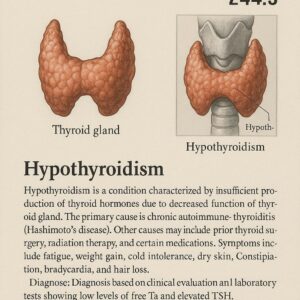
ICD-9 Code for Hypothyroidism
What is the ICD-9 Code for Hypothyroidism?
The primary and most general ICD-9 code for hypothyroidism is 244.9.
Let’s decode this number:
-
244: This is the parent category for “Hypothyroidism and other disorders of thyroid gland.”
-
.9: This fourth digit indicates “Unspecified hypothyroidism.”
In essence, code 244.9 was used when a provider documented a diagnosis of hypothyroidism without specifying a particular cause or type (e.g., post-surgical, drug-induced, or congenital). It was the “catch-all” code for a confirmed underactive thyroid state.
A Note on ICD-9-CM Structure
The ICD-9-CM system is hierarchical. The three-digit category (244) defines a broad disease group. The fourth and sometimes fifth digits provide greater specificity about the cause, manifestation, or anatomical site.
Key Insight: “Code 244.9 was the workhorse for generalized hypothyroidism in the ICD-9 era. Its use was appropriate when the clinical focus was on managing the hormone deficiency itself, rather than its specific etiology, in a given encounter.” – Common Perspective from Medical Coders
Breaking Down the Hypothyroidism Code Family in ICD-9
Hypothyroidism isn’t a single, monolithic condition. The ICD-9 system offered several codes under category 244 to capture these differences. Understanding this family of codes provides a clearer clinical picture.
Common ICD-9 Codes for Hypothyroidism and Related Conditions
| ICD-9 Code | Code Description | Clinical Context & Meaning |
|---|---|---|
| 244.0 | Posturgical hypothyroidism | Hypothyroidism resulting from the surgical removal of all or part of the thyroid gland (e.g., total thyroidectomy for cancer or Graves’ disease). |
| 244.1 | Other postablative hypothyroidism | Hypothyroidism following other thyroid-destructive procedures, most commonly radioactive iodine (RAI) therapy for hyperthyroidism. |
| 244.2 | Iodine hypothyroidism | Underactive thyroid caused by iodine deficiency (rare in developed countries) or, conversely, by excessive iodine intake. |
| 244.3 | Other iatrogenic hypothyroidism | Hypothyroidism induced as an unintended result of medical treatment, such as certain drugs (e.g., lithium, amiodarone, immunotherapy). Distinct from planned ablation (244.1). |
| 244.8 | Other specified acquired hypothyroidism | A category for other known causes not listed above, such as hypothyroidism from infiltrative diseases (e.g., amyloidosis). |
| 244.9 | Unspecified hypothyroidism | The most frequently used code. Applied when the diagnosis is hypothyroidism without specification of cause. Often used for primary, autoimmune hypothyroidism (Hashimoto’s) once confirmed. |
| 243 | Congenital hypothyroidism | A separate category entirely for hypothyroidism present at birth (cretinism), often due to thyroid gland malformation. |
| 246.8 | Other specified disorders of thyroid | Sometimes used for related conditions like sick euthyroid syndrome or thyroid hormone resistance. |
Why Specificity Mattersed
Using a more specific code like 244.0 (postsurgical) instead of the generic 244.9 provided valuable information:
-
Clinical History: It instantly communicated part of the patient’s medical history to other providers.
-
Billing & Reimbursement: While often not affecting payment for the office visit itself, specificity supported the medical necessity of the encounter and any related procedures.
-
Research & Epidemiology: It allowed for better tracking of the causes and outcomes of hypothyroidism at a population level.
Clinical Context: When Was Code 244.9 Used?
Code 244.9 was not just a random administrative label; it reflected a real-world clinical decision. Here are typical scenarios where this code was assigned:
-
Established Hashimoto’s Thyroiditis: Once autoimmune hypothyroidism (Hashimoto’s) is diagnosed via antibody tests, many providers would continue to use 244.9 for routine follow-up visits focused on checking Thyroid-Stimulating Hormone (TSH) levels and adjusting levothyroxine dosage, as the active management is of the hormone deficiency.
-
Initial Diagnosis Workup: During the initial encounter where symptoms suggest hypothyroidism and labs are ordered (TSH, T4), a provider might use a symptom code (like 780.79 for fatigue) or a screening code. Once lab results confirmed hypothyroidism, 244.9 would be used for subsequent visits, especially if antibody testing wasn’t performed immediately.
-
Routine Management Visits: For stable patients on long-term thyroid hormone replacement, the focus of the visit is monitoring the treatment efficacy, not re-evaluating the cause. Code 244.9 was perfectly appropriate here.
-
Documentation Limitation: If a patient’s records from another provider simply stated “hypothyroidism” without noting the cause, the coding professional had to use the unspecified code 244.9.
Important Note for Readers: If you are reviewing an old medical bill or record with code 244.9, it does not mean your doctor was negligent or vague. It often reflects the standard, efficient coding for ongoing management of a common condition. For the cause, always refer to the doctor’s notes, not just the billing code.
The Transition from ICD-9 to ICD-10: A Significant Change
On October 1, 2015, the U.S. healthcare system mandated a transition from ICD-9-CM to ICD-10-CM. This was not a simple update; it was a massive expansion in detail and specificity.
Why the Change?
ICD-9, with about 13,000 codes, had run out of space and lacked modern clinical detail. ICD-10-CM, with over 68,000 codes, allows for much more precise documentation of diseases, their causes, severity, and anatomy. This improves patient care, public health tracking, and the accuracy of reimbursement.
What Happened to Code 244.9?
The code 244.9 (Unspecified hypothyroidism) was crosswalked (mapped) to a new code in ICD-10-CM. The direct equivalent is:
-
ICD-10-CM: E03.9 – Hypothyroidism, unspecified
However, ICD-10 offers many more specific options. The “unspecified” code should now only be used when the information to assign a more precise code is truly not available.
ICD-9 to ICD-10 Comparison for Common Hypothyroidism Types
| Condition / Cause | Old ICD-9 Code | New ICD-10-CM Code | Notes on Increased Specificity |
|---|---|---|---|
| Unspecified Hypothyroidism | 244.9 | E03.9 | The direct equivalent. |
| Postablative Hypothyroidism | 244.1 | E89.0 | In ICD-10, this is now under “Postprocedural disorders,” not primary thyroid disease. |
| Drug-induced Hypothyroidism | 244.3 | E03.2 | More clearly defined in ICD-10. |
| Autoimmune (Hashimoto’s) Thyroiditis | Often 244.9 | E06.3 | ICD-10 has a dedicated code for autoimmune thyroiditis, allowing for precise tracking. |
| Congenital Hypothyroidism | 243 | E03.1 | Still a distinct category with further sub-codes. |
The Impact of the Transition
-
For Patients: Your medical records after October 2015 contain much more detailed codes. This can improve continuity of care if you see new specialists.
-
For Healthcare Providers: Documentation requirements increased significantly. Notes must now explicitly state the cause and type of hypothyroidism to support the most accurate code.
-
For Medical Coders: The coding process became more complex but also more clinically meaningful.
Practical Implications: Billing, Records, and Patient Understanding
Reading an Old Medical Bill or Explanation of Benefits (EOB)
If you see 244.9 on an old EOB or bill dated before October 2015, it simply confirms that the visit was for the management of hypothyroidism. It does not indicate the cause or severity. The associated Current Procedural Terminology (CPT®) codes (like 99213 for an office visit) and the diagnosis code 244.9 together told the insurance company: “This was a medically necessary visit to evaluate and manage hypothyroidism.”
Accessing Historical Medical Records
Researchers, patients, and new doctors reviewing records from the ICD-9 era must understand that 244.9 has a broad meaning. To find the cause, one must look at the physician’s narrative notes, surgical history, and lab results (like Thyroid Peroxidase Antibodies).
Why This Knowledge is Still Relevant Today
-
Continuity of Care: Understanding old records is essential for lifelong health management.
-
Disability & Insurance Claims: Historical coded data is often used in long-term disability or life insurance assessments.
-
Personal Health Literacy: Decoding your own medical history empowers you to be an active participant in your care.
Best Practices for Documentation (A Note for Professionals)
Even though ICD-9 is retired, the principles of good documentation it demanded are timeless and amplified under ICD-10. To ensure accurate coding—whether looking back or coding today—clinical notes should be clear:
-
Specify the Type: “Autoimmune hypothyroidism (Hashimoto’s),” “post-total thyroidectomy hypothyroidism,” “hypothyroidism due to lithium therapy.”
-
Link Cause and Effect: “Patient with history of Graves’ disease status post RAI ablation in 2010, now with iatrogenic hypothyroidism.”
-
Avoid Isolated Terms: Using the word “hypothyroidism” alone in a note inherently leads to an unspecified code.
Conclusion
The ICD-9 code 244.9 for unspecified hypothyroidism was a fundamental part of medical documentation for decades, representing the common clinical reality of managing an underactive thyroid. While the healthcare system has moved to the more detailed ICD-10, understanding this legacy code is key to interpreting historical records and appreciating the evolution of medical coding. Whether you’re a patient piecing together your health history or a professional handling old data, recognizing that 244.9 stands for a confirmed, but not further specified, diagnosis of hypothyroidism provides clarity and context in the complex landscape of healthcare documentation.
Frequently Asked Questions (FAQ)
Q: I have Hashimoto’s disease. Why does my old bill say 244.9 instead of a code for autoimmune disease?
A: In the ICD-9 system, there was no specific code for Hashimoto’s thyroiditis as a cause of hypothyroidism. Once diagnosed, the ongoing management was typically coded under the hypothyroidism code 244.9. ICD-10 now has a specific code (E06.3) for autoimmune thyroiditis.
Q: Can using an “unspecified” code like 244.9 cause my insurance claim to be denied?
A: For routine office visits for a well-established condition like hypothyroidism, using 244.9 in the ICD-9 era very rarely caused denials. It was a standard, accepted code. Denials were more often due to issues with the procedure code or lack of documented medical necessity in the notes.
Q: How do I find out the cause of my hypothyroidism from my old records?
A: The billing code (244.9) won’t tell you. You need to look at the actual clinical notes from your provider within your medical records. Key phrases to look for are “Hashimoto’s,” “post-surgical,” “status post radioactive iodine,” or specific medication names like “lithium.” Lab results showing high levels of “thyroid peroxidase antibodies (TPO Ab)” indicate autoimmune cause.
Q: My doctor’s office still seems to use ICD-9 codes. Is that okay?
A: No. As of October 1, 2015, all HIPAA-covered entities (like doctors’ offices, hospitals, insurers) in the U.S. are required to use ICD-10-CM for diagnosis coding. Use of ICD-9 for current services would result in claim rejections. They may be using a super-bill with old codes for your convenience, but their billing staff must convert them to ICD-10 for submission.
Q: What is the single most important thing to know about code 244.9?
A: It is a historical code meaning “hypothyroidism, cause not specified here.” It confirms the diagnosis but not the etiology. For the full story, always refer to the physician’s documentation.
Additional Resources
For those seeking to delve deeper into medical coding and thyroid health, here are authoritative resources:
-
The American Thyroid Association (ATA): (https://www.thyroid.org/) – Provides extensive patient education materials on hypothyroidism, Hashimoto’s, and all thyroid disorders.
-
Centers for Medicare & Medicaid Services (CMS): (https://www.cms.gov/medicare/coding/icd10) – The official U.S. government source for ICD-10 code sets, guidelines, and transition information.
-
National Center for Health Statistics (NCHS): (https://www.cdc.gov/nchs/icd/icd-10-cm.htm) – The CDC division responsible for maintaining the ICD-10-CM system in the U.S., offering code browsers and updates.
Disclaimer: This article is for informational and educational purposes only. It is not intended as medical advice, coding advice, or a substitute for professional healthcare guidance. While every effort has been made to ensure accuracy, medical coding guidelines are complex and subject to change. Always consult with a qualified healthcare provider for any health concerns and with a certified professional coder for specific coding and billing questions. The author and publisher are not responsible for any errors or omissions or for any outcomes related to the use of this information.
Date: January 03, 2025
Author: The Web Health Writer Team